Packaging delicate, high-value industrial or electronic film parts requires absolute immobilization. You need robust protection from moisture and dust. Achieving this without causing physical distortion presents a significant engineering challenge. Standard packaging methods often fall short when handling fragile geometries.
Transitioning from manual wrapping or standard vacuum pouches to specialized skin packaging requires careful equipment evaluation. You must assess capital equipment based on precision, throughput, and material compatibility. Decision-makers face a crowded market filled with overlapping equipment specifications. Selecting the correct system directly impacts your production line efficiency and final product integrity.
We provide an objective, engineering-focused comparison of skin seal packing machine configurations. You will learn to cut through marketing claims. We focus heavily on technical realities, implementation risks, and operational reliability. This guide equips you to specify, evaluate, and deploy the optimal packaging system for your facility.
Key Takeaways
- Categorization: Selecting the right Film Parts Skin Seal Packing Machine depends primarily on your production volume—ranging from standalone tabletop units to fully integrated inline thermoforming systems.
- Critical Specs: Heating uniformity and vacuum pump capacity (measured in m³/h) are the two non-negotiable metrics for preventing film webbing or part curling.
- Consumable Dependency: Machine performance is strictly tied to material compatibility; investing in high-end equipment yields poor results if backing board porosity or film chemistry (e.g., Surlyn vs. PE) is mismatched.
Why Standard Vacuum Sealers Fail for Film Parts
Understanding the transition to skin packaging requires analyzing the failures of traditional vacuum pouches. Standard vacuum sealers operate by evacuating air from a flexible bag. They then heat-seal the open end. This process introduces severe risks for delicate film parts.
The Problem of Physical Distortion
Standard vacuum pouches exert uneven atmospheric pressure across the packaged item. As the pump draws air out, the pouch collapses violently around the product. This uneven force risks creases, bending, or microscopic fractures in sensitive film components. Flexible pouches cannot distribute physical stress uniformly. They frequently warp thin edges and crush fragile electronic substrates.
Achieving Absolute Immobilization
Skin packaging solves distortion by altering the physics of the vacuum cycle. The process uses a heated top film acting as a "second skin." The machine softens this film until it becomes highly pliable. The vacuum then draws the film downward. It drapes smoothly over the contours of the part. Finally, it anchors the part directly to a rigid backing board.
This method eliminates transit abrasion entirely. The product cannot shift, slide, or vibrate against the packaging material. Immobilization remains absolute.
Visual and QA Inspection Advantages
Quality assurance teams require clear visibility for post-packaging inspections. Standard vacuum bags often wrinkle, obscuring visual details. Skin packaging provides exceptional optical clarity.
- Unobstructed Scanning: Barcodes and QR codes remain perfectly readable beneath the tight film.
- Defect Detection: Inspectors can identify microscopic flaws without opening the seal.
- Automated Vision Systems: High-clarity films allow camera-based QA systems to function seamlessly on the production line.
Machine Categories: Semi-Automatic vs. Fully Automatic Systems
Procurement teams must map the solution landscape carefully. Equipment scales dramatically based on output requirements. You must align the machine architecture to your specific throughput targets.
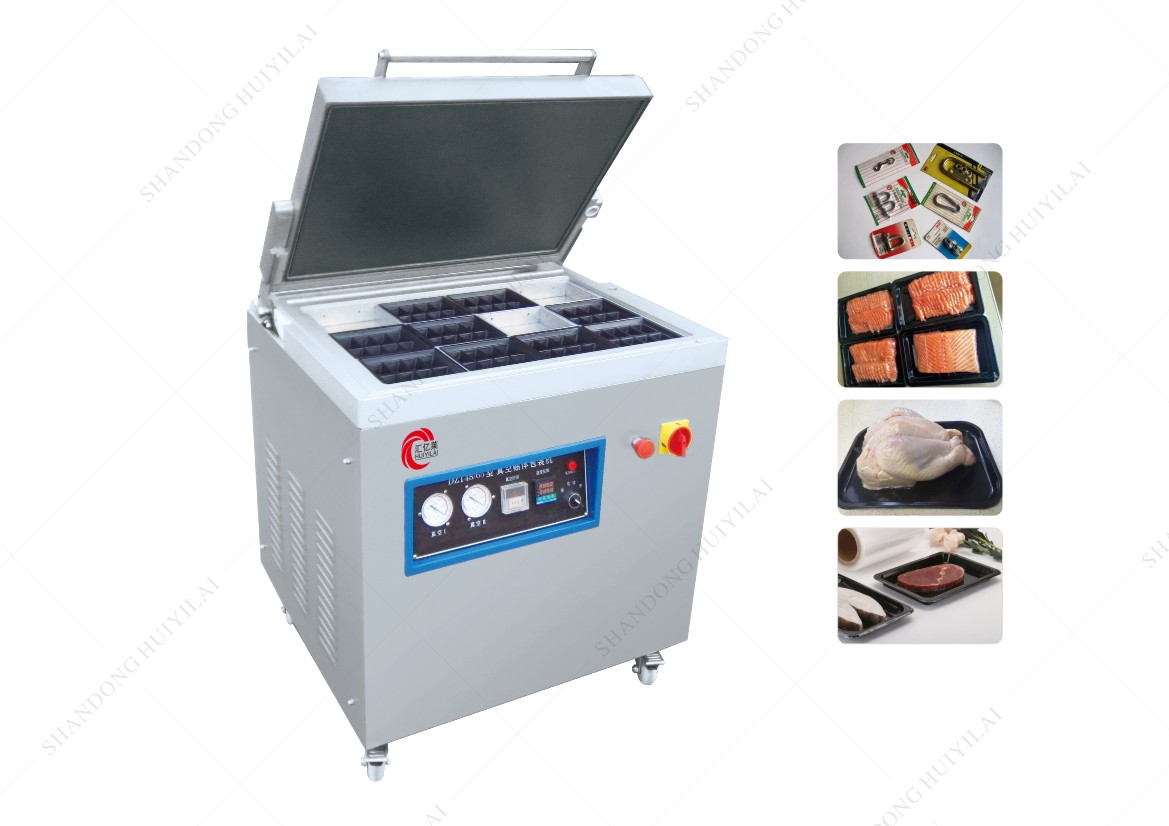
Standalone / Semi-Automatic Cabinet Machines
These systems feature a compact footprint. They operate as standalone workstations. An operator must manually load and unload the products.
Mechanics: The operator places a backing board onto the machine bed. They arrange the film parts onto the board. They pull the top film carriage over the bed. The machine then executes an automated heating and vacuum cycle. The operator removes the finished board and manually trims the edges.
Ideal for:
- Low-to-medium volume production runs.
- Facilities requiring frequent changeovers between part sizes.
- Prototype packaging or pilot manufacturing lines.
Limitations: Operator speed dictates cycle times. Output remains strictly limited by manual loading steps. Labor dependencies reduce overall shift predictability.
Inline Fully Automatic Thermoforming Skin Systems
Automatic systems remove manual handling from the core packaging loop. They utilize roll-fed materials to create a continuous production line.
Mechanics: The machine pulls backing material from a large roll. Conveyors index the material forward. Operators or robotic arms place the parts onto the moving web. The system applies the top film from a secondary roll. The integrated vacuum chamber seals the parts. An automated cutting die separates the individual packages before discharging them onto a conveyor.
Ideal for:
- High-throughput manufacturing environments.
- Standardized part sizes requiring identical packaging dimensions.
- Operations utilizing robotic pick-and-place part loading.
Limitations: These systems require substantial floor space. Upfront capital expenditure is high. Tooling changes involve complex mechanical adjustments. They do not suit operations requiring constant size variations.
System Comparison Summary
| Feature | Semi-Automatic Cabinet | Fully Automatic Inline |
| Throughput | Low to Medium (Operator Dependent) | Very High (Continuous Web) |
| Footprint | Compact (Tabletop or Small Floor Unit) | Large (Requires Extended Conveyor Space) |
| Changeover Speed | Fast (Minutes) | Slow (Tooling/Die Adjustments Required) |
| Material Feed | Manual Pre-Cut Boards | Dual Roll-Fed Webs |
Core Evaluation Dimensions (A Comparative Framework)
Selecting a reliable Film Parts Skin Seal Packing Machine demands strict technical evaluation. Engineering teams must compare specific hardware sub-systems. Do not rely on generic output claims. Analyze these three core dimensions.
Heating System Architecture
The heating array dictates film pliability. Pliability determines how effectively the film wraps around complex geometries.
Entry-level machines utilize single-zone heating arrays. These systems apply uniform voltage across all heating elements. Single-zone systems frequently struggle with edge cooling. The center of the film becomes overly soft while the edges remain rigid. This disparity causes localized film burning or incomplete adhesion.
Advanced systems deploy multi-zone infrared heating arrays. They allow technicians to adjust temperatures across different sectors of the heating plate. You can boost heat at the perimeter to counteract ambient cooling. This ensures strict temperature uniformity. Precise temperature control prevents the film from webbing or bridging across gaps in the parts.
Evaluation Metric: Demand documented temperature uniformity maps. The system must prevent localized hotspots to guarantee consistent adhesion.
Vacuum Pump Configuration and Pull-Down Speed
A skin packing machine relies entirely on its vacuum pump to form the package. The pump must evacuate air rapidly before the heated film cools and hardens.
Standard internal pumps often lack the necessary volumetric flow rate. They struggle to pull deep draws around intricate components. If the pump acts too slowly, the film chills midway through the cycle. This creates ugly, loose packages.
Industrial applications require heavy-duty external rotary vane pumps. Brands like Busch represent the industry standard. Rotary vane pumps deliver massive displacement capacities (measured in cubic meters per hour, or m³/h). They achieve deep ultimate vacuum pressures swiftly.
Evaluation Metric: Compare cycle times (cycles per minute). Verify the ultimate vacuum pressure (mbar) required for deep-draw capabilities around your specific geometries. Look for systems capable of reaching 2-5 mbar reliably.
Tooling and Changeover Agility
Production agility depends on tooling design. Fixed-mold systems bolt directly to the machine chassis. Changing these molds requires specialized tools, extended downtime, and machine recalibration. They severely limit production flexibility.
Modern equipment utilizes quick-release, modular mold designs. Operators can swap format parts using simple locking levers. Modular systems use pre-aligned pins to guarantee perfect seating upon insertion. This eliminates manual recalibration steps entirely.
Evaluation Metric: Measure the exact downtime required to switch from one film part dimension to another. A well-designed modular system should allow complete format changes in under ten minutes.
Material Compatibility & Implementation Realities
Hardware represents only half of the packaging equation. Consumables dictate the final result. Deploying a premium Film Parts Skin Seal Packing Machine will yield terrible outcomes if you mismatch the materials.
Film Type Tolerances
Machines exhibit varying levels of adaptability regarding film chemistry. You must match the film to the machine's heating capacity and the part's physical demands.
- Surlyn (Ionomer Resins): This material offers premium clarity and incredible puncture resistance. It softens uniformly and adheres aggressively. However, it requires precise temperature control to prevent over-melting.
- PVC (Polyvinyl Chloride): PVC provides a rigid, protective shell. It draws well but can become brittle over time. It requires strong exhaust systems due to fumes generated during heating.
- PE (Polyethylene): PE offers excellent flexibility and tear resistance. It requires a slightly different heating profile compared to Surlyn. Ensure your machine can store multiple heating recipes for different films.
Backing Board Porosity
Skin packaging relies on air passing through the backing material. The vacuum pump pulls air from beneath the board. The board must possess adequate porosity. If the board features a heavy, non-porous glossy coating, the vacuum cycle will fail. The air trapped between the board and the film cannot escape. The film will never adhere.
Best Practice: Always specify specialized skin-packaging backing boards. They utilize specialized primer coatings. These coatings promote adhesion while maintaining essential microscopic air channels. Alternatively, use pre-perforated trays for completely non-porous applications.
Facility Requirements
Industrial machines require specific facility preparations. Overlooking these prerequisites delays installation and voids warranties.
- Electrical Supply: Most systems require stable 3-phase power. Verify voltage compatibility (e.g., 220V vs. 480V) before delivery.
- Pneumatic Supply: Automated machines rely on compressed air for mechanical actuation. The air must remain entirely dry and oil-free. Moisture in the air lines destroys internal pneumatic valves.
- Ambient Environment: Extreme factory temperatures affect the heating and cooling cycles. Maintain moderate ambient temperature control to ensure repeatable cycle times.
Shortlisting Logic & Equipment Selection
Selecting the exact model requires systematic logic. Do not guess based on brochure specifications. Use structured frameworks to guide your final decision.
Volume-to-Value Matrix
Evaluate your upgrade path strictly based on output targets. Track your current labor hours dedicated to manual packaging. Calculate the exact number of units produced per shift. Compare this baseline against the theoretical maximum output of a fully automatic system.
When manual loading steps bottleneck your primary manufacturing line, you must upgrade. Semi-automatic machines make sense when batch sizes remain small. Switch to continuous inline systems when standardizing a single, high-volume product line.
Maintenance and Wear Parts
Evaluate equipment based on mean time between failures (MTBF). Downtime destroys production schedules. You must identify systems engineered for rapid servicing.
Analyze the accessibility of critical wear parts. Technicians must replace heating elements periodically. Teflon tape degrades and requires frequent swapping. Rotary vane pumps demand regular oil changes to maintain ultimate vacuum pressure. Machines featuring tool-less access panels minimize routine maintenance disruptions.
Vendor SLA and Support
The vendor relationship extends long after installation. Equipment downtime escalates rapidly if technical support remains unavailable.
- Localized Support: Prioritize vendors offering domestic or regional field technicians. Remote troubleshooting only solves minor software glitches.
- Spare Parts Availability: Request a localized inventory list of critical spares. Waiting weeks for an imported vacuum valve halts production entirely.
- Factory Acceptance Testing (FAT): Demand a comprehensive FAT before accepting delivery. You must run your actual products and films through the machine at the vendor's facility. Verify cycle times and adhesion quality in person.
Conclusion
Implementing the optimal skin packaging solution protects your delicate components. The best systems balance precise heating architecture with overwhelming vacuum power. You must respect the strict relationship between the hardware and your chosen consumables. Multi-zone heating arrays and robust rotary vane pumps ensure consistent, defect-free packaging.
Next Steps for Evaluation:
- Audit your current packaging cycle times and identify output bottlenecks.
- Request a vendor pilot test using your specific film parts, target films, and backing boards.
- Demand documented temperature uniformity maps for the heating system.
- Ensure the vendor contract includes specific cycle-time and vacuum pressure guarantees.
- Verify facility readiness regarding 3-phase power and dry compressed air.
FAQ
Q: What is the difference between skin packaging and blister packaging for film parts?
A: Blister packaging uses pre-formed plastic cavities. The item sits loosely inside this rigid bubble. Skin packaging operates differently. It forms a heated, pliable film directly over the part. This creates a custom, skin-tight seal. Skin packaging offers superior, absolute immobilization. It prevents delicate items from shifting and vibrating during transit.
Q: Can a single skin packing machine handle different sizes of film parts?
A: Yes, they offer excellent flexibility. Most flat-board semi-automatic cabinet systems are completely mold-agnostic. They can package any part that fits within their maximum bed size. You just arrange the parts differently on the board. However, fully automatic tray-sealing skin machines require specific modular mold changes for different dimensions.
Q: What is the typical cycle time for a semi-automatic skin packing machine?
A: Cycle times depend heavily on film thickness and vacuum pump capacity. Heating thicker films takes longer. Generally, a complete cycle ranges from 15 to 40 seconds. Utilizing heavy-duty external rotary vane pumps can significantly accelerate the vacuum pull-down phase, reducing overall cycle times.
Q: Why is my skin packaging film webbing or bridging around the parts?
A: Webbing usually indicates a technical failure during the cycle. It is often a symptom of insufficient heating time or uneven heating elements. The film fails to become pliable enough. It can also result from an underpowered vacuum pump failing to pull the film tightly into crevices. Resolving this requires adjusting temperature parameters or upgrading the vacuum unit.


