Upgrading or scaling food production infrastructure requires careful balancing. You must weigh heavy capital expenditures against strict food safety mandates. Operational demands shift rapidly in modern manufacturing environments. The cost of acquiring the wrong machinery extends far beyond the initial purchase price. Poor selections risk cross-contamination, unexpected downtime, and severe compliance failures. Standalone machines can easily create bottlenecks if they fail to communicate properly. These missteps quickly erode profit margins and damage your brand reputation.
We designed this guide to help you navigate these complex purchasing decisions. We provide facility managers, procurement heads, and operations leaders an evidence-based evaluation framework. You will learn how to confidently shortlist, evaluate, and implement commercial systems. This comprehensive resource ensures you secure the exact capabilities required for your specific production line.
Key Takeaways
- Sanitary design is non-negotiable: Equipment must align with FSMA/GFSI standards, utilizing appropriate materials (e.g., 304/316L stainless steel) and IP69K ratings for heavy washdown environments.
- Integration dictates efficiency: Standalone machines create bottlenecks; successful procurement requires evaluating how new equipment communicates with existing production lines and SCADA systems.
- New vs. Used decisions require strict risk modeling: While used equipment offers faster deployment, it requires rigorous inspection for metal fatigue, outdated control systems, and warranty voids.
Evaluating the Investment: When to Upgrade Food Processing Equipment
Identifying the production bottleneck requires precise operational data. You must differentiate between operator inefficiency and hard equipment capacity limits. Often, a slow production line stems from poor manual workflows. In other cases, the hardware simply maxes out its maximum throughput. You need accurate data to spot the difference. Evaluating your current Food processing equipment requires a critical look at your daily operational logs.
Calculating the cost of inaction brings clarity to procurement discussions. You must model the financial impact of current unplanned downtime. Product yield loss destroys margins silently over time. Excessive changeover times drain labor budgets every single week. When you quantify these ongoing losses, you build a stronger business case for upgrading. Operators often hide minor downtime events using manual paper logs. You need digital sensors to capture these expensive micro-stops accurately.
Defining success criteria ensures your investment delivers real value. You must establish baseline metrics for the new equipment before signing contracts. For example, you might demand a 15% increase in Overall Equipment Effectiveness (OEE). OEE multiplies your availability, performance, and quality scores. Alternatively, you could require a 20% reduction in Clean-in-Place (CIP) cycle times. These strict metrics hold vendors accountable. They also give your engineering team a clear target during installation.
Core Categories of Commercial Food Processing Equipment
Preparation and Separation Equipment
This category includes industrial slicers, dicers, and centrifuges. These machines handle raw ingredients at the beginning of the line. Your evaluation lens here must focus on yield optimization. You want maximum usable product from every raw batch. Waste reduction capabilities directly impact your daily ingredient costs. Precise cutting mechanisms reduce scrap significantly. Efficient centrifuges extract maximum moisture without damaging the cellular structure of the food.
Processing and Thermal Equipment
Industrial ovens, pasteurizers, and extrusion machines define this vital category. Extruders remain especially critical for pet food and snack manufacturing. Your primary evaluation lens is precision temperature control. Heat application must remain completely uniform across the entire batch. Energy efficiency also plays a massive role here. Thermal processes consume vast amounts of electricity and natural gas. Modern automated burners and heat recovery systems help offset these utility spikes.
Preservation and Packaging Equipment
Vacuum sealers, modified atmosphere packaging (MAP) units, and blast chillers secure the final product. These systems dictate how long your goods remain viable on store shelves. Your evaluation lens should prioritize shelf-life extension capabilities. You must also assess packaging material versatility. Consumer preferences shift constantly toward sustainable options. Your packaging lines must adapt to new eco-friendly films and rigid containers without requiring complete rebuilds.
| Equipment Category | Common Machinery | Primary Evaluation Lens | Key Manufacturing Application |
| Preparation & Separation | Slicers, Dicers, Centrifuges | Yield optimization, Waste reduction | Raw ingredient handling, Dairy separation |
| Processing & Thermal | Ovens, Pasteurizers, Extruders | Precision temperature, Energy efficiency | Pet food, Baked goods, Snack manufacturing |
| Preservation & Packaging | Vacuum Sealers, MAP, Blast Chillers | Shelf-life extension, Material versatility | Final product security, Retail readiness |
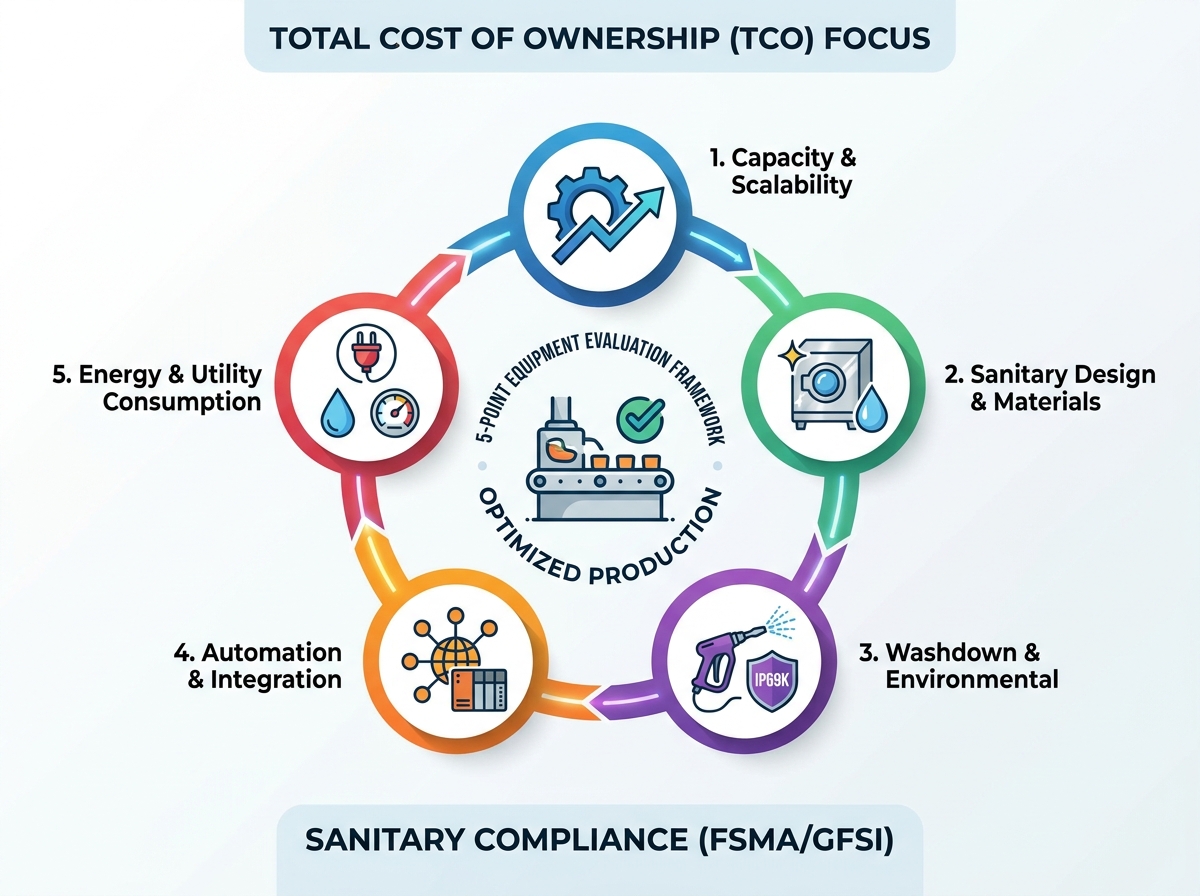
The 5-Point Evaluation Framework for Equipment Selection
1. Capacity Planning and Scalability
Matching machine throughput to current needs prevents unnecessary spending. However, you must also calculate the cost of upgrading later. Over-provisioning now ties up valuable capital. Under-provisioning forces a disruptive replacement project in just two years. You should seek highly modular designs. Modular systems let you add capacity blocks through software unlocks or physical expansions as customer demand grows.
2. Sanitary Design and Material Construction
You must ruthlessly assess the elimination of harborage points. Crevices, exposed threads, and flat surfaces collect moisture constantly. Bacteria thrive in these tiny spaces. Evaluating material grades is equally crucial. Engineers specify 304 stainless steel for general use. It resists standard corrosion well. However, you must use 316L stainless steel for high-acid environments. Highly corrosive products like citrus juices and tomato sauces degrade 304 steel quickly. Investing in 316L prevents costly premature replacements.
3. Washdown and Environmental Ratings
Matching ingress protection to the facility environment prevents catastrophic electrical failures. Standard enclosures cannot survive heavy sanitation shifts. You must verify IP69K requirements for high-pressure environments. Meat processing plants utilize high-temperature washdowns daily. An IP69K rating guarantees the internal electronics survive this aggressive chemical and thermal assault. Chlorinated foam cleaners easily strip away weak plastics and inferior seals.
4. Automation and Line Integration
New machinery must offer seamless compatibility with existing Programmable Logic Controllers (PLCs). It must also feed data into your Enterprise Resource Planning (ERP) software. Standalone analog machines disrupt modern data tracking. You must assess modularity during changeovers. Can operators easily bypass the equipment when running a different SKU? Retooling should take minutes, not hours. Utilizing modern IO-Link sensors enables real-time diagnostics directly to your maintenance dashboards.
5. Energy and Utility Consumption
High-capacity machines pull massive operational resources. You must evaluate compressed air usage accurately. Water demand and electrical draw must align with your current facility limits. A new industrial oven might require a complete electrical substation upgrade. Factoring these utility loads into the initial planning phase prevents budget blowouts. Spiking your electrical draw during shift startups often triggers expensive utility peak penalties.
Navigating Compliance, Safety, and Regulatory Standards
The Food Safety Modernization Act (FSMA) places strict mandates on manufacturers. Preventive controls represent the core of these modern regulations. Equipment design directly facilitates this compliance. Machines featuring tool-less disassembly allow operators to clean hidden zones quickly. This physical accessibility prevents dangerous pathogen buildups between shifts.
Evaluate CIP vs. COP capabilities closely. Equipment supporting Clean-In-Place (CIP) automation saves thousands of labor hours annually. It uses internal spray balls and automated chemical dosing to sanitize closed piping. Conversely, Clean-Out-of-Place (COP) requires labor-intensive teardowns. Operators must physically remove parts, scrub them in vats, and reassemble them. COP significantly increases the risk of recontamination during the assembly process.
Certifications validate a manufacturer's safety claims. You should verify compliance with USDA, FDA, 3-A Sanitary Standards, or European EHEDG guidelines.
Actionable tip: Always request the actual engineering documentation. Do not rely on marketing brochures. Brochures often highlight "sanitary design features" without holding formal industry certifications.
New vs. Used Equipment: Risk Assessment & Hidden Costs
Advantages and Blindspots of Used Equipment
Used machinery offers distinct advantages for tight budgets. You benefit from significantly shorter lead times. The lower initial capital expenditure allows you to launch new product lines faster. However, severe blindspots exist. You inherit unknown wear on critical internal components. You might face a severe lack of OEM replacement parts. Furthermore, older units often feature outdated safety guarding. These physical barriers might fail current OSHA inspections.
The Used Equipment Inspection Checklist
You must conduct a rigorous physical audit before purchasing second-hand assets.
- Verify structural integrity: Search specifically for micro-cracks in weld seams where bacteria hide. Use dye penetrant testing for accurate results.
- Evaluate the control panel: Check for obsolete PLCs. Legacy controllers cannot accept modern software updates or connect to cloud analytics.
- Assess wear components: Inspect bearings, gearboxes, and mechanical seals for excessive play or fluid leaks.
- Calculate true retrofit costs: Bringing a legacy machine up to current sanitary standards often costs more than buying a new unit.
Implementation Realities: Vendor Shortlisting and Rollout
Drafting the User Requirement Specification (URS) is your first operational step. You must document exact facility needs in this file. Include specific environmental constraints and complex product characteristics. Note floor loading capacities and ambient temperature ranges. Complete this document before ever approaching vendors. A detailed URS forces suppliers to quote accurately against your actual constraints.
Evaluating the Original Equipment Manufacturer (OEM) guarantees long-term success. You must review their Service Level Agreements (SLAs) thoroughly. Specifically, check their emergency technician dispatch times. A machine down for three days destroys a weekly production quota. Check the availability of domestic spare parts. Relying on international shipping for custom parts introduces massive supply chain risks.
Factory Acceptance Testing (FAT) protects your capital investment. It highlights the critical importance of running the equipment with your actual raw materials. You must conduct this physical test at the vendor’s facility prior to shipping. Run the machine at full capacity for several hours. Your specific ingredients behave differently under high pressure than standard testing materials.
Site Acceptance Testing (SAT) and training conclude the rollout. Managing this transition requires strategic patience. Operator training curves will temporarily slow down normal production speeds. You must schedule buffer time for initial calibration in your actual production environment. Rushing the SAT phase leads to permanent operational inefficiencies.
Conclusion
Sourcing commercial machinery remains an exercise in aggressive risk mitigation. It provides long-term margin protection rather than simple capacity expansion. You are building a resilient operation capable of meeting future demands. Proper procurement prevents devastating recalls and keeps your production schedules predictable.
We highly recommend you prioritize sanitary design and dedicated OEM support. These structural factors matter far more than the baseline purchase price. Durable, easily integrated equipment pays for itself through continuous, uninterrupted uptime.
Your next steps require immediate action. You should download a comprehensive vendor comparison checklist. Calculate your current line OEE to establish a firm performance baseline. Finally, consult directly with a specialized facility engineer to validate your upcoming layout plans before signing any procurement contracts.
FAQ
Q: How long is the typical lead time for custom food processing equipment?
A: Current supply chain realities affect delivery schedules significantly. You can expect lead times ranging from 12 to 36 weeks. The exact duration depends heavily on machine complexity and parts availability. Standard machines arrive faster, while highly customized automation systems require extensive engineering and testing phases.
Q: What is the difference between IP67 and IP69K ratings?
A: An IP67 rating means the equipment handles temporary submersion in water. It works well for standard damp environments. Conversely, an IP69K rating is mandatory for rigorous sanitization. It protects internal components from high-temperature, high-pressure water jets commonly used in meat and dairy processing washdowns.
Q: Can older food processing equipment be retrofitted for automation?
A: You can often retrofit older machines with modern sensors and updated PLCs. This improves data collection and basic automation. However, software cannot fix fundamental mechanical limitations. If the original machinery features poor sanitary design or restrictive throughput capacities, retrofitting will not solve those underlying structural problems.
Q: What should be included in a food processing equipment warranty?
A: A comprehensive warranty must clearly define coverage periods for specific components. You should check the terms for wear parts, which degrade quickly. Ensure coverage includes electronic components like sensors and PLCs. Furthermore, verify that the warranty covers labor costs and travel expenses for onsite emergency repairs.


