Upgrading or scaling production lines requires balancing upfront capital expenditure against long-term operational efficiency. Facility managers face immense pressure to modernize plants without halting daily output. Every machinery purchase impacts factory bottom lines directly. The decision matrix for industrial and commercial kitchens extends far beyond base functionality. You must thoroughly evaluate hygiene compliance, continuous labor reduction, and seamless workflow integration. Selecting inadequate systems disrupts complex operations and compromises vital food safety standards. Failing to align machinery capabilities against facility infrastructure inevitably leads to costly operational bottlenecks. This comprehensive guide breaks down core machinery categories, essential evaluation criteria, and realistic pricing models. We will explore how you can frame operational needs and assess strict sanitary design standards. You will gain actionable insights to support evidence-based procurement decisions for your plant.
Key Takeaways
- Alignment is Critical: Selecting the right food processing equipment depends heavily on matching capacity requirements with facility infrastructure.
- Feature Focus: Sanitary design (e.g., IP69K ratings) and automation capabilities outweigh superficial features in driving long-term value.
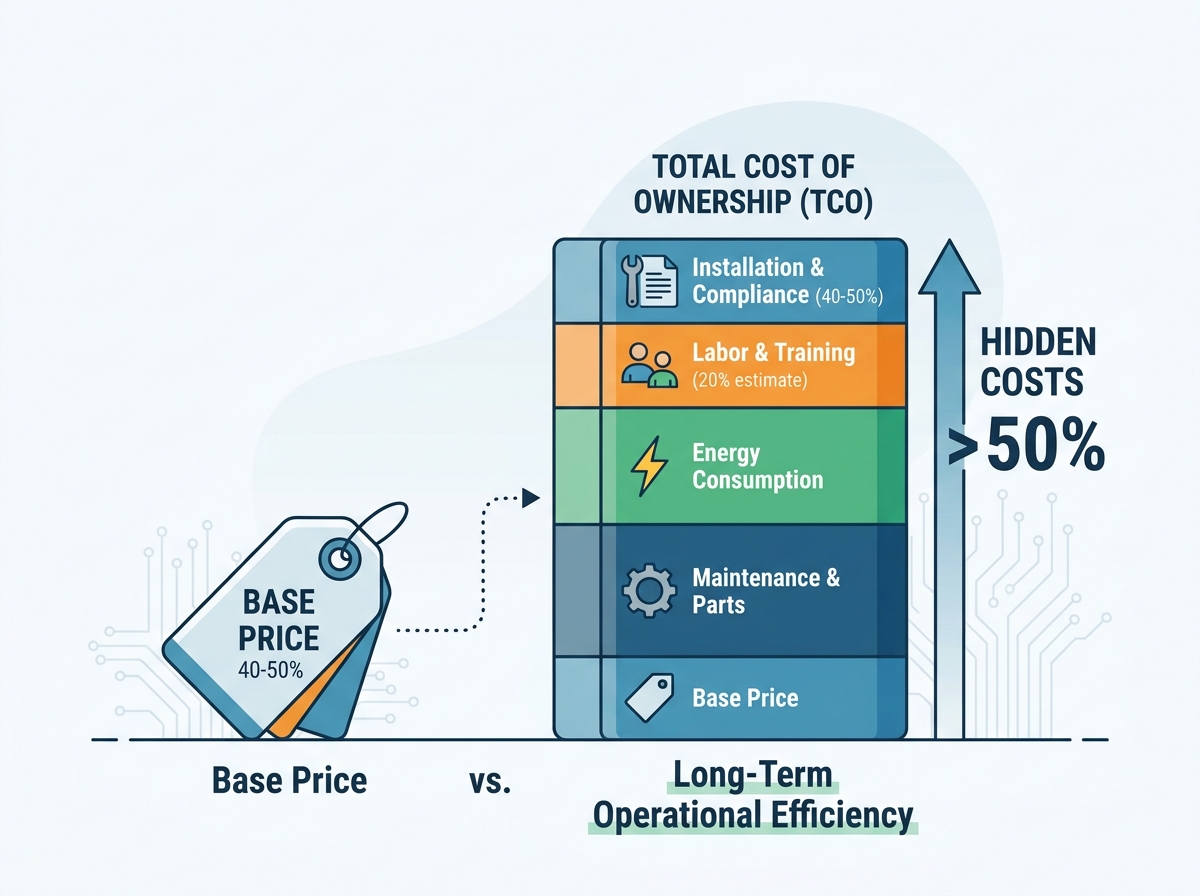
- Total Cost of Ownership (TCO): Base price typically represents only 40-50% of the lifetime cost; maintenance, energy, and labor integration make up the rest.
- Compliance Baseline: Non-negotiable adherence to HACCP, FSMA, or regional equivalents must guide all shortlisting efforts.
Defining Success: Operational Framing for Procurement
Every procurement cycle must begin by identifying clear operational goals. You cannot purchase machinery based purely on generic specifications. Instead, you need a highly tailored approach.
- Establishing the Business Case: Determine the primary driver behind your purchase. Are you trying to eliminate a specific production bottleneck? Perhaps you need to reduce manual labor costs. You might also want to improve raw material yield. Sometimes, companies buy equipment simply to enter new product categories. Documenting this core objective keeps your purchasing team focused. It prevents you from overpaying for unnecessary features.
- Capacity vs. Footprint Constraints: Expected throughput directly dictates machine size. You must evaluate your required kilograms per hour against available floor space. Physical dimensions are just the starting point. You must also check utility limits. Assess available electrical power, water pressure, and drainage capacity. Ceiling height often restricts the use of vertical conveyors or large hoppers. Measure your doorways to ensure the machine can actually enter the building.
- Integration Realities: Standalone machines rarely exist in modern facilities. You must assess how new machinery interfaces across legacy systems. Consider programmable logic controllers (PLCs) and SCADA systems. Can the new machine share data across your existing network? You must also map manual upstream and downstream processes. A high-speed slicer provides no value if your packaging team cannot keep up.
Best Practice: Always involve floor operators during the initial planning phase. They often spot integration issues long before engineers do.
Common Mistake: Buyers frequently overestimate their power grid capacity. This forces them into expensive electrical upgrades post-purchase.
Core Categories of Food Processing Equipment
Understanding equipment categories helps you structure your facility layout. Each category demands specific evaluation criteria. Properly sourcing Food processing equipment ensures product consistency and minimizes costly waste.
Preparation & Size Reduction
This category handles the initial stages of production. It transforms raw ingredients into workable formats.
- Scope: Industrial dicers, heavy-duty grinders, planetary mixers, and automated peelers.
- Evaluation Focus: Blade durability is paramount. You need hardened steel to resist constant wear. Ease of disassembly heavily impacts daily sanitation times. Look for consistency of output. Uniform cutting sizes directly minimize product waste.
Thermal Processing & Cooking
Applying or removing heat requires precise control. Product degradation happens quickly under poor temperature management.
- Scope: Industrial ovens, continuous pasteurizers, deep fryers, and steam blanchers.
- Evaluation Focus: Heat recovery systems lower operational expenses significantly. You must weigh energy efficiency between gas and electric models. Precision temperature controls remain critical. They prevent overcooking and protect delicate flavor profiles.
Preservation & Packaging
The final step protects your product for distribution. It extends shelf life and maintains safety.
- Scope: Chamber vacuum sealers, blast chillers, and automated filling lines.
- Evaluation Focus: Cycle times determine your maximum daily output. Seal integrity prevents premature spoilage and costly recalls. You also need adaptability. Machines should quickly adjust to accommodate multiple packaging formats.
Category Evaluation Comparison Chart | Equipment Category | Primary Function | Key Performance Indicator (KPI) | Critical Maintenance Area |
| Preparation & Size Reduction | Ingredient sizing and blending | Yield consistency (%) | Blade sharpening and alignment |
| Thermal Processing | Cooking and pasteurization | Energy consumption per batch | Heating element descaling |
| Preservation & Packaging | Shelf-life extension | Cycles per minute | Vacuum pump oil replacement |
Key Features to Evaluate for Long-Term Viability
Superficial features rarely deliver lasting value. You must look deeper into material science and system architecture. These foundational elements determine how long your machinery will survive in harsh environments.
Sanitary Design and Material Integrity
Food manufacturing environments destroy weak materials quickly. Corrosive cleaning agents break down standard metals over time. You must require 304 or 316L stainless steel for all contact surfaces. The addition of molybdenum in 316L steel makes it highly resistant to chlorides.
Inspect the welding techniques used on the machine. You need crevice-free, continuous welds. Bacteria thrive in tiny gaps and bolted joints. Look for sloped surfaces across the machine framework. Water must drain naturally after washdowns. Tool-less disassembly is another mandatory feature. Operators should easily strip down the machine for daily cleaning without using wrenches.
Automation and Labor Optimization
Labor shortages continue to challenge the manufacturing sector. You must carefully compare semi-automated systems against fully automated solutions. Semi-automated units require continuous operator input. They cost less initially but carry higher daily labor expenses.
Fully automated lines reduce human intervention. Look for robust programmable logic controllers (PLCs). These computers manage complex recipes seamlessly. Recipe management software ensures exact batch-to-batch consistency. Operators simply select a product code. The machine adjusts its own parameters automatically. This eliminates guesswork and prevents expensive formulation errors.
Safety and Ergonomics
Worker safety protects your staff and prevents legal liabilities. Do not compromise on standard safety features. Emergency stops (E-stops) must be accessible from multiple angles. Safety interlocks should immediately kill power if someone opens a guard door.
Ergonomics play a massive role in daily operations. Consider loading and unloading heights carefully. Operators should not repeatedly bend or reach above their shoulders. Ergonomic designs actively prevent repetitive strain injuries. This reduces workplace injuries and lowers your insurance premiums.
Pricing Breakdown: Capital Expenditure vs. Long-Term Expenses
Evaluating pricing requires a broad financial perspective. Initial purchase prices rarely tell the whole story. You must prepare a budget for the entire lifespan of the machine.
Upfront Pricing Tiers (Estimates)
- Entry-Level/Commercial: These machines are cost-effective but feature lower capacity limits. They suit localized commercial kitchens or pilot plants perfectly. You pay a lower initial cost. However, you will need higher manual labor to operate them.
- Mid-Market/Industrial: This tier offers specialized functions for larger facilities. You gain continuous operation capabilities and moderate automation. These units balance upfront costs against daily operational savings.
- Enterprise/Fully Automated Lines: Expect high capital expenditure here. These systems feature bespoke engineering tailored to your floor plan. They require heavy integration services. They deliver maximum throughput and lowest labor overhead.
New vs. Refurbished/Used Equipment
Buying used machinery presents distinct pros and cons. You gain immediate availability and much lower capital expenditure. This helps start-ups launch products faster.
However, risks accompany used purchases. You typically receive limited or zero warranties. Legacy parts scarcity becomes a massive headache when old components fail. You also inherit unknown wear and tear. A refurbished machine might look clean externally but possess failing internal gears.
Hidden Costs in Purchasing Models
You must calculate installation and rigging expenses upfront. Heavy machinery requires specialized transport and cranes. Facility utility upgrades often surprise buyers. You might need new electrical drops or reinforced flooring.
Operator training consumes valuable production time. You must pay staff while they learn the new system. Consumable parts add up quickly over a decade. Budget for replacement blades, specialized lubricants, and custom gaskets. Preventative maintenance schedules require dedicated technician hours.
Trust factor: Avoid absolute return-on-investment guarantees provided by sales reps. You should build your own financial models. Base your projections on your historical downtime costs and local labor rates.
Implementation Risks and Compliance Guardrails
Bringing new machinery online introduces distinct operational risks. You must manage regulatory compliance and workforce transitions carefully. Proper planning prevents expensive production delays.
Navigating Regulatory Standards
Your equipment must carry the necessary industry certifications. Look for stamps from NSF, USDA, CE, or EHEDG depending on your region. These certifications prove the machine meets strict sanitary design principles. They make it easier to maintain HACCP compliance.
Adhering to the Food Safety Modernization Act (FSMA) is non-negotiable. Inspectors will review your equipment design during audits. Uncertified machinery often leads to compliance failures. It can trigger mandatory facility shutdowns.
The Operator Adoption Curve
New technology always frustrates existing staff initially. You must acknowledge the steep operator adoption curve. Complex equipment leads to user error if left unmanaged.
You must pair new machinery alongside rigorous, accessible training programs. Use visual standard operating procedures (SOPs). Offer multi-lingual manuals if your workforce requires them. Hands-on training reduces mistakes and builds operator confidence quickly.
Lead Times and Supply Chain Realities
You cannot purchase heavy machinery like standard consumer goods. You must account for extended manufacturing and shipping times. Bespoke machinery often takes six to nine months to build.
Global supply chain delays can push delivery dates back further. Plan interim production strategies to survive the wait. You might need to lease temporary equipment. Alternatively, you could run extra shifts using your older machines.
Conclusion
Sourcing robust Food processing equipment acts as a strategic business investment. It guarantees regulatory compliance, ensures product consistency, and protects your profit margins. It is never just a simple hardware purchase. You must weigh daily labor savings against initial capital outlays. Planning for infrastructure constraints prevents integration failures on the factory floor.
Next Steps for Buyers:
- Develop a standardized Request for Proposal (RFP) prioritizing lifetime value over initial price.
- Demand physical or virtual factory acceptance testing (FAT) before signing off on large expenditures.
- Request detailed reference cases from OEMs for similar operational environments.
- Audit your facility utilities to confirm adequate power and water supplies.
FAQ
Q: What is the average lifespan of industrial food processing equipment?
A: Typically 10 to 15+ years. This lifespan heavily depends on diligent preventative maintenance. The operating environment plays a huge role; acidic processes wear down metals faster than dry environments. Strict adherence to recommended duty cycles also prevents premature motor burnout.
Q: How do IP washdown ratings impact equipment choice?
A: High-pressure, high-temperature cleaning requires IP69K-rated components. This specific rating prevents catastrophic electrical failure during intense sanitation shifts. It also stops microbial harboring inside delicate electronic enclosures, keeping your facility safe.
Q: Is it better to lease or buy food manufacturing machinery?
A: You should compare options based on your current cash flow. Consider available tax implications, such as Section 179 deductions. Finally, evaluate the expected technological obsolescence of the specific machine type. Rapidly evolving machines might favor short-term leasing.


