For commercial food processors, extending shelf life is only the baseline expectation. The real operational challenge lies in matching precise equipment specifications to your facility's specific application, throughput demands, and stringent sanitation standards. Misaligning equipment with product characteristics leads to severely compromised seal integrity. For example, processing liquids requires a vastly different mechanical approach compared to handling bone-in meats. Making incorrect equipment choices causes frequent downtime and creates massive bottlenecks across your production lines.
This guide breaks down the core industrial applications for implementing a robust vacuum packaging machine setup. You will learn the technical criteria required for different processing scenarios, from delicate dairy products to heavy-volume fresh proteins. We also provide an actionable decision framework to evaluate long-term operational impacts before you begin the procurement process. By understanding these variables, you can engineer a packaging line optimized for maximum yield and reliability.
Key Takeaways
- Application-Specific Matching: Chamber, thermoforming, and continuous belt vacuum machines serve distinct operational needs; success depends on matching pump capacity and seal bar configuration to the food product.
- Compliance & Sanitation: High-volume applications require verifiable washdown ratings (IP65/IP69K) and sanitary design to meet USDA/FDA and FSMA requirements.
- Risk Mitigation: The most common implementation failure is under-specifying vacuum pump size for the facility's altitude and production velocity, leading to inadequate cycle times.
Aligning Machine Types with High-Volume Processing Applications
Categorizing food processing use cases helps you map them to the correct architecture. Using the wrong equipment degrades product quality and slows down packaging lines. We must analyze the physical state of the food. We also evaluate throughput needs before matching them to specific machine categories.
Fresh and Processed Meats (Bone-In and Boneless)
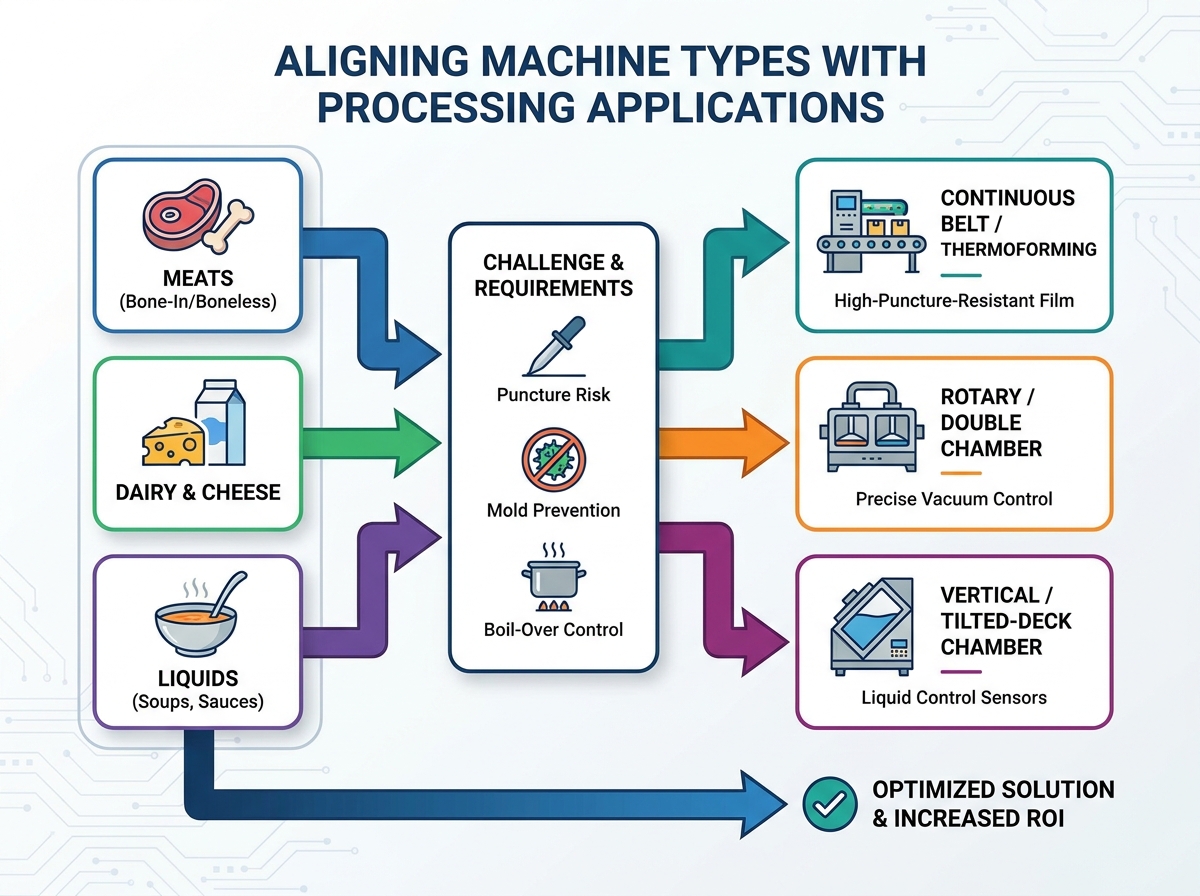
Processing fresh meats introduces high moisture content. Bone-in cuts present sharp edges causing severe puncture risks during the vacuum cycle. You also face extremely high throughput demands in modern meat processing facilities. A standard chamber machine often struggles here. You need continuous belt machines or automated thermoforming rollstock machines. These industrial systems handle heavy volumes continuously.
Focus on high-puncture-resistant film compatibility. You should specify heavy-duty seal bars capable of melting through fat or blood contaminants. Consider optional Modified Atmosphere Packaging (MAP) integration. MAP flushes the package using a specific gas mixture, such as nitrogen and carbon dioxide. This process extends the vibrant red color of fresh meat, appealing directly to retail consumers.
Dairy and Cheese Production
Cheese packaging requires preventing mold growth. You must simultaneously maintain the structural integrity of softer cheeses. Aggressive vacuum cycles easily crush delicate dairy products. Rotary vacuum chambers or double chamber models fit this application perfectly. They offer the controlled environments necessary for cheese blocks or wheels. A specialized vacuum packaging machine designed for dairy protects product aesthetics while ensuring safety.
The key feature focus involves precise vacuum control. Rely on sensor-based readings rather than time-based settings. Soft-air release capabilities are mandatory. Soft-air gradually allows atmospheric pressure back into the chamber. This prevents the film from violently snapping against the cheese and damaging it or puncturing the bag on sharp cheese corners.
Liquid-Heavy Foods (Soups, Sauces, and Marinades)
Handling liquid-heavy foods creates unique physics problems. Liquids boil over under low vacuum pressure at room temperature. Boiling liquids contaminate the seal area. They also get sucked into the vacuum pump, causing catastrophic mechanical damage. Standard horizontal models fail here. You must deploy vertical vacuum chamber machines. Alternatively, use tilted-deck chamber models. Gravity keeps liquids safely inside the pouch.
Specify liquid control sensors. These detect the exact moment boiling begins and instantly trigger the sealing process. Angled cavities and easily removable seal bars ensure daily sanitation remains efficient. This prevents cross-contamination between different sauce or soup batches.
Table: Application and Machine Architecture Mapping
| Food Product Type | Primary Challenge | Recommended Machine Type | Crucial Feature Requirement |
| Bone-In Meats | High puncture risk and moisture | Continuous belt / Thermoforming | Heavy-duty seal bars, MAP options |
| Soft Cheeses | Crushing and structural damage | Rotary or Double Chamber | Soft-air release, Sensor vacuum control |
| Soups & Sauces | Low-pressure boil-over | Vertical or Tilted-deck Chamber | Liquid control sensors, Angled deck |
Core Evaluation Dimensions for Your Processing Line
Procurement teams need a technical evaluation framework when comparing original equipment manufacturers (OEMs). Do not rely solely on marketing brochures. You must verify actual mechanical capabilities to ensure long-term reliability.
Throughput Requirements vs. Floor Space (Footprint)
Always assess cycles-per-minute (CPM) claims against real-world scenarios. Manufacturers often state maximum mechanical CPM. They rarely account for manual loading and unloading times. Ask for empirical data based on your specific pouch size and operator workflow. Evaluate the physical footprint-to-output ratio carefully. Transitioning from semi-automatic to fully automatic lines requires significant floor space. Ensure the new equipment fits within your existing facility layout without blocking critical sanitation pathways.
Vacuum Pump Architecture and Capacity
The vacuum pump acts as the heart of the system. You must compare rotary vane pumps against dry screw pumps. Rotary vane pumps handle standard applications well but require frequent oil changes. Dry screw pumps cost more initially but handle high ambient moisture levels better. They also require less frequent maintenance.
Follow a strict rule of thumb. The pump must be rated for the specific cubic volume of the chamber. It must also match the expected cycle frequency. An undersized pump overheats quickly and fails to reach target vacuum levels, creating massive production bottlenecks.
Sanitation, Washdown Ratings, and Hygienic Design
Food safety regulations demand transparent compliance data. Look for IP69K ratings if your facility uses heavy washdown procedures. IP69K ensures the machine withstands high-pressure, high-temperature water jets. Inspect the hygienic design closely. You want sloped surfaces to prevent water pooling. Water pooling breeds dangerous bacteria like Listeria. Demand tool-less removal of internal components. Operators must easily remove seal bars and filler plates for daily deep cleaning.
The Business Case: ROI, Yield, and Shelf-Life Extension
Frame your procurement decision around measurable business outcomes. Features matter, but financial impact drives the final executive approval. You must quantify how the equipment improves your bottom line.
Labor Reallocation and Automation Metrics
Calculate the reduction in manual handling. Automatic belt or inline systems drastically reduce labor compared to manual double-chamber loading. You can reallocate operators to higher-value tasks like quality control or logistics.
- Track the exact labor hours saved per shift.
- Multiply this by your fully burdened hourly labor rate.
- Factor in reduced ergonomic injuries from repetitive lifting.
This calculation provides a clear baseline for your return on investment.
Waste Reduction and Seal Integrity
Thicker, more consistent seals directly reduce the percentage of "leakers." Leakers are rejected packages losing their vacuum seal. Every leaker represents wasted packaging material and potentially wasted food product. Modern machines apply uniform pressure and heat across the entire seal bar. This consistency prevents micro-channels where oxygen can enter. Reducing your leaker rate by just two percent yields massive annual savings.
Logistics and Shelf-Life Economics
Quantify the impact of a reliable vacuum process. Reaching 99% or higher oxygen removal extends your distribution radius. You can ship products further without risking spoilage. Extended shelf life reduces retail spoilage chargebacks. Retailers penalize processors when products spoil before the expiration date. A high-performance vacuum packaging machine protects your brand reputation and your profit margins simultaneously.
Implementation Realities: Risks and Rollout Lessons
Operational experience reveals what goes wrong during installation. Understanding these risks helps you avoid costly rollout delays. Proper planning prevents weeks of lost production.
Under-Specifying Utility Requirements
Many facilities fail to account for necessary utility upgrades. A new machine might require a massive compressed air volume. If your Cubic Feet per Minute (CFM) is too low, the seal bars will not apply enough pressure. It may need specific three-phase electrical requirements. Certain high-capacity pump types even require dedicated chilled water lines.
Common Mistake: Ordering equipment before auditing your facility's utility drops. Always involve your plant engineer early in the specification process to verify infrastructure capacity.
Operator Adoption and Training Bottlenecks
Complex Human-Machine Interface (HMI) systems frustrate operators. Confusing menus lead to operator error during product changeovers. Incorrect settings ruin entire batches of product.
Best Practice: Prioritize equipment featuring programmable, recipe-driven touchscreens. You can pre-program the exact vacuum time, seal time, and cooling time for each product. The system should lock out unauthorized parameter changes using password protection. This ensures consistent quality regardless of which operator runs the shift.
Preventative Maintenance Realities
Ignoring oil change intervals on rotary vane pumps causes catastrophic pump failure. Moisture from the food contaminates the pump oil over time. Contaminated oil loses its lubricating properties, destroying the pump's internal vanes. Establish clear Service Level Agreements (SLAs) with the manufacturer. You need guaranteed spare parts availability. You also need defined technical support response times to minimize unplanned downtime.
Decision Framework: Shortlisting Your Next Vacuum Packaging Machine
Moving from research to procurement requires an actionable roadmap. Follow these structured steps to ensure a successful equipment acquisition.
- Conduct a Product Audit: Document your product dimensions accurately. Note the physical state, whether solid, liquid, or a mixture. Define your target shelf life clearly. Establish your daily volume targets. This audit forms the foundation of your equipment specification sheet.
- Request Pilot Testing: Never purchase equipment without running your exact product through the OEM's test facility. Send them your actual food product and your specific packaging film. You must verify cycle times and seal quality in a real-world simulation. Pilot testing exposes hidden compatibility issues before you sign a purchase order.
- Evaluate Long-Term Consumables and Maintenance: Build a Request for Proposal (RFP) looking beyond the initial purchase price. Request five-year projections on consumable parts. These include seal wire, Teflon tape, and pump oil. Factor in the preventative maintenance labor required to keep the machine running at peak efficiency.
Next Steps
Contact engineering partners to conduct a comprehensive site audit. They will help match your throughput goals with the appropriate machine architecture. A site audit ensures your facility can physically and operationally support the new equipment.
Conclusion
The best vacuum packaging machine is not the one boasting the most features. The optimal choice is the one engineered specifically for your product's physical properties. It must also match your facility's operational tempo. Misaligned equipment causes bottlenecks, while properly specified machinery drives efficiency and yield. Encourage your team to request a custom operational analysis. Schedule a product testing session with a dedicated packaging specialist today. Seeing your product run on the actual equipment provides the ultimate confidence for your procurement decision.
FAQ
Q: What is the difference between sensor-based and time-based vacuum packaging?
A: Time-based runs the pump for a set duration, which can lead to inconsistent results if atmospheric pressure or product volume changes. Sensor-based measures the exact millibar pressure inside the chamber, ensuring identical vacuum levels every cycle.
Q: How do I choose the right vacuum pump size for my machine?
A: Pump size should be determined by the volume of the vacuum chamber, the desired cycle speed, and the moisture content of the product. An undersized pump will struggle to reach target vacuum levels quickly, creating production bottlenecks.
Q: Can a standard vacuum packaging machine handle liquids and hot foods?
A: Standard flat-deck chamber machines struggle with liquids due to boil-over under pressure. Liquid applications require machines with angled decks or specialized liquid-control sensors that detect boiling and immediately trigger the sealing process.
Q: What is the expected lifespan of a commercial vacuum packaging machine?
A: With strict adherence to preventative maintenance (especially regular pump oil changes and seal bar replacements), high-quality industrial machines typically operate reliably for 10 to 15+ years.


