The price gap between entry-level commercial units and industrial-grade systems often shocks first-time buyers. You might see machines ranging from a few hundred dollars to tens of thousands. Navigating this immense price spectrum feels overwhelming for many business owners. Upfront price tags only represent a small fraction of your true long-term operating expenses. Choosing cheap equipment often leads to expensive breakdowns down the road. It also causes slow production lines and high consumable costs over time. A reliable machine protects your product margins and streamlines daily operations.
We designed this guide to provide a transparent breakdown of what drives equipment costs. You will learn how to match machine capabilities directly to your daily operational throughput. We also explain how to evaluate vendors critically before making your final purchase. By the end of this article, you will know exactly how to budget for your specific packaging needs without overspending.
Key Takeaways
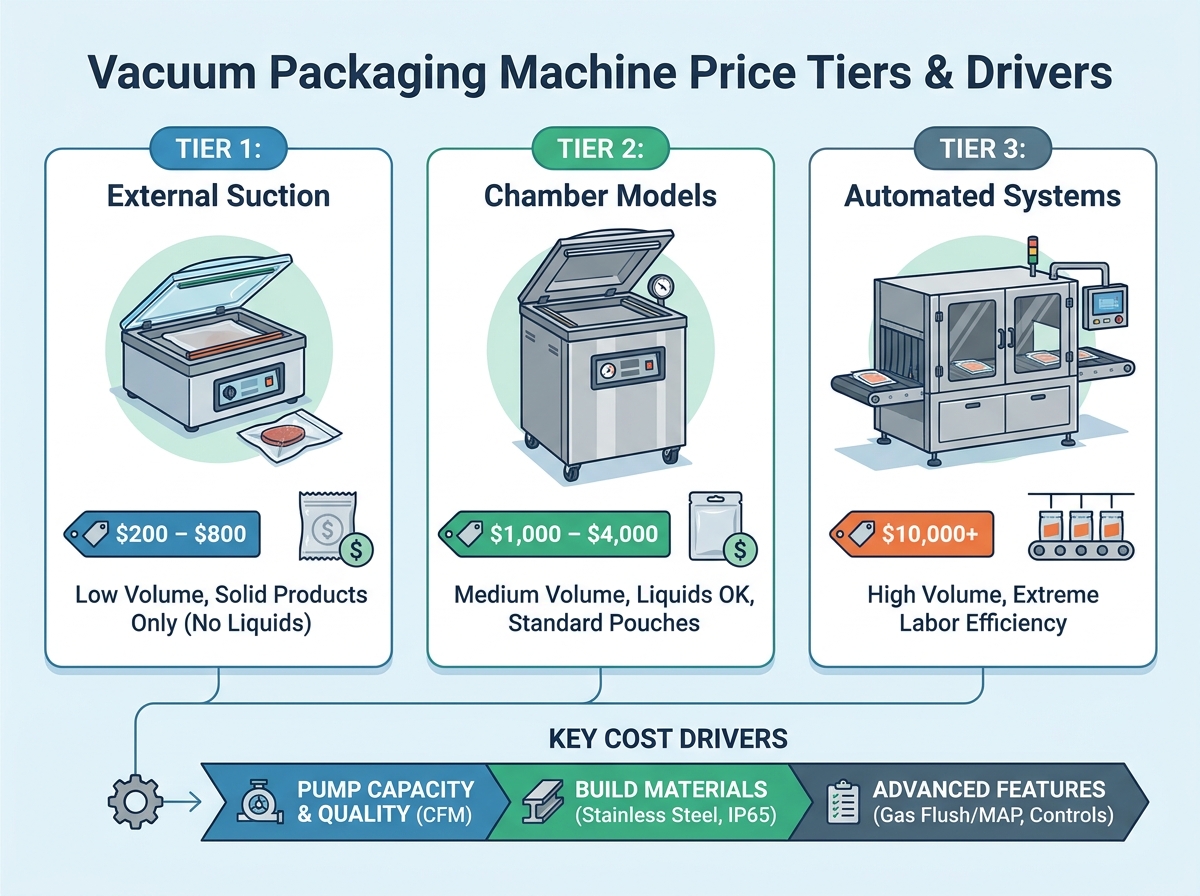
- Commercial vacuum packaging machines generally fall into three tiers: light-duty external suction ($200–$800), standard chamber models ($1,000–$4,000), and automated/continuous belt systems ($10,000+).
- Pump capacity and build quality (specifically 304/316 stainless steel for sanitary compliance) are the largest drivers of initial equipment costs.
- Consumables (bags/pouches) and routine maintenance (oil changes, seal wire replacements) represent the bulk of long-term operational expenses.
- Calculating true ROI requires measuring labor savings, reduced food waste (or product spoilage), and increased throughput against the amortized machine cost.
Baseline Price Tiers by Vacuum Packaging Machine Type
External Suction Sealers ($200 – $800)
External suction machines offer the lowest barrier to entry for small businesses. These units sit on a countertop. The operator places the edge of a bag into the front channel. The machine then sucks the air out directly from the bag. You should only use these machines for low-volume applications. They exclusively handle solid products like hard cheeses, dry goods, or whole cuts of meat.
You cannot package liquids using external suction sealers. The pump will suck liquid marinades or juices directly into the motor. This destroys the equipment instantly. While they require a low initial investment, they demand specialized embossed bags. These textured bags contain micro-channels allowing air to escape. Embossed bags cost significantly more than standard bags. This drastically increases your cost-per-pack over time.
Tabletop & Floor-Standing Chamber Machines ($1,000 – $5,000)
Chamber machines act as the workhorses for medium-volume commercial kitchens, mid-sized butchers, and small production facilities. Instead of sucking air from the bag, you place the entire bag inside a sealed chamber. The machine removes all air from the entire chamber simultaneously. This equalizes pressure inside and outside the pouch. Because of this equalized pressure, liquids stay inside the bag. You can easily package soups, sauces, and wet marinades.
These models demand a higher upfront cost. However, they utilize standard, smooth vacuum pouches. Smooth pouches cost a fraction of the price of embossed bags. Your consumable costs drop immediately. Pricing in this tier scales directly based on the chamber size and the pump horsepower. Floor-standing models accommodate larger cuts of meat and offer higher output.
Double Chamber & Continuous Belt Systems ($8,000 – $25,000+)
Industrial food processors and high-volume production lines require heavy-duty automation. Upgrading to an industrial vacuum packaging machine delivers extreme labor efficiency. Double chamber systems feature two distinct sealing areas. A single lid swings between them.
This design eliminates idle waiting time. An operator loads fresh bags onto one side while the machine actively vacuums and seals the other side. Continuous belt systems take this further by automatically feeding products through a sealing tunnel. The large capital expenditure easily justifies itself through massive reductions in manual labor hours. High-speed operations recoup this investment rapidly.
Key Variables That Drive Up Equipment Costs
Vacuum Pump Quality and Capacity (CFM/m³h)
The vacuum pump represents the literal heart of the machine. Pump capacity dictates how fast the machine removes air. Manufacturers measure this capacity in Cubic Feet per Minute (CFM) or Cubic Meters per Hour (m³h). A higher capacity drastically reduces cycle times. Faster cycle times mean higher daily throughput.
High-end machines often feature premium rotary vane pumps, such as Busch pumps. These German-engineered components run quieter, pull deeper vacuums, and outlast cheaper alternatives. Integrating a premium pump increases the base price of the unit. However, the reliability and speed gains offset the initial premium during heavy daily usage.
Seal Bar Dimensions and Configuration
Seal bars determine how many bags you can process in a single cycle. Basic units feature one short seal bar. Expensive units offer multiple long seal bars. Dual seal bars let you place bags on both sides of the chamber simultaneously. This effectively doubles your batch processing speed.
The physical wire configuration also impacts pricing. Standard machines use a thin 3mm to 5mm seal wire. Industrial units upgrade to 10mm wide flat wires or bi-active sealing. Bi-active sealing applies heat from both the top and bottom bars. You need this feature to securely seal thick foil pouches or multi-layered mylar bags.
Sanitary Design and Material Compliance
Food processing environments must adhere to strict sanitation regulations. Equipment built for these facilities commands a premium price. Cheap machines often use painted steel frames. Premium models utilize full 304 or 316 stainless-steel chassis. Type 316 stainless steel resists pitting from harsh salts and acidic marinades.
Regulatory compliance also increases manufacturing costs. Machines requiring NSF (National Sanitation Foundation) or CE certifications undergo rigorous engineering checks. Additionally, IP65 water-resistant ratings allow facilities to safely wash down machines using low-pressure water jets. These structural upgrades prevent bacterial harborage but add thousands to the purchase price.
Programmable Controls and Gas Flush (MAP)
Modern equipment relies on sophisticated digital sensors rather than basic mechanical timers. Sensor-based controls measure the exact atmospheric pressure inside the chamber. This guarantees a perfect vacuum level regardless of the product size.
Adding gas flush capabilities further increases costs. We call this Modified Atmosphere Packaging (MAP). The machine injects an inert gas mix, usually nitrogen or carbon dioxide, into the bag right before sealing. Nitrogen prevents potato chips from crushing. Carbon dioxide preserves the bright red color of fresh beef. MAP technology requires complex internal plumbing, specialized valves, and specialized digital controllers.
Cost Impact of Key Equipment Upgrades
| Feature Upgrade | Primary Benefit | Estimated Price Impact |
| Premium Rotary Vane Pump | Faster cycle times, deeper vacuum, longer lifespan | +$500 to +$2,500 |
| Dual Seal Bars | Doubles batch processing capacity per cycle | +$200 to +$800 |
| Gas Flush (MAP) System | Extends shelf life, protects fragile products | +$400 to +$1,500 |
| IP65 Washdown Rating | Allows safe cleaning in wet processing facilities | +$1,000 to +$3,000 |
The Hidden Costs of Implementation and Operation
Consumable Math (Embossed vs. Smooth Bags)
Buyers frequently overlook the ongoing cost of packaging materials. The hidden penalty of cheap external suction machines lies in their reliance on proprietary embossed bags. Because they lack a vacuum chamber, they need textured channels to pull air out.
Let us look at a realistic comparison. An embossed bag might cost $0.25 per unit. A standard smooth pouch of the exact same size costs around $0.05. If your business seals 10,000 bags a year, embossed bags will cost you $2,500. Smooth bags will only cost $500. Chamber machines easily win on long-term unit economics. The higher upfront cost pays for itself purely through consumable savings.
Maintenance Realities and Downtime Risks
Commercial packaging requires mandatory upkeep. Most commercial models use oil-lubricated rotary vane pumps. The oil creates an airtight seal and dissipates heat. However, the oil absorbs moisture from the food over time. It turns milky and loses viscosity.
You must perform regular oil changes and replace the exhaust filters. Neglecting this routine maintenance leads directly to catastrophic pump failure. A replacement pump often costs half the price of a new machine. Unplanned downtime also halts your entire shipping department, causing cascading revenue losses.
Common Maintenance Best Practices:
- Check pump oil levels and color weekly through the sight glass.
- Run the pump conditioning program daily to burn off accumulated moisture.
- Replace Teflon tape over the seal wire at the first sign of burning or discoloration.
- Inspect lid gaskets monthly for cracks or compressions.
Labor and Operator Training
You must address the human element of your packaging line. Complex machinery requires Standard Operating Procedures (SOPs). Your staff needs time to learn the equipment safely. Operators must understand how to clean the seal bars daily.
They must also learn how to switch digital programs when changing from liquid soups to dry goods. Factor the onboarding time for production staff into your initial implementation budget. Poorly trained operators will incorrectly seal bags, leading to immediate product spoilage and wasted inventory.
How to Calculate ROI on Your Packaging Investment
Metric 1: Shelf-Life Extension and Waste Reduction
The most immediate return on investment comes from reducing spoilage shrink. Oxygen fuels bacterial growth and causes freezer burn. Removing oxygen drastically extends the usable life of your inventory.
You can extend the shelf life of fresh meat from three days to up to fourteen days under refrigeration. A restaurant throwing away $200 of spoiled ingredients weekly loses over $10,000 annually. Eliminating this waste stream justifies the cost of a commercial machine within the first few months. Quantify the value of this saved inventory to measure your true ROI.
Metric 2: Throughput vs. Labor Costs
Manual labor represents the largest recurring expense for any production facility. Compare the manual labor hours required to operate a single-chamber unit versus the automated efficiency of a double-chamber model.
If an employee earns $20 per hour and spends four hours a day sealing bags on a small machine, they cost you $80 daily. Upgrading to a double-chamber unit can compress that same workload into just one hour. You save $60 a day in labor costs alone. Over a year, this labor efficiency easily funds the purchase of an industrial-grade system.
Metric 3: Freight and Storage Density
Air takes up valuable space. Vacuum-sealed products compress tightly, reducing their overall volume. This optimization directly impacts your logistics costs.
Denser packages mean you can fit more units into a single shipping box. You require less corrugated cardboard per shipment. You also maximize pallet space in your walk-in freezers. Lowering your freight costs and optimizing storage density adds passive profit back into your business model every single day.
Vendor Evaluation and Shortlisting Your Next Machine
Assessing Warranty and Parts Availability
The equipment market floods with cheap imports boasting attractive price tags. We strongly warn against buying obscure brands lacking domestic parts support. A machine is useless if you cannot fix it quickly.
Imagine saving $500 on the initial purchase price. Six months later, a $20 internal seal relay burns out. If the vendor operates overseas and has no local service network, you might wait three weeks for a replacement part. Halting your production line for three weeks erases any initial savings. Prioritize vendors offering comprehensive warranties and a fully stocked domestic parts warehouse.
Testing and Validation
Never guess how a machine will handle your specific product. Different pouch thicknesses, product moisture levels, and bone-in meats react differently under intense vacuum pressure.
We advise all buyers to request sample packaging runs before committing to a purchase. Ship a batch of your actual product to the vendor. Ask them to film a video sealing your product in their machine. They should test different vacuum times and confirm the final seal integrity. This validation step guarantees the equipment matches your exact operational needs.
Evaluating 5-Year Operating Expenses
Focusing purely on the invoice price creates a dangerous blind spot. We recommend using a simple 5-year operating cost framework to compare your options accurately.
- Initial Machine Cost: The base invoice price including shipping and installation.
- Consumable Spend: The projected cost of pouches based on your daily volume over five years.
- Maintenance Budget: The total cost of oil, filters, seal wires, and annual servicing.
- Labor Hours: The projected wages paid to operators running the machine.
A $5,000 machine using cheap smooth bags and operating twice as fast will heavily outpace a $1,000 machine using expensive embossed bags over a five-year timeline. Always calculate this long-term financial picture.
Conclusion
Buying a commercial packaging system represents an operational partnership, not a one-off transaction. The machine you choose will dictate your daily production speed, your product quality, and your long-term consumable expenses. Small decisions upfront compound over years of daily usage.
We recommend you over-index on pump reliability and post-sale support. A heavy-duty rotary vane pump and a reliable parts warranty will always outperform flashy digital touchscreens. Focus on durability and speed.
Audit your current daily packaging volume today. Count exactly how many pouches per hour you need to process. Use this data to determine which tier of machine aligns perfectly with your business plan. Investing in the right vacuum packaging machine secures your margins and scales your output smoothly.
FAQ
Q: Why is there such a massive price difference between oil-filled and dry pump vacuum machines?
A: Dry pumps operate without oil. They cost less upfront and require less maintenance. However, they cannot achieve the deep vacuum levels required for commercial food preservation. They also overheat quickly during heavy use. Oil-lubricated rotary vane pumps cost more, but they pull a superior vacuum and can run continuously all day without failing.
Q: Can a cheaper external vacuum sealer handle liquids or marinades?
A: No. External sealers pull air directly from the bag opening. They will suck liquid marinades directly into the internal motor, destroying the unit instantly. Liquid applications mandate a chamber model, which equalizes pressure inside the entire box.
Q: How long should a commercial vacuum packaging machine last?
A: With routine oil changes, filter replacements, and seal bar maintenance, a commercial-grade unit can reliably run for 7 to 10+ years. High-end industrial units often last decades if operators follow strict daily cleaning and maintenance schedules.
Q: Does gas flush (MAP) significantly increase the price of the machine?
A: Yes. Adding gas flush capability typically adds 15% to 30% to the base cost of a chamber machine. You must also budget for the ongoing cost of the shielding gas cylinders (like nitrogen or carbon dioxide) required to run the system.


