Upgrading packaging infrastructure represents a high-stakes operational decision for any growing facility. You must carefully balance initial capital expenditure against long-term throughput and product preservation. Traditional packaging methods offer a low barrier to entry. Manual wrapping, basic sealing, and standard shrink-wrap seem cost-effective initially. However, they scale poorly as your daily production demands increase. Conversely, adopting commercial vacuum packaging technology requires a significant upfront investment. It also demands noticeable shifts in your daily operational workflow. This article provides an objective, criteria-driven framework. We want to help operations managers evaluate these competing methodologies. You will discover if investing in a vacuum packaging machine yields verifiable returns for your specific production environment. We break down hardware classifications, shelf-life metrics, and common adoption risks. This comprehensive guide ensures your next equipment upgrade aligns directly with your long-term business goals.
Key Takeaways
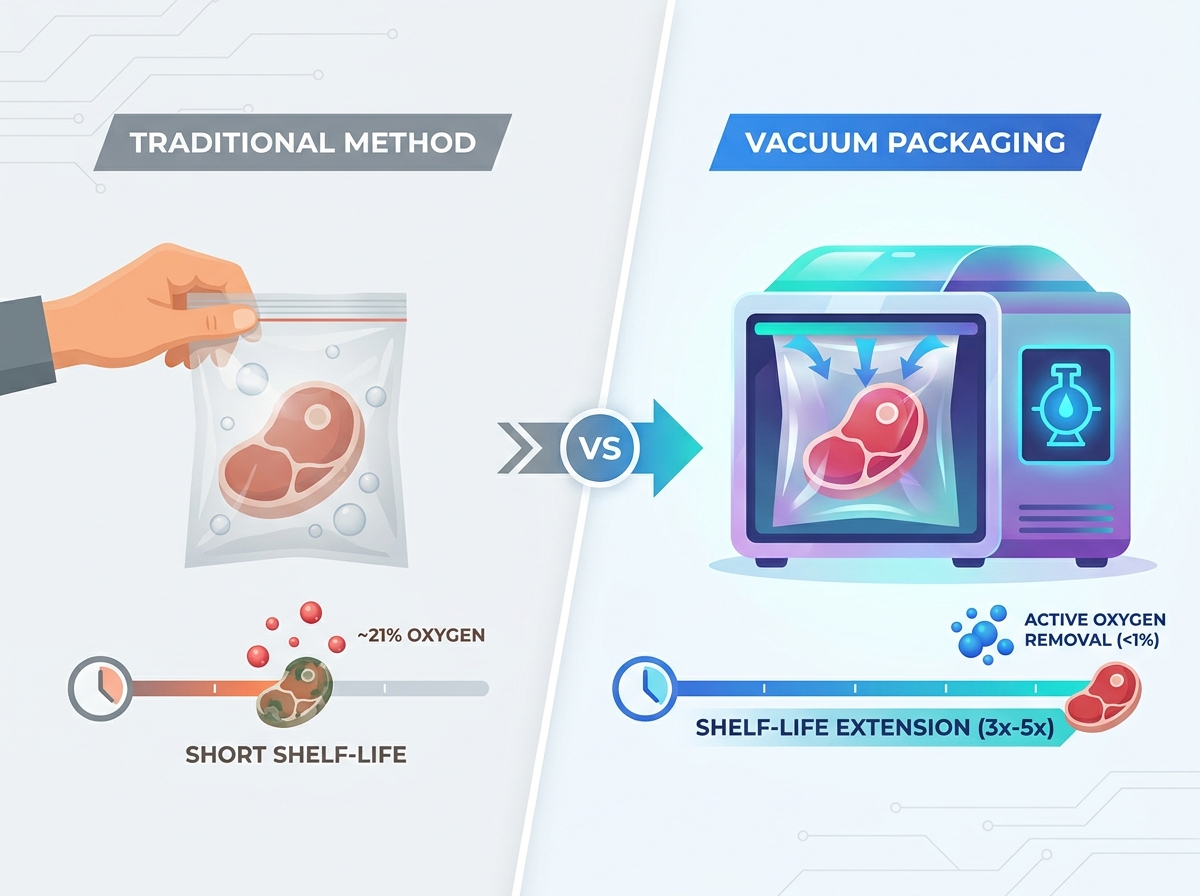
- Vacuum packaging extends shelf life by 3x to 5x compared to traditional methods by actively removing oxygen, directly impacting spoilage rates and inventory management.
- The transition requires evaluating total cost of ownership (TCO), factoring in specialized consumables (barrier bags) and routine maintenance (pump servicing), not just the machine's sticker price.
- Selecting between external sealers and chamber vacuum machines depends entirely on moisture content, throughput needs, and compliance standards.
- Upgrading to commercial vacuum technology typically reduces per-unit labor time but requires standardized operator training to ensure consistent seal integrity.
The Business Case: Limitations of Traditional Packaging
Operations managers must deeply understand current baseline systems before proposing upgrades. Standard poly-bag sealing, manual stretch wrapping, and basic atmospheric shrink packaging dominate many early-stage facilities. They require minimal training. Operators can start packing immediately on day one. You buy cheap rolls of plastic film. Workers wrap items quickly by hand.
However, these manual and semi-manual traditional methods quickly hit hard limitations. They rely heavily on human operator speed. Consequently, labor costs scale linearly alongside your production volume. You cannot simply double your daily output without doubling your packing staff. This creates major operational bottlenecks. These bottlenecks become especially painful during seasonal demand peaks. Worker fatigue sets in. Packaging consistency drops dramatically.
Furthermore, atmospheric packaging presents significant biological and physical risks. The process inherently traps ambient oxygen and moisture around the product. This micro-environment accelerates chemical oxidation. It causes severe freezer burn on frozen goods. Microbial growth thrives aggressively in these oxygen-rich conditions. Spoilage metrics rise quickly as a result. You lose valuable inventory constantly. Profit margins shrink due to persistent product waste.
How do you know it is time to switch? Facility leaders must define clear success criteria before transitioning. Benchmarks for upgrading include targeting a specific percentage reduction in weekly spoilage. Achieving strict HACCP compliance often forces the transition naturally. Sometimes, the primary goal involves shipping products over much longer distances. You must ensure absolute quality preservation during extended transit times. Upgrading to advanced technology solves these fundamental supply chain challenges.
Vacuum Packaging Machine Classifications and Capabilities
Understanding industrial hardware classifications remains crucial for accurate procurement. Equipment generally falls into three distinct categories. Engineers base these unique designs on mechanics, physical limitations, and intended daily throughput.
External Edge Sealers
These compact devices sit entirely outside the pouch. The machine physically pulls air directly from the bag opening. They work best for solid, completely dry goods. They fit perfectly into low-to-medium volume operations. Bakeries and small electronics shops often use them successfully. However, they possess a major limitation. They cannot handle liquids or high-moisture products effectively. The intense suction draws liquid straight into the internal mechanisms. This instantly damages internal components. Furthermore, they are highly susceptible to overheating. Continuous commercial use quickly degrades their fragile heating elements.
Chamber Vacuum Packaging Machines
This category completely changes the physical approach to air extraction. The operator places the entire product and bag inside a sealed cavity. The system evacuates air from the entire chamber simultaneously. This clever mechanism keeps air pressure perfectly equal inside and outside the pouch. Liquids stay calmly inside the bag during the entire cycle. They do not boil over or escape. Therefore, they are absolutely essential for marinades, soups, and high-volume commercial meat processing. We highly recommend utilizing a high-quality vacuum packaging machine in this chamber format for serious culinary facilities. They provide unmatched daily consistency.
Continuous / In-Line Rollstock Machines
Enterprise facilities require massive, uninterrupted daily output. These continuous form-fill-seal machines offer true enterprise-grade solutions. They automate the entire process for high-throughput environments. Industrial engineers design them to integrate directly into existing factory conveyor systems. They transform two large rolls of flat plastic film into custom-shaped pouches. They seal the product and cut the packages automatically. These massive systems handle thousands of units per hour effortlessly.
Evaluating Core Dimensions: Vacuum vs. Traditional
We must compare these distinct methodologies across several fundamental operational dimensions. Data-driven comparisons reveal the true underlying value of upgrading your lines.
Product Integrity and Shelf-Life Extension
The most profound advantage lies in active oxygen reduction. Scientific data points confirm this reality daily. Vacuum sealing routinely reduces residual oxygen to less than 1 percent inside the package. This microscopic level effectively starves and inhibits aerobic bacteria. Conversely, traditional manual sealing leaves ambient oxygen levels hovering around 21 percent. Spoilage organisms thrive aggressively in conventional packages. Removing this air directly safeguards your product integrity over long durations.
Visual Presentation and Packaging Effect
Visual appearance heavily influences final purchasing decisions. Traditional shrink packaging does conform tightly to product shapes. However, it fails completely at removing hidden air pockets. Blood and moisture pool inside these empty spaces unappealingly. A proper vacuum package provides a tight, highly transparent second skin. It completely prevents damaging ice crystal formation in retail freezers. This clean, professional look dramatically improves retail display appeal. Customers trust tightly sealed, pristine products much more readily.
Operational ROI and Consumables
Financial metrics shift considerably when you upgrade your lines. Traditional methods use significantly cheaper standard poly bags and thin films. They seem incredibly affordable upfront. Vacuum systems require specialized multi-layer barrier pouches. Manufacturers often blend durable nylon and polyethylene layers. These complex bags cost noticeably more per individual unit. However, this initial consumable expense deceives many buyers. Reduced food waste, extended retail shelf times, and fewer customer returns quickly offset these higher bag costs.
Security and Compliance Standards
Modern supply chains demand strict physical accountability. Traditional wrapping provides almost zero security against product tampering. People can unwrap and re-wrap items easily. Vacuum seals naturally provide tamper-evident closures. If an external seal breaks, the bag immediately loses surface tension. The plastic visibly relaxes. This instant visual cue remains critical for quality control inspectors. It helps facilities meet strict food safety regulations. It guarantees cold-chain compliance standards from the warehouse to the supermarket.
Packaging Method Comparison Summary
| Evaluation Criteria | Traditional Packaging | Vacuum Packaging |
| Residual Oxygen | ~21% (Ambient levels remain) | <1% (Actively inhibits aerobic bacteria) |
| Visual Presentation | Conforms loosely, leaves visible air pockets | Tight second skin, highly transparent finish |
| Freezer Burn Protection | Low (Trapped moisture escapes easily) | High (Effectively prevents ice crystal formation) |
| Tamper Evidence | Poor (Easily unwrapped and re-wrapped) | Excellent (Immediate visible tension loss) |
Implementation Realities and Adoption Risks
Upgrading brings exciting new capabilities to your production floor. However, it also introduces specific operational responsibilities. You must never underestimate the initial transition period.
Maintenance Requirements
Industrial mechanical equipment demands strict, regular care. Commercial vacuum pumps require routine oil changes just like vehicle engines. You must check and replace internal exhaust filters periodically. The heating seal bar utilizes specialized Teflon tape. This protective tape needs regular physical inspection and routine replacement. What is the primary risk here? Ignoring basic pump maintenance leads directly to costly, unplanned downtime. Dirty oil causes weak vacuum cycles. Weak cycles leave dangerous oxygen in the bag. Poor seals compromise entire product batches, leading to massive financial waste.
Workflow Disruption
Changing your primary packaging format alters the entire line pacing. Transitioning from traditional wrapping to chamber processing changes everything. The process shifts entirely from continuous manual handling to rigid batch processing. Line managers must plan their daily workflow carefully. You must maximize chamber space efficiently per cycle. Operators need to arrange multiple bags side-by-side on the seal bar. If they load the chamber poorly, overall daily throughput drops significantly.
Staff Training
Automation still requires skilled, observant human oversight constantly. Floor operators need standardized, formal training upon installation. They must learn how to adjust vacuum percentages accurately. They need to configure precise seal times and adequate cooling times. These machine settings change frequently. They vary drastically based on bag plastic thickness and differing product density. Improper settings lead to melted bag seams. Sometimes they cause insufficient oxygen removal. Proper education prevents these common daily mistakes.
Shortlisting Logic: How to Choose the Right Setup
Follow a highly structured approach to select your ideal commercial equipment. Never base this critical business decision purely on the lowest price tag.
Assess Product Characteristics
Look closely at your physical inventory. Different product categories require highly specific machine features:
- Liquids and Marinades: Require enclosed chamber designs to prevent boiling under atmospheric pressure.
- Fragile Baked Goods: Need MAP gas flush features to prevent physical crushing during extraction.
- Dense Solid Meats: Benefit immensely from maximum extraction power and highly robust sealing bars.
Calculate True Capacity Needs
Do not simply guess your daily volume requirements. Evaluate your realistically required cycles per minute carefully. Compare this required speed against the machine’s specific pump capacity. Engineers measure this extraction power in cubic meters per hour (m³/h). An undersized vacuum pump creates immediate production bottlenecks. It forces workers to wait on the machine continually.
Commercial vs. Consumer Pitfalls
Never cut financial corners on core hardware grades. Avoid utilizing consumer-grade vacuum sealers in commercial production environments. Their internal duty cycles remain far too short. Continuous factory operation results in rapid, premature motor failure. You will spend considerably more money replacing cheap units repeatedly. Investing properly in an industrial vacuum packaging machine saves essential capital long-term.
Vendor Evaluation Checklist
Equipment remains only as reliable as its supporting supplier network. Prioritize vendors heavily based on their aftermarket support. Use the following criteria when vetting new suppliers:
- Accessible Spare Parts: Ensure they stock replacement seal wires, Teflon tape, and silicone lid gaskets domestically.
- Technical Support Responsiveness: Look for highly knowledgeable technical support teams accessible during your actual operating hours.
- Transparent Warranty Coverage: Demand clear, written warranty terms specifically covering the internal vacuum pump and main circuit boards.
- Training Resources: Check if they provide detailed setup videos or direct operator training manuals for your team.
Conclusion
We must establish a final verdict on competing packaging methodologies. Sticking persistently with traditional manual methods remains viable only for highly specific scenarios. They work adequately for non-perishable goods. They suit localized, low-volume distribution networks reasonably well.
However, our strategic takeaway points directly toward modern automation. A commercial vacuum system is not merely a plastic sealing tool. It acts as an advanced, critical inventory management asset. It deliberately shifts operational costs. You move money away from unpredictable product spoilage waste. Instead, you invest it into predictable, highly manageable equipment maintenance.
Take immediate action on these next steps. Start your facility transition today. Audit your current weekly spoilage costs accurately. Document the exact labor hours your staff spends on traditional manual packaging. Establish this clear, undeniable baseline. You will use this exact data to calculate your definitive hardware upgrade return on investment.
FAQ
Q: Can a vacuum packaging machine handle liquids and soups?
A: Yes, but only chamber vacuum machines. They evacuate air from the entire enclosed space, keeping pressure equalized around the pouch. This holds liquids safely in place. External edge sealers will aggressively pull the liquid out of the bag during suction, which quickly destroys the internal pump.
Q: Are the bags used for vacuum packaging more expensive than traditional poly bags?
A: Yes. Vacuum bags require specialized multi-layer oxygen-barrier materials, such as Nylon or EVOH. These distinct layers maintain the internal vacuum tension over time. This complex manufacturing requirement makes them slightly more expensive per unit compared to simple, non-barrier poly bags.
Q: What is the routine maintenance for a commercial vacuum packaging machine?
A: Standard upkeep involves changing the vacuum pump oil regularly, typically every 200 to 250 hours of active use. You must also replace the heated seal bar wire and the protective Teflon tape routinely. Always check the rubber lid gaskets for physical wear or cracking.
Q: Does vacuum packaging replace the need for refrigeration?
A: No. Vacuum packaging successfully inhibits aerobic bacteria by actively removing ambient oxygen. However, it does not stop dangerous anaerobic bacteria, such as Botulism, which actively thrive without air. Perishable food goods must absolutely still be refrigerated or frozen to ensure complete consumer safety.


