Upgrading or outfitting a commercial kitchen requires balancing upfront capital expenditure against long-term operational expenses. You must select equipment carefully to protect your profit margins. Selecting the right fryer machine is rarely a simple preference. Menu volume, existing kitchen infrastructure, and local utility rates dictate this crucial choice. Making a poor selection often leads to sluggish kitchen output and frustrating bottleneck issues during peak service hours. Your cooking staff relies on responsive equipment to maintain food quality when order tickets pile up.
This guide breaks down the performance realities of electric, gas, and induction commercial fryers. You will discover how different heating mechanisms impact heat recovery times, daily utility loads, and overall kitchen workflow. We will also explore emerging induction technology to support an evidence-based purchasing decision for your facility.
Key Takeaways
- Utility Infrastructure dictates the baseline: Gas fryers require dedicated gas lines and robust HVAC systems, while electric models offer more flexible installation but demand specific voltage capacities.
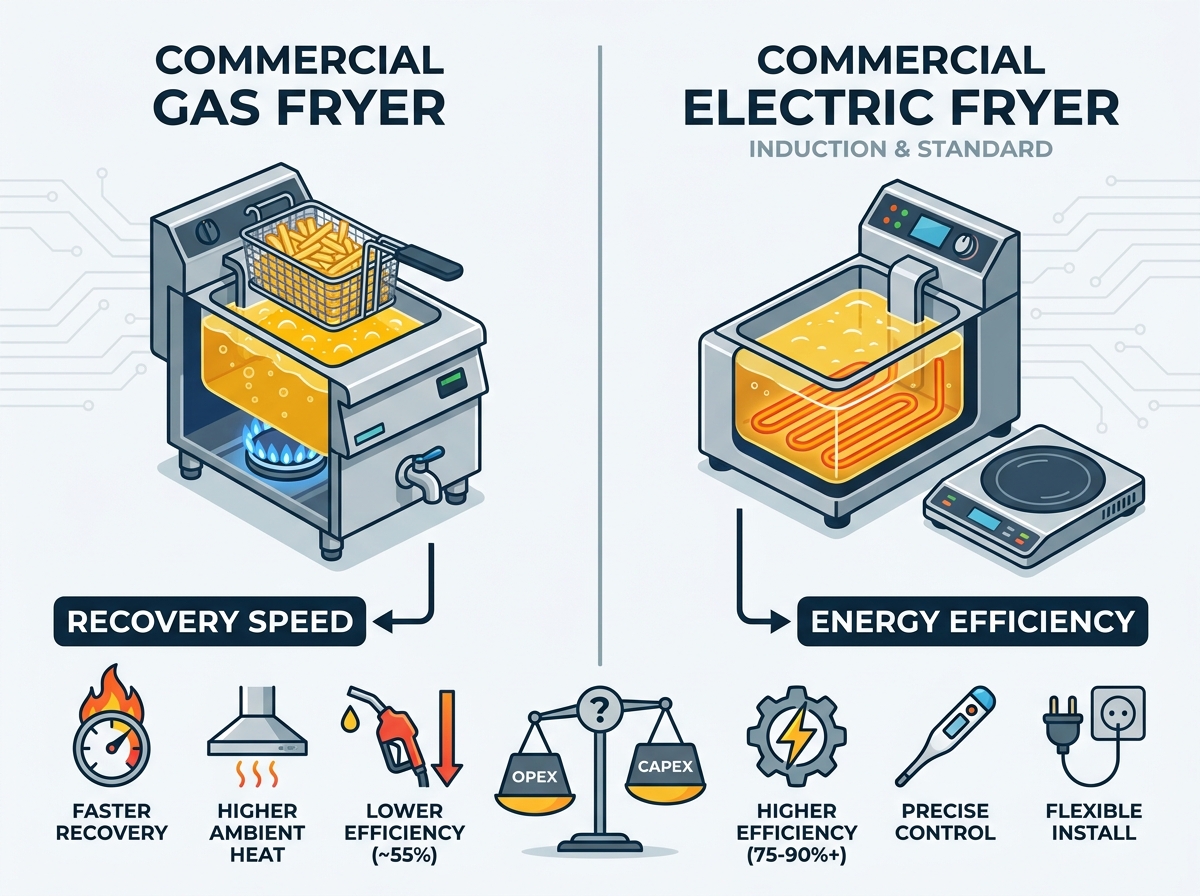
- Recovery time vs. Energy efficiency: Gas traditionally wins on raw heating speed and high-volume recovery, whereas electric models transfer heat more efficiently into the oil with less ambient heat loss.
- Emerging tech: Commercial induction fryers represent the highest energy efficiency and safety standards but require the largest initial investment.
Framing the Decision: What Drives Your Fryer Machine Choice?
Before comparing fuel types, you must audit your specific operational needs. Equipment buyers often focus solely on sticker price. They ignore hidden variables shaping daily performance. You must evaluate three core drivers before browsing catalogs.
Production Volume & Menu Profile
You must assess your required pounds-per-hour output. High-demand items cause rapid temperature drops in your oil. Frozen french fries represent the ultimate stress test. Dropping frozen product into hot oil plummets the temperature instantly. Your equipment must recover this lost heat quickly. We call this metric "recovery time." Fast recovery prevents greasy, soggy food. Heavy breading also demands stable heat to crisp properly. High-BTU recovery becomes non-negotiable for high-volume quick-service restaurants.
Kitchen Infrastructure Limitations
Your building dictates your options. You must evaluate your existing utility hookups. Installing new utilities costs thousands of dollars. Determine if your facility has natural gas lines. Check if you rely on liquid propane tanks. For electric options, verify your panel capacity. Most commercial kitchen equipment requires heavy-duty 3-phase electrical wiring. Standard outlets cannot power a commercial fryer machine effectively.
Ventilation and Compliance
Fire codes tightly regulate commercial frying. You must adhere to NFPA 96 standards. Gas combustion emits harmful byproducts like carbon monoxide. Consequently, gas units require stricter ventilation protocols. They demand dedicated Type 1 exhaust hoods. You must factor hood space into your footprint. Electric units sometimes allow slightly more flexible hood configurations. Some jurisdictions even permit ventless electric setups for specific light-duty applications. Always consult your local fire marshal before purchasing.
Commercial Gas Fryer Machines: Strengths and Limitations
Gas models remain the traditional backbone of high-volume restaurant kitchens. They offer raw power and aggressive heating profiles. Let us examine how they operate and where they excel.
The Mechanism
Gas units generate heat via open flames. Burners sit beneath the fry pot or run directly through it. Manufacturers offer three main configurations. Tube fryers use pipes running through the oil vat. Open pot fryers heat the exterior of the vat directly. Flat bottom fryers heat from underneath a wide, shallow pan. Each design serves specific menu items. Tube designs handle heavy sediment from battered foods perfectly.
Pros of Gas Heating
- Faster heat-up and recovery times: Open flames deliver aggressive heat quickly. They recover oil temperatures rapidly during continuous, high-volume frying.
- Cheaper operation in specific regions: Natural gas often costs significantly less than commercial electricity. This fuel price gap saves high-volume operators substantial money monthly.
- Higher maximum temperatures: Gas burners push oil to maximum frying temperatures faster than most standard resistance coils.
Cons of Gas Heating
- Lower energy efficiency: Gas wastes massive amounts of heat. Only about 50% to 55% of the generated heat transfers into the oil. The rest escapes up the flue.
- Increased HVAC strain: Escaping heat warms your kitchen ambiently. Your air conditioning system must work much harder to keep staff comfortable.
- Cumbersome cleaning: Tube fryers contain fixed internal pipes. Staff struggle to scrub carbon buildup from underneath these stationary tubes.
Common Mistakes to Avoid
Never ignore pilot light maintenance. A flickering or weak pilot light indicates a failing thermocouple. Replace thermocouples proactively. Waiting for failure during a Friday dinner rush ruins service. Also, avoid using flat-bottom gas fryers for heavily breaded items. The sediment burns on the flat bottom and degrades your oil instantly.
Commercial Electric Fryer Machines: Strengths and Limitations
Electric equipment dominates scenarios demanding efficiency, mobility, and cooler kitchen environments. They convert energy into cooking power entirely differently than gas equivalents.
The Mechanism
Electric units utilize submerged heating elements. These metal coils sit directly inside the oil vat. Electricity flows through the resistance coils, generating intense heat. The heat transfers directly outward into the surrounding liquid. This direct contact changes the efficiency equation dramatically.
Pros of Electric Heating
- High energy transfer efficiency: Submerged elements waste very little energy. Often 75% to 85% of the heat transfers directly into the oil. Very little ambient heat escapes into the kitchen.
- Portability and easier installation: You do not need hard-plumbed gas lines. If your power cord permits, you can place these units on casters. Moving them for floor cleaning becomes effortless.
- Rapid light-batch recovery: Because elements contact the oil directly, they recover temperature exceptionally well between light-to-medium batches.
Cons of Electric Heating
- Slower initial heat-up time: Heating a cold vat of solid shortening takes noticeably longer compared to aggressive gas burners.
- Higher utility rates: Regions commanding premium commercial electricity rates make these units expensive to run daily.
- Difficult deep cleaning: Submerged coils get in the way. If your model does not feature swing-up elements, filtering oil and scrubbing the vat bottom becomes frustrating.
Best Practices
Always buy electric models featuring self-lifting or swing-up elements. This single feature saves your staff hours of cleaning labor weekly. Furthermore, never turn an electric unit on while the vat is empty. The exposed elements will overheat, warp, and potentially cause a severe fire.
The Innovation Shift: Electric vs. Commercial Induction Fryers
Technology continues to evolve beyond standard resistance coils. Commercial induction frying represents a massive leap forward in kitchen engineering. It solves many traditional pain points while introducing new financial considerations.
The Mechanism
Induction technology abandons heating coils entirely. It uses electromagnetic fields to generate heat. A copper coil beneath the vat creates an alternating magnetic field. This field interacts directly with the metallic fry pot. The pot itself becomes the heat source. The oil absorbs heat evenly from the entire surface area of the vat.
Pros of Induction Technology
- Maximum efficiency: Induction boasts over 90% heat transfer efficiency. Almost zero heat escapes into your kitchen.
- Precise temperature control: Magnetic fields adjust instantly. Sensors provide real-time, pinpoint temperature accuracy. This prevents oil from overheating.
- Smooth, easy-to-clean vats: No submerged coils exist. The vat remains completely smooth. Staff simply wipe it out.
- Extended oil life: Traditional coils create ultra-hot contact points. These points scorch the oil. Induction heats evenly, extending expensive oil lifespan significantly.
Cons of Induction Technology
- Highest initial capital expenditure: These units cost significantly more upfront than standard gas or electric models.
- Limited model availability: Manufacturers produce fewer induction models. Finding the exact size you need proves slightly more difficult.
- Specialized repairs: When induction boards fail, you need highly specialized technicians. Standard kitchen repairmen often lack the training to fix them.
Head-to-Head Evaluation Matrix: Which Fryer Fits Your Operations?
Choosing the right equipment requires comparing key dimensions simultaneously. We structured the following matrix to clarify these differences. Review these operational parameters carefully.
| Comparison Dimension | Commercial Gas | Standard Electric | Commercial Induction |
| Initial Cost | Moderate to High | Low to Moderate | Very High |
| Operational Cost (Energy) | Low (in most regions) | Moderate to High | Low (Highly Efficient) |
| Heat Recovery Speed | Excellent (High-Volume) | Good (Medium-Volume) | Excellent (Precise) |
| Installation Complexity | High (Needs Gas/Hoods) | Low (Plug and Play) | Low (Plug and Play) |
| Maintenance & Cleaning | Difficult (Tubes/Burners) | Moderate (Coils in way) | Very Easy (Smooth Vat) |
Shortlisting Logic (Scenario Matching)
You can match your business model directly to these equipment profiles. Consider the following common operational scenarios.
- High-Volume Fast Food and Large Restaurants: Lean toward gas models. Peak rushes demand unmatched recovery speed. You cannot afford temperature drops when cooking hundreds of pounds of fries hourly.
- Ghost Kitchens, Mall Kiosks, and Low-Ventilation Spaces: Lean toward standard electric models. They simplify code compliance. They keep ambient temperatures manageable in tight, enclosed spaces.
- Premium Fine Dining with Strict Margins on Oil: Consider induction models. Fine dining requires precise temperature execution. Maximizing oil lifespan offsets the high initial purchase price over several years.
Implementation Risks and Ongoing Expenses
You must look past the initial invoice. Installing and running commercial cooking equipment introduces long-term financial realities. Failing to anticipate these expenses ruins operational budgets quickly.
Hidden Installation Costs
Installation rarely matches the quoted equipment price. Gas line retrofitting demands licensed plumbers. Upgrading gas manifolds to supply enough pressure costs thousands. Conversely, electric models present their own hurdles. Upgrading older electrical panels to handle 3-phase, 240V power requires expensive electricians. You must audit your utility panel before ordering any heavy-duty electric equipment.
The Cost of Frying Oil
Do not underestimate consumable costs. Oil represents the highest ongoing expense in any frying operation. Poor temperature management ruins oil fast. You must evaluate how your chosen model manages oil quality. Modern electric and gas units integrate automated oil filtration systems. These systems pump oil through micron filters daily. Automated filtration mitigates ongoing expenses dramatically. Extending oil life by just two days saves thousands of dollars annually.
Maintenance Realities
Every heating mechanism breaks down eventually. Gas units require constant checks on pilot lights. Thermocouples fail due to carbon buildup. Gas valves stick over time. Electric units face different issues. Heating elements degrade and warp. Contactors burn out from constant electrical cycling. You must secure reliable local repair services. Ensure your local technicians carry spare parts for your specific brand.
Conclusion
There is no universal "best" equipment for every kitchen. The optimal decision relies entirely on auditing your facility. You must calculate your peak volume demands accurately. You must assess your existing ventilation capacity. Most importantly, you need a clear understanding of your local utility rates.
Gas units deliver the raw power required for heavy, continuous volume. Electric models provide superior energy transfer and keep kitchens cooler. Induction technology offers unmatched precision and oil preservation for those willing to invest upfront.
Your next step involves practical math. Consult with a commercial kitchen designer or a trusted equipment dealer. Ask them to run a utility comparison. You need to weigh your local cost per kilowatt-hour against your cost per therm of natural gas. This data guarantees a profitable, evidence-based equipment investment.
FAQ
Q: Can I run a commercial electric fryer machine on a standard 120V outlet?
A: No. Commercial kitchens require high wattage to recover oil temperatures quickly. Standard 120V outlets cannot supply this power. Commercial electric units strictly require 208V or 240V connections. Furthermore, most high-output models demand 3-phase electrical wiring. Always verify your building's electrical panel capacity before purchasing.
Q: Which type of fryer machine lasts longer, gas or electric?
A: Lifespan depends more on maintenance routines than fuel type. Both types easily last 7 to 10 years if maintained properly. Gas models face metal fatigue from direct flames. Electric models experience heating element degradation over time. Routine boil-outs and automated filtration extend the lifespan of both types.
Q: Do electric fryers require the same exhaust hoods as gas fryers?
A: Usually, yes. Local fire codes generally require a Type 1 commercial hood for any grease-producing appliance. However, gas models emit combustion byproducts like carbon monoxide, making ventilation strictly non-negotiable. Some jurisdictions permit ventless electric models for light-duty applications. Always consult your local fire marshal for specific compliance rules.


