A commercial kitchen relies heavily on its frying station to keep service moving during rush hours. A high-quality fryer machine acts as a high-volume production engine rather than just a simple cooking vessel.
Selecting the wrong unit creates severe bottlenecks, slow ticket times, and inconsistent food quality. Furthermore, poorly matched equipment wastes gallons of expensive oil every single week. This direct loss of resources severely harms your profit margins. You need a strategic approach to choose the right equipment.
This comprehensive guide offers a practical framework to evaluate commercial deep fryers effectively. You will learn how to assess throughput requirements, utility infrastructure, and specific menu needs. By focusing on operational outcomes, you can confidently move past basic feature lists. We will help you make a smart, profitable purchasing decision.
Key Takeaways
- Volume Dictates Capacity: Size your fryer machine based on peak-hour production; standard industry metrics suggest 1.5 to 2 pounds of food per pound of oil per hour.
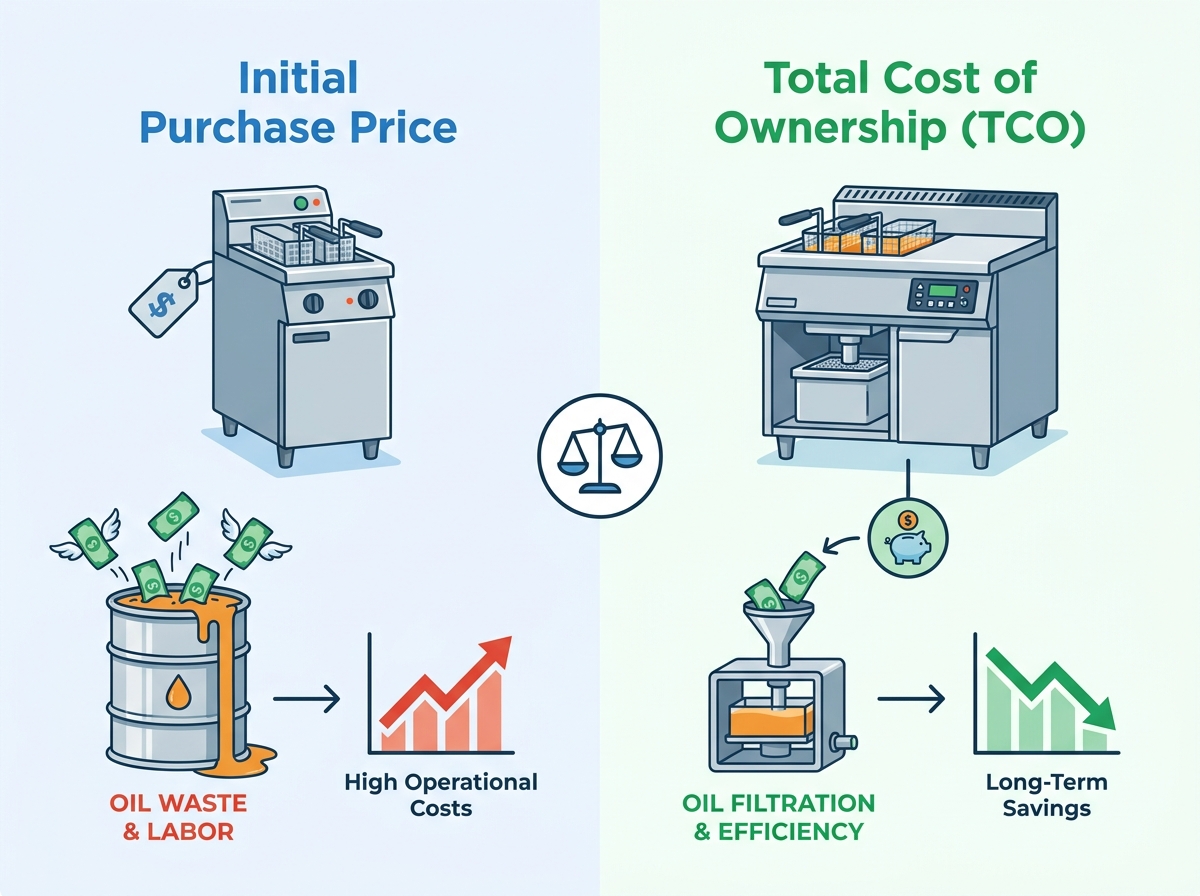
- Oil Costs Exceed Equipment Costs: Built-in filtration systems require higher upfront capital but drastically reduce long-term TCO by extending oil life.
- Menu Defines Burner Type: Tube fryers are necessary for heavy sediment (breading), while open-pot designs offer superior cleaning efficiency for light-sediment menus.
- Infrastructure is the Ultimate Constraint: Available utility hookups (gas vs. electric) and hood space strictly limit your deployment options.
Defining Your Operational Needs & Capacity Requirements
You cannot purchase kitchen equipment based on guesswork. Operations fail when managers underestimate their peak-hour demand. Assessing your specific capacity requirements ensures your kitchen runs smoothly during the busiest shifts.
Calculating Throughput
Map your menu’s peak-hour fried food demand accurately. Do not buy equipment meant for average daily volume. You must buy for the Friday night rush. A severe rush pushes your equipment to its absolute limit. If your tank capacity falls short, you risk rapid oil temperature drops. This results in greasy, unappetizing food and frustrated guests.
Follow these steps to calculate your true throughput needs:
- Review sales data to identify your busiest one-hour window of the week.
- Calculate the total weight of fried items sold during this specific hour.
- Factor in a 15% growth buffer to accommodate future menu expansion.
- Use this final weight as your absolute minimum hourly capacity target.
The "Pound-to-Pound" Rule
Industry professionals rely on the 1.5-to-2 ratio for sizing equipment. This rule states you can cook 1.5 to 2 pounds of food per hour for every pound of oil in the vat. It provides a reliable baseline for capacity planning. For example, a standard 40-pound fryer machine yields roughly 60 to 80 pounds of food per hour. If your peak hour requires 120 pounds of french fries, you need at least two 40-pound vats to keep up.
Recovery Time vs. Volume
Evaluate how quickly the unit returns to its optimal cooking temperature. We call this metric "recovery time." When you drop cold or frozen products into hot oil, the temperature immediately plummets. Slow recovery ruins product consistency. The food sits in lukewarm oil, soaking up grease instead of forming a crisp exterior. High-efficiency burners and advanced heating elements solve this issue by rapidly injecting heat back into the oil.
Comparing Fryer Machine Categories: Which Fits Your Menu?
Kitchen layouts and menus vary wildly. Manufacturers design different styles of fryers to meet these diverse operational challenges. You must match the category to your specific workflow.
Floor Models vs. Countertop Units
Your available floor space heavily influences your choice.
- Floor Fryers: Engineers design these for dedicated, high-volume continuous use. They require dedicated floor space. They also demand heavy-duty ventilation systems. Floor models dominate traditional fast-food and full-service restaurant kitchens.
- Countertop Fryers: These units are ideal for limited space. Food trucks and concession stands rely on them heavily. They also serve excellently as supplementary units. Many kitchens use a small countertop model strictly for gluten-free or allergy-specific items to prevent cross-contamination.
Power Sources: Gas vs. Electric
Your building's infrastructure dictates your power source. Each option carries distinct advantages and operational quirks.
- Gas (Natural or Liquid Propane): Gas generally offers faster heat recovery. Many regions also feature lower initial utility rates for natural gas. However, gas models require robust, dedicated gas lines. They also generate significantly more ambient heat, pushing your kitchen's HVAC system harder.
- Electric: Electric units are highly energy efficient. Submersion heating elements transfer heat directly into the oil, minimizing lost energy. They are easier to install and faster to clean. Historically, electric units suffered from slower recovery times. However, modern 3-phase electric models now rival the speed and power of premium gas units.
Tank Designs (Crucial for Sediment Management)
Your menu directly dictates the necessary tank design. Breading and batter create sediment. You must manage this sediment to prevent the oil from burning and ruining the food's flavor.
Fryer Tank Design Comparison
| Tank Design | Heating Method | Best Menu Applications | Cleaning Difficulty |
| Open-Pot | Heated from the outside of the vat | French fries, wings, light breading | Easiest (No internal obstacles) |
| Tube | Heating tubes run directly through the oil | Fried chicken, fish, heavy batter | Harder (Requires brushing around tubes) |
| Flat-Bottom | Heated from the bottom, no cold zone | Funnel cakes, tempura, wet dough | Moderate (Requires frequent skimming) |
Open-Pot: These feature a V-shaped bottom. They work best for light breading and fries. The unobstructed vat makes them incredibly easy to clean.
Tube: Heating tubes run through the oil. This creates a large, deep cold zone at the bottom. The cold zone catches heavy batter and breading. It prevents the sediment from scorching. You need this design for high-volume chicken and fish operations.
Flat-Bottom: These lack a cold zone entirely. They are highly specialized for dough products that float at the surface. You use these for funnel cakes, donuts, and delicate tempura.
Core Evaluation Criteria for Long-Term Profitability
Do not fixate solely on the initial sticker price. Smart operators evaluate equipment based on long-term efficiency, consumable usage, and operational reliability.
Oil Management & Filtration
Oil is the highest recurring expense in any frying operation. You must actively manage it to protect your margins. Evaluate models featuring built-in filtration systems versus those requiring manual filtering. Manual filtering involves hauling hot oil in buckets, which introduces severe employee burn risks. Built-in systems increase your upfront costs. However, they routinely yield a positive return on investment within 12 to 18 months. They conserve oil by filtering out micro-contaminants daily. They also heavily reduce labor liability and workers' compensation risks.
Energy Efficiency & Rebates
Energy costs eat into restaurant profits constantly. Look for Energy Star-certified fryer machine models. While they are more expensive upfront, they provide massive long-term benefits. They often qualify for localized utility rebates, giving you instant cash back after installation. More importantly, they lower ongoing energy consumption by up to 30%. They achieve this through advanced burner baffles and superior tank insulation.
Programmable Controls vs. Millivolt
The control interface dictates how your kitchen staff interacts with the equipment. You have two primary options:
- Solid-State/Programmable: These offer precise digital temperature control. They feature automated cook cycles and timers. Many advanced models automatically compensate for frozen foods by extending the timer slightly. This reduces your reliance on operator skill. Anyone can push a button and get a perfect batch of fries.
- Millivolt (Manual): These are traditional, thermostat-driven controls. They are highly reliable and much cheaper to repair. In gas models, they operate entirely without electricity. However, they rely entirely on the cook's intuition and timing. You risk inconsistent food if your staff turns over frequently.
Budgeting, Financing, and Operational Expenses
Purchasing commercial equipment requires a deep understanding of restaurant finance. You must balance the capital you spend today against the operational expenses you will incur tomorrow.
Acquisition Cost vs. Operating Cost
Never isolate the sticker price when making your final decision. A cheap machine often becomes a massive financial liability. Factor in your projected annual oil usage, daily utility consumption, and expected maintenance. A premium unit might cost twice as much initially. However, if it saves you two jugs of oil per week and reduces your gas bill, it pays for itself rapidly.
Common mistakes to avoid during budgeting:
- Ignoring the cost of freight and professional installation.
- Failing to budget for specialized cleaning tools and filter paper.
- Overlooking the cost of upgrading electrical panels or gas lines to meet the new equipment's requirements.
Financing and Leasing Options
For premium units, especially those featuring automated filtration, utilizing equipment financing proves highly beneficial. Financing helps preserve your working capital for inventory and payroll. In many cases, the monthly savings on cooking oil easily offset the monthly equipment lease payment. You essentially upgrade your kitchen without impacting your monthly cash flow. Discuss terms with specialized restaurant equipment financiers to find the best rates.
Warranty and Service Availability
Always evaluate the manufacturer’s warranty carefully. Pay attention to the difference between parts coverage and labor coverage. Some warranties cover parts for three years but only cover labor for one year. Furthermore, investigate the availability of certified technicians in your specific geographic market. An excellent warranty means nothing if the nearest authorized repair technician lives four hours away. Urban centers enjoy rapid service, but rural locations must plan for potential downtime.
Installation Risks and Compliance Considerations
Installing commercial cooking equipment involves strict legal and safety protocols. You cannot simply plug a unit into the wall and start cooking. Failing to meet compliance standards can result in hefty fines or forced closures.
Ventilation and Fire Suppression
Commercial fryers legally require installation under a Type 1 commercial exhaust hood. These hoods remove grease-laden vapors from the air. Furthermore, the hood must be equipped with an ANSUL (or equivalent) fire suppression system. The fire marshal will inspect this setup before granting your operating permit. Ensure your current hood system has enough physical space and extraction capacity to handle a new unit.
Utility Prerequisites
Verify your kitchen’s infrastructure before shortlisting any specific models. You must ask yourself technical questions:
- Do you have the correct natural gas pressure? Gas equipment requires a specific water column measurement to function properly.
- Does your kitchen have the required voltage and electrical phase for commercial electric fryers? Most heavy-duty electric units require 3-phase power.
- Is the utility hookup physically close enough to the proposed installation spot?
Clearance and Code Compliance
Local health and fire codes dictate strict spatial clearances. You must maintain specific distances between fryers and open-flame equipment, like charbroilers or ranges. Splashing hot oil into an open flame causes catastrophic fires. Factor in the cost of spatial reconfigurations. If you lack the required space, you must install certified stainless-steel dividers to meet fire code compliance.
Conclusion
Choosing the correct equipment transforms your kitchen's speed and profitability. Base your final decision on a strict hierarchy of constraints. First, evaluate your available utilities. Second, match the tank design to your menu and sediment type. Third, calculate your peak volume throughput to determine vat size. Finally, balance your capital budget against projected operational expenses.
Your next steps require immediate action. Audit your current utility hookups to know exactly what your building can support. Calculate your peak hourly poundage requirement using historical sales data. Finally, request specialized quotes projecting your long-term operating expenses over a three-year period. By acting on these steps, you secure a reliable, profitable frying station.
FAQ
Q: How long should a commercial fryer machine last?
A: With rigorous daily maintenance, including regular boil-outs and proper filtration, a standard commercial fryer lasts 7 to 10 years. Neglecting oil management and failing to clean the heating elements can drastically reduce this lifespan to under 5 years.
Q: Is a built-in oil filtration system worth the extra cost?
A: Yes. For high-volume operations using more than two or three jugs of oil a week, it is highly recommended. The significant reduction in oil consumption and lowered employee burn risks typically pays for the expensive upgrade within the first year of operation.
Q: What is the difference between a tube fryer and an open-pot fryer?
A: Tube fryers have heating pipes running through the tank. This creates a large cold zone where heavy breading settles without burning. Open-pot fryers heat from the outside of the tank. They have a smaller cold zone but are significantly easier to clean. This makes open-pots ideal for low-sediment foods like french fries.
Q: Can I run a commercial fryer without a hood?
A: In almost all commercial jurisdictions, standard open fryers legally require a Type 1 hood. Manufacturers do produce specialized, fully enclosed ventless fryers featuring built-in air filtration. However, these units have much lower cooking capacities and demand much higher initial acquisition costs.


