Food processors and commercial kitchens constantly face a major friction point today. You must balance strict flavor consistency and high product yields against rapidly rising labor and ingredient costs. Traditional static soaking methods eat up valuable cooler floor space. They also tie up your workforce in tedious manual preparation tasks. Vacuum tumbling technology offers a highly practical solution to this daily bottleneck. It accelerates marinade penetration using physical impact and negative pressure. It does this without making impossible industry promises. This mechanical process forces liquid deeply into protein fibers. It gently tenderizes the muscle structure at the same time. Our article provides a realistic framework for your daily operation. You will learn how to evaluate equipment return on investment properly. We will help you determine accurate sizing requirements for your batches. You will also discover how to identify hidden operational risks. We aim to equip you with the exact knowledge needed before purchasing a unit for your facility.
Key Takeaways
- Vacuum tumbling primarily drives ROI through reduced labor hours, lower marinade waste, and up to 15–20% increases in product weight retention.
- Selecting the right capacity requires calculating your maximum batch size against the drum’s optimal fill line (typically 60–70% of total volume).
- Maintenance protocols—particularly vacuum pump care and sanitation compliance—are critical hidden costs to factor into the investment.
- Not all operations require commercial-grade units; specific scales and product types dictate whether a commercial model or a high-end meat tumbler machine for home is appropriate.
The Business Problem: Manual Soaking vs. A Meat Tumbler Marinator
Traditional static soaking brings many hidden operational costs into your facility. Large plastic bins occupy massive amounts of walk-in cooler floor space. Flavor profiles often remain inconsistent across different batches. Gravity only pulls liquids so far into dense muscle tissue. Pieces at the bottom of a bin soak in concentrated spices. Meanwhile, pieces at the top dry out or lack flavor depth. Manual mixing demands extensive labor hours from your staff. Workers must periodically flip, stir, or rotate these large batches manually. They do this simply to ensure an even coating across the protein.
Switching to a meat tumbler marinator solves these exact production issues. It relies on the distinct mechanics of vacuum tumbling. The machine pulls air out of the drum to create negative pressure. This pressure expands the meat fibers much like a dry sponge. As the drum rotates, physical tumbling action mechanically drives the marinade deep into the protein structure. The internal baffles lift and drop the meat repeatedly. This forces a rapid exchange of moisture and breaks down tough muscle tissues.
You should frame this equipment decision beyond a simple speed upgrade. Think of it as a vital yield-protection and quality-control strategy. If your kitchen struggles to deliver uniform taste, this equipment standardizes your entire output. It removes human error from the marination equation. Your staff no longer guesses if a batch soaked long enough. You simply load the drum, set the specific program, and walk away. This creates highly predictable success criteria for every single shift.
Assessing the ROI: Does a Commercial Meat Tumbler Machine Actually Save Money?
You must calculate the true financial impact before upgrading your processing line. The shift from active manual prep to passive machine time drops labor costs significantly. Instead of spending several hours per batch stirring bins, workers spend just minutes. They only need time to load and unload the drum. They can dedicate those saved hours to higher-value tasks like trimming, packaging, or quality inspection. This labor cost reduction adds up quickly over a busy month.
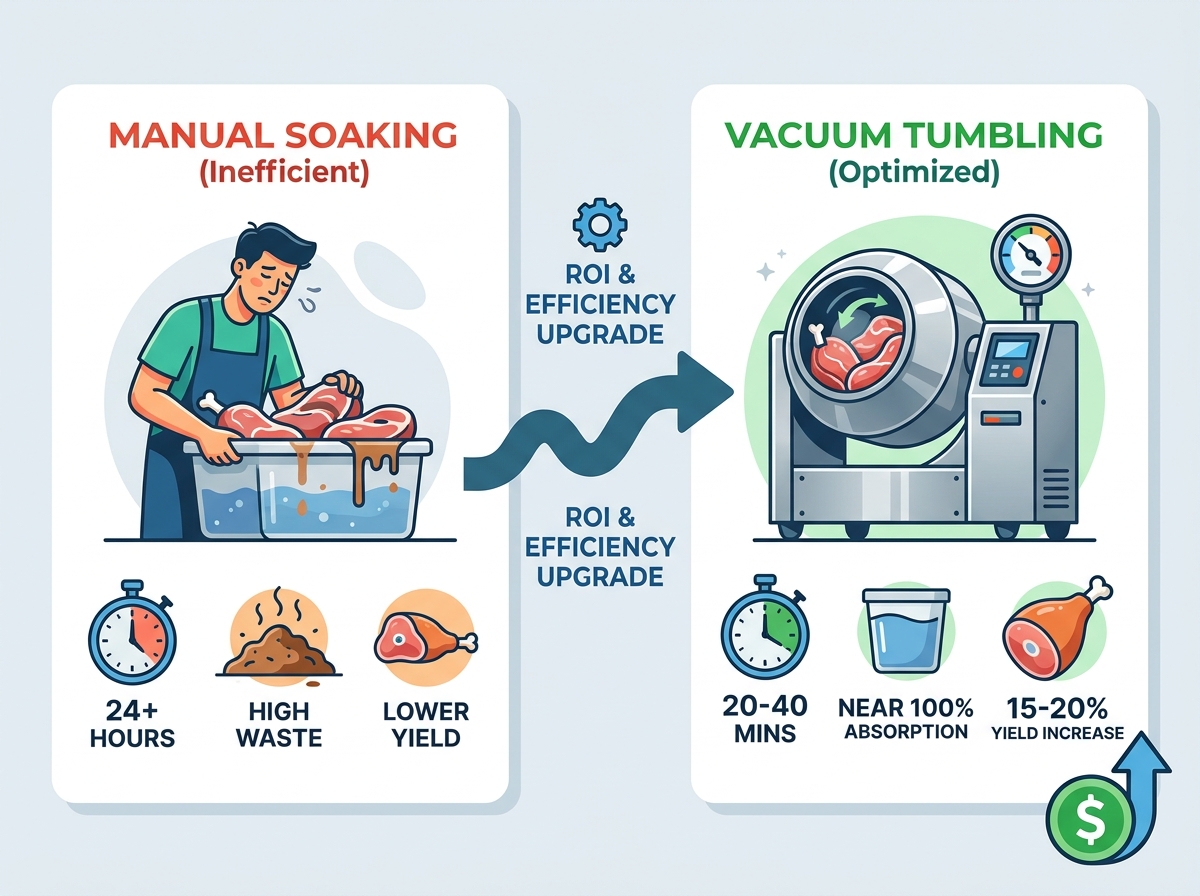
Achieving a near 100% absorption rate eliminates the steep cost of discarded marinades. Every single ounce of your expensive spices, oils, and liquids goes directly into the product. You stop pouring money down the drain at the end of a shift. This ingredient efficiency creates immediate savings. Improved protein binding also retains moisture heavily during the cooking phase. This translates directly to higher sellable yield on the scale. We avoid exaggerated claims here. We stick to verifiable 10-20% industry benchmarks for weight gain and moisture retention. When your protein retains moisture, you sell more final product weight to your customers.
Buyers can easily calculate their break-even point based on weekly volume and hourly wage rates. A commercial meat tumbler machine usually pays for itself rapidly in high-volume settings. You just need a simplified payback period formula to analyze your current numbers.
| Metric | Traditional Static Soaking | Vacuum Tumbling Method | Estimated Monthly Savings |
| Labor Hours | High (Constant manual stirring) | Low (Automated passive rotation) | 40+ hours per month |
| Marinade Waste | 20% - 30% unabsorbed | Under 2% unabsorbed | Hundreds of dollars in spices |
| Yield Retention | Standard moisture loss | 10% - 20% higher retention | Direct revenue increase per pound |
Operational Fit: Ideal Applications from Jerky to High-Volume Prep
Certain food products see the highest margin improvements from this technology. Beef jerky processing, whole muscle poultry, injected hams, and BBQ ribs benefit immensely. The tumbling process extracts salt-soluble proteins to the surface of the meat. This creates a sticky, protein-rich layer essential for proper binding in deli meats. It ensures your sliced turkey or ham holds together perfectly. These high-value scenarios make the initial equipment investment highly worthwhile.
Jerky makers and BBQ caterers gain a massive speed advantage. You can reduce a standard 24-hour soak time down to just 20 to 40 minutes. This allows same-day processing and packaging. You no longer need to plan your marination schedules days in advance. If a client places a massive rush order, you can prep and cook the meat on the exact same day. This speed advantage alone completely transforms catering operations and custom processing facilities.
However, we must acknowledge clear limitations regarding specific proteins. Not all products benefit from this aggressive massaging technique. You must evaluate your specific product before committing. Watch out for these common mistakes:
- Delicate Seafood: Fish fillets and scallops flake apart entirely under the physical impact of a rotating drum.
- Ultra-Thin Cuts: Paper-thin slices of beef or pork prove too prone to tearing inside the machine.
- Bone-In Fragility: Certain brittle bone-in poultry pieces can splinter if tumbled at excessively high speeds.
Understanding these limitations demonstrates balanced expertise. You protect your product quality by knowing exactly when to use the machine and when to rely on gentle static soaking.
Capacity and Scale: Sizing Your Equipment Correctly
You cannot fill a drum to 100% capacity and expect good results. Physics dictates how a meat tumbler machine operates efficiently. You must calculate functional working volume using the 60/40 fill rule. The drum needs at least 30 to 40 percent empty space to function properly. This open void allows the meat to drop and strike the internal baffles. This dropping action drives the tenderizing process. If you overfill the drum, the meat merely spins in place. It will not receive any physical impact, and the marinade will not penetrate deeply.
Commercial processing requires specific industrial features. Heavy-duty facilities need automated discharge systems to unload hundreds of pounds quickly. They require robust built-in cooling systems to keep meat temperatures safe during long cycles. These commercial facilities demand large batch capacities ranging from 100 lbs up to 2000 lbs per cycle. They run continuously across multiple daily shifts.
Conversely, artisanal producers, research labs, and competitive BBQ teams have very different requirements. They do not need massive industrial floor units. A meat tumbler machine for home or test kitchen handles smaller batch capacities perfectly. These smaller units typically range from 15 lbs to 50 lbs. They offer the exact same vacuum technology but fit easily on a standard stainless steel prep table. You must choose the size aligned strictly with your peak daily production numbers.
Implementation Realities: Maintenance, Compliance, and Risks
Sanitation compliance remains a strict daily reality for any food processing equipment. You must thoroughly clean internal baffles, drum gaskets, and vacuum lines after every shift. This prevents any dangerous bacterial harborage. A strict, documented cleaning protocol supports your facility's HACCP plan. Inspectors will look closely at the vacuum hose connections and the rubber lid seals. You must train your staff to dismantle and sanitize these specific contact points properly.
The vacuum pump represents the most common point of mechanical failure. You must understand the differences in pump types to maintain them correctly.
- Oil-Lubricated Pumps: These provide deep, powerful vacuum pulls. However, they require strict oil change schedules to prevent internal corrosion.
- Dry Pumps: These eliminate messy oil checks. Yet, they often suffer shorter lifespans under heavy moisture loads drawn from wet marinades.
- Liquid Ring Pumps: These handle moisture exceptionally well but require a continuous water supply to operate.
You also need to assess facility requirements early in the purchasing process. Larger commercial units demand 3-phase electrical power. You cannot simply plug them into a standard wall outlet. They also require dedicated floor drainage for daily washdowns. Furthermore, you must consider climate control. If your chosen unit lacks a built-in cooling jacket, you must operate it inside a refrigerated room. Ambient heat friction generated during tumbling can quickly push meat into dangerous temperature danger zones.
How to Evaluate a Meat Tumbler Machine for Sale: A Buyer’s Checklist
When you spot a meat tumbler machine for sale, approach the equipment listing systematically. First, insist on 304 food-grade stainless steel construction. Avoid cheaper 201 stainless alloys entirely. The 201 alloy corrodes quickly when exposed to salt-heavy marinades and acidic solutions. You want a machine built to withstand harsh, wet environments for decades.
Evaluate the control systems closely before committing to a brand. Programmable logic controllers (PLCs) offer superior reliability over basic mechanical relays. A good PLC allows you to save specific recipe programs. Variable speed controls and programmable interval rests are absolute non-negotiable features for delicate proteins. You need the ability to program a cycle that tumbles for ten minutes and rests for five minutes. This prevents the muscle structure from breaking down into mush.
Assess the vacuum pump quality and physical placement. The pump must be easily accessible for routine servicing. It should also feature a reliable moisture trap to protect the internal components from drawing in liquid marinade. A poorly placed pump will frustrate your maintenance team.
Finally, advise your procurement team to verify warranty terms. Check local parts availability and technical support service level agreements before finalizing any purchase. You do not want operational downtime while waiting weeks for a simple replacement gasket to ship from overseas. Strong post-sale support keeps your production line moving smoothly.
Conclusion
A vacuum tumbling system operates as a calculated operational upgrade, not a magic bullet. It pays for itself rapidly if your production volume and product type align with the technology. You gain immediate advantages through reduced labor, higher yields, and flawless flavor consistency. We encourage you to audit your current weekly marination labor hours today. Measure your current yield loss precisely. Use these exact figures as a solid baseline. Once you know your true operational numbers, you can confidently request equipment quotes. You will know exactly how to size the right drum for your facility and maximize your return on investment.
FAQ
Q: How much time does a vacuum meat tumbler actually save?
A: It saves tremendous amounts of time. A standard 24-hour static soak for beef jerky or pork ribs typically reduces to just 20 to 40 minutes in a vacuum drum. This allows for rapid same-day prep, marination, and cooking in commercial kitchens.
Q: Do I absolutely need the vacuum feature, or is tumbling enough?
A: You need the vacuum feature for optimal results. Negative pressure physically expands the muscle fibers like a sponge. When combined with the tumbling impact, it forces the marinade deep into the tissue much faster than gravity or friction alone.
Q: Can you over-tumble meat?
A: Yes, you can over-tumble it. Excessive massaging breaks down protein structures too far, resulting in a mushy texture. You must use programmable rest intervals to let the meat relax and absorb liquid without continuous physical stress.
Q: What is the expected lifespan of a commercial tumbler?
A: A well-maintained unit easily lasts 10 to 15 years. Lifespan depends heavily on strict sanitation, regular vacuum pump oil changes, and prompt replacement of worn drum gaskets. Neglecting pump maintenance remains the primary cause of premature failure.


