Manual marination and static soaking cause severe production bottlenecks. They cost commercial kitchens and processors hours of tedious labor. These old methods also produce highly inconsistent yields. Upgrading to automated tumbling solves these pressing consistency and labor issues. However, overbuying drains valuable capital quickly. Conversely, underbuying leads to rapid equipment burnout. You need the perfect fit. This guide breaks down essential evaluation criteria for sizing, vacuum technology, and operational throughput. We will help you select the exact equipment tier for your specific production demands.
Key Takeaways
- Calculating true batch capacity requires accounting for drum void space (typically 20-30% of total volume)—do not buy based on total drum volume alone.
- Vacuum tumbling drastically reduces marination time (often under 30 minutes) and increases moisture retention compared to standard static marinators.
- Equipment selection should dictate workflow: a meat tumbler machine for home or small-batch jerky requires vastly different sanitation and motor specs than an industrial floor model.
- Vendor support, parts availability, and food safety compliance are just as critical as the initial purchase price.
The Business Case: Structuring the ROI of Tumbling Equipment
Automating the massage and turning process frees up valuable staff. Your kitchen moves from hands-on mixing to unattended cycles. This shift reduces physical strain on workers. They can focus on higher-value tasks while the machine runs. Labor reduction often justifies the equipment purchase alone.
Protein extraction improves moisture retention during the cooking process. A proper meat tumbler machine expands muscle fibers gently. You introduce liquid marinades deep into the tissue. You sell more saleable weight without degrading product quality. Customers receive juicier, more flavorful cuts of protein.
Standardizing flavor profiles across batches remains crucial for brand reputation. Every batch meets customer expectations perfectly. You reduce waste caused by unevenly marinated batches. Consistency drives repeat business in commercial food service.
You must note that return on investment depends heavily on consistent batch volumes. Low-volume operations struggle to recoup commercial-grade costs quickly. You should project your weekly throughput honestly. This transparency mitigates financial risk before you sign a purchase order.
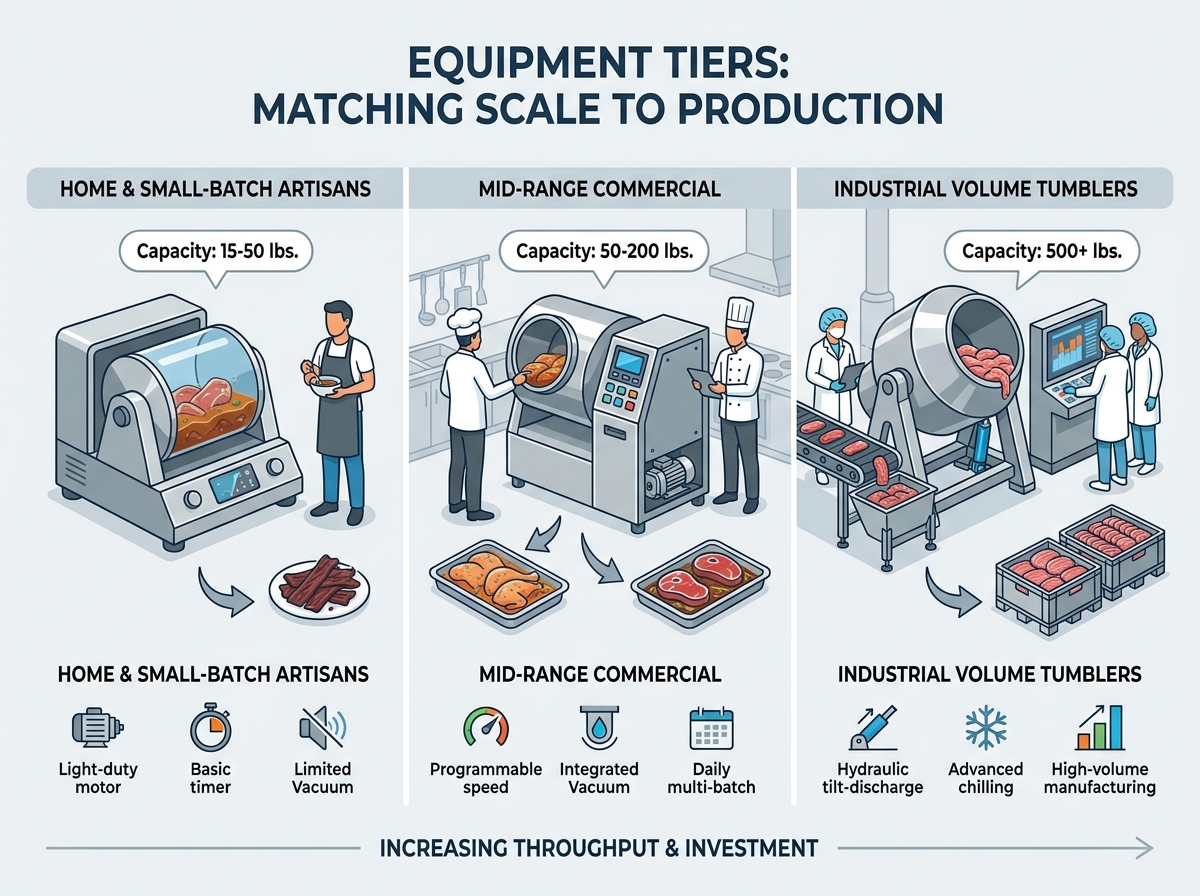
Equipment Tiers: Matching the Machine to Your Production Scale
Meat Tumbler Machine for Home & Small-Batch Artisans
Serious hobbyists and local farmers market vendors represent the primary target users here. Niche jerky producers also rely on these compact units. These operators process limited quantities of specialized proteins. They prioritize convenience and small footprints over industrial speed.
Typical specifications include a 15 to 50-pound capacity limit. They feature basic timer controls and occupy minimal countertop space. A meat tumbler machine for home usually plugs into standard 110V outlets. This simplicity makes them highly accessible for beginners.
However, these units carry distinct limitations. Light-duty motors overheat quickly under continuous commercial use. Vacuum strength remains limited compared to larger units. You should avoid running them back-to-back for eight hours.
Mid-Range Commercial Units
Restaurants and independent butcher shops benefit most from mid-range units. Mid-sized catering operations also utilize them heavily. These businesses need reliable daily output without sacrificing valuable kitchen floor space.
Typical specifications range from 50 to 200-pound capacities. A commercial meat tumbler machine features programmable variable speeds. They include integrated vacuum pumps and utilize a freestanding design. They offer robust stainless steel construction for rigorous sanitation.
Their key advantage lies in balance. They balance a compact physical footprint against necessary throughput. They handle daily, multi-batch usage perfectly. You can process chicken in the morning and beef in the afternoon seamlessly.
Industrial Volume Tumblers
Wholesale meat processors require massive processing power. High-volume manufacturing facilities depend on continuous production lines. These operators demand heavy-duty reliability above all else.
Typical specifications exceed 500-pound capacities per batch. They utilize hydraulic tilt-discharge systems to unload products automatically. They often feature advanced chilling and defrosting integration. These machines run continuously across multiple shifts.
Implementation realities demand strict facility planning. You must install dedicated floor drainage systems. You require robust 3-phase power connections. You also need structural floor support to handle immense mechanical vibrations.
Equipment Specifications Overview
| Equipment Tier | Capacity Range | Target User | Power Requirement |
| Small-Batch / Home | 15 - 50 lbs | Hobbyists, Market Vendors | Standard 110V |
| Mid-Range Commercial | 50 - 200 lbs | Restaurants, Butchers | 110V or 220V Single-Phase |
| Industrial Volume | 500+ lbs | Wholesale Processors | 220V/480V 3-Phase |
Vacuum vs. Standard Meat Tumbler Marinator: Which Technology Wins?
Negative pressure drives the science behind vacuum technology. The vacuum environment expands meat fibers physically. This expansion allows marinades to penetrate deeply into the tissue. The liquid does not just coat the surface. It absorbs into the cellular structure of the protein.
Standard tumblers operate differently. They work best for simple mixing tasks. You use them for dry-rub applications. They tenderize tough cuts mechanically through impact. However, they do not draw excess liquid into the meat core efficiently.
Outcome comparisons reveal stark differences. Vacuum cycles take mere minutes instead of hours. A meat tumbler marinator improves product shelf life significantly. It distributes curing agents evenly throughout the product. Standard soaking methods simply cannot match this rapid absorption rate.
You must conduct a strict cost-benefit analysis. Vacuum technology commands a premium price. This premium is highly beneficial for poultry and jerky production. Moisture retention drives profits in those categories. It is less critical for robust beef cuts requiring only a surface coating.
Sizing and Technical Specifications: Evaluating the Hard Numbers
You must understand the Rule of 70 percent. You can only fill a drum to 60 or 70 percent capacity. The remaining void space allows for proper mechanical impact. Meat pieces must fall and strike each other. This tumbling action extracts proteins efficiently. Never buy a machine based purely on total drum volume.
Interior fin designs change your processing outcomes. Aggressive baffles work well for tough muscle meats. They break down hard connective tissues quickly. Gentle massage fins protect delicate seafood and poultry. You must match the baffle design to your primary product line.
Material choices dictate food safety compliance. You need 304 or 316-grade stainless steel universally. Look for seamless welds to prevent bacteria buildup. Demand IP65 or NEMA 4X washdown ratings for electrical panels. These specifications meet strict FDA, USDA, and NSF health inspector standards.
Drive systems impact long-term maintenance budgets. Direct drive motors offer exceptional reliability. They eliminate belts and chains entirely. Chain drives require frequent tensioning and lubrication. You must evaluate these failure points against your maintenance capabilities.
Implementation Realities: Maintenance, Compliance, and Hidden Costs
Sanitation labor consumes significant daily hours. You must break down equipment thoroughly. Your team cleans and sanitizes vacuum lines daily. Drum interiors demand intense scrubbing to remove protein residues. You must factor these labor costs into your operational budget.
Wear parts require consistent budgeting. Vacuum pump oil needs regular replacement. Lid gaskets degrade over time and lose their seal. Inline filters clog rapidly under heavy use. Keep these spare parts stocked to avoid sudden production halts.
Operator training introduces a steep learning curve. Moving from static soaking to dynamic tumbling changes everything. You must standardize recipes immediately. You need to dial in specific times, speeds, and vacuum levels. Operators must record these parameters meticulously.
Common rollout risks include ruined equipment. Foaming marinades can enter and destroy vacuum pumps instantly. You prevent this damage using proper inline liquid traps. Train your staff to empty these traps between every single batch.
- Monitor vacuum pump oil clarity weekly to prevent moisture damage.
- Inspect lid gaskets daily for micro-tears or compression fatigue.
- Sanitize the inline moisture trap after every shift.
- Calibrate variable speed drives annually for consistent RPMs.
Evaluating a Meat Tumbler Machine for Sale: Vendor & Warranty Checklist
Assessing vendor trust protects your investment. You should buy direct from established commercial food service dealers. They offer reliable engineering and accountability. Finding the absolute cheapest imported unit often results in zero post-purchase support.
Warranty traps exist everywhere in industrial equipment. Differentiate clearly between parts-only and parts-and-labor warranties. A parts-only warranty forces you to hire costly local technicians. Read the fine print regarding motor replacement clauses.
After-sales support defines your uptime percentage. Local availability of replacement gaskets and pumps remains critical. Waiting weeks for overseas shipping causes days of expensive production downtime. Verify that your vendor stocks wear parts domestically.
You should follow a logical shortlisting framework when reviewing a meat tumbler machine for sale.
- Request detailed technical spec sheets from multiple manufacturers.
- Verify the real-world working capacity against the stated drum volume.
- Ask for a sample processing test if the vendor allows it.
- Review the exact electrical requirements with your facility manager.
Conclusion
Selecting the right machine requires aligning motor durability with your actual daily throughput. You must match the working capacity to your batch sizes perfectly. An undersized unit stalls production, while an oversized unit wastes valuable capital.
We advise starting your evaluation with true batch size requirements. You must also assess your facility sanitation capabilities. Base your decision on these operational realities rather than just the initial sticker price.
Review your current weekly marination volume today. Calculate your minimum required drum size using the 70 percent rule. Reach out to an equipment specialist to verify your calculations and secure the best unit for your kitchen.
FAQ
Q: Can you use a meat tumbler for making beef jerky?
A: Yes. Tumbling beef jerky speeds up cure times drastically. It ensures uniform flavor distribution across every single slice. The vacuum action forces marinades into the meat fibers quickly. You achieve consistent batches faster than traditional static soaking methods.
Q: How do you clean a vacuum meat tumbler effectively?
A: First, disconnect the main power supply. Remove the lid and any removable baffles. Use approved food-grade sanitizers to wash the stainless steel drum interior. Flush the vacuum lines carefully. Always clean inline liquid traps to protect the vacuum pump from damage.
Q: Does a meat tumbler tenderize the meat or just marinate it?
A: It does both effectively. The continuous tumbling action mechanically breaks down tough protein structures. The meat pieces strike the baffles and each other. At the same time, the vacuum forces liquid marinades deeply into the expanded meat fibers.
Q: What happens if I overfill my meat tumbler?
A: Overfilling eliminates crucial void space inside the drum. The meat cannot fall or tumble effectively. You lose mechanical impact entirely. This results in uneven marination, poor liquid absorption, and severe strain on the machine drive motor.


