Traditional static marination often plagues modern food processors. It creates inconsistent flavor profiles across different batches. You waste valuable production time waiting for proper absorption. You also lose significant yield during the final cooking phase. Modern food processing demands a much higher standard. To solve these specific inefficiencies, facilities deploy a core technology. The meat tumbler machine scales production effortlessly. It optimizes protein extraction for vastly improved texture. Ultimately, it increases your overall profit margins significantly. This guide breaks down the underlying mechanical principles. We will explore the quantifiable business benefits you can expect. We also outline strict evaluation criteria. You will learn exactly how to select the right equipment. Facilities rely on this equipment daily. It standardizes output seamlessly. Quality control becomes highly predictable. You can transform your entire marination workflow today.
Key Takeaways
- Mechanism: Vacuum tumbling leverages negative pressure to expand meat fibers, allowing marinades to penetrate deeply and rapidly.
- ROI & Yield: Commercial implementation typically reduces marination time from days to hours while increasing product yield and moisture retention.
- Scalability: Solutions range from a compact meat tumbler machine for home or boutique use to heavy-duty commercial units handling multi-ton daily capacities.
- Buying Criteria: Evaluating equipment requires looking beyond base price to assess vacuum pump reliability, sanitation design (304 stainless steel), and programmable controls.
The Mechanics: How a Meat Tumbler Machine Drives Protein Extraction
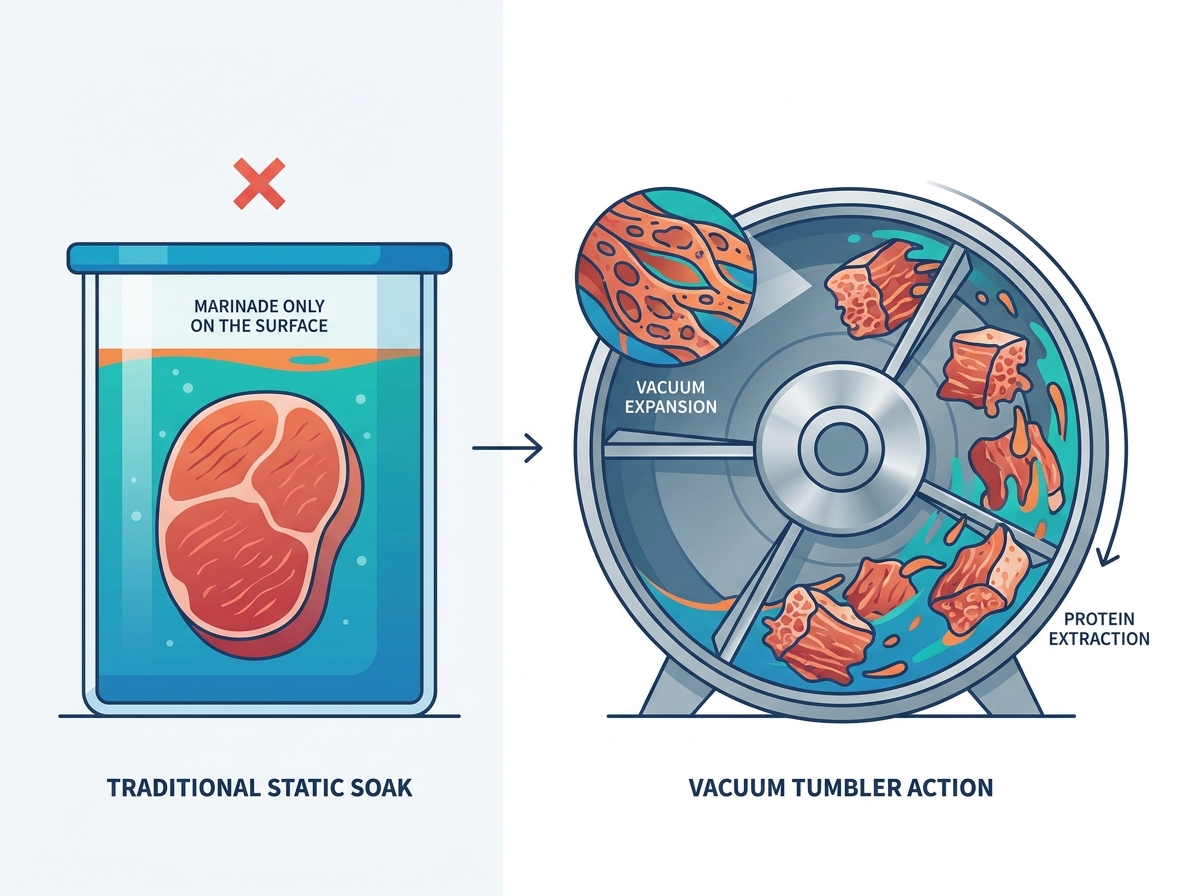
The vacuum environment plays a foundational role in modern marination. Negative pressure removes surrounding air from the drum. It also pulls air pockets from the muscle tissue. The meat cells physically expand under these conditions. They behave exactly like a dry sponge. They absorb surrounding liquids rapidly and deeply. Marinade penetration happens instantly.
Mechanical agitation amplifies this absorption process. The drum rotates continuously. The meat falls constantly. It strikes internal baffles repeatedly. This physical impact serves a highly specific purpose. It drives protein extraction at a cellular level. The impact forces salt-soluble proteins to the surface. A sticky exudate forms on the meat surface. This exudate acts as a natural binder. It locks in moisture effectively. It dramatically enhances the final cooked texture.
Continuous Vacuum
A continuous vacuum system maintains steady negative pressure. The pump runs without interruption. It holds the target vacuum depth perfectly. This setup works best for standard processing. We recommend it for hearty beef cuts. It handles dense pork effectively. It provides predictable, high-speed marination.
Breathing (Pulsating) Vacuum
A breathing vacuum alternates pressure levels intentionally. The system drops the vacuum, then restores it. This cycle massages the meat gently. The muscle fibers contract and expand repeatedly. It mimics a physical massage. We find this ideal for delicate products. It protects poultry breasts. It treats premium cuts flawlessly. It prevents unwanted structural damage.
We must emphasize an evidence-oriented claim here. Tumbling certainly accelerates liquid absorption. However, over-tumbling degrades muscle structure rapidly. The meat becomes mushy. It loses its appealing bite. Precise parameter control remains non-negotiable. You must monitor rotation speed carefully. You must track processing time strictly.
Business Value: Quantifying the Benefits of a Meat Tumbler Marinator
Traditional marination creates severe production bottlenecks. You might soak chicken for a full day. You wait hours for beef to absorb flavors. During cooking, processors commonly see a massive purge. This moisture loss reaches 5-10% easily. You lose valuable water weight. You lose expensive sellable weight.
Enter the meat tumbler marinator. This technology solves the purge problem entirely. Tumbling binds water at a cellular level. It locks the marinade inside the muscle fibers securely. Moisture stays trapped during the cooking phase. This directly translates to higher sellable weight. Your profitability jumps immediately.
Production cycles speed up exponentially. You abandon long static soaking completely. Automated tumbling cycles finish incredibly fast. A typical batch takes only 20-60 minutes. Your daily throughput increases dramatically. You can process multiple batches in a single shift.
Quality control stabilizes across your entire operation. Automated tumbling delivers uniform flavor profiles. Every single piece tastes exactly the same. Tenderness remains constant across every batch. Customer complaints drop sharply. Quality assurance failures become rare anomalies.
Operational Impact Comparison
| Metric | Traditional Static Marination | Vacuum Tumbling |
| Processing Time | 12-24 Hours | 20-60 Minutes |
| Moisture Loss (Purge) | 5-10% Loss | Minimal to Zero Loss |
| Flavor Consistency | Highly Variable | 100% Uniform |
| Labor Requirement | High (Manual Flipping) | Low (Automated) |
Applications and Scaling: From Boutique to Commercial Processing
A commercial meat tumbler machine dominates high-volume settings. Beef jerky processing relies heavily on this technology. Wholesale poultry marination requires massive daily throughput. Ready-to-eat (RTE) meat manufacturing lines demand absolute precision. These heavy-duty machines integrate flawlessly into larger operations. You can link them directly to automated loading systems. They feed perfectly into continuous processing lines. They handle multi-ton capacities effortlessly.
Smaller operators need practical solutions too. A meat tumbler machine for home or artisanal use fills this exact gap. Craft butchers use compact benchtop models daily. Hunters process wild game efficiently during busy seasons. Small-scale restaurants marinate their daily specials quickly. These units bring professional technology to boutique spaces.
We must compare their respective capabilities honestly. Smaller units offer incredible accessibility. They fit on standard prep tables easily. They require standard electrical outlets. However, they possess clear limitations. They usually lack advanced glycol cooling systems. They rarely feature programmable logic controllers. You must monitor them much more closely.
- Commercial Units: Ideal for 500kg to 2000kg batches. Feature automated unloading.
- Boutique Units: Ideal for 20kg to 50kg batches. Require manual loading.
- Hybrid Models: Mid-size units offering PLC controls for growing regional facilities.
Evaluation Framework: Sourcing the Right Equipment for Your Floor
Volume and load capacity require a strict reality check. Total drum volume is highly misleading. You cannot fill the machine completely. Actual working capacity sits around 60-70% of the total volume. The remaining empty space allows for effective tumbling. The meat needs adequate room to fall. The impact generates the required protein extraction. Calculate your required batch sizes carefully. Do this before you review any meat tumbler machine for sale.
Sanitary design guarantees regulatory compliance. You absolutely need food-grade materials. Focus specifically on 304 or 316-grade stainless steel. Inspect the equipment construction closely. Demand seamless welding throughout the drum. Ensure the vacuum traps are highly accessible. Look out for hidden "dead zones." Bacteria love to hide in tight corners. Seamless joints prevent bacterial growth entirely.
Control systems dictate your operational versatility. A PLC (Programmable Logic Controller) interface is mandatory for serious production. It lets you save specific recipe parameters easily. You can lock in cycle time securely. You set the exact vacuum depth. You program critical rest intervals. Variable speed drives (VSD) offer even more control. They let you process beef, poultry, and fish safely in a single machine.
Best Practices for Equipment Evaluation
- Calculate daily throughput requirements before speaking to vendors.
- Demand to see the interior baffle design and welding quality.
- Verify the vacuum pump brand for easy parts replacement.
- Confirm the controller interface supports multiple languages if needed.
Implementation Realities, Maintenance, and Adoption Risks
Operational bottlenecks often surprise new users. Loading and unloading heavy drums takes significant time. It stresses your workforce needlessly. We suggest specific logistical solutions. Buggy dumpers handle large volumes safely. Vacuum suction loading works incredibly well too. It pulls meat directly into the drum. This saves immense manual labor. It also reduces contamination risks.
Sanitation protocols demand daily attention. Outline a strict cleaning routine immediately. Train your sanitation staff thoroughly. Marinade crystallization represents a hidden risk. Sugars and salts harden inside vacuum lines quickly. They block the airflow entirely. This destroys pump efficiency. It happens if you ignore the vacuum traps. Clean these traps every single day.
Temperature control prevents costly disasters. Friction generates heat rapidly. Tumbling meat creates constant friction. Heat encourages rapid bacterial growth. It also causes premature protein breakdown. Your meat becomes mushy and unappealing. Specify a machine featuring a glycol-jacketed cooling drum. This maintains safe temperatures during long processing cycles. It protects your product completely.
Common Mistakes to Avoid
- Skipping the daily inspection of drum lid seals.
- Overloading the drum past the 70% capacity threshold.
- Using aggressive, highly acidic marinades without proper stainless steel grades.
Conclusion
Transitioning to a vacuum tumbler is fundamentally an investment. It guarantees incredible yield recovery. It standardizes your processing routine entirely. This equipment eliminates flavor inconsistencies. It drastically reduces processing times. Do not overlook its direct impact on your bottom line.
You should take action immediately. Audit your current marination bottlenecks today. Define your required batch capacities accurately. Request pilot testing using your specific product formulas. Observe the moisture retention firsthand. Evaluate the texture improvements closely. Complete these steps before finalizing your equipment purchase.
FAQ
Q: What is the difference between a vacuum tumbler and a meat mixer?
A: Mixers blend ingredients forcefully. Processors use them primarily for ground meats like sausage. Tumblers operate differently. They use negative vacuum pressure and gentle impact. They force liquid into whole-muscle cuts. Tumblers preserve the natural muscle structure. Mixers tear the muscle structure apart to create emulsions.
Q: Can I use a commercial meat tumbler machine for delicate items like fish?
A: Yes, you certainly can. The machine must feature a variable speed drive. You run the drum at very low RPMs. You should also utilize a pulsating vacuum setting. This gentle massaging action prevents structural damage. It keeps the fish fillets perfectly intact during marination.
Q: Is a meat tumbler machine for home use worth the investment?
A: It is highly worthwhile for serious hobbyists. Hunters processing large quantities of game benefit greatly. Boutique catering businesses see immediate returns. The massive time saved justifies the cost easily. The perfect flavor consistency elevates your final product. Entry-level benchtop models provide excellent value.
Q: What should I look out for when evaluating a used meat tumbler machine for sale?
A: You must inspect the integrity of the drum seals first. Check the operational health of the vacuum pump carefully. Look closely for hidden oil leaks. Test the machine for lost suction power. Finally, ensure the internal baffles are not severely dented or damaged.


