Scaling a meat processing facility or running a high-volume restaurant often exposes critical inefficiencies in your daily workflow. You might suddenly notice inconsistent marination quality, unacceptably long processing times, or disappointing final product yields. Upgrading your operation to a vacuum tumbling process directly solves these stubborn bottlenecks. However, selecting the wrong machine specifications can quickly lead to wasted capital and paralyzed production lines.
This guide provides an evidence-based, highly practical framework to help you evaluate, shortlist, and procure the exact right equipment for your facility. You will discover how to accurately size your drum capacity without falling for common manufacturer marketing traps. We will help you identify the most critical core technologies required for different protein types. You will also learn how to verify strict sanitation standards and build a reliable return on investment model for your specific operational scale.
Key Takeaways
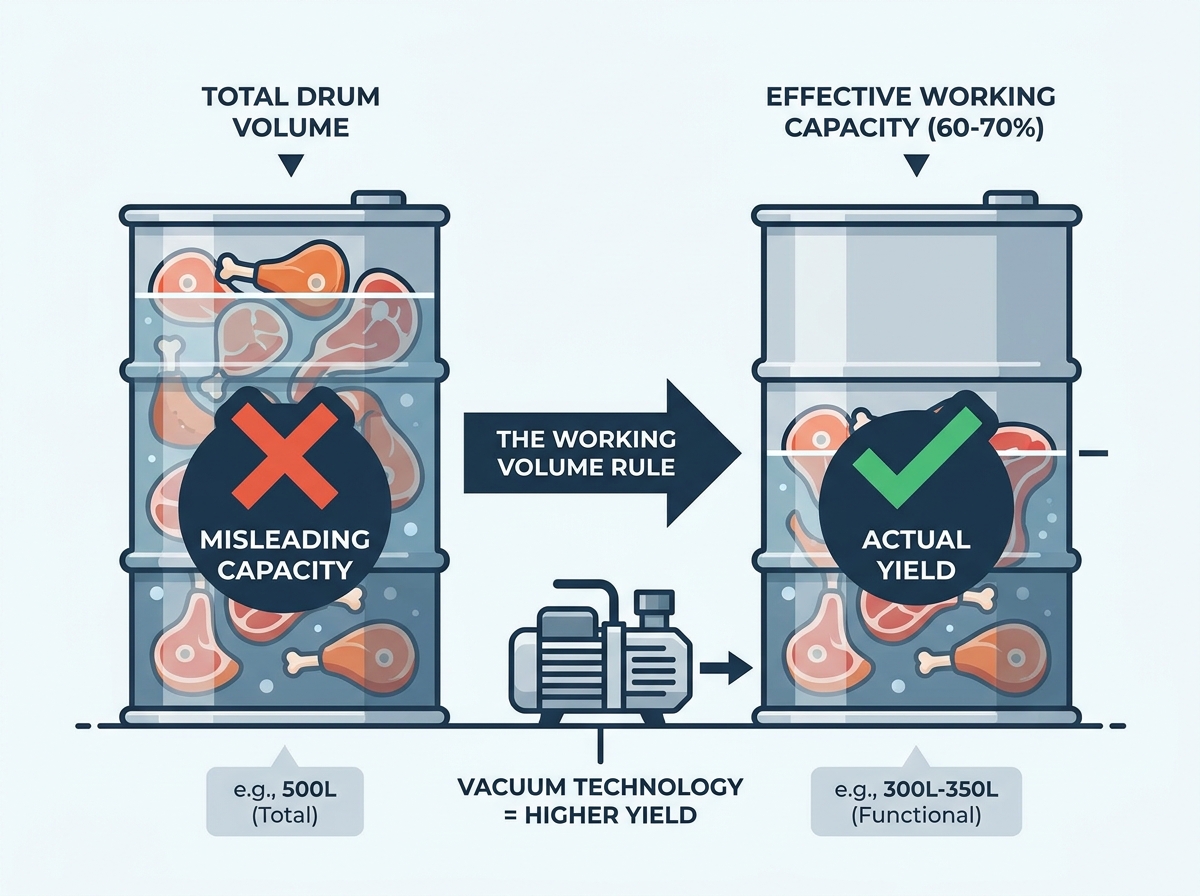
- Actual capacity is lower than drum volume: Never buy based on total drum size; calculate based on the 60–70% functional working capacity.
- Vacuum technology defines yield: Intermittent vacuum capabilities drive deeper marinade penetration and higher protein extraction compared to static tumbling.
- Sanitation impacts uptime: Evaluate weld quality, drain placement, and pump protection before looking at price tags.
- ROI is measurable: A properly sized commercial unit should pay for itself through verifiable increases in product yield and reduced labor hours.
Understanding Capacity: The "Working Volume" Rule
Many facility managers fall into a common and expensive sizing trap when purchasing processing equipment. They look at a manufacturer specification sheet. They see a 200-liter drum. They naturally assume they can process exactly 200 liters of raw product. This assumption causes immediate production failures on the facility floor. A successful vacuum tumbling process requires significant empty space inside the drum. The meat needs physical room to fall. It needs space to impact the internal baffles. It needs room to stretch, open up, and absorb heavy marinades.
Therefore, the effective working capacity sits much lower than the advertised volume. It typically ranges between 60% and 70% of the total drum size. Overfilling the machine completely eliminates the crucial massaging effect. It compresses the meat heavily at the bottom of the cylinder. It also severely overworks the drive motor and burns out expensive internal gears.
You must calculate your actual batch sizes carefully before reviewing any meat tumbler machine catalog. Start by defining your required daily throughput targets.
- Determine your total daily processing goal (e.g., 500 kilograms of poultry).
- Decide how many processing cycles you want to run daily (e.g., 5 batches).
- Calculate the required payload per batch (100 kilograms).
- Add a 30% to 40% empty-space buffer to find your minimum drum size.
- Select a drum volume of roughly 150 to 160 liters to accommodate this specific load safely.
Always plan for future operational scaling. Buying a slightly larger unit than your current demand requires is a remarkably smart strategy. It proves much safer than running multiple overlapping small batches in a tiny, overworked machine. A larger drum reduces continuous thermal strain on the main motor. It also drastically reduces manual operator labor. Your staff spends significantly less time repeatedly loading and unloading the drum. They spend more time executing high-value culinary prep tasks.
Core Technologies to Evaluate in a Commercial Meat Tumbler Machine
Evaluating the internal mechanical technology ensures you get the exact culinary results you need. The vacuum system acts as the absolute heart of the operation. You will generally encounter continuous and intermittent vacuum cycles in modern equipment. Intermittent cycles deliver vastly superior results for most whole-muscle proteins. The machine actively pulls a strong vacuum, holds it for several minutes, and releases it sequentially.
This shifting atmospheric pressure mechanically expands and contracts the meat fibers. It acts exactly like a sponge squeezing and releasing underwater. This specific action dramatically increases liquid retention. It also accelerates protein extraction to the surface of the meat. Extracted protein creates a sticky bind. This bind proves essential for forming high-quality deli meats and sausages.
You must also evaluate the internal baffle or paddle design inside the cylinder. Internal geometry strictly dictates the physical tumbling action.
- Rounded Baffles: These provide a gentle, sweeping massage. They work perfectly for delicate poultry breasts, flaky fish fillets, and fragile seafood.
- Aggressive Baffles: These feature sharp angles to create high-velocity impact. They quickly tenderize tough, dense cuts of beef and heavy pork shoulders.
- Asymmetrical Baffles: These mix different profiles to handle varied product lines effectively.
Choosing the wrong baffle profile easily destroys delicate products. Finally, variable speed and bidirectional controls remain absolutely non-negotiable for professional kitchens. Different meat densities require highly specific programmable drum speeds. You need extremely slow speeds for overnight marination. You need aggressive, faster speeds for rapid protein extraction.
Bidirectional function matters just as much for operator safety. The drum spins forward to tumble the product. It spins in reverse to actively discharge the meat. This reverse-discharge function ensures safe, ergonomic unloading directly into your standard meat buggies. When searching for a reliable commercial meat tumbler machine, verify these programmable control features during your initial vendor consultations.
From Industrial to Countertop: Classifying Equipment Grades
Equipment grades dictate motor power, overall longevity, and maximum throughput capabilities. You must classify machines correctly before allocating your capital budget. Industrial processors easily handle massive daily volumes. These high-capacity manufacturing systems generally exceed 500 liters in total volume. They strictly require dedicated three-phase power setups. They feature integrated pneumatic lifting and automated loading bins. They utilize highly advanced PLC touchscreens for complex, multi-stage recipe programming. These massive units strictly dominate large-scale meat packing facilities.
Light commercial and restaurant units serve entirely different daily needs. These standalone systems usually range from 50 to 200 liters. Engineers build them specifically for intense daily restaurant prep work. Manufacturers focus heavily on maintaining a compact physical footprint. They often feature simple plug-and-play voltage compatible with standard commercial kitchens. Many include heavy-duty locking casters for quick mobility around a crowded prep floor.
| Equipment Grade | Volume Range | Power Requirements | Ideal Operating Environment |
| Industrial High-Capacity | 500L – 2000L+ | 3-Phase / 380V+ | Large packing plants, wholesale butchers |
| Light Commercial | 50L – 200L | 1-Phase / 110V-220V | High-volume restaurants, catering kitchens |
| Domestic / Countertop | 5L – 20L | Standard Outlet | Home kitchens, very light occasional prep |
We must strongly address the transition from domestic equipment. Many startup operators foolishly try to adapt a meat tumbler machine for home for rigorous commercial use. This cost-saving strategy almost always fails catastrophically within the first month. Cheap countertop units completely lack basic industrial durability. They rely on incredibly weak, low-capacity vacuum pumps. They utilize cheap plastic gears and flimsy acrylic lids.
These domestic components simply shatter under continuous daily use. They cannot handle the dense physical weight of large commercial meat batches. Upgrading to a true commercial grade prevents sudden equipment failures during your busiest holiday rushes.
Assessing Build Quality, Sanitation, and Maintenance
Material standards directly dictate the usable lifespan of your processing equipment. You must explicitly demand 304 or 316-grade stainless steel construction throughout the entire machine. Many cheap imports secretly use lower-grade metal alloys to cut costs. These inferior metals pit, corrode, and rust rapidly. High-salt marinades and acidic fruit-based brines destroy weak steel within mere months. You simply cannot compromise on structural material integrity.
Hygienic design directly impacts your facility sanitation scores. Food safety inspectors scrutinize meat processing equipment strictly during routine audits. Look specifically for continuous, perfectly polished sanitary welds. You should find zero dark crevices where deadly bacteria can hide and multiply. Ensure the machine features large, easily accessible drain ports for rapid daily washdown. The main electrical control panel must carry an IP65 waterproof rating or higher. This rating explicitly protects sensitive internal electronics during high-pressure hose cleaning.
Predictable maintenance protocols prevent unexpected and costly downtime. The vacuum pump represents the most common point of mechanical failure. It pulls atmospheric air, but it also accidentally pulls microscopic moisture and protein debris. Inline moisture filters are absolutely critical. They protect the delicate vacuum pump from inhaling salty brines.
Essential Maintenance Checks
- Moisture Filters: You must regularly inspect and clean these filters weekly. A clogged filter starves the pump and burns out the motor.
- Pump Oil: Check vacuum pump oil levels monthly. Cloudy oil indicates moisture contamination and requires immediate replacement.
- Lid Gaskets: Rubber lid gaskets dry out and crack over time. A torn gasket destroys the vacuum seal instantly. Keep at least two spare gaskets in your parts room.
Ask your equipment supplier about the immediate availability of replacement lid gaskets. If you cannot pull a tight vacuum, your machine simply becomes a very expensive, slow-moving bucket.
ROI and Sourcing: Finding a Reliable Equipment Partner
Purchasing new processing equipment requires a clear, mathematical path to profitability. A reliable meat tumbler machine for sale generates a measurable return on investment very quickly. You must build a basic yield calculation model to justify the capital expense.
Vacuum pressure drives marinade deep into the cellular muscle tissue. This scientific process securely binds the liquid to the extracted proteins. Most professional operators see a highly conservative 10% to 15% increase in final retained product weight. This directly translates into higher profitable yield per batch. You essentially sell more finished, juicy product from the exact same raw material input.
Imagine processing 100 pounds of raw chicken daily. A 15% yield increase generates an extra 15 pounds of sellable product per batch. Multiply those extra pounds by your retail price. The daily financial gains become obvious. Furthermore, vacuum pressure drastically reduces total marination time. A process taking 24 hours in a static tub takes just 45 minutes in a vacuum environment. This incredible speed saves thousands of dollars in weekly labor. It also frees up highly valuable walk-in cooler storage space.
Sourcing the right vendor ultimately guarantees these financial returns. You need a strict vendor vetting checklist before signing purchase orders.
- Warranty Clarity: Always ask suppliers about their specific warranty terms. Focus heavily on the warranty covering the vacuum pump itself.
- Parts Availability: Inquire directly about domestic spare parts inventory. Waiting four weeks for an international parts shipment paralyzes your production line.
- Testing Options: Request Factory Acceptance Testing (FAT) options. Premium manufacturers gladly test your specific product parameters in their facility before shipping the final unit.
A reputable supplier acts as a true partner. They will confidently answer these questions and provide clear documentation.
Conclusion
Upgrading your culinary workflow requires careful strategic planning. The perfect meat tumbler marinator perfectly balances adequate working capacity, flawless hygienic design, and verifiable product yield improvements. You must look far past the total drum volume. Focus intensely on internal baffling, intermittent vacuum capabilities, and robust stainless steel construction.
Your immediate next steps involve auditing your current production floor. Accurately measure your average daily batch weights. Physically measure your available prep floor space and check your existing electrical voltage capabilities. Once you gather these hard metrics, you can confidently approach suppliers. We highly encourage you to consult directly with a commercial equipment specialist. They will help you review a catalog of fully vetted, high-performance commercial models tailored perfectly to your growth targets.
FAQ
Q: How long does a typical meat tumbling cycle take?
A: A standard commercial tumbling cycle ranges from 20 minutes to 2 hours. The exact duration depends heavily on the specific protein density, the thickness of the cuts, and the strength of the vacuum pump. Delicate poultry requires short cycles, while dense beef briskets require much longer processing times.
Q: Can you tumble bone-in products?
A: Yes, you can tumble bone-in products. However, it carries significant risks to the internal drum. You must strictly use specialized heavy-duty machines. They require thicker stainless steel walls and uniquely reinforced baffles to completely prevent bone-chipping and severe drum denting.
Q: What is the difference between a vacuum tumbler and a standard marinator?
A: A standard marinator relies purely on gravity and time to coat the meat. A vacuum tumbler actively alters atmospheric pressure. This pressure difference physically pulls apart the meat fibers. It forces marinades deep into the tissue, drastically reducing overall marination time compared to gravity alone.
Q: How often should the vacuum pump oil and filters be changed?
A: You should inspect the inline moisture filters weekly and clean them thoroughly. Check the vacuum pump oil monthly. Under standard daily commercial use, completely replace the pump oil every three to six months to ensure maximum equipment longevity and strong vacuum pressure.


