Scaling commercial vegetable production requires a significant shift in daily operations. You must transition from fragmented, standalone equipment to an integrated vegetable processing line. A continuous flow guarantees you meet aggressive production quotas without suffering bottleneck delays. However, procurement teams face a highly complex manufacturer landscape. It is difficult to balance throughput capacity, strict hygiene compliance (such as FDA or CE standards), and a realistic return on investment. Navigating these options without a solid strategy often leads to costly production limits. This article delivers a transparent breakdown of processing line architectures and critical evaluation frameworks. You will discover actionable feature-to-outcome comparisons and explore realistic pricing tiers. We intend to support your confident, data-backed procurement decisions and ensure your next major capital expenditure drives real operational growth.
Key Takeaways
- Capacity vs. Capital: Processing lines range from $20,000 semi-automated setups to $150,000+ enterprise-grade automated systems; the right choice depends heavily on your 3–5 year volume projections.
- Hidden Costs: Total Cost of Ownership (TCO) is heavily influenced by water/energy utility consumption, spare parts availability, and localized technician SLAs, not just upfront capital expenditure.
- Compliance is Non-Negotiable: Sanitary design (304/316 stainless steel, IP65+ washdown ratings, Clean-In-Place systems) directly impacts shelf-life and recall prevention.
1. Core Categories of Vegetable Processing Lines
Selecting the correct equipment architecture dictates your entire production capability. You must evaluate various system designs based on your expected volume and product diversity. Understanding these categories prevents costly over-investments or restrictive under-investments.
Semi-Automated vs. Fully Automated Systems
Your capital budget and labor availability heavily influence this choice. Semi-automated and fully automated systems serve entirely different business models.
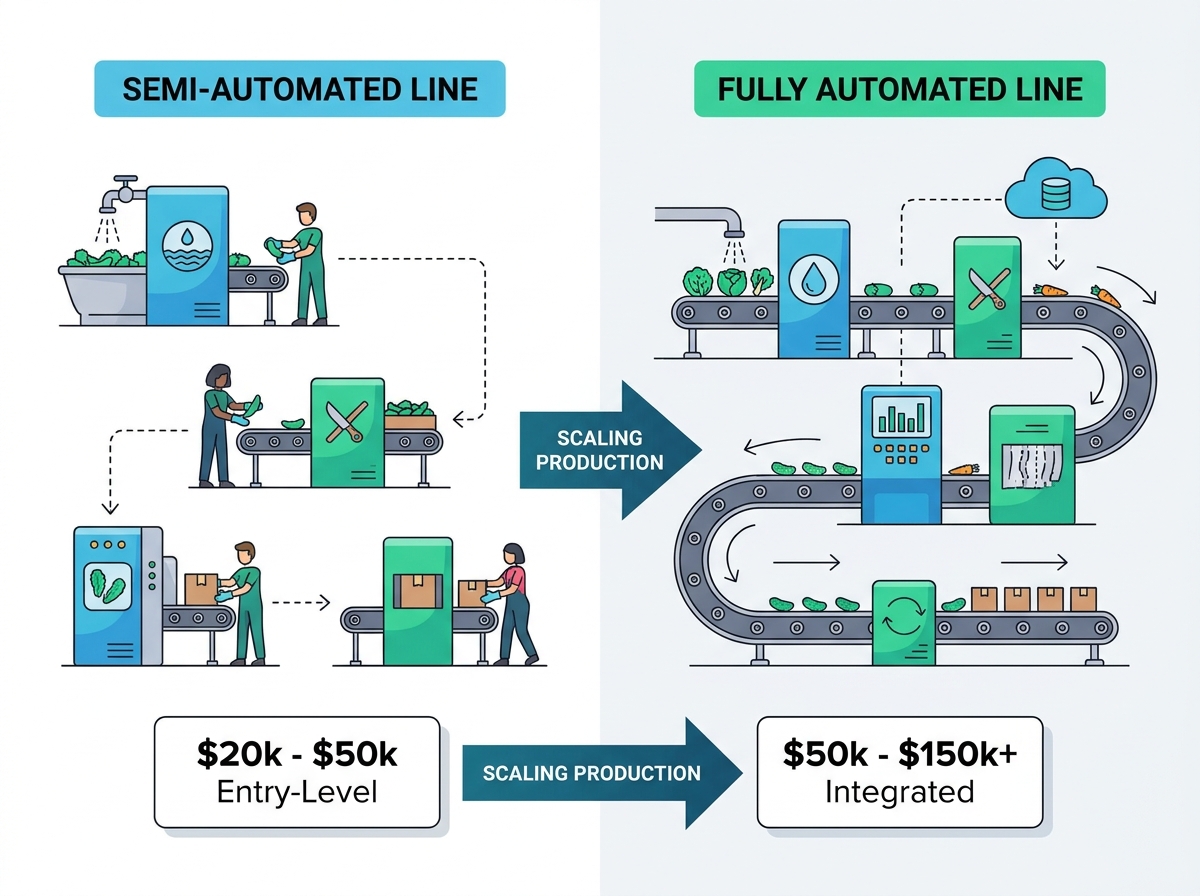
- Semi-Automated: These setups demand lower upfront capital. However, they rely heavily on manual labor. Workers must handle inter-machine product transfers manually. Staff physically move bins between peeling and cutting stations. These configurations work best for regional suppliers. They also suit seasonal processors handling varying crop volumes.
- Fully Automated: These systems require high capital expenditure. They utilize programmable logic controller (PLC) continuous flow mechanisms. Belts and flumes transport products automatically. These lines eliminate manual touchpoints entirely. You achieve maximum efficiency for high-volume, standardized SKU production.
Specialized vs. Multi-Purpose Lines
Raw material characteristics dictate equipment design. A universal machine rarely processes delicate leaves and hard roots equally well.
- Root Vegetable Lines: Carrots, potatoes, and beets require aggressive handling. These lines emphasize abrasive peeling modules. They utilize heavy-duty washing drums. Cutting modules feature rigid dicing blades designed for dense cellular structures.
- Leafy Green Lines: Spinach and lettuce demand gentle processing. These lines focus on delicate bubble washing. They incorporate specific insect removal flumes. Centrifugal drying systems gently remove moisture to prevent cell bruising.
Decision Node
You must evaluate your core business strategy. Determine whether your facility needs a dedicated line for a single high-volume crop. Alternatively, you might need a modular setup. Modular setups require manual reconfiguration for varied seasonal produce. Dedicated lines maximize throughput. Modular lines maximize operational flexibility.
2. Critical Evaluation Dimensions for Procurement
Procurement teams must evaluate machinery beyond basic brochure specifications. You need a structured approach to measure equipment viability. Assessing these four critical dimensions ensures you purchase a highly functional system.
Throughput and Yield Efficiency
You must match machine capacity (measured in kg/hr) directly to your facility bottlenecks. An oversized cutter wastes money if your washing module runs slowly. Furthermore, assess machines based on raw material waste reduction. Precision peeling and cutting phases must maximize usable product yield. Poorly calibrated peelers strip away profitable vegetable flesh.
Sanitary Design & Food Safety
Hygiene standards dictate your market access. You must verify equipment uses 304 or 316-grade stainless steel construction. Assess the physical accessibility of belts, rollers, and blades. Sanitation crews must clean these components daily. Insist on IP65+ rated electrical components. These ratings guarantee protection during aggressive daily washdown procedures.
Modularity and Scalability
Business growth requires equipment adaptability. You should evaluate the ability to retrofit new modules later. For example, you might want to integrate an optical sorter next year. You might need an advanced blanching unit for new recipes. The core conveyor architecture must support these additions without requiring a complete system replacement.
Resource Efficiency
Utility consumption directly impacts your monthly operating budget. Evaluate built-in water recycling filtration systems. These systems clean and reuse washing water continuously. You should also calculate energy consumption per ton of processed product. High-efficiency motors reduce long-term electricity expenses significantly.
Equipment Evaluation Matrix
| Evaluation Dimension | Standard Requirement | Enterprise Standard |
| Material Construction | 304 Stainless Steel | 316 Stainless Steel (High Acid) |
| Washdown Rating | IP65 (Splash proof) | IP67/IP69K (High-pressure proof) |
| Control System | Manual switches / Basic panel | Centralized PLC / SCADA integration |
| Water Management | Single-pass municipal water | Multi-stage closed-loop filtration |
3. Feature-to-Outcome Comparison of Top Systems
Modern equipment includes dozens of technical features. However, buyers often struggle to translate these features into tangible production outcomes. Evaluating a modern vegetable processing line requires understanding exactly how mechanical designs impact final food quality.
Washing & De-stoning Modules
Cleaning raw materials represents the most critical first step. You must match the washing technology to the crop.
- Feature: High-pressure spray nozzles versus air-bubble agitation tanks.
- Outcome: Bubble agitation creates a rolling water effect. This gently cleans delicate leafy greens without tearing them. Conversely, high-pressure sprays are mandatory for heavily soiled root vegetables. They blast away compacted dirt and stones effectively.
Cutting & Dicing Precision
Blade technology determines product appearance and longevity on store shelves. Ragged cuts lead to rapid spoilage.
- Feature: Quick-change interchangeable blade cassettes combined with variable frequency drives (VFD).
- Outcome: VFDs allow operators to adjust belt speeds instantly. Quick-change cassettes allow rapid shape adjustments. Consistent, clean cut sizes reduce cellular oxidation. This extends shelf-life remarkably. It also improves final packaging presentation for retail buyers.
Drying Technologies
Moisture control dictates packaging success. Excess water inside bags causes rapid bacterial growth.
- Feature: High-velocity air-knife blowers versus continuous centrifugal dryers.
- Outcome: Centrifugal dryers spin produce rapidly. Air-knives blow moisture off traveling belts. You must balance the risk of product mechanical damage against the necessity of removing surface moisture. Excellent drying is mandatory for modified atmosphere packaging (MAP).
Feature-to-Outcome Comparison Chart
| Module Phase | Technical Feature | Direct Production Outcome |
| Washing | Closed-loop water filtration | Reduces municipal water bills by up to 60%. |
| Cutting | Variable Frequency Drive (VFD) | Enables precise slice thickness control on the fly. |
| Sorting | Optical color sensors | Automatically ejects foreign materials and rotting produce. |
| Drying | Continuous centrifugal spin | Prepares surface texture perfectly for MAP bagging. |
4. Realistic Pricing Tiers and Hidden Expenses
Capital expenditure planning requires absolute transparency. Manufacturer quotes rarely tell the entire financial story. You must prepare for secondary installation expenses to avoid budget overruns. Processing equipment falls into three distinct pricing categories.
Entry-Level / Semi-Automated ($20,000 – $50,000)
These setups feature standard mechanical components. They utilize manual transfer points between washing and cutting stages. Operators manage machines via basic push-button control panels. This tier is ideally suited for startup processors. It also serves localized catering suppliers requiring lower daily volumes.
Mid-Range Integrated Lines ($50,000 – $150,000)
Mid-range investments deliver fully synchronized continuous flow. Belts transfer products seamlessly between modules. These systems feature centralized PLC controls for unified operation. You will typically find automated water filtration systems included. They also offer reliable CIP (Clean-in-Place) functionality. CIP spray balls clean internal components automatically, saving hours of labor.
Enterprise-Grade Lines ($150,000+)
Enterprise setups guarantee exceptionally high-capacity throughput. They often feature optical sorting integration to guarantee zero defects. These lines include SCADA data logging systems. SCADA provides digital traceability for strict food safety audits. Manufacturers also design custom facility layouts to maximize your specific floor plan efficiency.
Hidden Implementation Factors
You must budget an additional 15–20% beyond the equipment sticker price. Procurement teams frequently ignore these inevitable expenses.
- Freight and Customs: International shipping for heavy machinery requires specialized containers and incurs high import duties.
- Factory Acceptance Testing (FAT): Sending your engineers to the manufacturer's facility to verify operation before shipping.
- Spare Parts Inventory: Purchasing essential wear parts (blades, belts, sensors) upfront prevents future downtime.
- Facility Upgrades: Upgrading your factory to support high-capacity industrial drainage and installing new three-phase power supplies.
5. Implementation Risks and Rollout Realities
Buying equipment represents only half the challenge. Physical installation and staff integration present major hurdles. You must anticipate these operational realities before finalizing any purchase order.
Facility Constraints
Industrial processing lines require substantial physical infrastructure. They demand specific, elongated floor space footprints. Many facilities lack adequate drainage capabilities. High-volume washing modules discharge thousands of liters hourly. Your facility requires high-capacity industrial drainage systems to prevent dangerous floor flooding. Furthermore, heavy machinery demands upgraded three-phase power supplies. Standard commercial wiring cannot handle continuous industrial motor loads.
The "After-Sales" Trap
Procurement teams often chase the lowest upfront price. This frequently leads to buying from overseas manufacturers without a localized technician network. This creates a severe operational trap. If a critical sensor fails, you cannot wait two weeks for international shipping. Downtime waiting for proprietary spare parts will rapidly negate any initial equipment savings. You must prioritize vendors offering localized support.
Common Mistake: Relying entirely on virtual support for complex mechanical failures. Video calls cannot fix misaligned conveyor drives or burnt PLC boards. Always verify local technician availability.
Operator Adoption
New machinery requires new operational skills. Transitioning staff from manual processing to managing advanced PLC interfaces is difficult. Workers must learn to read digital alerts and adjust VFD parameters. This transition requires structured, vendor-provided training hours. Do not expect staff to operate a highly automated system safely without extensive hands-on instruction.
6. Shortlisting Logic: How to Choose Your Manufacturer
Comparing different vendors feels overwhelming. You need a disciplined methodology to filter out unqualified manufacturers. Follow this shortlisting logic to secure a reliable equipment partner.
Define the Non-Negotiables
Establish hard baseline requirements before accepting sales calls. Define a strict floor for capacity. For example, mandate a minimum throughput of 1,000 kg/hr. Outline acceptable utility limits for water and electricity. Demand proof of local regulatory compliance (such as FDA food-contact certifications or CE electrical safety marks). Reject any vendor failing these immediate baselines.
Demand Proof of Concept
Do not rely on polished marketing spec sheets. Marketing numbers often represent perfect laboratory conditions. Request live video demonstrations using your specific raw materials. A machine cutting perfect potatoes might destroy delicate sweet potatoes. Conduct reference calls with their existing clients. Speak to factory managers operating the equipment in similar climates or regions.
Best Practice: Send a sample batch of your hardest-to-process vegetable to the manufacturer. Ask them to film the entire washing, cutting, and sorting process in a single unedited take.
Audit the Service Level Agreement (SLA)
Scrutinize the warranty documentation thoroughly. Ensure it explicitly covers wear-and-tear parts for a clearly defined period. A warranty covering only the steel frame is practically useless. The SLA must offer binding guarantees on technical support response times. Know exactly how many hours it will take for a technician to arrive on-site during an emergency.
Conclusion
The optimal processing equipment is rarely the one boasting the highest number of features. Instead, it is the system aligning strictly with your facility's realistic throughput, labor availability, and sanitation standards. Balancing initial capital against long-term reliability guarantees a profitable upgrade. Always prioritize hygienic design and modular flexibility over flashy touchscreens.
Before requesting vendor quotes, map out your facility's exact floor plan and current utility constraints. Next, consult with an internal or third-party integration engineer to define your precise modular requirements. Taking these steps ensures your investment transforms your production capacity successfully.
FAQ
Q: What is the standard lead time for a custom vegetable processing line?
A: Standard manufacturing cycles typically require 45 to 90 days. Custom configurations or enterprise-grade lines take longer. You must also add 30 to 45 days for international ocean transit. Finally, allocate one to two weeks for facility installation, integration, and staff training. Plan your procurement at least four months in advance.
Q: Can a single processing line handle both leafy greens and root vegetables?
A: Yes, through modular bypass belts, but it is highly inefficient. Root vegetables introduce heavy soil and stones into the machinery. Mixing these with delicate leafy greens causes severe contamination risks and potential mechanical bruising. We strongly advise dedicating separate lines or performing intensive deep-cleaning between changeovers.
Q: How much water does a continuous washing line consume?
A: Older single-pass systems consume massive amounts of water, sometimes exceeding 2,000 liters per hour. However, modern equipment features closed-loop water recycling and multi-stage filtration systems. These technologies drastically reduce liters-per-ton consumption. They continuously filter and recirculate water, cutting total utility usage by up to 70%.
Q: What is the difference between 304 and 316 stainless steel for this equipment?
A: Both are food-grade materials. However, 316 stainless steel contains molybdenum, which offers significantly higher corrosion resistance. You must choose 316 if you process highly acidic vegetables (like tomatoes or onions). It is also required if your sanitation crew uses harsh chlorinated cleaning chemicals daily to prevent pitting.


