Upgrading or installing a new vegetable processing line is a high-stakes capital expenditure. A mismatched system leads to product damage, hygiene compliance failures, and costly production bottlenecks. Scaling production requires moving beyond standalone machines. You need an integrated, continuous flow. However, buyers often struggle during the procurement phase. They must balance automation levels against strict budget constraints. They also face rigid facility footprint limitations. You need a system tailored to your exact operational reality. Off-the-shelf solutions rarely deliver optimal results. This guide provides an evidence-based framework for evaluating equipment. We will help you shortlist and select the perfect machinery. You will learn to align equipment with your specific throughput requirements. We cover material types and long-term production goals. You will discover how to assess core modules effectively. We also explain how to match technology to specific produce types. Finally, we guide you through implementing a seamless factory acceptance test.
Key Takeaways
- Capacity must dictate design: Overestimating throughput wastes capital; underestimating creates immediate bottlenecks. Match line capacity to your peak seasonal yield.
- Material dictates technology: Fragile leafy greens require gentle bubble washing, while root vegetables demand robust friction peeling and high-pressure cleaning.
- Integration is the primary failure point: The handoff between washing, cutting, drying, and packaging is where most inefficiencies occur.
- TCO outweighs initial CapEx: Factor in water consumption, energy use, sanitation labor, and spare parts availability when evaluating equipment costs.
1. Defining Success Criteria: Capacity, Yield, and Compliance
Before buying equipment, you must define clear success metrics. Vague requirements lead to poor purchasing decisions. Start by calculating your required input capacity in kilograms per hour. Compare this figure against your desired output yield. Always account for seasonal volume spikes. A system running at maximum capacity during off-peak months will fail during the autumn harvest. You need built-in scalability for future growth.
Next, identify your current production bottlenecks. Pinpoint exact areas where manual labor slows down your workflow. Look for stages causing inconsistent product quality. For example, manual dicing often produces uneven cuts. Automated slicing guarantees uniformity and reduces physical waste. Upgrading these specific choke points yields immediate efficiency gains.
Finally, define your regulatory and hygiene standards. Your target market dictates specific compliance frameworks. You might need to meet FDA, CE, or HACCP standards. Establish strict sanitation requirements early in the planning phase. You might need Clean-in-Place (CIP) systems for automated internal washing. Highly accessible drainage is also critical to meet local health codes.
Common Mistake: Buyers frequently underestimate wastewater drainage requirements. Inadequate floor trenches cause dangerous standing water. This leads to immediate health inspection failures and slippery working conditions.
2. Core Modules of an Industrial Vegetable Processing Line
An industrial vegetable processing line consists of several interconnected modules. Each module must perform flawlessly to maintain continuous flow. A single weak link disrupts the entire operation.
- Pre-Washing and Sorting: This stage handles initial dirt and debris removal. It protects downstream equipment from damage. Evaluate water recycling capabilities here. Good recycling systems drastically reduce daily utility costs.
- Washing and Peeling: Choose between brush rollers, abrasive peelers, or steam peeling. Base your selection on acceptable waste percentages. Different vegetables require different peeling intensities to maximize usable yield.
- Cutting, Slicing, and Dicing: Focus on blade durability and precision. Measure the time required to swap cutting profiles. Faster swaps minimize costly downtime during product changeovers.
- Blanching and Cooling: If applicable to your product, assess temperature control accuracy. Precise heating deactivates enzymes effectively. Rapid cooling then stops the cooking process without compromising vegetable texture.
- Drying and Dewatering: Compare centrifugal dryers against air-knife systems. High moisture removal efficiency is critical. Air-knives shear water off the product surface safely. Excess moisture breeds bacteria and shortens product shelf life.
- Packaging Integration: Ensure seamless conveyor handoffs. Your line must feed smoothly into downstream equipment. It should integrate perfectly into multi-head weighers and Vertical Form Fill Seal (VFFS) packaging machines.
Best Practice: Always test blade metallurgy before committing. Hardened stainless steel blades hold their edge longer. Dull blades crush plant cells instead of slicing them. This cellular crushing accelerates oxidation and rapid spoilage.
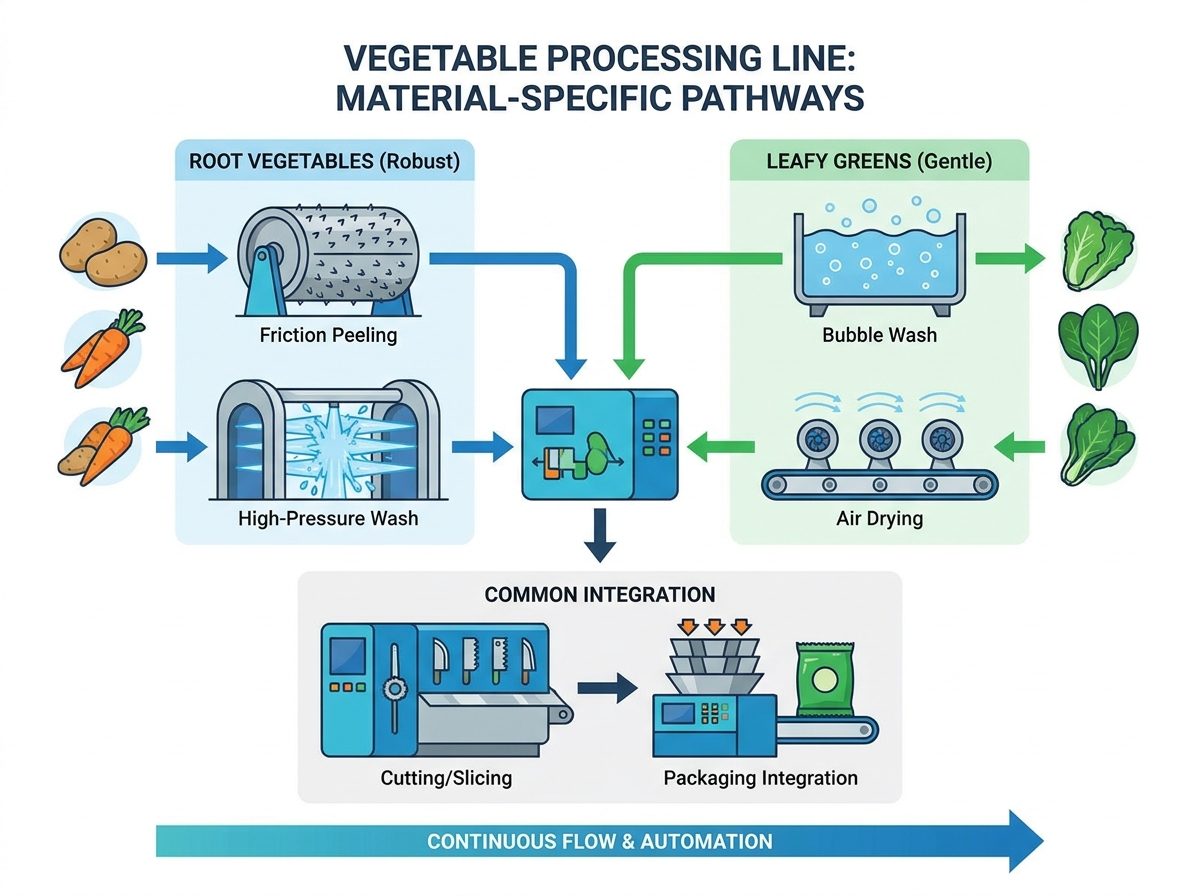
3. Aligning Equipment with Vegetable Types (The "One Size Doesn't Fit All" Rule)
Different vegetables require vastly different handling techniques. Applying the wrong mechanical force destroys product yield. You cannot treat delicate greens like hard root vegetables.
Handling Root Vegetables
Potatoes, carrots, and beets require heavy-duty processing. Focus on robust motors and abrasive peeling efficiency. You also need effective stone and clod removal mechanisms. Root vegetables carry heavy field debris. Your equipment must withstand this constant abrasive wear. Weak motors will burn out quickly under these harsh daily conditions.
Handling Leafy Greens
Lettuce, spinach, and cabbage are highly susceptible to bruising. They suffer rapid volume reduction if mishandled. These fragile items require specialized gentle handling. Look for air-bubble washing machines. These machines use gentle water agitation instead of harsh mechanical friction. Soft-mesh conveyors prevent physical damage during transport. Low-impact air drying is essential to maintain cellular integrity.
Handling Mixed Batches
Many facilities process multiple vegetable types daily. If you handle mixed batches, evaluate modular lines. Modular designs allow operators to bypass certain machines easily. For instance, you can bypass the abrasive peeler when running leafy greens. This flexibility maximizes equipment utilization across different growing seasons. It prevents you from buying redundant standalone machines.
4. Critical Evaluation Metrics for Sourcing Processing Equipment
Sourcing the right machinery requires strict evaluation criteria. Do not rely solely on brochure specifications. You must inspect the engineering details closely.
Build Quality and Material Standards
Verify the use of food-grade SUS304 or SUS316 stainless steel. Reject equipment featuring hard-to-clean crevices. Avoid machines using non-food-grade plastics. Poor build quality directly causes bacterial buildup. It leads to inevitable hygiene compliance failures. High-quality welds and smooth surfaces are mandatory for food safety.
Automation and Control Systems
Assess the Programmable Logic Controller (PLC) interfaces. Look for intuitive touchscreens. Operators need simple controls to minimize training time. Preset recipe saving ensures consistent batch quality across different shifts. Error-diagnostic alerts are crucial for quick troubleshooting. Good automation reduces operator error and prevents catastrophic line jams.
Footprint and Facility Layout
Evaluate whether the supplier offers custom line layouts. You might need a U-shape, L-shape, or straight line configuration. Custom layouts fit existing floor plans perfectly. They prevent you from requiring expensive facility expansion. A smart layout also optimizes operator movement and forklift access.
Resource Efficiency
Analyze stated water consumption rates and energy draw. Look for integrated water filtration and recirculation systems. Efficient resource management keeps daily operating expenses manageable. High utility bills quickly erode your profit margins over time.
Common Mistake: Purchasing control panels lacking proper waterproof ratings is a costly error. Always demand IP65 or IP69K rated enclosures. High-pressure washdowns will quickly destroy unrated electrical components.
Equipment Evaluation Checklist
| Evaluation Metric | What to Look For | Red Flags to Avoid |
| Build Quality | SUS304/SUS316 stainless steel, smooth continuous welds | Non-food-grade plastics, deep structural crevices |
| Automation | Intuitive PLC, recipe memory, diagnostic error alerts | Manual-only controls, overly complex interfaces |
| Facility Layout | Custom U-shape or L-shape modular configurations | Rigid straight-line only engineering designs |
| Resource Efficiency | Multi-stage water recycling, low energy component draw | High municipal water dependency, no filtration |
5. Lifecycle Maintenance and Operational Efficiency
A successful vegetable processing line must remain efficient long after installation. You must evaluate ongoing maintenance requirements. Daily operational demands dictate your long-term profitability.
Evaluating Long-Term Operating Costs
Look beyond the initial purchase price. Model the daily cost of utilities, operator labor, and sanitation routines. A cheaper machine often consumes more water. It usually requires more manual intervention to keep running. Balancing upfront machinery costs against daily operating expenses is vital. This proactive balance ensures sustainable profitability over the equipment's lifespan.
Sanitation Labor and Downtime
Evaluate how easily operators can disassemble machines for daily washdowns. Tool-less removal of belts and blades significantly reduces sanitation labor costs. Complex teardowns extend daily downtime. They also frustrate cleaning crews, leading to rushed, inadequate sanitation. Fast, accessible cleaning mechanisms are non-negotiable for high-volume food facilities.
Spare Parts and Vendor Support
Assess the availability of consumable parts. You will frequently replace blades, belts, and brushes. Verify the supplier’s Service Level Agreement (SLA) for technical troubleshooting. Ask about replacement part shipping times. Fast vendor support mitigates extended downtime. Establish a predictive maintenance schedule to order parts before they fail. You cannot afford week-long delays during critical harvest windows.
6. Next Steps: Shortlisting Suppliers and Planning Implementation
Once you define your requirements, begin shortlisting potential suppliers. Follow a structured implementation plan to guarantee success. Rushing this phase leads to costly installation errors.
- Requesting Proof of Concept: Demand detailed case studies from manufacturers. Ask for reference sites operating similar equipment. They should process similar vegetable types at your desired capacities. Seeing equipment perform in real-world conditions builds purchasing confidence.
- The Factory Acceptance Test (FAT): Establish strict criteria for the FAT before taking delivery. Ensure the line hits stated throughput and yield metrics. Always use your actual raw materials during this test. Simulated tests rarely reveal true operational flaws.
- Evaluating Warranties and Installation Support: Clarify exactly what the warranty covers. Distinguish clearly between parts and labor coverage. Verify whether the supplier provides on-site installation. They should also offer machine calibration and comprehensive staff training.
Best Practice: Bring your lead machine operator to the Factory Acceptance Test. Engineers design the equipment, but operators use it daily. Their practical feedback during the FAT is invaluable for spotting usability issues.
Conclusion
Choosing the right equipment requires looking past surface-level specifications. You must evaluate system integration and material-specific handling. Real-world maintenance demands also play a massive role in your success. A well-designed system minimizes product waste. It maximizes daily throughput and ensures strict hygiene compliance.
Your next actionable step is to document your peak capacity requirements. List your target vegetable types clearly. Measure your exact floor space constraints. Armed with this accurate data, approach your shortlisted manufacturers. Request a customized layout drawing from them. Ask them for a detailed operational analysis based on your specific facility metrics. Taking these deliberate steps ensures your new processing line drives long-term operational success.
FAQ
Q: How much floor space does a complete vegetable processing line require?
A: Space varies heavily by capacity and layout. A basic 500kg/h line might require 15–20 meters in a straight configuration. However, modular systems can be engineered into U-shapes or L-shapes to fit compact facilities without requiring building expansions.
Q: Can one processing line handle both root vegetables and leafy greens?
A: Yes, but it requires a modular design. Facilities often use a shared cutting and packaging backend. They run parallel or bypass-capable washing modules at the front end. You might use a bubble wash for greens and a brush wash for roots.
Q: What is the typical lead time for manufacturing and installing an industrial processing line?
A: Custom industrial lines typically require 45 to 90 days for manufacturing. You should also expect 1 to 3 weeks for shipping, installation, and on-site commissioning. Exact timelines depend heavily on the supplier's location and overall line complexity.
Q: How do automated processing lines reduce water consumption?
A: Modern lines incorporate multi-stage water recycling systems. Water from the final clean rinse is often filtered and pumped backward. It is then reused in the initial pre-wash stage. This closed-loop approach drastically reduces total municipal water draw.


