Selecting a vacuum packaging machine is not a simple, one-size-fits-all purchase. Making the wrong choice frequently leads to frustrating workflow bottlenecks, inflated consumable expenses, and compromised product integrity. Too often, business owners treat this equipment like a basic kitchen appliance rather than a critical operational investment. This mindset ignores the major shift from simple food preservation to commercial-scale production and strict health compliance. A mismatched unit can quickly drain your profits through slow cycle times and frequent breakdowns.
This guide provides a structured evaluation framework to help you navigate the procurement process. You will learn how to match machine architecture, pump type, and capacity directly to your specific business workflows. By following these steps, you can eliminate guesswork and secure reliable, efficient packaging capabilities for your facility.
Key Takeaways
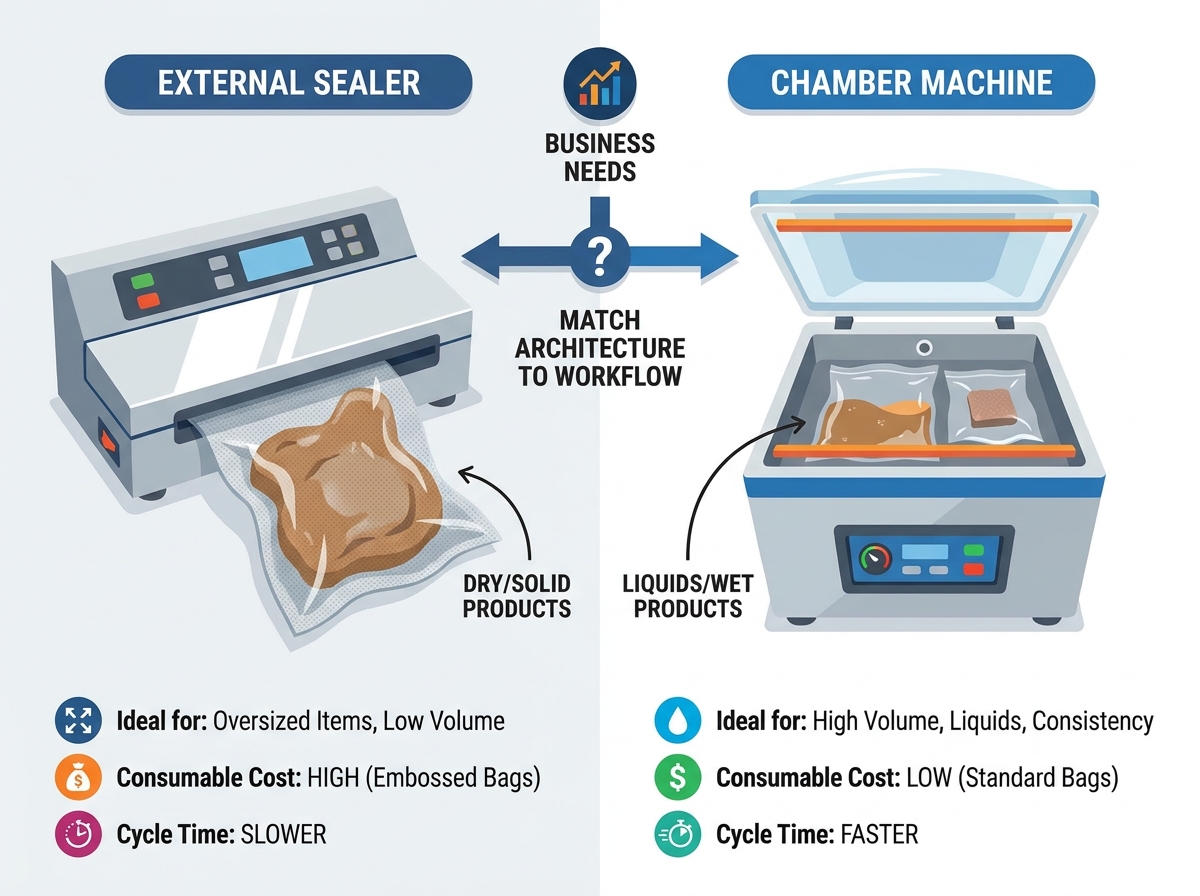
- Product dictates the machine: Liquid-heavy or high-moisture products require chamber-style machines, whereas dry, oversized items can be processed with external edge sealers.
- Total Cost of Ownership (TCO) outranks upfront price: Cheaper external machines require expensive embossed bags, often making them more costly over a year of commercial use than a premium chamber unit using standard bags.
- Pump longevity requires maintenance: Commercial scaling requires oil-lubricated rotary pumps, which demand strict adherence to maintenance schedules to prevent operational failure.
- Throughput relies on seal bar configuration: Cycle time and multi-bag sealing capabilities are the primary drivers of packaging efficiency and labor cost reduction.
Assessing Your Core Packaging Requirements and Success Criteria
Defining Production Volume
You must clearly define your daily production volume before evaluating any equipment. Manufacturers categorize equipment capabilities based on expected daily cycles. Overworking a smaller unit causes rapid component failure. Underutilizing a massive industrial unit ties up vital capital.
- Light-duty operations: These process fewer than 50 cycles per day. They suit small cafes or test kitchens.
- Medium-duty operations: These handle 50 to 200 cycles daily. They serve bustling restaurants and boutique food producers.
- Continuous industrial use: These require robust systems running all day. They fit large-scale processing plants and meatpackers.
You also need to identify your peak operational hours. A machine might average 100 cycles a day. However, if staff perform 80 of those cycles in one hour, the equipment might overheat. High burst-usage demands a larger pump capacity to prevent costly workflow bottlenecks.
Evaluating Product Characteristics
Your product physical traits dictate your necessary machine features. Liquids and wet marinades require careful handling. Vacuum pressure physically alters the environment inside the chamber. It lowers the boiling point of liquids. Cold soups can suddenly boil over under deep vacuum pressure. You need specific chamber settings or angled insert plates to prevent messy spills.
Abrasive or bone-in products introduce different challenges. Sharp edges easily pierce standard plastic. You must use thicker, high-mil puncture-resistant bags. Your vacuum packaging machine also needs variable vacuum control. Stopping the cycle early prevents bones from tearing the plastic.
Delicate items like pastries or soft cheeses require gentle handling. A standard vacuum cycle will crush them completely. You must seek equipment offering gas flush capabilities. We call this Modified Atmosphere Packaging (MAP). The system injects an inert gas before sealing. This creates a protective cushion around delicate foods.
Operational Footprint and Ergonomics
Space constraints heavily influence your final decision. Countertop units save floor space but limit your maximum bag size. Floor-standing models process larger items but demand dedicated facility real estate. You should measure your available workspace carefully before purchasing.
Electrical infrastructure is equally vital. Light-duty countertop units typically plug into standard 110V outlets. Medium and heavy-duty commercial units draw significantly more power. They usually require 220V or even 3-phase electrical setups. Upgrading your facility wiring adds hidden costs to your procurement process. Always verify your existing electrical capacity first.
External vs. Chamber Vacuum Packaging Machines: Structural Comparison
External (Edge/Out-of-Chamber) Sealers
External sealers represent the most basic architecture. They pull air directly from the bag opening. You place the product on a counter and feed the bag edge into the machine jaws. This design keeps the actual product outside the unit.
They work best for low-volume operations. They also excel at packaging uniquely large or irregularly shaped products. If you need to seal a whole large fish or oversized mechanical parts, an external sealer is ideal. These massive items simply cannot fit inside a fixed chamber.
However, external units have severe limitations. They cannot effectively handle raw liquids. The pump will suck marinades directly into the internal mechanics. They also feature much slower cycle times. Continuous use often causes the heating elements to overheat rapidly.
Chamber Vacuum Packaging Machines (Single & Double)
Chamber models use a completely different physical mechanism. You place the entire bag inside a closed cavity. The pump evacuates air from the entire enclosed space. This equalizes pressure inside and outside the bag. Because the pressure remains equal, liquids stay safely inside the pouch.
Single chamber units fit perfectly in restaurants, mid-sized butchers, and artisanal food setups. They deliver high consistency and reach exceptionally deep vacuum levels. Operators can achieve professional, airtight results repeatedly.
Double chamber machines serve continuous industrial food processors. They feature two separate cavities and a swinging lid. Operators load one side while the machine cycles the other side. This continuous rhythm effectively doubles your throughput and drastically cuts labor hours.
Table: Structural Comparison of Vacuum Sealer Types
| Feature | External Sealers | Single Chamber | Double Chamber |
| Mechanism | Pulls air from bag edge | Evacuates entire enclosed cavity | Evacuates alternating cavities |
| Liquid Handling | Poor (Requires freezing) | Excellent | Excellent |
| Best For | Oversized items, light use | Restaurants, medium butchers | Industrial processing facilities |
| Throughput | Low | Medium | High (Continuous) |
Evaluating Technical Specifications and Component Reliability
Vacuum Pump Technology (Dry vs. Oil-Lubricated)
The pump serves as the beating heart of your equipment. Choosing the wrong pump technology guarantees operational headaches. You generally choose between dry piston pumps and oil-rotary pumps.
Dry piston pumps offer a maintenance-free experience. You never need to change oil or monitor fluid levels. However, manufacturers limit them to lighter commercial applications. They generate friction and heat during operation. You must allow them adequate cooldown periods between heavy batch runs.
Oil-rotary pumps represent the gold standard for continuous, heavy-duty use. They achieve deeper atmospheric pulls, often reaching 99.9% evacuation. The oil lubricates moving parts and dissipates heat effectively. They run constantly without overheating. However, they demand rigorous maintenance. You must commit to regular oil changes to prevent catastrophic pump failure.
Seal Bar Configuration and Heating Elements
Seal bar design directly impacts your packaging speed and security. Look closely at the length and placement of the bars. Multiple seal bars allow you to process several bags simultaneously. For example, a chamber with front and back bars can seal four small pouches in one cycle. L-shaped configurations accommodate unique bag sizes easily.
You also need to evaluate the seal wire types:
- Single wire: Creates one basic seal line. It works for lightweight applications but risks failure if grease touches the seal area.
- Double wire: Creates two parallel seals. This provides exceptional security for liquids and commercial retail products.
- Cut-off wire: Creates a primary seal and neatly cuts off the excess bag flap. This improves aesthetic presentation for retail shelves.
Digital Controls and Programmability
Modern commercial kitchens juggle diverse menus. Basic analog dials slow down your operations. Digital controls offer precision and consistency. You should look for units offering programmable memory banks.
Programmable memory transforms your workflow. A chef can switch instantly from a delicate cheese setting to a dense beef cut setting. Staff simply press one button instead of guessing the correct vacuum percentage. This reduces human error and standardizes your product quality across all shifts.
Implementation Realities and Compliance Standards
Consumables and Long-Term Operating Costs
Your bag selection determines your long-term operating budget. External sealers demand specialized channeled or embossed bags. These bags feature textured interiors. The micro-channels allow air to escape while the jaws clamp down. Unfortunately, the manufacturing process makes embossed bags extremely expensive.
Chamber units use flat, smooth poly-nylon bags. Because the machine evacuates the whole chamber, the bags need no special texture. Standard flat bags cost a fraction of embossed versions. If you package high volumes, the cheaper flat bags quickly offset the higher machine price.
Bag thickness also affects your costs and presentation. Standard 3-mil bags handle smooth items like cheese or boneless chicken. Bone-in steaks or abrasive crusts require 4-mil or 5-mil thickness. Thicker bags cost more but prevent costly returns due to lost seals.
Maintenance Workflows and Downtime Risks
Equipment downtime halts your production lines. You must establish realistic maintenance workflows to protect your investment. Oil-lubricated pumps require strict attention. A standard best practice involves changing the oil after the first 25 hours of operation. This removes initial metallic dust. Afterward, you should change it every 60 hours or whenever the fluid appears cloudy.
You must also assess the availability of replacement parts. Teflon tape and heating elements degrade naturally over time. Lid gaskets compress and lose their airtight seal. Before buying, verify your vendor maintains a robust service network. Waiting weeks for a simple replacement gasket paralyzes your business.
Sanitation and Industry Certifications
Commercial food environments face strict regulatory scrutiny. Health inspectors actively look for specific certification markers on your equipment. You must identify necessary markers like NSF, ETL, CE, or UL. These badges prove the machine meets recognized safety and sanitation standards.
Daily cleaning protocols demand specific structural features. Emphasize machines built with high-grade stainless steel housing. Avoid models with exposed crevices where bacteria can hide. Removable seal bars are absolutely essential. They allow your staff to wipe down the entire inner chamber efficiently during closing shifts.
ROI Analysis and Shortlisting Your Vendors
Calculating the Breakeven Point
Upfront price tags often mislead buyers. You must calculate a realistic breakeven point to justify your purchase. Compare the initial cost of a premium vacuum packaging machine against your expected monthly savings.
First, factor in labor savings. A chamber model with dual seal bars halves your packaging time. Less time packing means less money spent on hourly wages. Second, calculate your consumable savings. Bulk flat bags cost significantly less than embossed alternatives. For a high-volume butcher, the savings on bags alone often pays for the machine within eight months.
Vendor Vetting Criteria
Do not base your decision solely on a glossy spec sheet. Vendor reliability matters just as much as machine performance. Evaluate their warranty terms closely. Some companies offer extended parts warranties but refuse to cover the expensive labor required for repairs.
Check their technical support response times. If a pump fails on a Friday afternoon, you need a vendor who answers the phone. Lastly, verify actual machine lead times. Global supply chain issues frequently delay commercial equipment deliveries. Ensure the vendor actually holds the unit in stock.
Next-Step Actions
You should map out exactly what you intend to seal over the next 12 to 18 months. Anticipating future product lines prevents you from under-sizing your equipment today. If you plan to introduce soups next winter, buy a chamber unit now.
Never issue a Purchase Order blindly. Advise your procurement team to request a physical demonstration. Better yet, send your most difficult sample products directly to the manufacturer. Ask them to film a test sealing. This visual proof guarantees the machine handles your specific food items properly.
Conclusion
- The ideal vacuum packaging machine seamlessly aligns pump capacity, chamber architecture, and your daily operational workflow.
- Focusing purely on the cheapest upfront price routinely creates severe production bottlenecks and inflates your monthly consumable costs.
- Always prioritize equipment featuring robust sanitation markers and easy-to-clean stainless steel components to satisfy strict health inspectors.
- Take time to review your upcoming product pipeline and physically measure your available workspace before contacting vendors.
- Consult a commercial equipment specialist and request real-world test seals for your most challenging products to finalize your specifications confidently.
FAQ
Q: Can I vacuum seal liquids with an external sealer?
A: Technically, you can if you freeze the liquid into a solid block first. However, this is highly inefficient for any commercial business use. A chamber vacuum packaging machine is strictly required for packaging raw liquids, wet marinades, and soups reliably without messy spills.
Q: What is the difference between an oil pump and a dry pump?
A: Dry pumps require no maintenance but suffer from shorter lifespans and lower overall throughput. They need cooldown periods. Oil pumps offer true industrial-grade durability and achieve deeper vacuum pulls. However, they require you to perform regular oil changes and frequent filter replacements.
Q: Why are bags for external sealers more expensive?
A: External sealers require specialized textured, or embossed, bags. The manufacturing process creates micro-channels that allow air to escape while the machine clamps the edge. Chamber machines use standard, smooth-sided flat bags. These cost significantly less when purchased in commercial bulk quantities.
Q: Do I need a gas flush (MAP) feature?
A: You only need it if you are packaging highly crushable items. Potato chips, soft baked goods, or delicate cheeses benefit greatly from MAP. It is also necessary if you require an extended shelf life for specific retail environments. The machine injects inert gases like nitrogen to protect the food.


