Upgrading or scaling a production line is always a capital-intensive risk. A poor equipment choice does more than waste your budget. It often creates severe compliance liabilities, hidden production bottlenecks, and ongoing maintenance nightmares. Purchasing decisions must evaluate hygienic design, daily operational efficiency, and robust lifecycle support. You cannot rely solely on baseline specifications. Overlooking long-term operating factors frequently leads to shrinking profit margins and unexpected facility downtime.
This guide breaks down the critical evaluation criteria you need today. We explore essential regulatory considerations and effective supplier vetting frameworks. You will learn exactly how to make a secure, high-ROI investment in Food processing equipment for your growing business. Smart procurement strategies protect your workforce, ensure product safety, and guarantee scalable production for years to come.
Key Takeaways
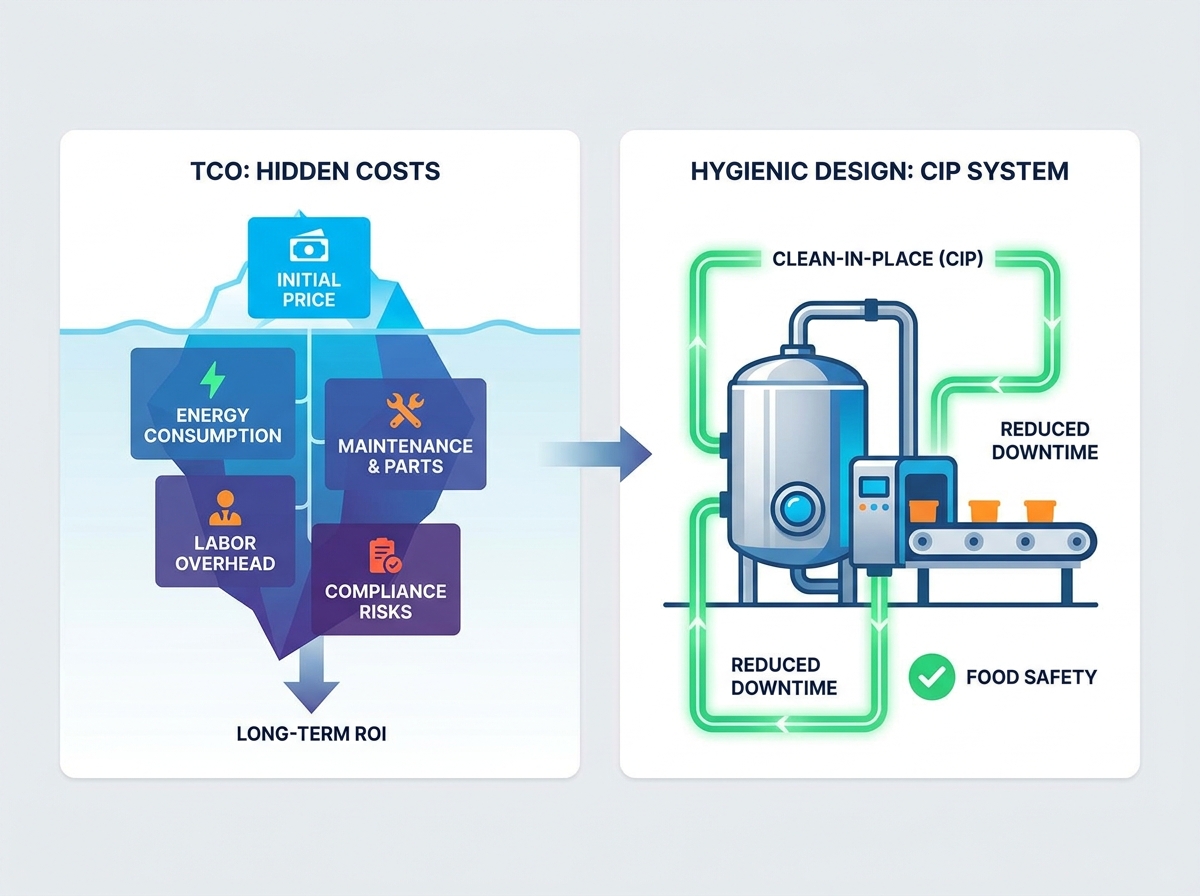
- Initial purchase price typically represents only a fraction of the equipment's Total Cost of Ownership; energy, labor, and maintenance dictate true ROI.
- Regulatory compliance (FDA/USDA) and hygienic design (e.g., Clean-in-Place compatibility) are non-negotiable prerequisites, not optional upgrades.
- The choice between new and used equipment hinges heavily on production scale, warranty requirements, and historical contamination risks.
- Vendor vetting must include clear terms for Factory Acceptance Testing (FAT), Site Acceptance Testing (SAT), and spare parts availability.
Assessing Your Production Needs and Facility Constraints
Defining your actual production needs forms the foundation of any purchase. You must calculate current yield requirements against projected growth. We recommend planning for a three-to-five-year expansion window. Over-specifying machinery wastes precious capital upfront. You tie up funds better spent on marketing or distribution. Conversely, under-specifying creates immediate production bottlenecks. You must strike a balance based on realistic market demand and historical sales data.
Before shortlisting any models, you must evaluate your facility infrastructure. Hard constraints dictate what machinery you can physically install. Many buyers skip this audit and face costly installation delays later. Consider these physical and utility limitations before requesting quotes:
- Floor space dimensions: Measure operational footprints, including required clearance for maintenance technicians.
- Structural weight limits: Verify your flooring can handle heavy vibration and static machine weight.
- Ceiling height clearances: Account for hopper loading zones, lift mechanisms, and ventilation hoods.
- Three-phase power availability: Check your electrical panels for peak load capacities and voltage stability.
- Water pressure consistency: Ensure adequate gallons-per-minute (GPM) for both processing and sanitation cycles.
- Drainage capacity: Evaluate your wastewater management protocols and floor trench sizing.
Integration presents another major hurdle. New machinery rarely operates in isolation. You must assess how new units interface alongside existing conveyor systems. Packaging lines require seamless handoffs to prevent product damage. Current control software, including PLC and SCADA systems, must communicate effectively. Open-architecture control systems prevent costly software integration delays. Map out your entire production flow before inserting a new mechanical variable.
Core Evaluation Criteria for Food Processing Equipment
Lifecycle Costs vs. Initial Price
Evaluating machinery requires looking past the initial price tag. Initial capital expenditure only represents the beginning. You must calculate installation fees, ongoing energy consumption, and scheduled preventative maintenance. Operator labor significantly impacts your long-term financial layout. Automated features often require higher initial investments. However, automation sharply reduces manual labor overhead. It minimizes costly human errors during long production runs.
You must measure these ongoing labor savings against the upfront purchase price. Factor in the cost of consumable parts like seals, gaskets, and filters. High-efficiency motors might cost more today but save thousands in electricity annually. This comprehensive approach reveals the true financial impact of your investment. It separates cheap machinery from truly cost-effective solutions.
Material Grades and Durability
Stainless steel remains the undisputed industry standard. However, material grades differ significantly in chemical durability. You must standardize compliant materials across your facility to avoid cross-contamination. Ensure all plastics and elastomers are strictly food-grade and metal-detectable.
| Material Grade | Primary Characteristics | Best Application Scenarios |
| Type 304 Stainless Steel | Resists standard food acids, easy to sanitize, cost-effective. | Dry goods, bakeries, standard dairy processing, non-corrosive environments. |
| Type 316 Stainless Steel | Contains molybdenum. Superior resistance to chlorides and harsh chemicals. | Meat processing, high-saline foods, acidic sauces, rigorous chemical washdowns. |
| Food-Grade UHMW Plastic | High impact strength, low friction, FDA compliant. | Conveyor guides, chute linings, star wheels, scraper blades. |
| Detectable Elastomers | Shatter-resistant, triggers metal detectors if broken. | O-rings, gaskets, suction cups, and flexible tubing. |
Ergonomics and Workforce Safety
Safety and ergonomics demand equal attention during procurement. Assess the physical toll on your operators. Repetitive motions, poor loading heights, and awkward maintenance access cause chronic injuries. Lost labor hours disrupt production schedules.
Your chosen machinery must include standard safety mechanisms. Look for integrated failsafes, accessible emergency stop buttons, and interlock guarding. These features keep your facility compliant. They meet strict OSHA standards and regional safety guidelines. Modern light curtains automatically halt moving parts when an operator breaches the safety zone. Protect your workforce to maintain consistent, uninterrupted production levels.
Navigating Food Safety Compliance and Hygienic Design
Sanitary Engineering Standards
Hygienic design is an absolute necessity. You must eliminate all potential contamination harbor points. Avoid machinery featuring dead legs, hollow rollers, or perfectly flat horizontal surfaces. Water must drain freely to prevent bacterial growth. Improper welds create microscopic crevices. Pathogens like Listeria and Salmonella breed rapidly in these exact spots.
You should demand compliance alongside recognized industry benchmarks. The 3-A Sanitary Standards and EHEDG guidelines provide excellent baselines. Equipment meeting these standards undergoes rigorous design scrutiny. Engineers design these units for maximum cleanability. Rounded corners, continuous TIG welds, and sloped surfaces act as your first line of defense against product recalls.
CIP (Clean-in-Place) vs. COP (Clean-out-of-Place)
Sanitation protocols directly impact your facility uptime. You must evaluate equipment based on cleaning efficiency. Integrated CIP systems reduce downtime, lower water usage, and guarantee repeatable sanitation cycles. Manual COP breakdown introduces human error and extends production halts.
| Feature | Clean-in-Place (CIP) | Clean-out-of-Place (COP) |
| Automation Level | Fully automated, controlled via PLC logic. | Highly manual, requires physical dismantling. |
| Downtime Impact | Minimal. Cleans between batches rapidly. | High. Takes hours to disassemble and reassemble. |
| Resource Usage | Optimized water and chemical dosing. | Variable. Often wastes water and cleaning agents. |
| Validation | Highly repeatable and digitally recordable. | Relies entirely on visual inspection and swabs. |
The Financial Debate: Buying New vs. Used Equipment
When Used Makes Sense
Used machinery occasionally offers strategic advantages. Early-stage startups often benefit from lower capital requirements. Low-risk food preparation environments might not need pristine new units. Non-critical auxiliary processes also tolerate older models well. Used units offer immediate availability. You skip the long manufacturing lead times entirely. This proves crucial when replacing a suddenly broken machine during peak seasonal production.
The Hidden Risks of Used Machinery
However, used machinery carries substantial hidden risks. You cannot accurately verify past wear-and-tear. Historical contamination risks pose a severe threat. Microscopic scratches from previous owners often harbor resilient biofilms. Standard sanitizers struggle to penetrate these biofilms.
Furthermore, you lose crucial OEM warranties. Replacement parts frequently become obsolete. Sourcing custom parts for discontinued models causes extended downtime. You might save capital upfront, but emergency fabrications quickly erase those savings.
The ROI of Buying New
Purchasing new machinery provides distinct operational advantages. Consider these primary benefits when calculating your return on investment:
- Guaranteed compliance matching the most recent food safety regulations.
- Higher energy efficiency through modern motor designs and smart controls.
- Exact customization tailored specifically for your unique facility footprint.
- Comprehensive lifecycle support directly from the original equipment manufacturer.
- Easier integration into modern, interconnected smart-factory ecosystems.
How to Vet Suppliers and Request Actionable Quotes
Beyond the Brochure
Do not judge a manufacturer by marketing materials alone. You must evaluate their underlying financial stability. Review their historical industry track record thoroughly. Demand proof of specific experience within your exact sub-sector. Dairy processing requires vastly different hygiene expertise than meat processing. Ask for client references. Call those references to ask about post-installation support and machine reliability.
The RFP (Request for Proposal) Process
A detailed Request for Proposal yields accurate quotes. Vague specifications lead to costly change orders later. Your spec sheet must include precise details. List your exact product viscosity ranges. Note all specific temperature requirements during heating or cooling phases. State your minimum and maximum throughput targets clearly. Mention your preferred component brands for motors and PLCs. This ensures your maintenance team already knows how to service them.
Testing and Validation Clauses
Never accept delivery without proper validation clauses. Insist upon Factory Acceptance Testing (FAT). This testing occurs before the machinery leaves the supplier. It proves the machine meets your baseline requirements using water or dummy products. You observe the machine running at full speed to verify structural integrity.
Next, define clear terms for Site Acceptance Testing (SAT). SAT occurs after installation in your actual facility. It verifies performance under real-world utility conditions using your actual food product. Outline commissioning terms to ensure proper final handoff. Withhold the final payment percentage until the machine passes the SAT.
Post-Sale Service Level Agreements (SLAs)
The supplier relationship truly begins after installation. Evaluate their post-sale Service Level Agreements closely. Check their guaranteed response times for technician dispatch. Verify they maintain a local spare parts inventory. Understand their software update policies for PLC systems. Strong SLAs prevent minor breakdowns from becoming major catastrophes. A reliable partner proactively schedules preventative maintenance visits.
Conclusion
Sourcing industrial machinery requires balancing risk mitigation against scalable growth. You must evaluate physical constraints, material grades, and sanitation requirements before signing a purchase order. Prioritize hygienic design and daily operational efficiency over baseline pricing. Cheap equipment often costs substantially more over its usable lifespan through labor waste and maintenance downtime.
Audit your current facility constraints immediately. Document your utility capacities, spatial limitations, and target throughput goals. Reach out to a certified engineering consultant or vetted supplier to begin your specification process. Smart planning today guarantees profitable, compliant production runs tomorrow.
FAQ
Q: How do you calculate ROI on new food processing equipment?
A: Calculate ROI by comparing the new machine's comprehensive operating costs against your current baseline expenses. Factor in the initial purchase price, then subtract the projected savings from reduced labor, lower energy consumption, and decreased product waste. Finally, add the revenue generated by increased yield capacity over a three-to-five-year period.
Q: What is the standard lead time for custom food manufacturing equipment?
A: Lead times vary widely based on machine complexity. Expect standard custom builds to take between 12 and 24 weeks. Complex automated lines can exceed 30 weeks. Lead times depend heavily on supply chain factors for raw materials, engineering approval phases, and Factory Acceptance Testing scheduling.
Q: How long should commercial food processing machinery last?
A: Well-maintained, high-grade stainless steel equipment typically lasts 10 to 20 years. Heavy-use industrial machinery can exceed this lifespan provided you strictly follow preventative maintenance schedules. You must consistently replace OEM wear parts like seals and bearings to maximize equipment longevity.
Q: Does financing differ for new vs. used food processing equipment?
A: Yes. Lenders generally offer significantly better rates and longer repayment terms for new equipment. New machinery features predictable depreciation schedules and carries comprehensive OEM warranties. Used equipment carries higher lending risks due to unknown wear and shorter remaining lifespans, resulting in stricter financing terms.


