Commercial kitchens and industrial plants rely heavily on robust hardware to scale operations effectively. You cannot view this machinery simply as metal and motors. Instead, it acts as the critical infrastructure dictating your production scalability, unit economics, and facility compliance. Operations managers face constant tension during the procurement process. You must carefully balance upfront capital expenditure against long-term reliability. Strict safety mandates also force buyers to scrutinize every single component before purchasing. Falling out of compliance carries massive financial and legal risks for any organization.
This guide clarifies how to approach your next major procurement cycle confidently. We provide a standardized breakdown of machine types and critical industry applications. You will learn a realistic framework for evaluating your facility's specific hardware needs. By the end, you will understand how to choose optimized systems. You can confidently select hardware aligning perfectly to your operational goals.
Key Takeaways
- Food processing equipment is categorized by production stage: preparation, mechanical/thermal processing, preservation, and packaging.
- Material selection (e.g., 304/316 stainless steel) and sanitary design (CIP-ready) are non-negotiable for HACCP and FDA/GFSI compliance.
- Evaluating equipment requires factoring in maintenance intervals, utility consumption, and integration costs.
- Successful implementation hinges on operator adoption and mitigating planned downtime during the installation phase.
The Commercial Role of Food Processing Equipment
Legacy systems often bottleneck production on the plant floor. Manual processes introduce unacceptable variance in final product quality. They also increase contamination risks across your entire facility. Modern operations require automation to remain competitive and profitable in tight markets. Labor shortages continue to push facilities toward automated solutions.
Success requires modern hardware delivering on three specific fronts. First, you need repeatable quality through precision engineering. Second, scalable throughput ensures you hit daily volume targets easily. Third, verifiable hygiene guarantees continuous safety compliance during unannounced audits. Without these three pillars, your operation remains highly vulnerable to disruption.
Stop focusing merely on isolated machine features or technical specifications. Instead, shift your focus toward measurable operational outcomes. High-quality Food processing equipment reduces raw material waste significantly. It improves Overall Equipment Effectiveness (OEE) across the board. You will also see minimized changeover times between different product runs.
Core Components of Equipment Effectiveness:
- Availability: Reduces unplanned downtime caused by sudden mechanical failures.
- Performance: Maintains consistent processing speeds without experiencing micro-stops.
- Quality: Yields higher percentages of perfectly spec-aligned finished goods.
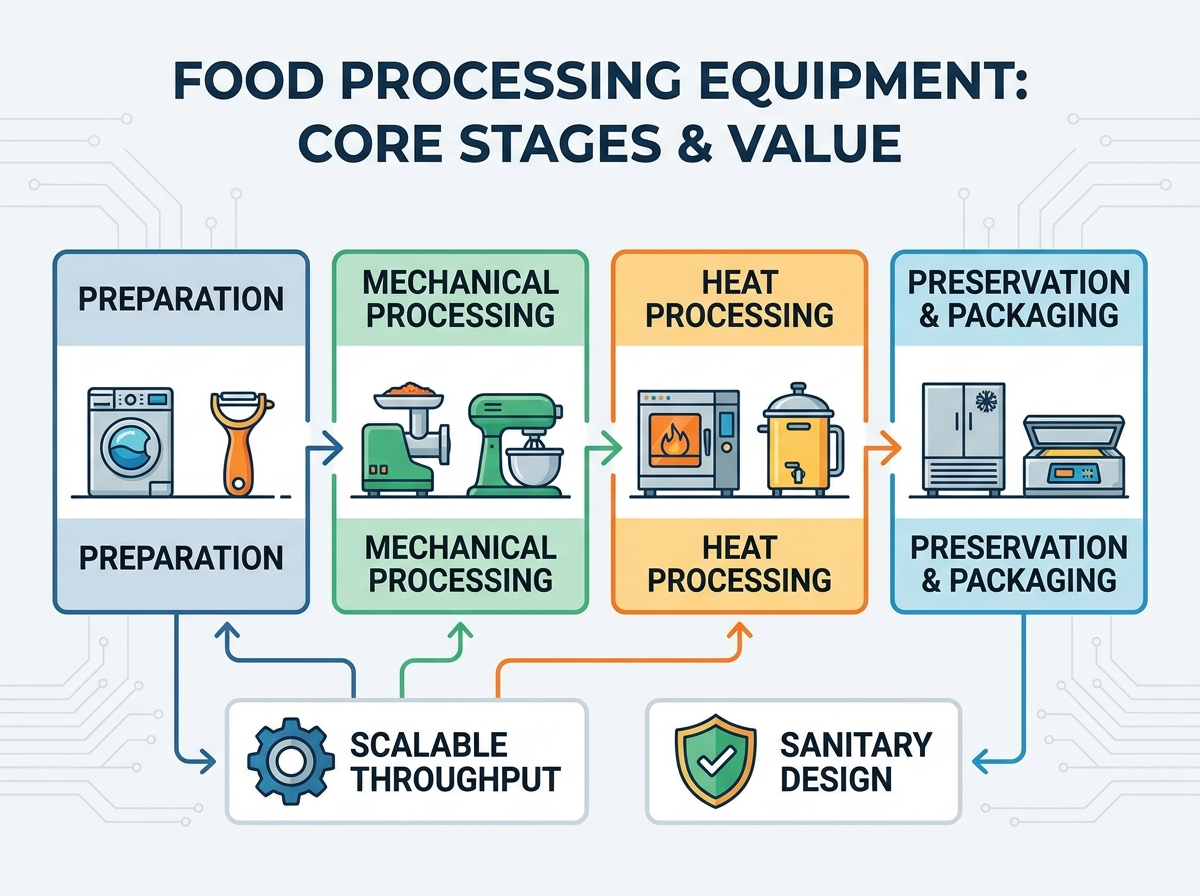
Core Types of Food Processing Equipment (By Production Stage)
Preparation Equipment
Every commercial production line begins at the preparation stage. Washers remove dirt, debris, and pesticides from raw ingredients. Flume washers use gentle water currents to handle delicate leafy greens. Rotary drum washers scrub root vegetables aggressively to remove stubborn field dirt. Graders sort items by size, color, or weight automatically. Modern optical graders use high-speed cameras to reject defective items instantly. Peelers strip away outer layers quickly and efficiently. Steam peelers loosen tomato skins rapidly, while abrasive peelers handle tough potatoes.
Proper preparation reduces downstream raw material waste immensely. It ensures strict baseline hygiene before complex processing ever begins. If you fail here, field contaminants will ruin entire downstream batches.
Best Practices for Preparation:
- Calibrate optical graders daily to avoid miscategorized product batches.
- Inspect flume washers for debris buildup between every production shift.
- Adjust steam peelers based on seasonal variations in produce skin thickness.
Mechanical Processing (Size Reduction & Separation)
This stage fundamentally alters your raw ingredient structures. Grinders reduce meat or vegetables into uniform, manageable pieces. You control piece size by swapping different grinder plates. High-shear mixers blend liquids and solid powders seamlessly. Ribbon blenders handle dry powders gently to prevent ingredient degradation. Twin-shaft paddle mixers provide aggressive blending for heavy meat blocks. Slicers cut portions to exact, repeatable dimensions every time. Centrifuges separate components based purely on fluid density.
Mechanical processing dictates overall product consistency and visual appeal. It determines final texture and ingredient blend uniformity. A key evaluation metric involves comparing continuous versus batch capabilities. Continuous processing suits high-volume environments perfectly. Batch processing offers better flexibility for frequent recipe changes.
Common Mistakes in Mechanical Processing:
- Using standard batch mixers for high-volume continuous output demands.
- Failing to sharpen slicer blades regularly, causing product tearing.
- Ignoring vibration alerts on industrial centrifuge equipment entirely.
Heat Processing (Thermal Treatment)
Thermal processing controls safety and alters product flavor profiles. Industrial ovens bake or roast products at massive scale. Impingement ovens blast hot air directly onto products for rapid baking. Convection systems provide even, gentle heat for delicate pastries. Heat exchangers pasteurize raw liquids rapidly and safely. Plate heat exchangers handle milk, while tubular designs handle viscous sauces. Fryers submerge foods in hot oil for continuous crisping.
Heat treatment provides extremely critical lethality steps. Pathogen reduction keeps consumers safe from foodborne illnesses. It also extends product shelf-life significantly on retail shelves. Energy efficiency remains a primary buying criterion in this category. Precise temperature control prevents accidental scorching or dangerous undercooking.
Preservation & Packaging
The final production stage secures your hard work entirely. Blast freezers drop core product temperatures rapidly to lock freshness. Individual Quick Freezing (IQF) technology freezes small items separately without clumping. Vacuum sealers remove oxygen to prevent premature spoilage. Modified atmosphere packaging (MAP) systems inject protective gas mixtures. MAP typically uses nitrogen and carbon dioxide to slow bacterial growth.
Packaging protects product integrity during complex distribution routes. It directly impacts recall prevention and brand reputation. Proper sealing guarantees retail viability and extends expiration dates effectively.
Key Industry Applications and Material Requirements
Mapping Equipment to Sector Needs
Different sectors demand highly specialized machine capabilities and ratings. Processing meat looks completely different from baking bread. We summarized these specific operational requirements in the comparison chart below.
| Industry Sector | Key Hardware Needs | Primary Operational Focus |
| Meat & Poultry | Heavy-duty IP69K washdown ratings, high-torque processing | Extreme temperature resistance and cross-contamination prevention |
| Dairy & Beverage | Closed-system fluid dynamics, tubular heat pasteurization | Ultra-hygienic automated cleaning and strict flow control |
| Bakery & Confectionery | Precise dough extrusion, bulk dry powder handling | Consistent thermal profiling and airborne dust mitigation |
Meat processing requires extreme durability and waterproof electrical ratings. Cross-contamination zones demand strict physical separation between raw and cooked items. Dairy relies on sanitary piping and strict flow dynamics. Milk processing must adhere to 3-A Sanitary Standards strictly. Bakery facilities need exact temperature zones and humidity controls. Flour dust creates serious explosion hazards requiring intrinsically safe electronics.
The Material Mandate (Why Construction Matters)
Material selection directly dictates hygiene levels across your facility. You must insist on certified food-grade materials always. AISI 304 and 316 stainless steel represent the industry standards. They provide excellent corrosion resistance against harsh cleaning chemicals. Grade 316 contains molybdenum for superior resistance against salt and chlorides. Harsh sanitation routines will quickly degrade lesser carbon metals.
Sanitary welding remains completely non-negotiable for safety compliance. Welds must be ground smooth and polished extensively. Surface roughness must measure very low to prevent residue clinging. Any crevices or dead legs create dangerous harbor points. Bacterial growth thrives heavily in these microscopic gaps. You simply cannot compromise on base construction quality.
How to Evaluate and Select the Right Equipment
Capacity vs. Footprint
Match theoretical throughput ratings against realistic operational capacity carefully. Do not buy machines solely based on maximum speed ratings. Look at your upstream and downstream bottlenecks first. If your oven processes 2000 kilograms hourly but your freezer handles 1000, efficiency dies. Account for your available floor space before signing purchase orders. Consider your overall facility layout and daily operator workflow. Crowded plant floors lead directly to accidents and material jams.
Compliance and Sanitary Design
Verify alignment against standard HACCP safety principles immediately. Prioritize machines featuring Clean-In-Place (CIP) functionality where possible. Wash-In-Place (WIP) systems also provide massive operational value. These automated systems reduce manual labor hours dramatically. They ensure consistent, repeatable sanitation cycles every single time. Modern CIP sensors track chemical concentration and flow rate for audit trails. This data proves invaluable during third-party GFSI audits.
Evaluating Lifecycle Expenses
Do not fall into the upfront capital expenditure trap. Focusing solely on initial sticker prices is a dangerous procurement strategy. You must calculate long-term operational variables very carefully. Include baseline energy and water consumption rates in your financial models. Machines featuring Variable Frequency Drives (VFDs) reduce motor energy consumption significantly. Factor in the regular cost of preventative maintenance kits. Compare proprietary replacement parts against off-the-shelf industrial alternatives. Proprietary parts often carry heavy markups and long delivery times.
Interoperability
Assess how new machines talk to existing plant infrastructure. Can they integrate easily into current SCADA monitoring systems? Check software compatibility across your Programmable Logic Controllers (PLCs). Most modern systems use standard protocols like EtherNet/IP or Modbus. Ensure seamless product handoffs to downstream packaging lines. Poor software integration creates isolated data silos. Poor mechanical integration creates physical production bottlenecks requiring manual intervention.
Implementation Realities and Adoption Risks
The Hidden Costs of Installation
Installation rarely happens without significant facility disruption. Account for expensive production downtime upfront in your planning. You may require significant local utility upgrades. Higher voltage drops or larger compressed air lines cost real money. Some heat exchangers require dedicated chilled water loops. Structural modifications might involve reinforcing existing concrete floors. Heavy machinery requires specialized forklifts and experienced riggers to move safely. Plan for these hidden expenses early to protect project budgets.
Operator Training & Safety
The best machinery fails if staff cannot run it efficiently. Operators must know how to tear down and clean systems correctly. Insist on comprehensive vendor-supplied training programs for your team. Modern Human Machine Interfaces (HMIs) feature intuitive graphical layouts. This reduces the learning curve for new operators drastically. Consider ergonomic machine design to reduce workplace injuries proactively. Poor ergonomics lead directly to repetitive strain and high staff turnover. Include multilingual touchscreens if your local workforce requires them.
Maintenance Bottlenecks
Specialized hardware often requires highly niche maintenance technicians. This creates a severe operational bottleneck during unexpected breakdowns. Look for accessible Service Level Agreements (SLAs) during final negotiations. Prioritize vendors offering robust domestic parts availability. Waiting three weeks for overseas parts destroys your production schedules completely. Explore equipment offering remote diagnostic capabilities.
Actionable Maintenance Steps:
- Keep critical wear parts stocked heavily in your internal toolcrib.
- Schedule comprehensive preventative maintenance during planned weekend downtime.
- Implement remote diagnostic tools for faster vendor troubleshooting.
- Utilize thermal imaging to predict bearing failures before they happen.
Conclusion
Shortlisting Logic
Start your decision process by mapping strict capacity requirements accurately. Narrow your options based on mandatory safety compliance standards. Filter the remaining choices by reviewing lifecycle operational expenses closely. Finally, validate the selection through rigorous material specifications and weld inspections.
Next-Step Actions
Request detailed functional specification sheets from potential machinery vendors immediately. Ask for specific ROI case studies matching your exact sub-industry. Always arrange for physical pilot testing using your actual raw ingredients. Execute a thorough Factory Acceptance Test (FAT) before issuing any final purchase orders. These steps guarantee you select the best hardware for your specific operational goals.
FAQ
Q: What is the difference between standard and custom food processing equipment?
A: Standard equipment offers lower costs and faster delivery times. It works well for common applications like basic mixing or conveying. Custom equipment is engineered specifically for your unique facility layout or proprietary recipes. While custom builds maximize efficiency and solve niche bottlenecks, they require higher upfront investments and significantly longer lead times.
Q: How does CIP (Clean-in-Place) impact equipment ROI?
A: CIP systems dramatically reduce manual labor costs associated with teardowns. They automate the circulation of cleaning chemicals and rinse water. This automation minimizes planned downtime, allowing your facility to run more production shifts. CIP also standardizes sanitation quality, reducing the risk of costly product recalls.
Q: What is the average lifespan of industrial food processing machinery?
A: Most industrial processing machines last between 10 and 25 years. This longevity depends heavily on your operating environment and sanitation chemicals. Highly acidic products or harsh caustic washdowns accelerate material wear. Adhering strictly to preventative maintenance schedules ensures you reach the upper end of this lifespan.
Q: Are there financing or leasing options for major processing equipment?
A: Yes, many vendors and third-party lenders offer flexible financing structures. Leasing allows you to classify the machinery as an operational expense rather than a capital expense. This approach preserves your cash flow and provides flexibility to upgrade hardware seamlessly as modern technology improves.


