Consumers and commercial kitchens face growing concerns over pesticide residues today. Foodborne pathogens and thick wax coatings on fresh produce also pose severe risks. Washing greens under tap water simply falls short. Achieving verifiable cleanliness presents a major challenge. You must remove harmful contaminants without damaging delicate fruits. You also want to avoid relying on harsh chemical washes. We need reliable, safe solutions.
This challenge brings up a core debate in food safety. Should you rely on standard mechanical and chemical washing? Or should you upgrade to advanced ultrasonic technology? Each method offers distinct benefits. Each method also has unique drawbacks. Making the wrong choice can waste money. It can also compromise food safety.
This article provides an evidence-based, objective framework. We will evaluate which fruit cleaning machine merits your investment based on real-world effectiveness and operational needs. You will discover the science behind these systems. You will learn operational trade-offs. You will also gain practical selection criteria to make an informed decision.
Key Takeaways
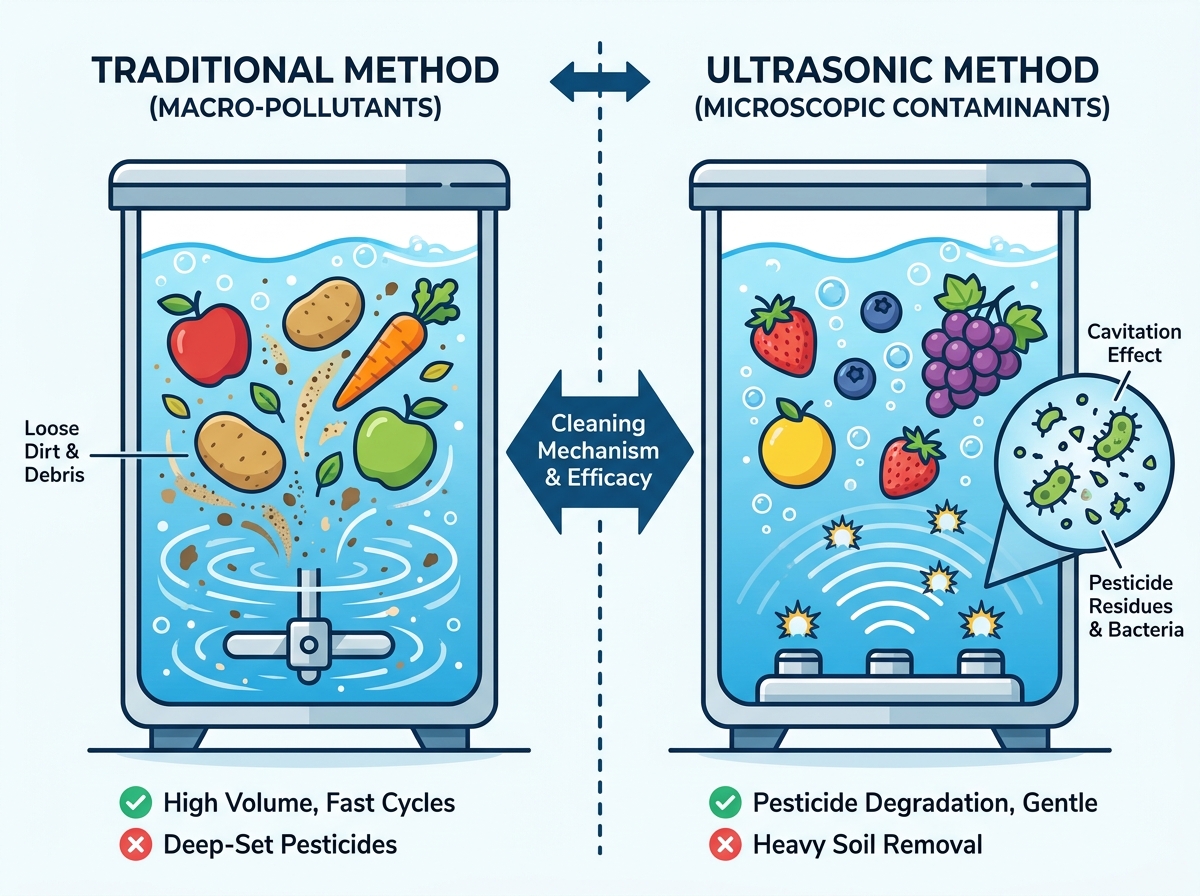
- Traditional fruit cleaning machines (pulsator/bubble) excel at removing loose dirt and heavy debris but struggle with microscopic contaminants and deep-set pesticides.
- Ultrasonic fruit cleaning machines utilize cavitation to clean at a microscopic level, backed by food science literature for higher efficacy in pesticide degradation.
- Operational trade-offs exist: ultrasonic models require a higher upfront investment and specific capacity considerations, whereas traditional models are often cheaper and handle bulk hardier produce well.
- Selection should be based on produce volume, fragility, and specific contaminant concerns (e.g., commercial kitchens vs. health-conscious households).
Defining the Standard: Traditional Cleaning Methods and Machines
The Baseline Problem
Manual washing often fails. People usually use plain tap water. They hope it removes all hidden dangers. Consumer testing proves otherwise. Water only washes away loose surface dirt. It leaves stubborn chemical residues behind. Chemical vegetable washes create another problem entirely. They often leave secondary chemical residues on your food. This defeats the purpose of washing your greens. Commercial kitchens face even higher stakes. They process massive volumes of food daily. Manual washing wastes expensive labor hours. It also yields highly inconsistent cleaning results.
Mechanical Approaches: Bubble and Pulsator
Traditional machines solve the labor problem. They rely on physical agitation. These systems typically fall into two categories:
- Bubble Washing Machines: These push air through water. They create vigorous bubbling action. The bubbles agitate the water. This continuous motion lifts dirt from produce.
- Pulsator Washing Machines: These use rotating blades or impellers. They create strong water vortexes. The swirling water creates physical friction against the vegetables.
Success Criteria
Traditional machines excel in specific scenarios. They remove macro-pollutants effortlessly. Mud, sand, and insects wash away quickly. They work perfectly for robust vegetables. Potatoes, carrots, and apples handle the friction well. High-volume root vegetable processing relies heavily on these workhorses. They handle bulk loads efficiently. They also require very little training to operate.
The Gap in Traditional Cleaning
Traditional machines have distinct limitations. They struggle to address chemical residues and sticky waxes. Bacteria easily hide in porous or uneven surfaces. Broccoli florets trap dirt tightly. Strawberries have tiny seeds on their exterior. Water friction cannot penetrate these microscopic crevices. The physical agitation only cleans the outermost exposed layers. Relying solely on a traditional fruit cleaning machine leaves microscopic threats intact. You need a different approach for true sanitation.
Common Mistakes
Do not over-rely on chemical additives in traditional machines. Adding more soap does not improve deep cleaning. It simply increases the risk of soap absorption into porous vegetables.
The Science of Ultrasonic Fruit Cleaning Machines
Mechanism of Action
Ultrasonic machines operate on a completely different scientific principle. They do not rely on visible water friction. Instead, they use high-frequency sound waves. These sound waves travel through the water bath. They create a phenomenon called the "cavitation effect." The sound waves generate millions of microscopic bubbles. These tiny bubbles grow rapidly. Then, they implode violently against the surface of the produce. This implosion releases a tiny but powerful burst of energy. We call this a micro-jet. These micro-jets scrub the food at a microscopic level. They reach into every tiny crevice. They clean areas invisible to the naked eye.
Evidence-Oriented Efficacy
Food science and biotechnology research back this technology. Ultrasonic cleaning degrades specific pesticide molecular chains. The intense energy breaks down complex chemical bonds. This renders the pesticides harmless. It also disrupts bacterial cell walls. The implosions physically tear apart pathogens like E. coli and Salmonella. Studies show ultrasonic cleaning significantly outperforming tap water. It removes a much higher percentage of surface-level agricultural chemicals. It offers a verifiable method for deep sanitation.
Produce Integrity
You might worry about damaging delicate foods. The cavitation process sounds violent. However, it cleans deeply without physical abrasion. The energy acts on a microscopic scale. It does not tumble or smash the produce. Raspberries, blueberries, and leafy greens remain perfectly intact. A properly calibrated ultrasonic fruit cleaning machine prevents the bruising caused by pulsator machines. It extends the shelf life of delicate berries.
Best Practices
Always use room-temperature water. Extremely hot water can prematurely cook delicate greens. Extremely cold water reduces the efficiency of the cavitation effect.
Head-to-Head Evaluation: Ultrasonic vs. Traditional
Equipment Comparison Data
| Evaluation Dimension | Traditional (Bubble/Pulsator) | Ultrasonic Cavitation |
| Heavy Soil & Debris | Excellent | Medium (Pre-rinse often needed) |
| Chemicals & Wax | Low to Medium | High Effectiveness |
| Pathogen Disruption | Low (Relies on wash additives) | High (Cell wall destruction) |
| Delicate Fruits Safety | Poor (Can cause bruising) | Excellent (No physical abrasion) |
| Processing Speed | Fast (Continuous flow possible) | Slower (Requires batch processing) |
Dimension 1: Contaminant Removal Efficiency
Traditional machines score high for soil and visible debris. However, they score low for chemicals and pathogens. Ultrasonic machines flip this dynamic. They offer high efficiency for microscopic pathogens and pesticide residues. They score medium for heavy soil. Heavy mud can absorb the sound waves. This weakens the cavitation effect. Therefore, heavily soiled root vegetables often require a quick pre-rinse before ultrasonic cleaning.
Dimension 2: Operational Efficiency and Labor
Traditional machines win on sheer speed. They run fast cycles. They handle high volume easily. Many commercial models allow continuous feeding. You pour dirty produce in one end. Clean produce exits the other end. Ultrasonic machines require batch processing. You must fill the tank. You run a cycle for 5 to 15 minutes. Then, you drain and remove the batch. This slows down total throughput. Commercial kitchens must plan their prep schedules accordingly.
Dimension 3: Cost and Scalability
Let us compare upfront capital expenditure versus long-term value. Traditional machines generally cost less upfront. They use simple mechanical parts. Ultrasonic models require specialized transducers. This increases the initial purchase price. However, ultrasonic machines offer excellent long-term value. You save money on consumable chemical fruit washes. You also reduce produce spoilage. Microscopic cleaning extends the shelf life of costly berries and greens. This minimizes food waste.
Dimension 4: Maintenance and Longevity
Maintenance profiles differ significantly. Traditional machines have many moving parts. Motors, belts, and impellers wear out over time. They require regular mechanical maintenance. Ultrasonic units have no moving parts in the cleaning tank. The primary wear component is the transducer. Transducers degrade very slowly over many years. Eventually, they lose their cleaning power. You will need to replace the unit or the transducers down the line.
Implementation Realities: Risks and Limitations
The Overkill Factor
You must assess your actual needs. Lab-grade ultrasonic cleaners are often unnecessary for basic household use. Peeling an orange removes the pesticides on the skin. Boiling potatoes kills surface bacteria. If you only eat thick-skinned, cooked produce, ultrasonic cleaning provides diminishing returns. Standard washing suffices for these specific scenarios. Do not overcomplicate a simple kitchen routine.
Capacity Constraints
Cavitation requires physical space to work effectively. Water must surround every piece of produce. Sound waves must travel freely through the liquid. Overcrowding the basin drastically reduces ultrasonic efficacy. If you pack too many apples into the tank, the waves cannot reach the center. You must maintain a strict water-to-produce ratio. This often means running multiple smaller batches. Impatient operators often ignore this rule. This completely nullifies the benefit of the machine.
Noise Levels
Ultrasonic machines generate specific sound frequencies. The transducers operate at high pitches. They create a distinct buzzing or squealing noise. This represents a common pain point for residential and commercial users. Prolonged exposure in a quiet home kitchen can feel irritating. Commercial kitchens naturally have higher ambient noise. However, operators should still expect noticeable high-pitch hums during operation.
False Promises in the Market
Beware of cheap, underpowered gadgets. The market features many battery-operated "ultrasonic wands". These tiny devices claim to clean entire sinks full of water. They lack the wattage to produce genuine cavitation. A true ultrasonic fruit cleaning machine requires significant electrical power. It needs multiple heavy-duty transducers attached to the tank. Always verify the wattage specifications before purchasing. Small wands offer nothing more than a placebo effect.
Decision Framework: Choosing the Right Fruit Cleaning Machine
When to Choose a Traditional (Bubble/Pulsator) Machine
Certain operations thrive on traditional mechanics. You should select a bubble or pulsator model if:
- You primarily process high-volume root vegetables like potatoes and carrots.
- You operate under strict upfront budget constraints.
- Your primary concern revolves around visible dirt, mud, and physical debris.
- You need continuous, non-stop feeding capabilities for industrial meal prep.
When to Choose an Ultrasonic Fruit Cleaning Machine
Precision cleaning requires advanced technology. You should invest in an ultrasonic model if:
- You prioritize the breakdown of pesticide residues and chemical wax removal.
- You frequently process fragile, thin-skinned, or highly porous fruits. Examples include berries, grapes, and leafy greens.
- You run a commercial environment needing verifiable sanitation protocols. Juice bars and raw food restaurants benefit immensely.
- You want to extend the shelf life of expensive organic produce by removing decay-causing bacteria.
Shortlisting Logic and Specifications
If you decide to purchase, pay attention to exact specifications. Ignore marketing fluff. Focus on these critical metrics:
- Transducer Frequency: Look for 40kHz. This frequency provides the ideal balance. It remains aggressive enough for dirt but gentle enough for fragile produce.
- Adequate Wattage: Ensure the machine offers roughly 50 to 100 watts per gallon of water capacity. Anything less will struggle to clean a full load.
- Tank Capacity: Buy a size slightly larger than your daily batch needs. Remember, you cannot overcrowd the tank.
- Integrated Drainage Systems: Commercial units must have large, easy-to-access drain valves. Emptying heavy tanks manually causes workplace injuries.
Conclusion
The "best" machine remains entirely context-dependent. Traditional machines stand as the ultimate workhorses for heavy physical soil. They move fast and clear away mud efficiently. However, ultrasonic technology offers scientifically backed advantages for microscopic cleaning. It excels at breaking down pesticides and destroying unseen pathogens.
Here are your action-oriented next steps:
- Audit your most frequently washed produce. Identify if you handle mostly root vegetables or delicate berries.
- Calculate your daily processing volume. Determine if you can accommodate batch processing times.
- Evaluate your budget against your sanitation requirements.
- Source equipment from reputable commercial suppliers who list exact wattage and frequency specifications.
Take the time to assess your kitchen’s unique demands before finalizing any equipment purchase.
FAQ
Q: Does a fruit cleaning machine remove 100% of pesticides?
A: No machine removes 100% of agricultural chemicals. Some pesticides penetrate deep into the cellular structure of the plant during growth. However, an ultrasonic machine significantly reduces surface-level residues compared to plain tap water. It breaks down the molecular chains of topical pesticides and waxes effectively.
Q: Can ultrasonic cleaners damage delicate fruits like raspberries?
A: No, they do not cause physical damage if properly calibrated. Ultrasonic cleaning relies on microscopic cavitation, not physical tumbling. A frequency setting around 40kHz remains perfectly safe for fragile berries. It prevents the bruising and tearing typically caused by aggressive pulsator machines.
Q: Are chemical fruit washes better than an ultrasonic machine?
A: Chemical washes present recurring costs and potential drawbacks. You must buy them continuously. They also risk leaving secondary chemical residues on your food. An ultrasonic machine requires a higher initial investment but uses only water and sound energy. This eliminates recurring chemical costs and secondary residue risks.
Q: Do I need a lab-grade ultrasonic cleaner for home use?
A: You do not need a lab-grade unit for a residential kitchen. Lab-grade machines often feature extreme frequencies and lack food-safe certifications. Purpose-built food cleaners provide the correct 40kHz frequency. They feature food-grade stainless steel tanks. They offer sufficient wattage for daily household produce safety.


