Moving away from manual washing methods transforms food preparation fundamentally. Automated systems now dominate the modern processing landscape. They scale commercial juice lines efficiently. They also deliver verifiable food safety for high-end home kitchens. Manual rinsing often leaves hidden surface contaminants entirely intact. Modern technology solves this persistent problem effectively.
However, severe market confusion exists today. Buyers often struggle to differentiate between unverified residential "pesticide purifiers" and high-throughput commercial processing equipment. Marketing claims frequently obscure actual mechanical capabilities. Choosing the wrong system leads to bruised produce, wasted water, and compromised food safety. We frequently see facilities install inadequate systems due to poor initial research.
This article breaks down everything you need to know. We provide an objective framework for matching machine capabilities to your exact requirements. You will learn how to evaluate technology, scale, and build quality effectively. We cut through the noise so you can make a confident, evidence-based equipment decision.
Key Takeaways
- Match tech to produce: Delicate berries require air-bubble washing, while root vegetables need brush-roller or ultrasonic technology.
- Scale dictates the system: Commercial viability relies on continuous throughput (kg/hr) and water-recycling capabilities, not just cleaning power.
- Prioritize verifiable specs over marketing claims: Look for food-grade stainless steel (SS304/SS316), standardized food safety compliance, and accessible maintenance over unproven "100% pesticide removal" guarantees.
Defining Your Operational Scale and Success Criteria
Operational scale heavily dictates your ideal equipment choice. You must first evaluate your specific application environment thoroughly. Residential kitchens require a compact countertop footprint. They demand absolute ease of use. You should maintain realistic expectations regarding pesticide degradation. Independent reviews from outlets like Wirecutter highlight the limitations of small purifiers. These units handle light surface cleaning well. They cannot replace robust mechanical agitation.
Mid-sized commercial setups need fundamentally different features. Restaurants and small community farms focus on batch-processing efficiency. They prioritize long-term durability. Operators need ergonomic loading and unloading mechanisms. Industrial production plants operate on an entirely different level. Processing facilities require seamless continuous integration. They measure success by ton-per-hour (t/h) throughput. Automated discharge capabilities become strictly necessary at this scale.
Next, you must identify your primary target contaminants. Different pollutants require completely different removal strategies. You cannot treat all soil and chemical residues identically.
- Surface dirt, soil, and grit: This category demands high physical agitation. Heavy particulate matter sinks rapidly. Your system needs robust bottom filtration to trap these heavy particles effectively.
- Waxes, oils, and chemical residues: Removing these substances requires precise temperature control. Cold water rarely dissolves wax. Specific aqueous ozone or hydroxyl technology handles these stubborn chemical layers safely.
- Pathogen load reduction: Facilities targeting dangerous bacteria rely on integrated sanitization. Standard water washing fails here. UV light chambers or commercial ozone integration neutralizes these biological threats effectively.
You must map your primary contaminant to the correct mechanical solution. A mismatch here leads to failed safety audits. It also causes unnecessary product spoilage.
Evaluating Core Fruit Cleaning Technologies
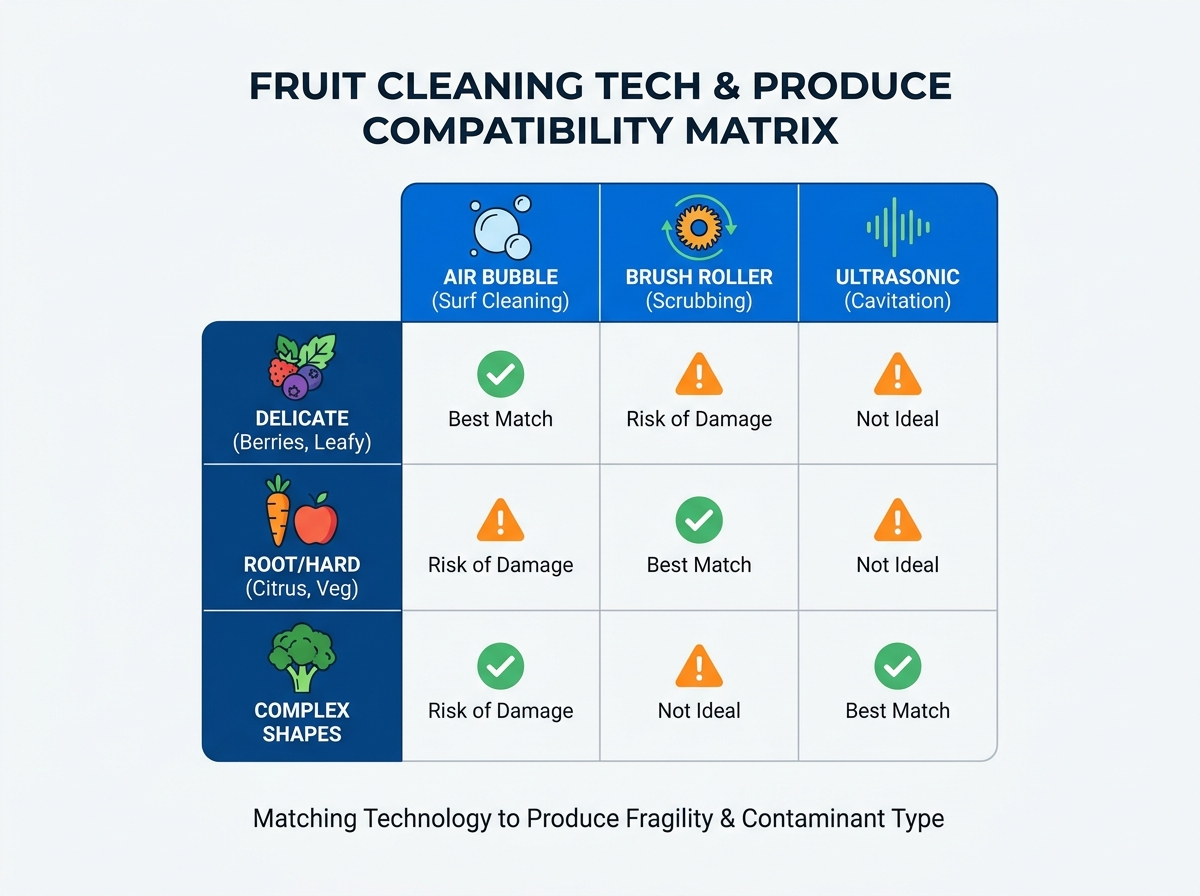
The market offers several distinct cleaning technologies. You must match the physical mechanism to your specific produce type. Using aggressive machinery on fragile items causes catastrophic damage. Finding the ideal fruit cleaning machine requires understanding these core mechanics.
Air Bubble Washing Machines utilize a specialized surf cleaning method. The system forces high-pressure air through submerged pipes. This action creates a gentle tumbling water effect. This surfing motion protects delicate surfaces beautifully. It works best for leafy greens, fresh strawberries, and ripe tomatoes. Easily bruised fruits thrive in this highly oxygenated environment.
Brush Roller and Peeling Machines scrub the produce surface directly. Hard rotary brushes rotate rapidly to dislodge stubborn, caked-on dirt. They excel at processing dense root vegetables. Carrots, potatoes, and thick citrus fruits handle this friction easily. You can also utilize them for commercial wax removal or light skin peeling operations.
Ultrasonic Cleaning Systems rely on rapid microscopic cavitation. Millions of tiny bubbles form and collapse continuously. This process penetrates microscopic crevices easily. They work exceptionally well for complexly shaped items. Broccoli and cauliflower benefit from ultrasonic waves. However, operators require careful equipment calibration here. Improper high-frequency settings cause permanent cellular damage to soft fruits.
Ozone and Hydroxyl Water Systems neutralize dangerous surface pathogens. They infuse standard wash water utilizing reactive oxygen species. These volatile compounds break down certain pesticide residues safely. We must evaluate these specific claims objectively. Ozone provides excellent bacterial load reduction. It destroys E. coli and Salmonella effectively. However, no machine removes 100% of systemic pesticides. Systemic chemicals reside deep inside the internal plant tissue. Surface treatments simply cannot reach them.
| Technology Type | Primary Mechanism | Ideal Produce Application | Key Safety Consideration |
| Air Bubble (Surf) | High-pressure aeration | Berries, leafy greens, tomatoes | Requires regular nozzle descaling |
| Brush Roller | Friction and scrubbing | Potatoes, carrots, citrus | Brushes harbor bacteria if uncleaned |
| Ultrasonic | High-frequency cavitation | Complex shapes, dense vegetables | May rupture cells in soft berries |
| Ozone/Hydroxyl | Reactive oxygen oxidation | High-risk organic produce | Requires strict ambient ventilation |
Must-Have Features and Evaluation Dimensions
Selecting the right equipment requires analyzing specific engineering dimensions. You need a highly capable machine aligned to your exact outcome goals. Do not rely on basic visual aesthetics. Focus entirely on industrial output metrics and material compliance.
Throughput and capacity dictate your daily operational success. You must calculate your required processing volume accurately. Match the machine batch size to your absolute peak daily needs. Belt speed determines your continuous flow rates. Undersized units cause massive production bottlenecks during harvest seasons. Oversized units waste massive amounts of utility resources unnecessarily.
Material quality remains absolutely critical for compliance. Commercial food safety demands uncompromising structural material choices. Utilizing SS304 or SS316 stainless steel is non-negotiable. It provides essential, long-term corrosion resistance. Acidic fruit juices destroy lesser metals rapidly. You must verify food safety compliance thoroughly during your inspection.
Look specifically for easily removable transport belts. Accessible internal corners speed up daily sanitation. Seamless welding prevents bacterial buildup. Your sanitation team must execute CIP (Clean-in-Place) protocols quickly. Machines harboring hidden blind spots will eventually fail standard USDA or local health inspections.
Resource efficiency heavily impacts your daily environmental footprint. Fresh water consumption represents a major operational hurdle. Look for built-in water filtration systems. Advanced cascade recirculation capabilities lower utility demand significantly. You must also evaluate phase-power requirements carefully. Small countertop units run on standard 110V/220V lines comfortably. Large industrial processing equipment requires dedicated 3-phase electrical setups. Attempting to retrofit a facility for 3-phase power causes extreme implementation delays.
Common Pitfalls and Gimmicks to Avoid
Many buyers fall into predictable marketing traps. Consumer protection forums frequently highlight these common industry mistakes. Navigating the equipment market requires heavy skepticism. You must separate verified engineering from inflated sales promises.
The "Zero Pesticide" myth remains the most prevalent gimmick. Be highly skeptical of perfect chemical removal claims. You must understand the core biological difference here. Systemic pesticides grow inside the fruit itself. The plant absorbs them through the root system. Contact pesticides merely sit on the outer skin layer. Surface washing removes contact chemicals efficiently. It cannot extract systemic compounds safely. No surface wash alters internal plant chemistry.
Underestimating drainage and facility infrastructure happens frequently. Many promising facilities fail during the initial implementation phase. They completely ignore basic plumbing requirements. You need proper, sloped floor drains to handle excess water flow. Heavy agricultural runoff clogs standard pipes instantly. Installing heavy-duty grease and sediment traps prevents costly plumbing blockages. Furthermore, specialized ozone systems require extensive ambient air ventilation. You must protect facility workers from accidental respiratory irritation.
Ignoring the mechanical bruise rate destroys profitability. Buying an aggressive machine ruins soft produce inventory. Heavy-agitation devices handle root potatoes perfectly. They quickly obliterate delicate raspberries. High product yield loss negates any operational efficiency gained. You end up washing waste. Always match the baseline agitation level to your most fragile product. Slower, gentler processing yields significantly higher marketable output.
Shortlisting and Implementation Considerations
Finalizing your equipment decision requires strict due diligence. Follow a highly structured approach before signing any purchase order. You must eliminate assumptions early in the process. Ask demanding questions regarding specific mechanical tolerances.
- Request precise case studies. Ask the manufacturer directly for video demonstrations. These videos must feature your exact target produce. Watching a machine wash apples tells you nothing about its ability to handle soft peaches.
- Verify spare parts availability. Belts, spray nozzles, and rotary brushes wear out eventually. Ensure local technical support exists in your specific region. Waiting weeks for international shipping halts your entire production line.
- Assess operator training requirements. Complex commercial systems demand specialized staff knowledge. Your team must understand digital panel calibration. They must also execute daily maintenance teardowns confidently.
Finally, heavily scrutinize your system integration plans. Consider your entire production flow carefully. Your new equipment does not operate in total isolation. Determine exactly how it connects to upstream sorting tables. Evaluate all downstream connections carefully. The wet produce must transition smoothly into drying air knives. It then moves into juicing or packaging equipment. Seamless integration prevents costly manual handling delays. A perfectly washed apple degrades quickly if it sits wet in a holding bin.
Conclusion
Selecting the ideal processing equipment requires careful, continuous balance. You must weigh the inherent fragility of your produce against required daily processing volumes. Heavy root vegetables demand aggressive friction. Delicate berries require gentle pneumatic surfing. Your unique facility infrastructure dictates realistic installation options. You cannot ignore available electrical phasing or baseline floor drainage capacity.
Prioritize verifiable material safety over flashy marketing language. SS304 stainless steel and transparent throughput numbers matter most. We highly encourage buyers to consult a dedicated processing equipment engineer. You should request a customized, site-specific capacity calculation. Perform this critical step before ever requesting a formal manufacturer quote. Proper planning ensures seamless daily operation.
FAQ
Q: Can an industrial fruit washing machine handle both soft berries and hard root vegetables?
A: Some advanced bubble washers feature adjustable agitation controls. However, relying on a single machine presents significant risks. Dedicated or modular systems work much better. They prevent catastrophic damage to fragile berries. They also ensure adequate scrubbing pressure for dense root vegetables. Attempting to process entirely different profiles simultaneously usually compromises overall quality.
Q: How much water does a commercial fruit cleaning machine use?
A: Modern commercial units consume surprisingly little fresh utility water. They utilize innovative cascade water systems internally. Integrated multi-stage filtration allows the equipment to recycle water continuously. This advanced recycling significantly reduces hourly consumption rates. The exact gallon usage depends heavily on your overall throughput scale and soil load.
Q: Are ozone fruit purifiers actually safe for food processing?
A: Yes, they operate safely when calibrated correctly. Operators must strictly follow established FDA and USDA standards. Ozone leaves absolutely zero chemical residue behind. It naturally reverts back to safe oxygen after sanitization. However, proper ambient ventilation remains strictly required. Adequate airflow ensures continuous worker safety during heavy production runs.


