Transitioning from manual washing to automated processing is a significant CapEx decision. It directly impacts your product yield, labor overhead, and food safety compliance. Upgrading your equipment fundamentally changes how your facility operates during peak shifts.
Selecting the wrong equipment often results in bruised produce, bottlenecked production lines, or excessive water waste. You might face unexpected downtime if the chosen system cannot handle your specific soil loads. We see many facilities struggle because they miscalculate their exact washing needs early in the planning phase.
This guide provides a clear framework to evaluate technical specifications before you request vendor quotes. You will learn how to match machine types to your specific produce and effectively assess return on investment. Let us explore how you can streamline your operations and ensure consistent product quality across every batch.
Key Takeaways
- Define your required throughput (kg/hour) and floor space limits before exploring equipment categories.
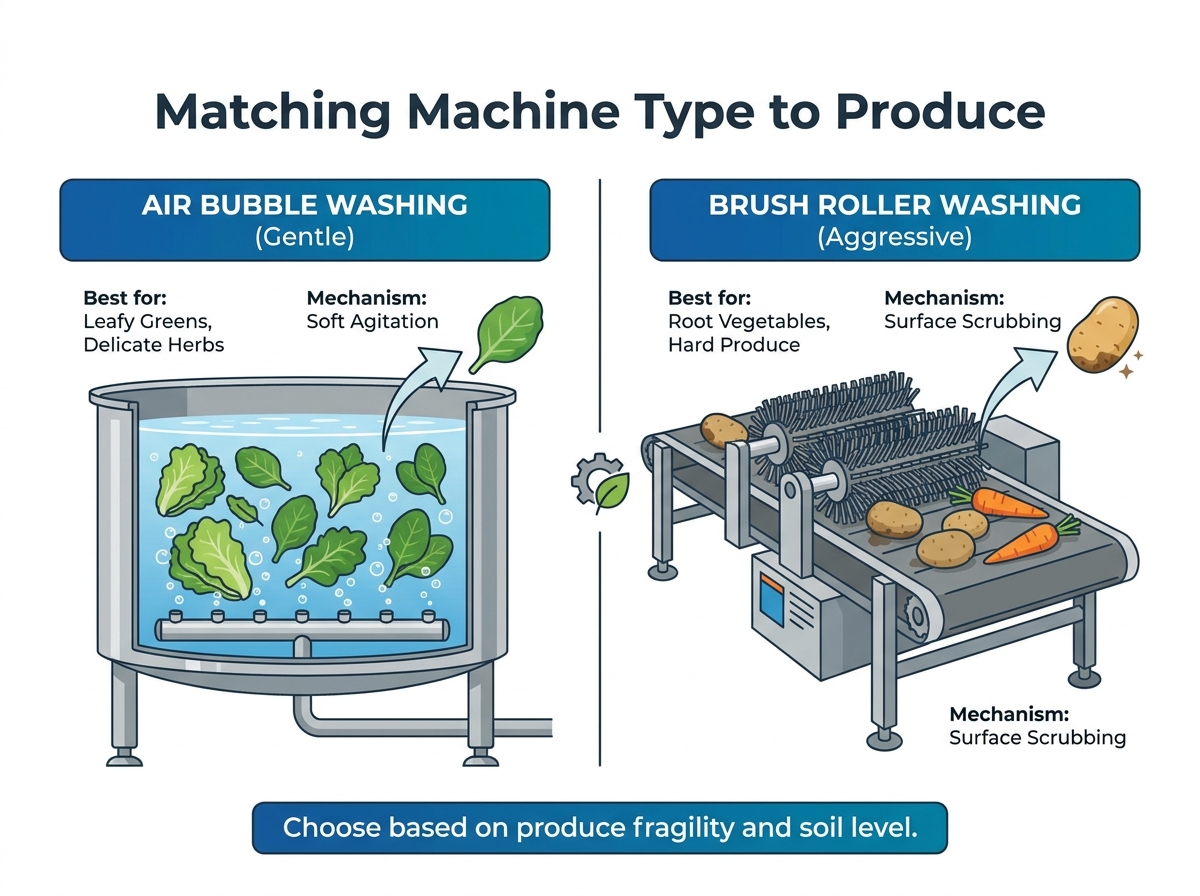
- Match the machine's agitation method (e.g., air bubble vs. brush roller) to the fragility and soil level of your specific vegetables.
- Prioritize food-grade 304 stainless steel construction and accessible drainage systems to meet HACCP and local health compliance standards.
- Look beyond the sticker price; factor in water recycling capabilities, energy consumption, and daily maintenance labor when calculating ROI.
Defining Your Baseline: Capacity, Space, and Success Criteria
Purchasing industrial equipment requires a strict evaluation of your current operational baseline. You cannot improve what you do not accurately measure. Establishing clear metrics ensures your new investment aligns perfectly with your production goals.
Throughput Requirements
You must calculate your peak hourly volume in kilograms per hour. Many buyers mistakenly use daily averages to size their equipment. Daily averages hide the intensity of surge periods. If your morning shift processes 70% of your daily volume, a machine sized for an even daily average will severely bottleneck your line. Always add a 20% capacity buffer to your peak hourly calculation. This buffer accommodates seasonal harvest spikes and future business growth.
Yield Protection
Every facility must define its acceptable damage thresholds. Automated washing must balance aggressive soil removal against the structural integrity of the produce. Soft leafy greens bruise instantly under harsh agitation. Conversely, root vegetables require aggressive mechanical action to dislodge heavy clay. You should document the fragility of your primary crops. This documentation directly influences the specific washing mechanism you eventually select.
Labor Reallocation
Establish your baseline manual washing costs right now. Track the exact number of man-hours spent scrubbing, soaking, and moving produce. Once you calculate this current labor spend, you can accurately project the ROI timeline for your new equipment. You do not just eliminate labor costs. You reassign those workers to higher-value tasks. Moving staff from manual washing to quality control or packaging significantly boosts overall plant productivity.
Facility Constraints
Audit your processing floor thoroughly before considering specific models. We often see buyers purchase machines they cannot physically fit into their workflow. Measure your available square footage. Map the proximity of commercial floor drains. Confirm your phase power availability at the proposed installation site. A robust machine requires adequate drainage to prevent floor pooling. It also demands sufficient power to run high-torque motors without tripping facility breakers.
Core Types of Vegetable Cleaning Machines Explained
Selecting a commercial vegetable cleaning machine heavily dictates your final product quality. The market offers distinct categories tailored to specific crop types. Understanding their mechanisms prevents costly misapplications.
Air Bubble Washing Machines (Surf Washers)
These machines utilize high-pressure fans and air pipes installed beneath a water tank. The fans force air upward, creating a vigorous, tumbling water bath. This tumbling action mimics the gentle scrubbing of human hands but on a massive scale.
They are best suited for delicate items. We highly recommend them for leafy greens, fragile herbs, berries, and soft fruits. The buoyant nature of the bubbles lifts dirt without crushing cellular structures.
However, air bubble systems have strict limitations. They struggle against heavy clay or deeply embedded dirt. If you process unwashed potatoes straight from muddy fields, an air bubble washer will likely leave a dirt film behind.
Brush Roller Washing Machines
Brush roller systems rely on direct mechanical friction. They feature a bed of rotating cylindrical nylon brushes. As vegetables move across this bed, the brushes aggressively scrub the outer surface. You can customize brush stiffness based on the application.
They excel at processing hard root vegetables. Facilities use them extensively for potatoes, carrots, beets, and ginger. Depending on the brush texture, these machines can either gently wash or fully peel the vegetables.
Their main limitation is the potential for produce damage. They will completely destroy fragile greens or soft fruits. Furthermore, the nylon brushes wear down over time. You must schedule regular brush replacements to maintain peak cleaning efficiency.
Eddy Current / Vortex Washers
Vortex washers employ a sophisticated spiral water flow. Pumps generate a continuous circular current inside the washing tank. This whirlpool effect provides continuous, gentle cleaning while simultaneously transporting the produce forward.
This technology is perfect for pre-cut vegetables. Diced root crops, shredded cabbage, and mixed salad blends thrive in vortex washers. The swirling water separates cut pieces and flushes out hidden debris efficiently.
The downsides include a higher upfront investment. Vortex machines also demand a larger facility footprint compared to standard air bubble tanks. They require precise water flow calibration to prevent damaging the cut produce.
Equipment Comparison Breakdown
Review the chart below to quickly match your produce type to the appropriate washing technology.
| Machine Type | Primary Mechanism | Ideal Produce | Key Limitation |
| Air Bubble Washer | High-pressure air agitation | Leafy greens, soft fruits, herbs | Ineffective on heavy clay and roots |
| Brush Roller | Rotating nylon friction brushes | Potatoes, carrots, hard roots | Destroys soft or fragile produce |
| Eddy Current / Vortex | Spiral whirlpool water flow | Pre-cut vegetables, mixed salads | Higher initial cost, larger footprint |
Key Evaluation Criteria for Commercial Buyers
Look beyond basic functionality when evaluating different models. Build quality and sanitation features separate professional-grade equipment from temporary solutions. You must scrutinize the engineering choices made by the manufacturer.
Material and Build Quality
You must insist on SUS304 or 316 food-grade stainless steel construction. Continuous water exposure quickly degrades inferior metals. Avoid any machines utilizing mild steel framing. You should also reject equipment featuring non-food-grade plastics. Cheap materials inevitably lead to rapid corrosion. Corrosion creates micro-fissures where dangerous bacteria multiply. This compromises your entire food safety protocol.
Water and Resource Efficiency
Industrial washing consumes massive volumes of water. Evaluate machines offering integrated water filtration systems. Recirculation tanks capture overflow, filter out particulate matter, and pump clean water back into the main bath. This closed-loop approach drastically minimizes utility overhead. High-efficiency models can dramatically lower your monthly water bills. They also help facilities meet increasingly strict municipal wastewater regulations.
Sanitation Accessibility
A machine is only useful if your staff can clean it thoroughly. Assess how easily operators can disassemble the unit for end-of-shift washdowns. You want quick-release belts and easily removable spray nozzles. Inspect the internal tank design closely. Look for sloped drainage pans. Reject designs featuring sharp blind corners or tight crevices. Dirt accumulates in blind corners, creating major bacterial hazards.
Common Sanitation Mistakes
- Buying equipment requiring specialized tools just to remove the primary conveyor belt.
- Ignoring the accessibility of the bottom drainage valves during the visual inspection.
- Failing to ensure the control panel carries an adequate IP-65 or higher waterproof rating.
Component Reliability
The mechanical core of your machine dictates its lifespan. Verify the manufacturer uses standard, off-the-shelf motors and electrical components. Brands like Siemens, Schneider, or Danfoss represent reliable industry standards. Proprietary motors pose a massive risk. If a proprietary motor burns out, you might wait weeks for international shipping. Using universal components ensures your local technicians can source replacement parts same-day.
Facility Requirements and Food Safety Compliance
Your processing floor must support the new equipment seamlessly. Overlooking infrastructure prerequisites causes severe installation delays. You must strictly align the machine specifications with your building capabilities and health inspector requirements.
Utility Prerequisites
Cross-check the machine's electrical demands against your current infrastructure. Determine if the unit requires single-phase or three-phase power. Large brush rollers almost always demand three-phase voltage for necessary startup torque. Next, verify your facility's water inlet pressure. Finally, calculate your floor drain capacity. A tank dumping 500 liters of water during an emergency drain will flood a poorly designed processing room instantly.
HACCP Alignment
Your Hazard Analysis and Critical Control Points (HACCP) plan dictates your daily operations. Ensure the machine's design actively supports your HACCP guidelines. The equipment must allow for rapid visual inspections. It should facilitate precise temperature monitoring if you use chilled water systems. Documented, repeatable cleaning procedures are mandatory for food safety audits. A well-engineered washer makes passing these audits much easier.
Chemical Compatibility
Facilities rely on strong commercial sanitizers to eliminate pathogens. Common chemicals include chlorine solutions, peracetic acid, and quaternary ammonium compounds. You must confirm the machine's internal pumps, rubber seals, and conveyor meshes withstand these specific chemicals. Incompatible seals degrade rapidly, causing leaks and requiring constant maintenance downtime. Discuss your exact chemical regimen with the manufacturer before purchasing.
Operator Safety
Protecting your workforce is non-negotiable. Inspect the equipment for standard safety features. Emergency stop buttons must sit within immediate reach of the operator station. All moving parts, especially drive chains and motor belts, require heavy-duty shielding. Confirm the electrical panel includes built-in overload protection. Overload sensors automatically shut down the motor if a rock jams the conveyor system, preventing catastrophic mechanical failure and operator injury.
How to Shortlist Suppliers and Make Your Final Decision
Narrowing down your vendor list requires a systematic approach. Do not rely solely on glossy brochures. You must demand proof of performance and clear contractual protections before signing any purchase orders.
Requesting Sample Tests
Never assume a machine cleans your specific crop perfectly. Ask shortlisted manufacturers to run a live test batch. Send them a sample of your produce in its standard, unwashed state. Request unedited video footage of the entire wash cycle. This visual proof verifies the cleaning efficacy. It also allows you to calculate exact damage rates before committing capital. A reputable vendor welcomes this testing process.
Warranty and SLA Terms
Examine the fine print of every warranty document. You must distinguish between structural warranties and wear-and-part warranties. Structural framing usually carries a multi-year guarantee. However, belts, nylon brushes, and rubber gaskets break down naturally. Clarify exactly how long the vendor guarantees these wear parts. Understand your Service Level Agreement (SLA). Know exactly who pays for shipping if a defective motor needs replacing.
Post-Sale Support
Excellent machinery becomes useless without reliable technical support. Evaluate the vendor's average response time during initial communications. Ask about the availability of local, certified technicians. You must insist on comprehensive, English-language operational manuals. Ensure they provide detailed troubleshooting guides and electrical schematics. Navigating a machine breakdown is incredibly stressful if the manual lacks clear diagnostic steps.
Structuring the Quote
Refuse vague, lump-sum pricing documents. You must request heavily itemized quotes to compare vendors accurately. Follow this quoting structure to maintain transparency:
- Base Machine Cost: The exact price of the bare equipment.
- Custom Modifications: Costs for extended conveyors or upgraded motors.
- Shipping and Customs: Door-to-door freight charges, including any import tariffs.
- Installation and Commissioning: Fees for technicians to set up and calibrate the line.
- Spare Parts Kit: Pricing for an essential backup kit containing extra belts, bearings, and fuses.
Separating these costs prevents hidden markups. It provides absolute clarity on what you actually pay for.
Conclusion
Investing in commercial washing equipment is ultimately about aligning mechanical action with biological realities. Your produce dictates the required technology. Matching delicate greens to gentle air bubbles, or rugged roots to firm brushes, ensures maximum yield and minimal waste.
Always prioritize ease of sanitation and long-term reliability over flashy, novel features. An advanced machine that takes three hours to clean will eventually become a major food safety liability. Your operators need accessible, straightforward equipment to maintain peak daily performance.
Take action today by mapping out your current facility constraints. We recommend downloading a technical specification checklist to guide your internal audits. Contact an equipment specialist to schedule a capacity consultation, and send a sample of your most challenging crop for a live washing demonstration.
FAQ
Q: How much water does a commercial vegetable cleaning machine use?
A: Water consumption varies heavily by machine capacity and design type. Standard continuous-flow models consume significant volumes. However, modern models featuring built-in filtration and recirculation tanks efficiently reuse water. These closed-loop systems can reduce overall water usage by up to 50-70% compared to older, continuous-flow setups. Always check the required liters-per-hour rating.
Q: Can one machine wash both leafy greens and root vegetables?
A: While some hybrid machines exist on the market, using one unit for both is generally ineffective. Brush rollers quickly bruise and tear delicate greens. Conversely, air bubbles fail to dislodge embedded clay from hard roots. We strongly recommend building modular lines or purchasing dedicated machines for mixed processing operations.
Q: What is the standard maintenance schedule for this equipment?
A: Operators must conduct visual inspections and perform thorough washdowns daily. Maintenance teams should grease all exposed bearings and drive chains weekly to prevent rust. You need quarterly assessments of high-wear parts. Regularly inspect drive belts for fraying and check nylon brushes for flattening, replacing them promptly to maintain cleaning efficiency.
Q: Does the machine dry the vegetables after washing?
A: Washing represents only the first step. Some washers include basic overhead air blowers to knock off excess surface water. However, this does not dry the produce completely. A dedicated dewatering machine, such as a centrifugal spinner or a high-velocity air-knife tunnel, is usually required to prepare produce for final packaging.


