Procuring industrial equipment remains a high-stakes decision for any facility manager. Under-speccing your washing equipment leads to immediate production bottlenecks. Conversely, over-speccing destroys your return on investment and ties up capital. The modern washing landscape demands exact precision. Today's vortex cleaning relies on advanced fluid dynamics. It effectively removes heavy contaminants without damaging the underlying product. This holds true whether you process delicate leafy greens or machined industrial components.
Navigating the equipment market requires a clear, objective strategy. This guide provides a vendor-agnostic evaluation framework. It helps operations and procurement teams make informed decisions based on technical realities. We will show you how to match machine specifications directly with your facility footprint. You will learn to align equipment capabilities with compliance mandates and daily throughput targets. By the end, you will know exactly how to select the right system for your specific production line.
Key Takeaways
- Match Agitation to Material: The choice between high-shear and gentle-flow vortex systems depends entirely on the fragility and density of the product being washed.
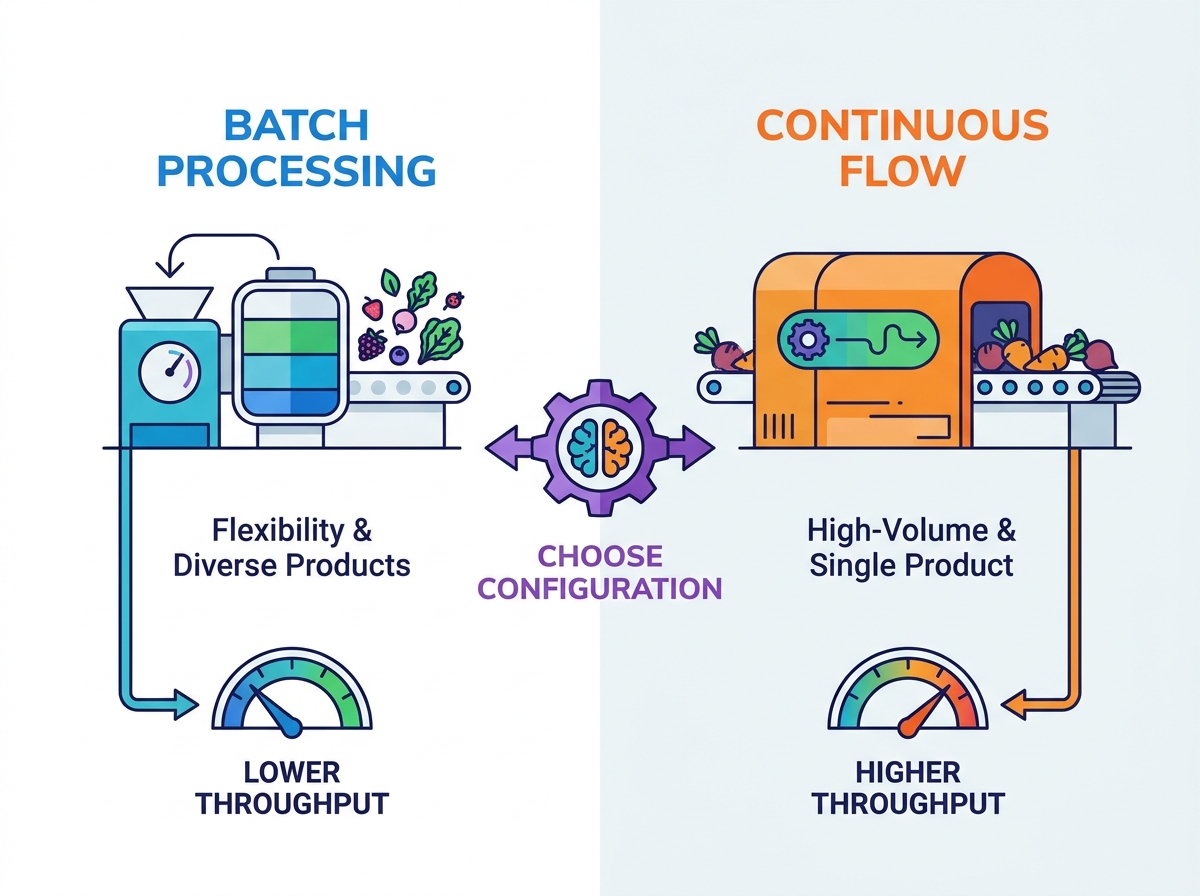
- Throughput Determines Configuration: Continuous-flow machines suit high-volume, single-product lines, while batch-processing units offer necessary flexibility for diverse operations.
- Prioritize Sanitary Design: In food and pharma applications, machines must feature crevice-free welds, toolless disassembly, and CIP (Clean-in-Place) compatibility to minimize cross-contamination risks.
- TCO > Purchase Price: Long-term viability hinges on water recycling efficiency, filtration maintenance, and utility consumption rather than the initial capital expenditure.
1. Defining Your Baseline: Production Volume and Material Constraints
Before reviewing equipment brochures, you must establish strict operational baselines. A successful procurement process starts by auditing your actual production needs. Identifying your precise throughput, material characteristics, and soil profiles prevents costly misalignments later.
Throughput Requirements (kg/hr)
You must establish verifiable minimum and maximum processing capacities. Relying purely on average daily volumes often leads to severe under-speccing. Production lines rarely operate at a perfectly flat rate. Deliveries arrive in bulk, and harvest times dictate sudden influxes of raw materials.
To avoid operational bottlenecks, calculate your surge volumes accurately. Identify your absolute peak hour of production during your busiest season. Multiply this peak volume by a safety factor of 1.2 to 1.3. This buffer ensures your vortex cleaning machine easily handles unexpected delivery spikes without slowing down downstream processing equipment.
Material Fragility vs. Density
Vortex dynamics must match the physical properties of your product. Applying the wrong water velocity will either destroy delicate items or fail to clean dense materials.
- Delicate organics (e.g., berries, leafy greens): These products require extremely gentle handling. You must look for systems featuring variable frequency drives (VFD). A VFD controls the water velocity precisely. Operators can dial down the pump speed to create a gentle swirl, preventing costly bruising and product degradation.
- Heavy/Rigid materials (e.g., root vegetables, hardware): Dense products demand aggressive mechanical action. These applications require high-torque pumps and aggressive aeration systems. The water must hit the product forcefully to dislodge stubborn particulates trapped in crevices.
Contaminant Profile
Classify the primary soils you need to remove. Field dirt and loose sand drop away easily under standard water flow. However, sticky clay, pesticides, machining oils, or metal shavings require targeted engineering.
Heavy soil loads dictate specific water pressure settings and advanced filtration requirements. If you wash root vegetables coated in thick mud, your machine needs a robust primary filter to prevent pump clogging. If you clean industrial parts coated in cutting fluids, you need skimmers and specialized overflow tanks to remove floating oils. Mapping your contaminant profile dictates the exact filtration architecture required.
2. Batch vs. Continuous Flow: Selecting the Core Configuration
The core architecture of your machine dictates how your entire facility operates. You must choose between batch processing and continuous flow. Each configuration serves entirely different production philosophies.
Batch Vortex Cleaning Machines
Batch systems wash defined quantities of product in distinct cycles. They excel in facilities processing multiple different product lines daily. They are also ideal for operations enforcing strict allergen segregation requirements.
The primary advantage is precision. Operators exercise absolute control over wash time, temperature, and chemical concentration for every single load. However, this configuration carries distinct drawbacks. It requires significant manual intervention for loading and unloading. Consequently, batch systems yield a lower overall hourly throughput compared to automated setups.
Continuous Vortex Cleaning Systems
Continuous systems accept a steady stream of product at one end and discharge clean product at the other. They are the undeniable choice for high-volume, mono-product processing lines running around the clock.
These machines deliver maximum efficiency and seamless automated integration. They eliminate the downtime associated with manual loading. The main disadvantage involves space and flexibility. Continuous systems demand a much larger facility footprint. Furthermore, they are notoriously harder to clear and sanitize during rapid product changeovers.
Horizontal vs. Vertical Agitation
The direction of water flow directly impacts processing efficiency. You must evaluate how the water moves inside the main tank.
Vertical vortexes create a deep, downward-pulling whirlpool. They excel at submerging floating items like leafy greens or hollow plastic parts, forcing them under the water surface for thorough cleaning. Conversely, horizontal flows create a pushing current. They perform better for advancing heavy, sinking items steadily down a long production flume.
Configuration Comparison: Batch vs. Continuous Flow
| Operational Feature | Batch Systems | Continuous Systems |
| Ideal Production Environment | High-mix, low-volume facilities | Low-mix, high-volume facilities |
| Changeover Speed | Fast and easily verifiable | Slow, requires flushing the entire line |
| Facility Footprint | Compact and modular | Large, linear space required |
| Automation Potential | Low to Medium | Extremely High |
3. Critical Specifications and Component Quality to Scrutinize
Looking past the marketing brochures is essential. You must evaluate the raw engineering data to determine machine reliability. Component quality dictates whether your machine runs flawlessly for ten years or fails within ten months.
Pump Size and Fluid Dynamics
Many buyers make the mistake of relying on pump horsepower alone. Horsepower only tells part of the story. You must evaluate liters-per-minute (LPM) circulation rates. A high LPM indicates a high volume of water turnover, which directly translates to cleaning power.
Additionally, assess the adjustability of the vortex manifold. Fixed manifolds limit your operational flexibility. Adjustable manifolds allow technicians to direct water jets precisely, optimizing the fluid dynamics for different product shapes and densities.
Filtration and Water Recycling
Industrial washing consumes massive amounts of water. You must thoroughly assess the primary and secondary filtration systems. Effective filtration separates debris rapidly, preventing soil from recirculating into the clean water zone.
Look specifically for wedge-wire screens. Unlike standard punched-hole mesh, wedge-wire profiles prevent particulates from wedging and clogging the screen. Demand systems featuring automatic debris discharge mechanisms. Overflow tanks are equally vital, as they continuously skim floating contaminants, significantly reducing total water consumption and improving sustainability metrics.
Material and Build Quality
Industrial environments destroy inferior materials rapidly. Insist on 304 or 316-grade stainless steel for all wetted parts. 304 stainless steel handles most standard applications, while 316 provides crucial resistance against harsh sanitizing chemicals and saline environments.
Check the gauge thickness on load-bearing tanks. Thin steel might look shiny, but it flexes under the immense weight of circulating water. Predict equipment lifespan by examining weld integrity and structural bracing. Continuous vibration from heavy pumps will quickly cause fatigue cracking in thin, poorly braced tanks.
Automation and PLC Integration
Modern production relies heavily on data. Evaluate the control panel's capability to integrate directly with your existing SCADA systems. Manual push-button controls are no longer sufficient for enterprise-level operations.
The Programmable Logic Controller (PLC) should store multiple wash recipes. This allows operators to switch between products with a single screen tap. Furthermore, the system must provide verifiable data logging. Tracking water temperature, chemical dosing history, and wash duration is critical for passing stringent quality assurance audits.
4. Navigating Compliance, Safety, and Sanitation Standards
Industrial equipment must protect both the end consumer and the machine operator. Ignoring compliance and safety standards opens your facility to failed audits, product recalls, and workplace injuries.
Sanitary Design Principles
Sanitary design is non-negotiable in food and pharmaceutical applications. Highlight the necessity of continuous, smooth welds. Spot welds and bolted seams create microscopic crevices where bacteria harbor and multiply.
Engineers must eliminate all "dead legs" within the piping system. A dead leg is a stagnant zone where water stops flowing, providing a perfect breeding ground for biofilm. Every surface inside the washing chamber must slope toward a drain, ensuring complete emptying during changeovers.
Regulatory Alignment
Ensure the equipment meets specific regional and industry standards. Relying on visual inspections is insufficient. You need verifiable certifications. In the food sector, look for adherence to FDA guidelines or Good Manufacturing Practices (GMP). European facilities should demand CE marking and compliance with EHEDG (European Hygienic Engineering & Design Group) guidelines. These frameworks guarantee the machine achieves the highest sanitary benchmarks.
Maintenance and Cleanability
A machine only generates revenue when it runs. A reliable system must allow for rapid, completely toolless disassembly. Operators should easily remove belts, lift filters, and access spray manifolds using only their hands.
Calculate the daily downtime required for mandatory washdown procedures. If a machine takes three hours to disassemble using wrenches, you lose massive production capacity. Snap-fit components and hinged access panels reduce turnaround times dramatically, keeping your production schedules intact.
Operator Safety
Equipment must protect the people running it daily. Check meticulously for standard safety features. Emergency stops must be highly visible and accessible from multiple angles around the machine footprint.
Drive mechanisms, belts, and rotating shafts must feature robust, interlocked enclosures. If an operator opens a guard door, the machine should immediately stop. Finally, evaluate the ergonomic loading heights. Forcing operators to lift heavy crates above shoulder level daily will inevitably cause musculoskeletal workplace injuries.
5. Assessing Implementation Risks and Operational Logistics
Evaluating physical integration and ongoing operational demands is crucial before finalizing any purchase. A machine might look perfect on a specification sheet but fail miserably once it arrives on your facility floor.
Utility Consumption
Frame your energy (kW/h) and weekly water usage as massive long-term operational drivers. You must audit exactly how much power and water the machine requires to sustain daily operations.
Compare machines featuring closed-loop water recycling against standard drain-and-fill models. A closed-loop system filters and treats wash water, reusing it across multiple cycles. While these setups require slightly higher energy to run internal recycling pumps, they drastically lower municipal water bills and reduce wastewater discharge penalties.
Spare Parts Availability and Vendor Support
Even the finest engineering requires eventual maintenance. A machine quickly becomes a massive liability if critical wear parts require an 8-week international lead time. You cannot afford to halt production while waiting for basic pump seals.
Scrutinize the vendor's domestic inventory deeply. Ask exactly which wear parts they stock locally. Belts, specialized nozzles, and sensors should ship within 24 hours. Furthermore, review their Service Level Agreement (SLA). Ensure they provide responsive technical troubleshooting during your actual operating hours, not just their local business hours.
Facility Integration Risks
Address the strict physical realities of installation early in the procurement phase. Measure your facility access points meticulously. Many buyers discover too late that their new machine cannot fit through standard facility loading doors without heavy modifications.
Examine your current drainage infrastructure. A high-capacity washing unit discharges hundreds of liters per minute during a flush cycle. Is your floor trench drain sufficient for this massive discharge rate, or will it flood the production floor? Finally, verify your electrical infrastructure. Ensure your facility supplies the specific voltage and electrical phases required to drive heavy industrial motors.
Conclusion
Selecting the right washing equipment dictates the efficiency of your entire production line. The ideal machine balances gentle product handling with ruthless contaminant removal. It ensures sustainable utility usage while meeting stringent sanitary requirements.
Your next step requires practical validation. We strongly advise buyers to request physical or live video demonstrations. Send your specific raw materials and soils to the vendor before finalizing any short list. Seeing the equipment handle your exact product provides clarity no brochure can offer.
Take action today to secure your operational efficiency. Download a spec-sheet comparison template to standardize your vendor evaluations. Alternatively, contact a specialized engineering team for a customized throughput analysis tailored exactly to your facility footprint.
FAQ
Q: Can a single vortex cleaning machine handle both delicate and heavy products?
A: Yes, provided it is equipped with a Variable Frequency Drive (VFD) for the main pumps. It also requires adjustable aeration valves. These components allow operators to easily modify the agitation intensity. You can switch from a gentle swirl for delicate berries to a harsh, aggressive turbulence suitable for dense root vegetables.
Q: How much water does a continuous vortex washer typically save compared to manual or traditional flume washing?
A: Systems utilizing integrated wedge-wire filtration and closed-loop recirculation tanks save massive amounts of water. They can reduce fresh water consumption by 30% to 50%. The exact savings depend heavily on the initial soil load and the specific type of secondary filtration installed on the machine.
Q: What is the standard lead time for industrial vortex cleaning equipment?
A: Standard, off-the-shelf models may ship within 4 to 6 weeks. However, custom configurations requiring integration into existing production lines take much longer. They typically require 10 to 16 weeks to accommodate custom engineering, localized fabrication, and rigorous Factory Acceptance Testing (FAT) prior to shipping.
Q: Are vortex systems effective without the use of chemical sanitizers?
A: The intense mechanical action of the vortex successfully removes physical debris and actively disrupts surface biofilms. However, mechanical action alone cannot achieve complete sterility. Chemical dosing, using agents like chlorine or peracetic acid, or integrating ozone generators is usually still required to meet strict microbial log-reduction standards.


