Commercial sectors constantly demand faster, deeper surface cleaning solutions. Auto detailing shops and high-volume janitorial operations face immense pressure daily. They must deliver spotless results quickly to remain competitive. Traditional manual scrubbing simply takes too much time. It also causes significant physical fatigue for operators.
A vortex cleaning machine meets this commercial demand head-on. We define it as a pneumatically driven or specialized vacuum system. It utilizes cyclonic air motion to atomize cleaning fluids. Simultaneously, this motion lifts embedded debris from complex surfaces. It replaces heavy manual labor with air pressure.
We will evaluate the technical viability of integrating this technology into your workflow. You will learn about the required pneumatic infrastructure and operational ROI. We will also explore crucial maintenance realities. By the end, you will understand how to successfully deploy these machines in professional environments.
Key Takeaways
- Mechanism: Vortex cleaning machines use high-pressure cyclonic air to dislodge trapped dirt, significantly reducing reliance on aggressive mechanical scrubbing.
- Primary Value: They drastically cut turnaround times in commercial auto detailing and deep-cleaning applications, specifically for hard-to-reach crevices and heavily soiled textiles.
- Infrastructure Dependency: Successful implementation requires matching the tool with an adequate air compressor (specific CFM/PSI ratings) or vacuum power source.
- Maintenance Reality: To maintain performance and prevent premature wear, operators must adhere strictly to daily flushing and lubrication protocols.
How a Vortex Cleaning Machine Actually Works
The Cyclonic Physics
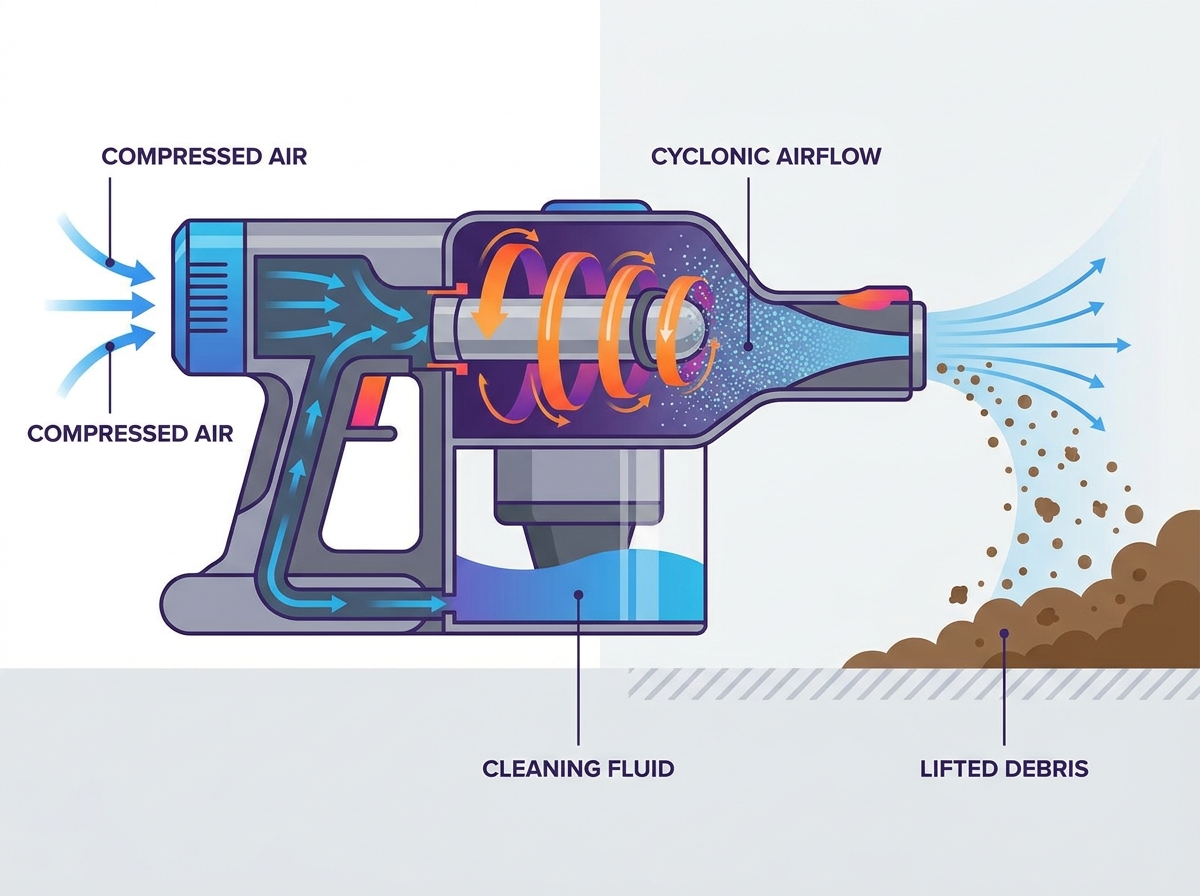
The core of this technology relies on unique internal physics. Inside the cone, you will find a weighted tube or ball-bearing mechanism. When pressurized air enters the tool, this assembly spins rapidly. It often exceeds thousands of revolutions per minute. This rapid spinning creates a localized tornado effect. We call this the vortex. It generates immense kinetic energy right at the nozzle tip. This energy physically beats the dirt out of fibers. It essentially replaces the bristles of a brush with high-speed air.
Atomization Process
The spinning mechanism does more than just move air. It actively pulls liquid cleaning solution from an attached reservoir. The machine mixes this liquid with the high-velocity air. It creates a fine micro-mist. This atomization process is critical for effective cleaning. The mist penetrates porous surfaces deeply and evenly. It breaks down grime instantly. More importantly, it achieves this without oversaturating the material. You avoid soaking car seats or commercial carpets.
Lift vs. Suction
You must differentiate between two primary vortex configurations. Vortex blowers or guns blow air forcefully. They lift dirt out of tight spaces. They blast debris away from the surface. In contrast, vortex vacuums extract the dirt simultaneously. They combine the cyclonic agitation with active suction. Blowers work best for hard-to-reach crevices. Vacuums excel on broad textile surfaces where extraction is necessary. Choose the configuration based on your specific cleaning task.
Success Criteria
Effective operation depends entirely on airflow consistency. You cannot force the tool to work better by pressing harder. In fact, pressing the cone into the surface stops the spinning mechanism. The machine relies on sustained, uninterrupted airflow. Your air compressor must deliver continuous pressure. The tool does the heavy lifting for you. You only need to guide it smoothly over the target area. Rely on the pneumatic power, not your own physical force.
Primary Applications: Where Vortex Technology Outperforms
Auto Detailing (Interior & Exterior)
A vortex cleaning machine shines brightest in auto detailing. Car interiors present complex geometries. Seat rails, air vents, and dashboard seams trap immense dirt. Tight console gaps resist traditional vacuuming. The cyclonic air blasts this debris out effortlessly. On floor mats, the technology excels at lifting embedded sand. It pulls stubborn pet hair to the surface before extraction. Detailers save hours on neglected vehicles.
Commercial Upholstery & Janitorial
Janitorial teams face similar challenges on a larger scale. Office furniture endures daily coffee spills and body oils. Theater seating requires rapid turnaround between showings. Commercial textiles need deep cleaning without long drying times. The atomized mist spot-treats these areas perfectly. It lifts stains without leaving watermarks. Janitors can clean high-traffic seating areas swiftly. The furniture dries quickly, minimizing operational downtime for the business.
Engine Bay & Heavy Equipment Cleaning
Engine bays house delicate electronics alongside heavy grease. High-pressure washing often forces water into electrical connectors. This causes expensive damage. Hand scrubbing intricate mechanical parts takes hours. The cyclonic tool degreases these areas safely. It pushes atomized degreaser into tight spaces around engine blocks. It cleans effectively without water pooling. Heavy equipment operators use it to maintain sensitive hydraulic joints safely.
Problem Framing
Why do traditional methods fail in these environments? Traditional tools create numerous bottlenecks. We can frame these problems clearly:
- Manual Brushes: They require immense physical effort and cause rapid operator fatigue.
- Steamers: They sanitize well but often push dirt around rather than lifting it.
- Wet-Vacuums: They leave textiles excessively wet, increasing moisture retention.
- Spray Bottles: They apply chemicals unevenly, leading to chemical waste and saturated spots.
Cyclonic air tools bypass these limitations entirely. They offer a dry, touchless, and highly efficient alternative.
Core Benefits vs. Traditional Cleaning Methods
Reduced Turnaround Time
Time is money in commercial operations. Eliminating manual scrubbing cuts labor hours drastically. You can detail a heavily soiled car interior much faster. A job taking three hours manually often drops to one hour. You blast dirt out of crevices in seconds. You no longer spend minutes picking debris from seat rails. This speed allows businesses to process more units daily. The efficiency directly increases daily revenue capacity.
Lower Chemical Consumption
Traditional spray bottles waste expensive chemicals. You often spray more than necessary. The fluid drips and runs off surfaces. Air-driven atomization solves this issue completely. It mixes a tiny amount of liquid into a massive volume of air. You use significantly less cleaning fluid per job. A small reservoir lasts through multiple vehicles. This efficiency lowers your daily consumable expenses dramatically.
Moisture Control
Excess moisture creates massive problems in commercial cleaning. Wet car seats develop sour smells. Damp office chairs invite mold risk. Vortex tools offer exceptional "dry blow" capabilities. You can shut off the liquid valve entirely. The tool then blasts dry, high-speed air. This pushes moisture out of fabrics rapidly. It reduces drying times from hours to mere minutes. You return vehicles or spaces to clients much faster.
Ergonomic Advantages
Operator fatigue ruins productivity. Scrubbing carpets by hand strains wrists and shoulders. By midday, workers slow down significantly. A pneumatic tool eliminates this physical strain. The compressed air does the hard work. The operator simply holds and guides the lightweight tool. This ergonomic advantage supports scalable daily operations. Your team maintains high energy and consistent quality from morning until evening.
Comparison of Cleaning Modalities
| Feature | Pneumatic Cyclonic Tool | Traditional Scrubbing | Standard Wet Vacuum |
| Drying Time | Very Fast (Minutes) | Slow (Hours) | Moderate (Depends on suction) |
| Chemical Usage | Low (Atomized) | High (Direct Spray) | High (Saturation required) |
| Operator Fatigue | Very Low | High | Moderate |
| Crevice Cleaning | Excellent | Poor | Poor |
Key Evaluation Criteria: Choosing the Right Vortex Machine
Air Compressor Compatibility (The Critical Constraint)
You cannot ignore air compressor compatibility. It represents the most critical constraint for these tools. You must check CFM (Cubic Feet per Minute) and PSI requirements. Undersized compressors lead to immediate pressure drops. The tool will stall and stop spinning entirely. A pancake compressor will not work. Most professional tools require at least 5 CFM at 90 PSI. Commercial pacing requires larger 60-90 gallon continuous compressors. Verify your air supply before purchasing.
Build Quality & Wear Parts
Professional environments destroy cheap tools quickly. You must evaluate build quality carefully. Contrast aluminum or alloy bodies against cheap plastic housing. Metal bodies survive drops on concrete shop floors. Next, check the internal rotational assembly. Flexible plastic tubes whip around and wear out rapidly. Metal ball-bearing mechanisms offer much higher durability. They cost more upfront but survive daily commercial abuse far better.
Fluid Control Mechanisms
You need precise control over your cleaning chemicals. Assess the fluid metering valves on the tool. Cheap units feature simple on/off switches. Premium units offer adjustable metering valves. These allow you to dial in the exact air-to-liquid ratio. You can spray a heavy foam for deep stains. You can switch to a fine mist for delicate headliners. Adjustable valves make the tool versatile across different materials.
Ergonomics and Modularity
Operators hold these tools for hours. Weight matters immensely. A heavy alloy tool might cause wrist strain over a ten-hour shift. Test the trigger comfort. Stiff triggers cause hand cramps. Consider the availability of modular attachments. Can you swap the standard cone for a brush cone? Does it accept vacuum extraction attachments? Modularity increases the value of the tool across various detailing scenarios.
Implementation Risks and Maintenance Realities
The "Mud Pie" Effect
Improper use creates new problems. We call the most common error the "Mud Pie" effect. If you spray liquid onto a dusty seat, you create mud. The cyclonic air then blasts this wet mud deeper into the foam padding. The surface looks clean briefly, but stains wick back up later. You must always perform a preliminary dry vacuuming. Remove loose dirt before introducing any atomized liquids to the fabric.
Chemical Inhalation & Safety
Atomization creates airborne particles. This presents serious safety risks. Atomizing aggressive degreasers or high-pH chemicals puts operators in danger. Inhaling these micro-particles damages lungs rapidly. You must warn your team about these risks. Outline strict PPE requirements. Operators must wear respirators or high-quality masks. They need eye protection. Ensure excellent ventilation compliance in enclosed shops. Never atomize heavy acids or toxic solvents.
Component Degradation
Internal parts wear down over time. The internal rotation set has a finite lifespan. Friction and chemical exposure degrade the bearings or tubes. You must accept component degradation as a maintenance reality. Prevent premature failure through strict habits. You must perform immediate post-use flushing. Run clean water through the tool after every shift. This prevents chemical crystallization inside the delicate fluid tubes. Daily lubrication of air fittings is also mandatory.
Noise Compliance
Pneumatic tools generate intense noise. The compressed air exiting the cone creates a high-decibel output. Operating these tools in an enclosed concrete shop amplifies the sound. This poses a severe risk to operator hearing. You must note local noise compliance regulations. Hearing protection is an absolute requirement. Provide your team with quality earmuffs or earplugs. Failure to do so leads to permanent hearing damage over time.
Common Maintenance Mistakes to Avoid
- Storing the tool with harsh chemicals left inside the reservoir.
- Dropping the tool directly on the plastic cone tip, causing micro-fractures.
- Running the tool at pressures exceeding 110 PSI, which blows out internal seals.
- Skipping the daily application of pneumatic oil into the air inlet.
Conclusion
A vortex cleaning machine represents a highly profitable investment. It transforms operations for businesses dealing with complex surface cleaning. It eliminates slow, physically demanding manual labor. However, this remains true only if the facility possesses the required pneumatic infrastructure. Without adequate air supply, the tool becomes entirely useless. You must balance the incredible speed advantages against your current equipment capabilities.
We recommend a phased rollout for commercial teams. Do not buy ten tools at once. Start with one high-quality unit. Use it to test workflow improvements on the floor. Verify that your existing compressor capacity handles the continuous CFM draw. Train your staff on proper technique and maintenance protocols. Once you prove the concept and see the labor savings, you can outfit the entire team.
Take action today to modernize your cleaning workflow. Evaluate your current air compressor specifications immediately. Check the CFM and PSI ratings on the tank. Once verified, review compatible cyclonic tool models. Upgrading your equipment will reduce turnaround times and dramatically improve your finishing quality.
FAQ
Q: What size air compressor do I need for a standard vortex cleaning tool?
A: You need a compressor that delivers a minimum of 5 CFM at 90 PSI. Small pancake compressors will stall the tool within seconds. For continuous commercial pacing, we highly recommend a 60 to 90-gallon tank. This ensures uninterrupted airflow without constant pressure drops during long detailing sessions.
Q: Can a vortex cleaning machine damage headliners or delicate fabrics?
A: Yes, it can. Older auto headliners are prone to delamination. The high-pressure air can blow the fabric right off the foam backing. When working with delicate textiles, you must adjust your technique. Lower the PSI at the compressor and hold the tool further away from the surface.
Q: How does a vortex cleaner compare to a steam cleaner?
A: They use entirely different mechanisms. A cyclonic tool uses high-speed air and liquid agitation to physically lift dirt. A steam cleaner uses extreme heat to sanitize surfaces and melt heavy grease. They are complementary tools. Use air to blow out dry debris, and steam to sanitize and dissolve sticky residues.
Q: Why is my vortex tool losing spinning power?
A: Loss of spinning power stems from three common failure points. First, the internal fluid tubes might be clogged with crystallized chemicals. Second, the rotational bearings may lack daily lubrication, causing friction buildup. Third, your air compressor might be experiencing pressure drops, failing to supply the necessary CFM.


