
Views: 0 Author: Site Editor Publish Time: 2026-11-19 Origin: Site


Growing butcher shops face a constant operational balancing act every single shift. You must process meat quickly while maximizing product yield and keeping operators safe. As production demands scale, hand tools often become a bottleneck for efficiency. Upgrading to a commercial Machine For Sawing Bones marks a major business decision. Deciding between electric and manual options requires evaluating daily throughput, labor limits, and specific product types. Processing fresh carcasses demands an entirely different approach than slicing deep-frozen blocks. Failing to match the tool to your exact needs causes waste and operator fatigue. This guide provides an evidence-based framework for evaluating bone saw equipment. We will explore volume thresholds, necessary safety standards, and practical maintenance realities. You will learn how to choose the precise equipment profile matching your facility's daily demands and compliance requirements.
Every butcher shop eventually reaches a breaking point regarding production capacity. Hand saws work perfectly for occasional tasks and specialized cuts. However, processing hundreds of pounds of meat daily completely changes the operational equation. Manual sawing quickly causes diminishing returns across your facility. Operator fatigue sets in rapidly after just an hour of continuous cutting. This fatigue slows down turnaround times significantly during peak shifts. It also dramatically increases the risk of accidental slips and workplace injuries. You must establish clear baseline production metrics. Calculate exactly how many pounds you process per day. Once you cross a specific volume threshold, manual processing simply becomes unsustainable. Upgrading to a powered Machine For Sawing Bones keeps production moving efficiently and safely.
Customers immediately notice inconsistent cuts in the display case. Standardized cuts remain essential for retail displays and demanding restaurant clients. Professional chefs expect uniform thickness for even cooking times. Achieving this precision manually requires immense skill and excessive time. A fixed-blade machine simplifies this entire process for your staff. It delivers perfectly uniform slices every single time. Consistent blade speed prevents frustrating bone splintering. It also drastically reduces jagged meat tearing. This mechanical precision directly protects your shop's profit margins. You lose far less product to uneven edges and useless bone dust. Better yield translates into noticeably higher revenue per carcass.
Consider your overall payroll expenses carefully. You pay butchers for their specialized knowledge, not just their brute physical strength. Frame the equipment upgrade strictly as a labor-saving investment. Calculate the exact time saved per carcass breakdown. A task taking thirty minutes by hand might take only five minutes mechanically. You can reallocate that saved time highly efficiently. Staff can focus on specialized, higher-margin tasks instead of manual labor. They can craft artisanal sausages, prepare value-added marinades, or interact with retail customers. Labor optimization justifies the equipment investment quite rapidly in busy environments.
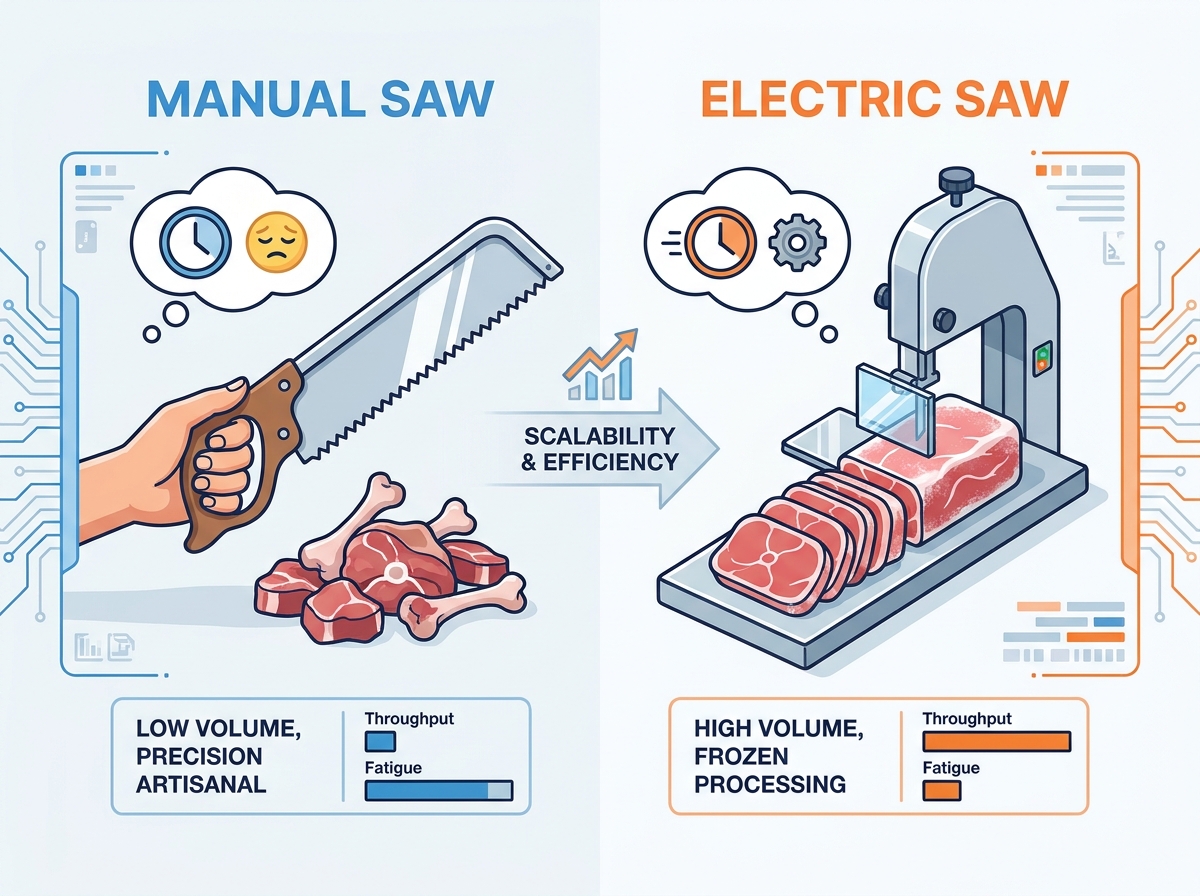
Choosing the right tool demands a clear understanding of practical capabilities. Let us thoroughly break down both primary options available to butchers.
Manual saws offer ultimate simplicity and reliability. They require zero operational footprint in a crowded workspace. You do not need dedicated power outlets or special wiring. Upfront costs remain incredibly minimal compared to powered equipment. These tools work perfectly for delicate artisanal work requiring tactile feedback. They also suit extremely low-volume settings perfectly. You can easily sanitize them in any standard commercial sink. However, the drawbacks become aggressively obvious at scale. They place high physical strain on the operator's arms and back. Processing times remain incredibly slow during busy rushes. Dense or frozen bones often yield terrible, inconsistent cuts. Hand tools simply cannot handle deep-frozen blocks effectively.
Electric models completely redefine production speed. Consistent blade speed ensures remarkably clean cuts. It safely prevents dangerous bone splintering into the meat. You can rapidly process frozen blocks without hesitation. High throughput pairs perfectly with greatly reduced physical fatigue. Operators smoothly guide the meat rather than forcing the cut. Conversely, these units require a dedicated footprint. You must supply appropriate electrical power, often three-phase. The higher initial investment requires serious consideration. Furthermore, you must implement rigorous safety training for all staff. Daily sanitation protocols demand much more attention than simple hand tools.
Equipment Capability Comparison Chart
| Feature Category | Manual Saws | Electric Machines |
|---|---|---|
| Throughput Speed | Low (Depends on operator stamina) | Extremely High |
| Operator Fatigue | High | Low |
| Frozen Meat Capability | Not Recommended | Highly Effective |
| Cut Precision | Variable | Consistently Exact |
| Footprint & Power | Zero | Dedicated Space & Wiring Required |
Motor Power and Drive Systems matter immensely. You must match machine horsepower to your specific application. Processing fresh carcasses differs wildly from cutting frozen bone. Frozen materials require significantly higher torque to prevent binding. Insufficient power leads directly to costly motor burnout. A 1 HP motor might struggle with deep-frozen beef femurs. High-volume facilities usually need motors exceeding two or three horsepower. This ensures smooth, continuous operation during demanding long shifts. Always verify the drive system reliability before purchasing a Machine For Sawing Bones for heavy industrial use.
Material Construction and Hygiene Compliance determine equipment lifespan. Strict food safety standards demand highly specific materials. You should insist on 304 or 316 stainless steel construction exclusively. These grades provide superior corrosion resistance against moisture and salt. They easily withstand harsh chemical sanitizers applied daily. Proper construction ensures full compliance with commercial food safety standards. Look specifically for trusted certifications like CE or NSF. Cheaper aluminum components degrade rapidly in intensive washdown environments.
Workplace injuries destroy businesses and livelihoods. You cannot compromise on operator protection features. Modern electric models must include non-negotiable safety mechanisms. Keep these mandatory features in mind:
Precision and Cut Quality affect your bottom line directly. A quality machine actively minimizes product waste. Adjustable thickness guides guarantee uniform steaks for your customers. Sturdy blade tensioners maintain exact alignment during heavy use. Proper tension prevents the fast-moving blade from wandering. This minimizes meat waste and significantly reduces bone dust generation. Clean cuts directly enhance product shelf life and retail visual appeal.
Consumable parts require very careful inventory tracking. Blades wear down steadily based on daily usage intensity. Cutting frozen bone dulls teeth much faster than fresh meat. You must learn the physical signs of blade wear. Operators often notice increased resistance during standard cuts. Operating dull equipment poses serious workplace risks. It ruins product yield and aggressively strains the drive motor. High-volume shops might realistically replace blades weekly. Always keep multiple spare blades in your immediate inventory.
Daily cleaning realities demand serious management attention. Meat processing environments require exceptionally strict hygiene practices. Bacteria harbor in microscopic scratches left unchecked. Standardizing your washdown procedure prevents dangerous cross-contamination. Follow these essential daily sanitation steps for your machine:
You cannot ignore the necessary onboarding curve. Deploying a high-speed machine requires heavily updated safety protocols. Management must provide dedicated, documented operator training. Ensure everyone thoroughly understands the severe mechanical risks involved. Operators must wear assigned protective gear consistently. Chainmail gloves provide absolutely vital secondary protection. Supervisors should monitor technique closely during the first few weeks of implementation.
Space and budget usually dictate choices for small retail shops. We highly recommend keeping quality manual saws available. Pair them smartly with a compact, entry-level tabletop electric saw. This combination handles occasional heavy-duty tasks highly efficiently. It balances upfront cost and practical capability perfectly. Boutique butchers rarely need massive floor units.
Volume demands steady reliability for mid-to-large butcher shops. We strongly recommend freestanding mid-range electric machines here. Look specifically for units focused on quick blade changeovers. Easy daily cleaning remains crucial for busy supermarkets. Floor models offer vastly superior motor endurance. They easily handle consistent daily use without overheating.
Industrial meat processing facilities break down massive quantities continuously. Point your procurement directly toward high-horsepower, heavy-duty floor models. They must seamlessly withstand continuous shift operation daily. Often, you will integrate them into wider processing lines. Exceptionally robust construction successfully prevents highly costly production downtime.
Never purchase commercial equipment blindly. We strongly advise buyers to request a live demonstration first. Test the equipment strictly using your specific meat products. Compare exactly how it handles fresh versus frozen cuts. This practical test prevents very expensive procurement mistakes. Ensure the chosen unit aligns with your facility layout perfectly before finalizing procurement.
Finding the perfect Machine For Sawing Bones requires careful, objective evaluation. The right equipment is not universally the most powerful option available. Instead, it perfectly aligns with your shop's specific daily volume. It fits your physical space constraints precisely. It strongly reinforces your facility's internal safety culture. We strongly encourage operations managers to audit current breakdown times. Analyze your current meat waste percentages thoroughly. Use this concrete data to build a solid operational case. An informed equipment investment pays massive dividends through better yield and vastly happier operators.
A: Yes, provided the machine uses the correct blade type. Scalloped blades or specific tooth-per-inch configurations prevent tearing soft tissue. However, freezing the meat slightly often improves cut uniformity and overall presentation.
A: Lifespan varies heavily based on usage and material. Cutting frozen bone degrades teeth faster than fresh meat. High-volume shops may replace blades weekly or bi-weekly. Regular replacement maintains optimal yield, prevents motor strain, and ensures operator safety.
A: Tabletop models work adequately for low-to-medium volume retail environments. High-volume processors breaking down whole carcasses daily require more power. They need the motor endurance and expansive working space of a heavy-duty, floor-standing model.
A: Operators must strictly use integrated pusher plates. Never use hands to guide meat near the active blade. Wear appropriate cut-resistant safety gear, including chainmail gloves. Always ensure the machine is fully powered down before adjusting the blade or cleaning.


