Procuring a commercial-scale vegetable processing line remains a capital-intensive decision for any facility. Misaligned specifications directly impact your product yield, utility consumption, and regulatory compliance. The demand for fresh-cut produce continues to rise globally. Operational realities require moving far beyond basic equipment catalogs. You must carefully analyze integration capabilities, sanitary design, and continuous throughput reliability. A poorly integrated system creates cascading bottlenecks across your entire production floor. These bottlenecks cause severe delays and compromise food safety protocols. This guide breaks down the critical technical specifications required for maximum operational success. We will highlight severe integration risks and provide proven evaluation frameworks. You will learn exactly how to confidently shortlist the best equipment vendors for your specific production needs.
Key Takeaways
- Throughput vs. Yield: Matching rated capacity (kg/hr) with actual operational yield depends heavily on input quality and the precision of the peeling/cutting modules.
- Sanitary Design is Non-Negotiable: True food-safe lines demand continuous-welded 304/316 stainless steel and Clean-in-Place (CIP) compatibility to meet HACCP and FDA/USDA standards.
- Vendor Accountability: Shortlisting must prioritize manufacturers offering performance guarantees, transparent FAT (Factory Acceptance Testing), and localized aftermarket support.
Aligning Production Goals with Vegetable Processing Line Configurations
Before analyzing raw equipment specifications, define your exact success criteria. Framing the business problem guarantees better machinery alignment. Do you need maximum hourly throughput? Are you prioritizing minimal product bruising? You must answer these foundational questions first. Different raw materials require fundamentally different processing approaches.
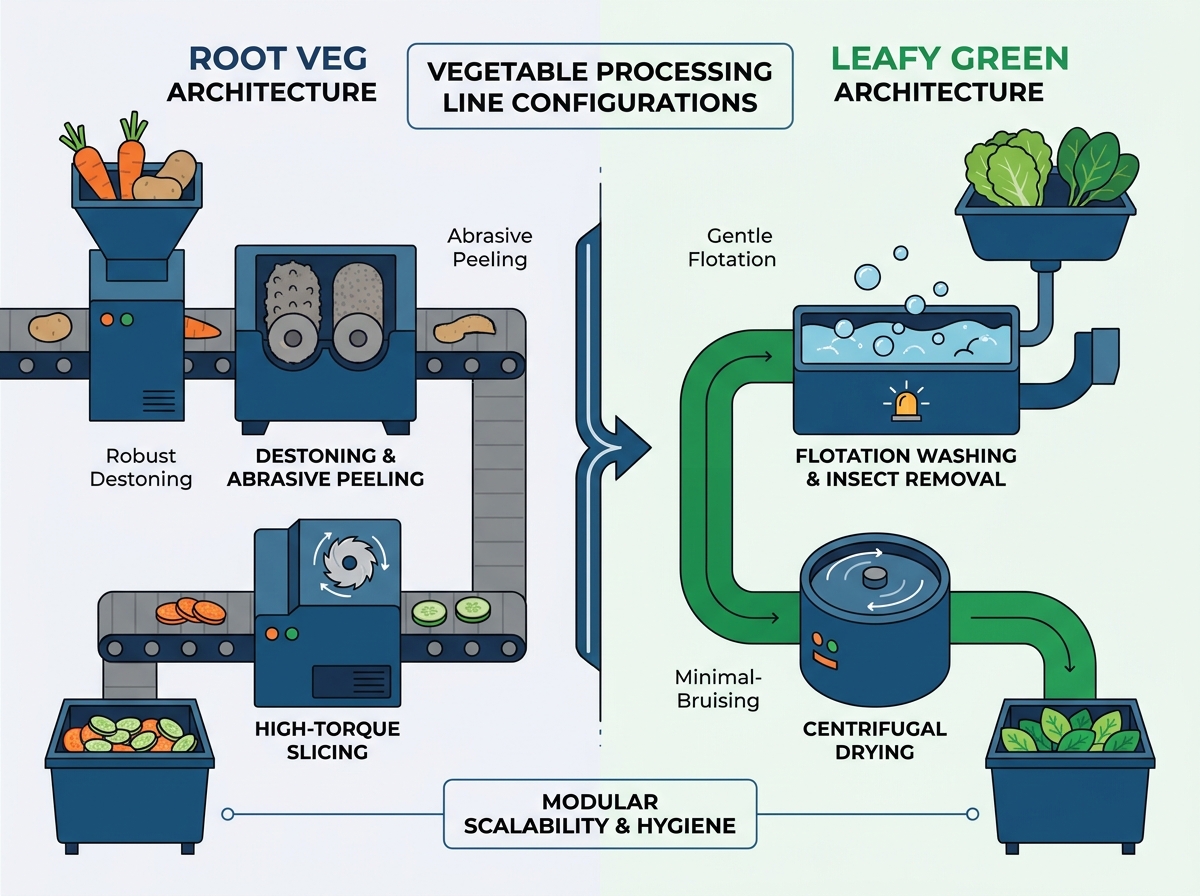
Root vegetables demand entirely different architectural setups compared to leafy greens. Heavy-duty lines handle robust root crops like potatoes, beets, and carrots. They focus on aggressive destoning, abrasive peeling, and high-torque slicing mechanisms. These products carry heavy soil loads and stones from the field. Delicate lines process leafy greens like spinach and arugula. They require gentle flotation washing, precise insect removal, and minimal-bruising centrifugal drying. Mixing these architectures rarely produces optimal operational results. You cannot effectively wash delicate spinach in a heavy root flume. It destroys the cellular structure of the leaves.
Evaluate your volume thresholds carefully. Transitioning from batch systems to continuous automation yields a positive return only at certain scales. If you process over 500 kilograms per hour consistently, continuous processing usually makes sense. It reduces manual labor dependencies and ensures uniform product quality. Below that volume threshold, batch systems offer better flexibility. They allow operators to manage smaller runs efficiently. Assess your labor availability. Automated continuous lines require fewer manual handlers but demand skilled technical operators.
Plan ahead for future SKU diversification. Assess your machinery for modularity and scalability. Quick changeovers allow you to pivot rapidly when consumer demand shifts. You might cut diced carrots today and julienne peppers tomorrow. Modular cutting heads make this transition seamless. Rigid lines limit your market responsiveness. Always prioritize equipment offering tool-less changeover capabilities.
Core Modules and Technical Specifications to Scrutinize
Evaluating a modern vegetable processing line means inspecting individual module performance rigorously. Each phase contributes directly to the final product quality.
Intake and pre-cleaning modules require strict attention. Review soil removal efficiency metrics closely. Look for integrated water recycling mechanisms. Ensure the destoning capabilities match your specific harvest conditions. Heavy clay soils require aggressive pre-soaking tanks. Sandy soils need efficient sediment traps. Ignore these factors, and field debris will destroy downstream cutting blades rapidly.
Washing and peeling dictate your final usable yield. Scrutinize flume dynamics carefully. Check brush and roller grades for long-term durability. Compare yield loss percentages between abrasive and steam peeling methods. Steam peeling generally offers higher yield retention for root crops. Abrasive peeling works better for irregular shapes. Always monitor water flow rates in liters per minute. High flow rates ensure proper agitation but increase utility bills. Balance is key.
Cutting, slicing, and dicing require absolute precision. Review blade steel grades for edge retention. Demand quick-release mechanisms for rapid sanitation between shifts. Monitor waste percentages during precision cuts. High waste indicates poor blade alignment or insufficient product gripping. The right impeller speeds prevent cell damage during slicing. Clean cuts extend the shelf life of fresh produce significantly.
If blanching and cooling apply to your product, check temperature delta control. Analyze your steam consumption rates meticulously. Integrated chilling efficiency prevents dangerous bacterial growth post-blanching. Rapid cooling locks in product color and nutritional value. Slow cooling leads to mushy textures and rejected batches.
Drying and packaging handoff finalize your processing cycle. Verify air knife velocity. Assess mechanical dewatering rates. Leafy greens require gentle centrifugal drying. Over-drying causes wilting, while under-drying encourages rot in the bag. Ensure seamless conveyor integration into your multi-head weighers. Smooth transitions prevent product clumping before final packaging.
Processing Module Specification Checklist
| Module Phase | Critical Specifications | Primary Performance Indicator |
| Pre-Cleaning | Destoning capacity, water recycling rate | Soil removal percentage, machinery protection |
| Washing | Flume dynamics, flow rate (L/min) | Microbial reduction, minimal product bruising |
| Cutting & Dicing | Blade steel grade, quick-release locks | Waste percentage, cut uniformity |
| Blanching | Temperature delta, steam efficiency | Enzymatic deactivation, color retention |
| Drying | Air knife velocity, dewatering rate | Surface moisture retention levels |
Evaluating Infrastructure, Utilities, and Compliance Requirements
Your physical facility dictates which equipment you can successfully install. Footprint and layout constraints often limit your choices. Analyze linear versus U-shape configurations based on available floor space. Linear setups work well in long halls. U-shape configurations optimize space in square rooms and allow operators to monitor multiple stations simultaneously. Ensure operators maintain safe accessibility around all moving parts. Crowded walkways lead to workplace accidents and slower sanitation routines.
Calculate peak utility draw early in the planning project. Identify three-phase power requirements and peak energy loads in kilowatts. Evaluate baseline water consumption accurately. Mandate built-in filtration and recycling loops. They manage wastewater volume effectively and keep you compliant with municipal discharge limits. High BOD (Biochemical Oxygen Demand) in wastewater incurs heavy municipal fines. Proper filtration screens out organic matter before it reaches the drain.
- Maintain a floor drainage slope between 1% and 2%.
- Separate high-voltage panels from low-voltage control systems.
- Install heavy-duty epoxy flooring to withstand thermal shock.
- Ensure overhead clearance accommodates bulk tippers.
Sanitary design remains absolutely non-negotiable in modern food processing. Verify IP65 or IP69K washdown ratings immediately. These high ratings protect essential motors and sensitive control panels from high-pressure cleaning. Identify potential harborage points during preliminary inspections. Avoid machinery utilizing hollow tubing or exposed threads. Bacteria hide in these microscopic crevices. Demand continuous TIG welds ground smooth. True compliance meets strict HACCP and FDA/USDA regulatory standards.
Implementation Realities and Integration Risks
Purchasing machinery represents just one step in a complex journey. Facility retrofitting introduces massive hidden challenges. You often need upgraded flooring, improved drainage systems, and stronger HVAC units. They must handle increased water usage and higher thermal loads from blanchers. Steam extraction hoods are mandatory over hot processing areas to prevent ceiling condensation. Condensation drops represent a severe contamination risk.
Establish realistic downtime and installation windows. Plan your delivery, rigging, and calibration schedules closely. This preparation minimizes disruption to your existing daily operations. Rushing the installation guarantees poor machine calibration. Poor calibration leads to immediate product waste during startup. Schedule dedicated time for dry runs before introducing valuable raw materials.
Automation creates a significant workforce handoff challenge. Assess the learning curve for new PLC (Programmable Logic Controller) and HMI (Human-Machine Interface) systems. Interfaces must remain intuitive for non-engineers. Transition your staff from manual handling roles. Train them for automated oversight and preventative maintenance instead. Empowered operators keep lines running smoothly. Uninformed operators bypass safety sensors and cause catastrophic downtime.
Follow these essential steps for a smooth installation handoff:
- Audit your current facility utility capacities thoroughly.
- Map out the exact floor footprint using laser measuring tools.
- Schedule a dedicated rigging and delivery window during off-peak hours.
- Conduct comprehensive operator training on the new HMI screens.
- Perform multiple dry runs before processing raw materials.
How to Shortlist Equipment Manufacturers
Never buy a commercial vegetable processing line from a static catalog alone. Testing and validation prove real-world capability. Require pre-purchase testing using your specific raw materials. This validates vendor yield and throughput claims objectively. A machine cutting perfectly round carrots might struggle with irregular organic carrots.
Establish a rigorous Factory Acceptance Testing (FAT) protocol early. Define clear performance metrics in your contract. The equipment must meet these benchmarks before leaving the manufacturer floor. Video FATs provide some value, but in-person inspections catch subtle vibration or noise issues. Request all CE or UL certification documentation during this phase. Do not wait until the equipment arrives.
Evaluate aftermarket support availability thoroughly. Review Service Level Agreement (SLA) terms carefully. Check spare parts availability. Local stocking always beats overseas shipping. Verify technician deployment speeds for emergency breakdowns. A beautiful machine becomes useless if you wait three weeks for a replacement sensor. Demand an explicit list of recommended wear parts to keep in your own inventory.
Decide between turnkey and integrated best-of-breed approaches. Single-source turnkey vendors provide seamless integration. One company handles all PLC communication and physical handoffs. However, integrating specialized modules from multiple OEMs offers maximum individual performance. You might buy the best peeler from Europe and the best slicer from North America. Choose the strategy matching your internal engineering resources. If you lack a strong internal maintenance team, lean toward turnkey solutions.
Conclusion
Selecting commercial processing equipment requires balancing immediate performance needs with long-term operational efficiency. You must prioritize strict hygiene protocols, modular flexibility, and consistent product yield. Ignoring these structural factors leads to massive integration failures and daily production bottlenecks. Focus on robust sanitary designs and accurate utility calculations to ensure smooth operations. Prioritize rigorous testing before any final procurement commitments.
Take action now by initiating your internal procurement process. Conduct a thorough facility audit focusing on utilities and available floor space. Request detailed, product-specific pilot tests from two or three vetted manufacturers. Compare their performance data directly against your defined business goals. Engage your maintenance team early to evaluate the serviceability of each shortlisted machine.
FAQ
Q: What is the standard lead time for a commercial vegetable processing line?
A: Standard lead times typically range from 12 to 24 weeks. This depends heavily on your required customization and modularity. Current global supply chain constraints for PLC components and specialized stainless steel can also extend delivery schedules significantly. Always add a four-week buffer to manufacturer estimates.
Q: How much water does a continuous washing line consume?
A: Consumption varies widely by processing capacity and product type. However, you must prioritize built-in water recycling and filtration modules. These integrated systems can reduce net water consumption by up to 70%, significantly lowering your wastewater treatment burdens and municipal utility costs.
Q: Can a single processing line handle both root vegetables and leafy greens?
A: While some basic modularity exists, physical requirements differ drastically. Heavy root processing requires aggressive abrasion and destoning. Delicate leaf washing relies on gentle flotation. These opposing physical needs usually dictate installing specialized or parallel lines for optimal yield and minimal product damage.
Q: What should I look for in the equipment warranty?
A: Always check the distinction between standard wear parts and structural guarantees. Blades and belts rarely carry long warranties. Focus on motor, PLC, and structural frame guarantees. Ensure the warranty includes guaranteed rapid response times for critical breakdown support and software troubleshooting.


