Investing in a commercial facility requires massive capital expenditure. The operational stakes run incredibly high for facility directors and engineers. You cannot afford missteps when building these complex industrial systems. Success requires looking far beyond a basic equipment list. You must evaluate exact material specifications, automation capabilities, and strict compliance standards. A single weak link can severely bottleneck your daily throughput. This guide provides operations directors and procurement leads an objective framework. You will use it to evaluate technical solutions efficiently. We will show you how to define exact equipment specifications. You will learn to properly align your facility capacity constraints. Finally, we provide strategies to shortlist manufacturers based on proven engineering competence. By the end, you will understand how to procure reliable infrastructure for long-term production.
Key Takeaways
- Material matters: High-acid fruits require SS316L stainless steel components to prevent corrosion and contamination, not just standard SS304.
- Yield vs. Throughput: A true evaluation of a fruits processing line must balance Tons Per Hour (TPH) capacity with extraction yield percentages.
- Automation reduces OPEX: Integrated PLC systems and Clean-in-Place (CIP) technology are non-negotiable for minimizing downtime and ensuring batch traceability.
- Vendor capabilities: The right manufacturer should offer end-to-end support, from initial P&ID (Piping and Instrumentation Diagram) design to Factory Acceptance Testing (FAT) and on-site commissioning.
Essential Equipment Specifications in a Fruits Processing Line
Every robust fruits processing line requires specialized machinery designed for continuous duty cycles. You cannot rely on generalized food equipment. You need specific engineering solutions built for optimal yields. We must first break down the foundational infrastructure required to transform raw agricultural products into premium consumable goods.
Sorting and Washing Infrastructure
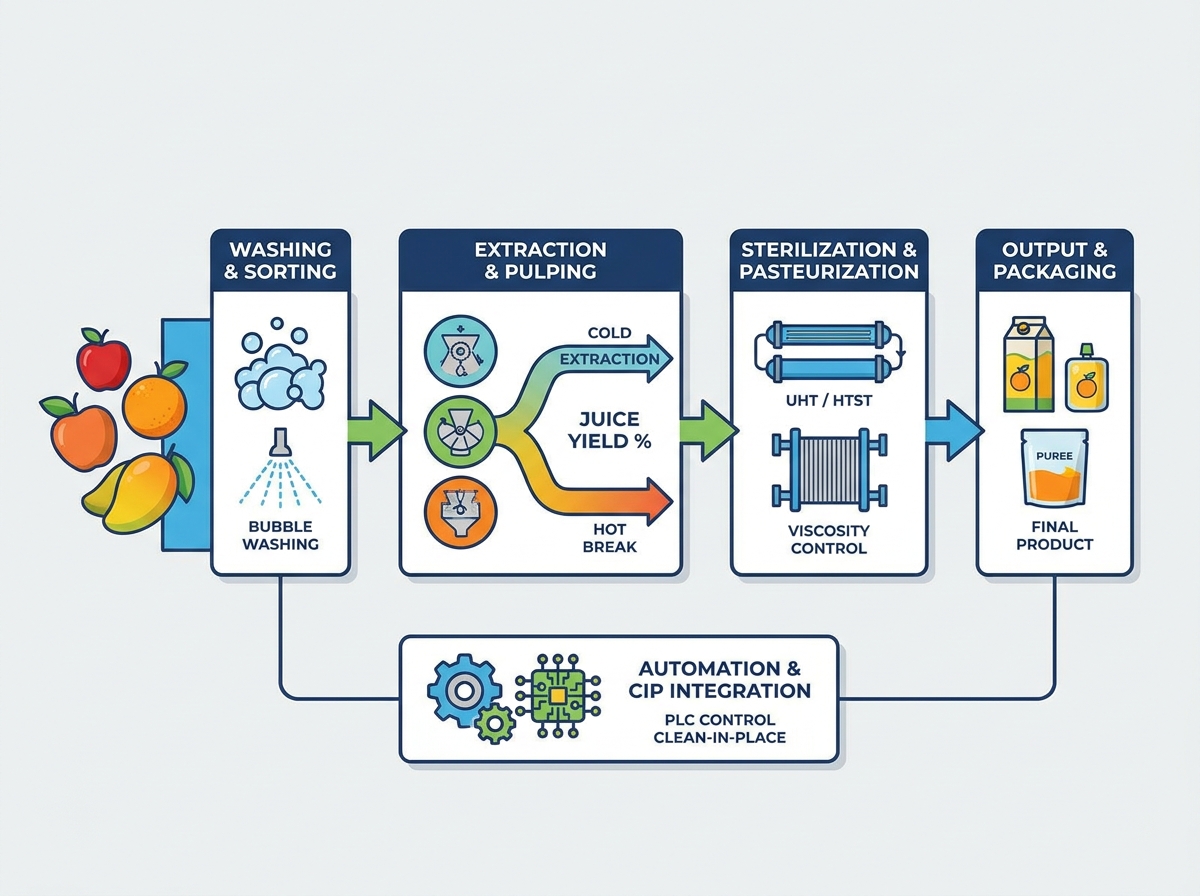
Raw materials arrive carrying field dirt, pesticide residues, and stones. You must specify dual-stage washing mechanisms. Bubble washing introduces high-volume air into the wash tank. This aeration creates intense water turbulence. It gently lifts dirt from delicate skins without causing surface bruising. Following this, a high-pressure spray manifold removes stubborn debris. Water consumption dictates your operational efficiency. You must mandate closed-loop water recycling capabilities. A primary filter screen catches large debris, allowing the same water to power the initial flume stage.
Extraction and Pulping Units
Extraction technology determines your final product quality. You must differentiate between cold extraction and hot break processing. Cold extraction operates in an oxygen-reduced environment. It preserves delicate flavor compounds and vibrant natural colors. This method works perfectly for premium clear juices. Conversely, hot break processing rapidly heats the crushed mash. This sudden thermal shock inactivates pectinase enzymes instantly. It produces high-viscosity products like thick mango purees. You must also evaluate destoning efficiency carefully. Improper destoning leaves bitter seed fragments behind. These fragments ruin juice yield percentages and degrade flavor profiles.
Filtration and Clarification
Clarity defines premium juices. Evaluate ultrafiltration (UF) systems against traditional decanter centrifuges. Ultrafiltration pushes liquid through semi-permeable ceramic membranes. It removes suspended solids at a molecular level. It delivers crystal-clear outputs. Decanter centrifuges rely on rapid mechanical rotation. They spin out heavy solids aggressively. Centrifuges handle high-pulp loads effectively. Focus heavily on membrane lifespan when specifying UF systems. Membrane replacement costs accumulate quickly. Best practice requires installing pre-filtration strainers. They protect expensive UF membranes from large abrasive particles.
Sterilization and Pasteurization
Shelf-stability requires precise thermal processing. UHT (Ultra-High Temperature) systems flash-heat products to 135°C for just seconds. They destroy heat-resistant spores completely. HTST (High Temperature Short Time) operates around 75°C. HTST preserves delicate nutritional profiles better but often requires refrigerated supply chains. Your crucial specification involves the heat exchanger design. Tubular heat exchangers manage thick, fibrous pulps easily. Plate heat exchangers offer superior thermal transfer for clear liquids.
Common mistake: Purchasing a plate heat exchanger for pulpy juices. The narrow corrugated channels will bridge and clog within hours, forcing total system shutdowns.
Heat Exchanger Specifications: Tubular vs. Plate
| Specification | Tubular Heat Exchanger | Plate Heat Exchanger |
| Best Suited For | High-viscosity pulps, pastes, fibrous purees | Clear juices, low-viscosity liquids, water |
| Clog Resistance | Excellent (wide internal channel paths) | Poor (narrow corrugated channel paths) |
| Thermal Efficiency | Moderate | Very High |
| Cleaning (CIP) | Easy to flush automatically | Requires periodic manual plate teardowns |
Capacity Planning: Sizing Your Line to Facility Constraints
You cannot purchase processing equipment in a vacuum. You must align every machine to your building footprint and utility limitations. A poorly sized system will throttle your production immediately.
Defining TPH (Tons Per Hour)
You must calculate raw input against finished output accurately. Different raw materials yield varying mass balances. Citrus fruits deliver high liquid volumes, often exceeding 45% juice yield. Mangoes produce thicker pulps but require aggressive skin and large stone removal. A 10 TPH input of citrus creates a different downstream bottleneck than 10 TPH of stone fruit. Know your exact extraction ratios before finalizing pump sizes.
Footprint and Layout Constraints
Floor space dictates layout choices heavily. Linear configurations suit long, narrow industrial buildings perfectly. Modular setups stack vertically to fit compact spaces. Mapping operational flow prevents logical bottlenecks. You must separate dirty receiving zones from sterile packaging areas.
Follow this standard operational flow sequence:
- Raw material receiving and initial bulk weighing.
- Primary sorting and dry debris removal.
- Multistage washing and sanitization flumes.
- Core extraction, destoning, and pulping.
- Pasteurization, cooling, and waste byproduct disposal.
Utility Requirements
Industrial power sustains peak capacity. A standard fruits processing line might demand 500 kW of steady three-phase power. Steam generation enables pasteurization loops. You will likely need industrial boilers pushing 2000 kg/h at 8 bar pressure. Compressed air drives automated pneumatic valves. It must remain completely oil-free (Class 0) to prevent food zone contamination. Request transparent baseline estimates from your manufacturer early in the planning phase.
Compliance, Hygiene, and Automation Standards
Food safety regulations leave no room for error. A single contamination event can destroy a brand overnight. You must build hygiene and automation directly into the physical hardware.
Food Safety and Material Certifications
Regulatory bodies demand strict adherence to global rules. You must meet FDA, CE, and HACCP standards continuously. Elastomers require food-grade certification. Specify EPDM or PTFE for all gaskets and seals. Avoid standard NBR rubber, as it degrades under high heat. Furthermore, standard SS304 stainless steel pits under high acidity. You must specify SS316L for any wetted parts touching citrus or pineapple products.
Clean-in-Place (CIP) Integration
Sanitation cannot rely on manual labor. Multi-tank CIP systems offer automated, repeatable cleaning. They utilize separate acid, alkali, and hot water cycles. The acid removes mineral scale thoroughly. The alkali saponifies organic fats and proteins. You gain verifiable sanitation between batches. Ensure spray balls provide 360-degree coverage inside all holding tanks. Use inline conductivity sensors to monitor chemical concentration automatically.
SCADA and PLC Control Systems
Centralized control eliminates devastating human errors. Siemens and Allen-Bradley dominate reliable industrial automation. You need accurate temperature logging across every heating zone. PID loops manage steam valves precisely to hold pasteurization temperatures steady. Valve control ensures audit-ready traceability. Traceability means knowing exactly which batch experienced a slight temperature drop. You can then quarantine that specific batch instead of destroying a whole day's production.
Vendor Evaluation Framework: Choosing the Right Manufacturer
You are entering a long-term partnership. Do not treat this as a transactional purchase. The manufacturer must demonstrate deep engineering knowledge.
Engineering and Customization Competence
Avoid off-the-shelf generalized machinery. Demand custom P&ID (Piping and Instrumentation Diagram) workflows. Tailor the design strictly to your end-product. Clear juice requires fundamentally different pipe routing than fibrous purees. NFC (Not From Concentrate) juices require gentle handling and nitrogen blanketing to prevent oxidation. A competent vendor will map every valve and sensor before cutting any steel.
Factory Acceptance Testing (FAT)
Never skip rigorous FAT protocols. You must mandate testing at the manufacturer's facility before shipment. Travel to the factory personally. Run water or a substitute product through the system. Verify throughput parameters objectively. Test emergency stops safely. Ensure automation sequences function exactly as specified in the P&ID. If a pump fails here, the vendor fixes it immediately. If it fails at your facility, you lose weeks of production.
After-Sales and Spare Parts Availability
Service Level Agreements determine your long-term success. Assess commissioning support carefully. Require comprehensive operator training from factory engineers, not local third-party mechanics. Guarantee the availability of proprietary wear parts in writing.
- Guaranteed response times for remote technical support.
- On-site commissioning timeline commitments.
- Guaranteed stock levels for proprietary decanter gearboxes.
- Scheduled annual preventative maintenance service visits.
Implementation Realities
Moving from a blueprint to a fully operational fruits processing line involves managing complex logistics. You must prepare your facility and your team for the physical reality of heavy industrial installation.
Installation and Commissioning Risks
Integrating heavy machinery takes significant time. Anticipate planned downtime realistically. You must manage third-party contractors closely. Trenching drains for wastewater requires precise sloping. Piping and electrical wiring demand precise coordination. Welders must use orbital welding techniques for hygienic sanitary pipes. Any sloppy manual weld can harbor dangerous bacteria. Build realistic timelines from initial concept to full operational capacity. Do not rush the commissioning phase. Rushed commissioning leads to chronic sensor faults.
Cross-Compatibility
Upstream extraction equipment must feed downstream packaging seamlessly. Evaluate your existing bottling infrastructure immediately. Check connector sizes, pipe diameters, and maximum flow rates. An analog upstream extractor cannot easily handshake with a fully digital downstream filler. Ensure communication protocols match. Use standardized industrial network bridges like Profinet or IO-Link to ensure the newly installed processing line communicates flawlessly with your older packaging machines.
Conclusion
Specifying a commercial processing line represents a complex engineering integration project. It is never a simple hardware purchase. You must balance exact material specifications, strict compliance standards, and facility constraints. Always prioritize high-grade SS316L materials for high-acid environments. Demand integrated PLC and CIP automation to ensure consistent, verifiable batch traceability. Finalize your specific output requirements and confirm your facility's utility capacities before initiating deep vendor discussions. Take action by requesting comprehensive P&ID proposals and detailed case studies from your shortlisted manufacturers.
FAQ
Q: Can a single fruits processing line handle multiple types of fruit?
A: Yes, but it requires highly modular components. You can swap destoners for standard extractors when changing batches. You must implement thorough CIP protocols between runs. However, limitations exist. Citrus processing and stone fruit processing require fundamentally different primary extraction mechanics. You cannot run oranges through a peach destoner successfully.
Q: What is the typical lead time for a commercial processing line?
A: Custom commercial lines generally require 3 to 6 months from the finalized P&ID design to physical delivery. This timeline excludes shipping transit and on-site commissioning. Complex automated systems with custom programming often push toward the 6-month boundary. Standardized modular skids can sometimes ship faster.
Q: How do we calculate the ROI on automated CIP systems?
A: Frame your ROI around resource conservation and uptime. Automated CIP systems drastically reduce chemical and municipal water waste. They eliminate hundreds of manual labor hours annually. Most importantly, they increase operational uptime by speeding up sanitation cycles between product changeovers, allowing you to run more revenue-generating batches per week.


