
Views: 0 Author: Site Editor Publish Time: 2026-11-10 Origin: Site


Commercial food manufacturing faces a constant operational tension. You must scale throughput rapidly while protecting the structural integrity, flavor, and nutritional value of delicate raw fruit. Pushing machines too fast often ruins the harvest.
We must rethink the definition of a modern fruits processing line. It goes far beyond basic mechanized washing vats. Today, it represents a data-driven, automated ecosystem. These advanced lines adapt seamlessly to varying fruit calibers and unpredictable seasonal yields.
Facility managers and operational directors need a smarter evaluation approach. You must judge equipment based on verifiable metrics like OEE, yield percentages, and sanitary compliance. Stop relying on superficial feature lists. In this guide, you will learn how to balance volume alongside quality, evaluate core machinery, and future-proof your production floor.
Commercial food processors face a brutal reality. Bottlenecks cost money and destroy product integrity. Raw fruit degrades quickly once harvested. A delayed processing schedule triggers enzymatic browning. It also accelerates fermentation and spoilage. You risk losing entire batches of expensive raw materials if the line stops unexpectedly.
Scaling up magnifies this problem significantly. Entry-level machinery handles low-volume batch processing well. However, it fails miserably during continuous, multi-shift production runs. Light-duty motors overheat. Basic filters clog rapidly. Manual transfer points create massive workflow jams. Transitioning to high-capacity operations requires heavy-duty integration.
How do you recognize a successful operational upgrade? A well-designed fruits processing line delivers specific, measurable results. Consider these primary success criteria:
You need hardware capable of running continuously without compromising these critical benchmarks.
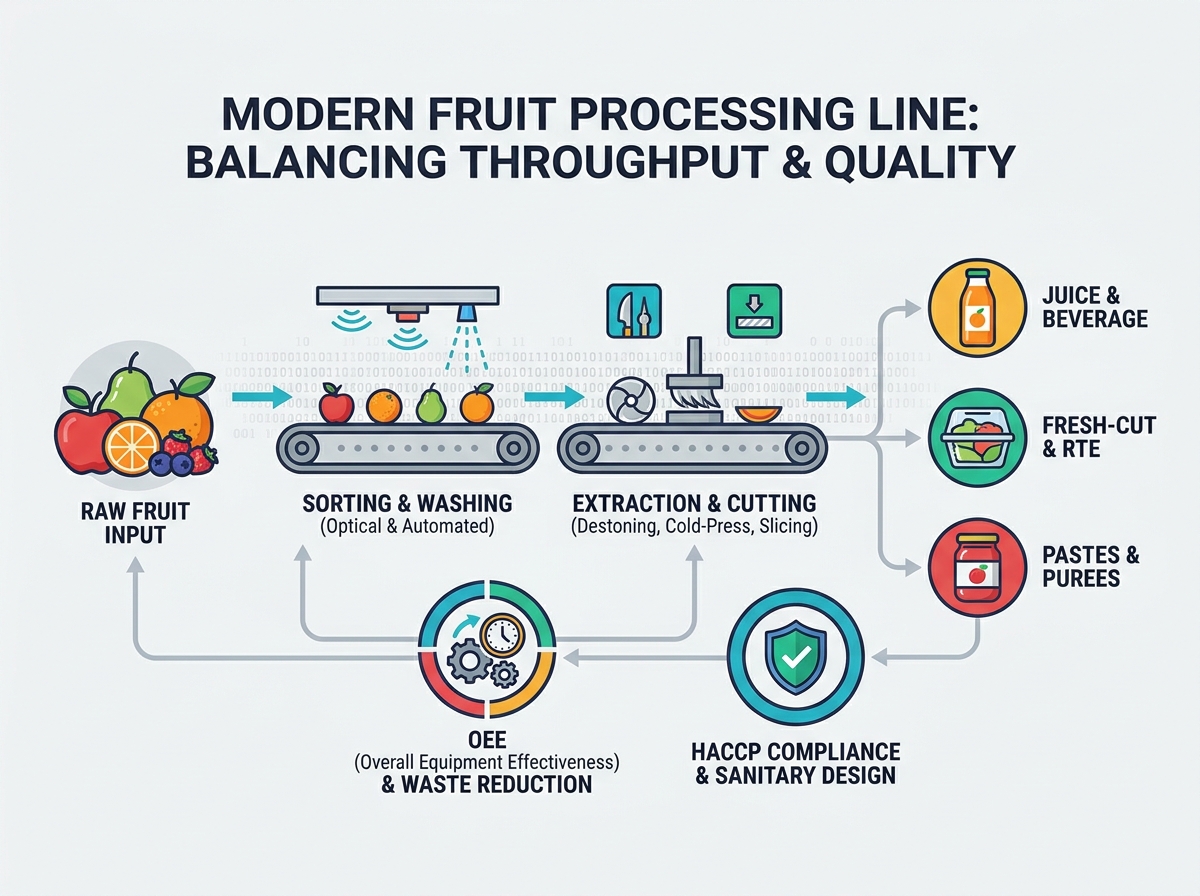
Modern consumer demands require immense production flexibility. A premium processing line adapts to multiple revenue streams. It must pivot quickly between different end-products.
Juice extraction requires delicate handling to preserve nutrients. Heat degrades vitamins rapidly. Advanced systems use precise destoning and crushing mechanisms. They pair these steps using cold-pressing techniques. This approach prevents thermal damage to the juice profile. Facility managers measure success here using strict performance metrics. Target extraction yields and continuous flow rates matter most. You track performance in Liters Per Hour (LPH) or Bottles Per Hour (BPH).
The RTE market demands flawless visual appeal. Bruised fruit gets rejected instantly. Operators rely on high-speed, seamless optical sorting. Precise slicing mechanisms portion the fruit gently. Hygienic handling extends the product shelf life significantly. You achieve optimal results by integrating Modified Atmosphere Packaging (MAP). This technology replaces oxygen to keep cut fruit fresh longer.
Producing thick pastes requires distinct thermal treatments. Manufacturers use vacuum evaporation to remove excess water content. You must achieve precise viscosity and targeted Brix levels. However, excessive heat causes Maillard browning. This ruins the color and flavor profile. Modern evaporators operate under vacuum pressure to boil water at lower temperatures. This protects the fruit while concentrating the solids safely.
Building an efficient line requires careful equipment selection. You must evaluate each module for durability and precision.
Manual sorting introduces human error continuously. Optical sorters use advanced cameras and sensors instead. You evaluate them based on sensor accuracy for defect and color detection. They reject rotten or unripe items instantly. Automated washing follows this crucial step. Look for robust water-recycling capabilities during the washing phase. Recycling flume water reduces your municipal utility costs drastically.
Fruits vary wildly in texture and density. Your extraction equipment needs high mechanical adaptability. It must process soft berries and tomatoes just as easily as hard apples and mangoes. Evaluate the mechanism for its changeover speed. Operators must switch tooling quickly between different harvest runs. Flexible screens and adjustable crushers keep your line moving efficiently.
Food safety relies entirely on proper sterilization. However, over-processing destroys natural flavors. You must evaluate the energy efficiency of your heat exchangers. They need precise temperature control systems. This ensures you meet microbiological safety standards without accidentally cooking the product. Ultra-High Temperature (UHT) systems flash-heat the liquid. They kill pathogens in seconds to preserve authentic taste.
Speed means nothing if quality suffers. You need a holistic approach to evaluate line performance accurately.
Stop relying on theoretical nameplate capacity. Machine manufacturers advertise peak speeds under perfect conditions. Real-world production is never perfect. You must track Overall Equipment Effectiveness (OEE) instead. OEE measures your actual uptime, performance speed, and first-pass quality yield. It reveals hidden bottlenecks in your fruits processing line. Improving OEE by just a few percentage points boosts profitability heavily.
Fruit processing generates massive amounts of solid waste. Peels, seeds, and pomace pile up quickly. Smart operators transform waste disposal costs into new revenue streams. You can capture apple pomace for commercial pectin extraction. Citrus peels provide valuable essential oils. Dried fruit waste serves as nutritious animal feed. Secondary industrial applications make your operation highly sustainable.
Labor shortages plague the food manufacturing sector globally. Automation offers a permanent operational solution. Centralized PLC (Programmable Logic Controller) systems run the entire floor. They monitor temperatures, adjust pump speeds, and control valves automatically. This reduces human error significantly. You can decrease your operator headcount on the processing floor. Reallocate those workers to high-value quality control tasks instead.
Table: Core Production Efficiency Metrics
| Metric Category | Measurement Focus | Target Outcome |
|---|---|---|
| Equipment Uptime | Actual run hours vs. scheduled hours | Minimize unscheduled maintenance stops |
| Performance Speed | Current throughput vs. maximum rated speed | Maintain consistent flow without jamming |
| First-Pass Yield | Usable product vs. total raw input | Reduce bruising and extraction loss |
| By-Product Recovery | Volume of captured peels, seeds, and pomace | Convert waste into secondary revenue streams |
Upgrading your facility introduces complex logistical challenges. Proper planning prevents expensive installation delays.
New machinery demands significant supporting infrastructure. You must assess the hidden costs of installation early. Verify your available floor space against the equipment footprint. Modern lines require immense utility support to function. Calculate your water pressure needs and drainage capacity thoroughly. Industrial extractors and sterilizers draw massive power. Confirm your facility meets the high-voltage electrical requirements before ordering equipment.
Sanitation dictates your long-term market survival. Food safety recalls destroy brand reputations overnight. The critical role of automated Clean-in-Place (CIP) and Sterilize-in-Place (SIP) systems cannot be overstated. They flush pipes and tanks using chemical cleaners automatically. Ensure all product contact parts meet rigorous international standards. Your equipment must carry FDA, CE, or EHEDG certifications. Sanitary welds prevent bacteria buildup in hidden crevices.
Installing a new line stops your current production. You must mitigate the risk of prolonged halts. Transitioning from legacy systems to new integrated lines requires phased execution. Work closely alongside engineers to schedule weekend installations. Prepare your utility hookups before the machinery arrives on site. This keeps your downtime window as tight as possible.
Selecting the right manufacturing partner determines your long-term success. A disjointed procurement strategy leads to integration nightmares.
Many suppliers only sell standalone machines. Avoid them if you need a cohesive system. Prioritize vendors who offer complete, turnkey solutions. A single-source provider guarantees seamless communication between the washer and the sorter. Buying disjointed machinery forces you to hire third-party integrators. This inflates your budget and blurs warranty responsibilities.
Never accept shipment without proof of performance. Buyers must mandate rigorous Factory Acceptance Testing (FAT). You should send your specific raw materials to the vendor facility. Run the line at full capacity under their roof. Identify mechanical flaws before the equipment ships. Follow this up using Site Acceptance Testing (SAT) at your facility. This ensures everything works correctly after transit and reassembly.
Initial capital expenditure only tells half the story. You must calculate long-term operational viability over a 10-year lifecycle. Assess the immediate availability of replacement spare parts. Ask the vendor about remote PLC troubleshooting capabilities. Can their engineers diagnose software faults via a secure cloud connection? Strong warranty terms and rapid technical support keep your line running profitably for decades.
Investing in a commercial fruits processing line requires careful strategic planning. You must balance hygienic design, yield optimization, and verifiable throughput. The best equipment protects the natural quality of the harvest while scaling up volume seamlessly.
Before you draft a Request for Proposal (RFP), look inward. Advise your decision-makers to audit current waste metrics carefully. Identify your exact bottleneck stages first. Understanding your specific pain points makes equipment selection much easier.
Take action today. Encourage your team to consult directly with specialized process engineers. Map a custom line layout that aligns with your specific fruit varieties and capacity goals. A tailored approach ensures maximum efficiency and long-term profitability.
A: True capacity is dictated by the slowest bottleneck in your line. If your crusher handles 10 tons per hour but the sterilizer only manages 5, your line capacity is 5 tons. We typically measure this in input tons per hour (TPH) for raw fruit, or output bottles per hour (BPH) for finished juices.
A: These terms refer to thermal treatments. Hot-break processing applies high heat immediately after crushing. It inactivates enzymes quickly, making it ideal for high-viscosity products like tomato paste or thick purees. Cold-break processing uses lower temperatures. This method preserves fresh flavor profiles and vibrant natural colors, making it perfect for premium juices.
A: Modern systems utilize modular, interchangeable components to maximize versatility. Operators can swap specific destoners, customized extraction screens, and milling blades quickly. This flexibility allows a single processing line to handle soft stone fruits, hard apples, and tough citrus varieties with minimal changeover time between production runs.
A: Baseline compliance requires strict adherence to food safety standards. All product contact surfaces must use food-grade stainless steel, typically SUS304 or SUS316 for high-acid fruits. Equipment must feature sanitary welds to prevent bacterial growth. Additionally, integrated Clean-in-Place (CIP) systems are mandatory to maintain continuous HACCP and FDA compliance.


