Choosing a reliable kitchen prep tool requires looking past basic marketing claims like "razor-sharp" or "time-saving." Many home cooks and professionals quickly realize a poorly designed device causes more frustration than it actually solves. Buyers frequently face harsh implementation realities shortly post-purchase. Common issues include cracked plastic hinges, frayed pull-cords, trapped water in sealed lids, or spinning blades crushing ingredients into mush rather than slicing them cleanly. These hidden flaws ruin meal prep efficiency.
This guide breaks down the technical specifications, material compliance standards, and mechanical designs of these essential devices. You will learn exactly how to evaluate which Vegetable Chopper aligns perfectly with your specific daily prep volumes and long-term durability requirements. Understanding these core mechanics prevents premature equipment failure.
Key Takeaways
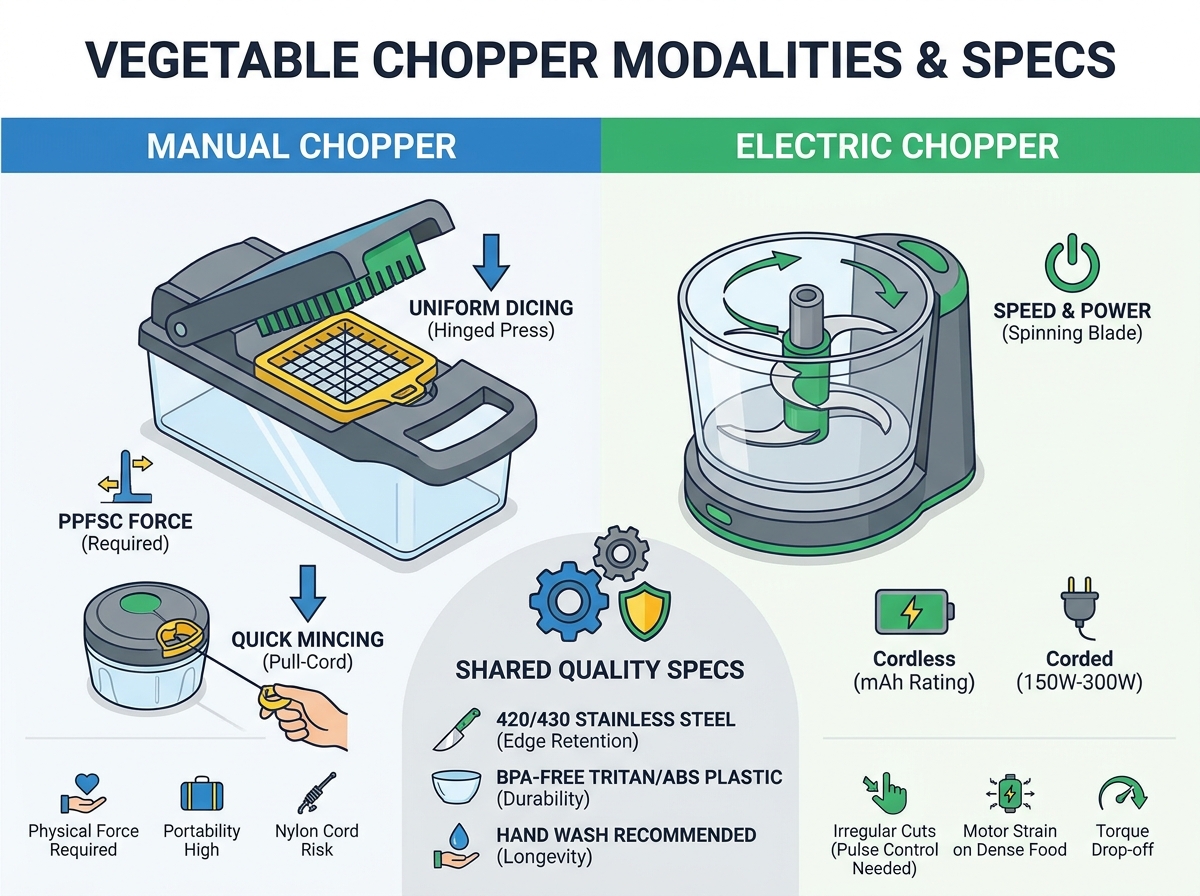
- Mechanism defines outcome: Hinged press-choppers deliver uniform dicing; spinning blade models (manual or electric) excel at mincing but yield irregular cuts.
- Material grades matter: Look for 420 or 430-grade stainless steel for blade edge retention, and BPA-free Tritan or ABS plastic for high-impact bowl durability.
- Maintenance dictates adoption: If a chopper lacks a self-cleaning mechanism or traps water in its gear housing, user adoption will drop due to cleaning friction.
- Know the functional boundaries: Vegetable choppers are not food processors; pushing them to handle dense meats, ice, or hard nuts degrades the motor or warps the blades.
Core Modalities: Manual vs. Electric Vegetable Choppers
Selecting the right power modality dictates your daily prep experience. Kitchen workflows vary drastically, and matching the machine's mechanism to your cooking habits ensures you actually use it. We divide these devices into manual and electric categories, each presenting distinct mechanical advantages and failure points.
Manual Modalities (Pull-Cord vs. Press-Down vs. Hinged Lid)
Manual choppers rely entirely on human kinetic energy. They thrive in environments where portability and simplicity matter most. However, their physical construction requires careful scrutiny.
Hinged Mandoline/Dicer Style: This design remains best for uniform cubing. If you process onions, bell peppers, or potatoes for consistent visual presentation, this modality works flawlessly. You must apply downward physical force to push the produce through a static metal grid. The key failure point here is plastic hinge fatigue. When users force dense root vegetables through the grid, the rear hinges absorb massive stress. Over time, cheap plastic hinges develop micro-fractures and snap. We recommend inspecting the hinge thickness before purchasing.
Pull-Cord/Rotary: These models excel at quick mincing tasks for garlic, ginger, and soft herbs. Portability is remarkably high, making them popular for camping or small kitchens. A rapid pull generates impressive blade RPMs. However, the nylon cord presents a common long-term failure risk. Abrasive friction against the housing exit hole eventually frays the cord. Users often pull the cord to its absolute maximum limit, which forcefully stresses the internal recoil spring.
Electric Modalities (Corded vs. Cordless)
Electric models remove physical exertion from the equation. They suit high-volume prep but introduce electrical failure risks and require proximity to power outlets.
Wattage Specifications: Motor power dictates cutting efficiency. A range of 150W to 300W serves as the standard baseline for efficient vegetable chopping without motor strain. Sub-100W models are highly prone to stalling on dense root vegetables like carrots or beets. When a weak motor stalls, it overheats rapidly. This heat degrades internal wiring and shortens the appliance lifespan. Always verify the wattage rating on the manufacturer label.
Battery Limitations (Cordless): Cordless models offer excellent mobility across the kitchen island. When evaluating them, you must assess their mAh (milliampere-hour) ratings. A higher mAh rating sustains peak power longer. Cordless models experience noticeable torque drop-off as battery life depletes. A half-charged battery might spin the blades fast enough for tomatoes, but it will likely jam when processing dense onions.
Table: Manual vs. Electric Modalities Comparison
| Modality Type | Best Suited For | Primary Weakness | Ideal Specification |
| Hinged Dicer (Manual) | Uniform cubing, salsas, salads | Hinge fatigue, requires physical force | Reinforced ABS hinges |
| Pull-Cord (Manual) | Quick mincing, aromatics, herbs | Nylon cord fraying, spring failure | Braided nylon cord |
| Corded Electric | High-volume prep, tough vegetables | Requires outlet, takes up counter space | 150W - 300W motor |
| Cordless Electric | Mobile prep, moderate volumes | Torque drop-off at low battery | High mAh lithium-ion battery |
Evaluating Blade Quality and Cutting Mechanisms
The blade serves as the heart of any chopping device. Poor blade quality ruins produce, turning crisp vegetables into bruised, weeping messes. Evaluating metallurgy and structural architecture separates professional-grade tools from disposable gadgets.
Metallurgy and Edge Retention
Steel quality directly impacts how long your device remains useful. You must demand transparency in steel grading from manufacturers.
Look specifically for 420J2 or 430 stainless steel. These specific alloys offer the necessary hardness for impact resistance against tough skins. Tomatoes and bell peppers possess surprisingly tough outer skins that quickly dull inferior metals. The 420 and 430 grades maintain their microscopic edge geometry through hundreds of impacts without premature dulling.
Conversely, avoid generic "stainless steel" labels lacking grade specifications. These vague labels almost always indicate softer 304 steel. While 304 steel provides excellent rust resistance, it performs poorly for blade edges. It bends and rolls at the microscopic level upon impact with hard vegetables. A rolled edge crushes food cells, releasing excess water and ruining texture.
Blade Architecture
The physical shape and arrangement of the blades govern the final texture of your ingredients. Different architectures serve entirely different culinary purposes.
- Grid/Dicer Blades: These blades intersect to form a square grid. You should measure the grid spacing carefully (e.g., 1/4 inch versus 1/2 inch) based on your recipe needs. Welded joints on the grid must be perfectly seamless. Sloppy spot-welding creates tiny crevices where food particles trap and rot. High-quality grids use laser welding to ensure a flush, hygienic surface.
- Tiered Spinning Blades: Rotary models utilize horizontal spinning blades. Single-level blades often miss food pushed to the upper edges of the bowl. Multi-level blades (bi-level or tri-level) solve this issue. They create a vertical cutting zone that prevents un-chopped food from safely resting at the bottom or top of the bowl. This architecture ensures a highly consistent mince.
Capacity, Footprint, and Material Compliance
A beautifully engineered blade means little if the bowl size frustrates your workflow or the plastics leach chemicals. Proper sizing and strict material compliance ensure the device fits seamlessly and safely into your daily routine.
Sizing the Bowl for the Workflow
Bowl capacity dictates how many batches you must run to finish a recipe. Choosing the wrong size creates unnecessary dishwashing or tedious repetitive processing.
- Micro/Mini (1-2 Cups): These compact units are ideal for aromatics. If you primarily process garlic, ginger, or small shallots, a micro bowl keeps the ingredients close to the blades. Large bowls scatter small amounts of garlic out of the blade's reach.
- Standard (3-5 Cups): This size fits typical household meal prep perfectly. It comfortably handles one to two whole onions per batch. It strikes the best balance between counter footprint and practical output.
- Overfilling Risk: You must respect the maximum fill lines. Spinning blade choppers lose efficiency rapidly if filled past the 60% capacity mark. Overfilling prevents the ingredients from circulating. The bottom layer turns into a watery mush while the top layer remains completely whole.
Food Safety and Structural Integrity
Kitchen plastics endure harsh environments. They face acidic tomato juices, staining spices, and physical impacts. You must verify FDA or equivalent food-grade certifications before allowing plastics to touch your food.
Evaluate the housing materials critically. ABS plastic serves as the industry standard for the outer shell due to its high impact resistance. It survives accidental drops off the kitchen counter. However, the clear collection bowl requires different properties. Bowls made of Tritan plastic or borosilicate glass offer vastly superior performance compared to basic polycarbonate. They provide better resistance to aggressive staining from turmeric or carrots. Furthermore, Tritan and glass prevent odor retention. Basic plastics absorb garlic oils permanently, tainting future batches of food.
Application Boundaries: Chopper vs. Slicer vs. Processor
Consumers often confuse the capabilities of different kitchen appliances. Expecting a lightweight prep tool to perform heavy-duty processing leads to broken equipment and voided warranties. Understanding application boundaries protects your investment.
Defining the Primary Use Case
A Vegetable Chopper is optimized for swift, coarse-to-fine reduction of water-dense or moderately firm produce. It excels at breaking down onions, celery, carrots, and peppers. Its primary goal is reducing knife work time for standard mirepoix, salsas, and stir-fry bases.
Where Choppers Fail (The Reality Check)
Pushing these devices beyond their intended engineering limits guarantees failure. You must recognize their mechanical boundaries.
Dough and Heavy Emulsions: Never attempt to mix bread dough or thick nut butters in these devices. The motors completely lack the necessary torque. If you try this in a manual model, the internal gearboxes will strip their plastic teeth instantly.
Hard Fibers & Ice: Processing ice cubes or extremely hard fibrous roots (like mature galangal) destroys the cutting mechanisms. Metal grids will bend under the pressure. Spinning blades will chip their delicate edges or stall the motor entirely.
Slicer Overlap
Many hinged models include interchangeable mandoline slicing plates. This adds excellent versatility, but you must assess the rigidity of the plastic track. When you slide a potato across the mandoline, you apply lateral pressure. Any flex in the plastic track leads to uneven slices. More importantly, a flexing track creates severe safety hazards, as the food guard can slip and expose your fingers to the blade.
Usability and Maintenance: The "Ease of Cleaning" Metric
If an appliance takes longer to clean than it saves in prep time, it will sit unused in a cabinet. Maintenance friction dictates long-term user adoption. You must evaluate how easily the device sheds food debris and resists water damage.
The Dishwasher-Safe Myth
Manufacturers frequently advertise their products as "dishwasher safe." You should treat this claim with high skepticism. While bowls and blades are often top-rack dishwasher safe, the harsh environment takes a toll. High heat degrades ABS plastic over time, making it brittle. Furthermore, aggressive dishwasher detergents dull blade edges through micro-abrasions. Hand washing remains the evidence-backed recommendation for maximizing longevity and sharpness.
Water Ingress Risks
Water trapped inside mechanical components breeds bacteria. You must examine the lid design of pull-cord or electric models carefully. Sealed gearboxes are absolutely essential. If wash water enters the pull-cord cavity, it cannot evaporate easily. Mold growth inside the dark, damp cavity is highly probable. Look for models featuring silicone gaskets or fully sealed motor housings that prevent water ingress during rinsing.
Clearing Mechanisms
Grid dicers naturally trap food skins between their plastic pusher teeth. Evaluate the included cleaning accessories before buying. A dedicated cleaning claw is helpful, but an integrated push-plate is vastly superior. A push-plate sits behind the pusher teeth; pressing a button forces the plate forward, ejecting all trapped food scraps instantly. This feature is a non-negotiable requirement for hinged dicers, saving you from picking out onion skins with a toothpick.
Conclusion
Selecting the ideal kitchen prep tool requires matching mechanical specifications to your daily culinary habits. Base your final decision strictly on your prep routines rather than flashy marketing. If visual uniformity acts as your primary success criteria for salsas or salads, prioritize a hinged grid-dicer equipped with 420-grade stainless steel. If speed for soups, sauces, and marinades represents your main goal, prioritize a 200W+ electric model or a robust multi-tier pull-cord device.
Take actionable steps before purchasing. Audit your current kitchen prep bottlenecks to understand what slows you down. Determine your realistic tolerance for manual cleaning versus automated washing. Finally, filter your options strictly by material transparency, ensuring you secure BPA-free, high-impact plastics and verified steel grades.
FAQ
Q: Can a vegetable chopper process meat or hard nuts?
A: Occasional light use for boneless, semi-frozen meat or soft nuts (like walnuts) is possible in electric models exceeding 250W. However, manual grid dicers cannot process meat under any circumstances. Attempting to chop hard nuts in manual models will likely crack the plastic housing or dull the blades rapidly. Always defer to a heavy-duty food processor for dense proteins.
Q: Why does my electric vegetable chopper turn onions into mush?
A: This is a direct result of over-processing or overfilling the bowl. Spinning blades lack the clean, downward shear of a grid dicer. To fix this, use short, 1-second pulses rather than continuous operation. Pulsing allows the food to fall back down to the blades evenly, helping you maintain a distinct, chopped texture rather than a puree.
Q: How do I prevent the pull-cord from breaking on a manual chopper?
A: Pull directly outward on a strict horizontal plane. Pulling at an upward or downward angle creates harsh friction against the plastic exit hole, which frays the nylon cord over time. Furthermore, never pull the cord to its absolute maximum extension. Stop slightly short of the limit to protect the internal recoil spring from snapping.
Q: Are glass bowls better than plastic bowls for vegetable choppers?
A: Glass, specifically borosilicate, resists scratches, prevents odor transfer (crucial for pungent garlic and onions), and won't warp in the dishwasher. However, glass bowls are significantly heavier and present a dangerous shatter risk if dropped on hard kitchen floors. High-grade Tritan plastic serves as a competitive, durable alternative that bridges the gap.


