Moving from consumer-grade tools to industrial procurement marks a critical milestone for any growing operation. You are no longer just sealing a few bags for short-term storage. Instead, you are securing an entire production line against costly disruptions. Food spoilage, rapid product oxidation, and unpredictable workflow bottlenecks pose severe risks to both commercial kitchens and large-scale manufacturing plants. Without verifiable hygiene standards and continuous cycle times, operations quickly lose efficiency and compromise overall product quality.
Scaling your packaging process requires a strategic approach to risk mitigation and operational reliability. This guide provides a comprehensive framework to evaluate technical specifications and align equipment capabilities with your strict production requirements. You will learn exactly how to assess different pump technologies, determine the right machine category for your product volume, and navigate the practical realities of implementation seamlessly.
Key Takeaways
- Match Machine to Volume: Choosing between external, chamber, or continuous models depends entirely on daily cycle frequency and product dimensions.
- Pump Technology Dictates Performance: Oil-lubricated pumps offer higher vacuum levels and durability for heavy use, while dry pumps lower maintenance requirements for lighter duty.
- Look Beyond Upfront Cost: Total Cost of Ownership (TCO) must factor in consumable costs (pouches, oil), seal bar replacements, and potential downtime.
- Application Specifics Matter: Operations dealing with liquids, delicate items, or specific compliance standards require tailored features like gas flush (MAP) or wash-down ratings.
Defining Your Baseline Production Requirements
Selecting the right equipment begins by mapping out your daily operational demands. A mismatch here leads to either severe workflow bottlenecks or wasted capacity. You must audit your current processes to define an accurate production baseline.
- Volume and Cycle Speed: Calculate your required cycles per minute and per hour. Differentiate clearly between intermittent prep-station use and continuous industrial processing. A kitchen sealing fifty portions a day has vastly different needs than a processing plant moving thousands of units per shift.
- Product Characteristics: Audit the exact physical state of the products being packaged. You need to know if they are solid, liquid, powder, sharp-edged, or easily crushed. Sharp bones require thicker pouches, while delicate pastries demand specific pressure controls.
- Pouch and Dimension Limits: Determine the maximum dimensions of your largest single product. This measurement establishes your required seal bar length and the necessary chamber volume. Trying to force large items into undersized chambers compromises seal integrity.
- Labor Footprint: Assess your workforce involvement. Decide whether the process will remain highly manual and operator-dependent or if you plan to integrate the equipment into a semi-automated line. Manual operations rely heavily on user training, whereas automated lines require precise timing synchronization.
Core Categories of Commercial Vacuum Packaging Machines
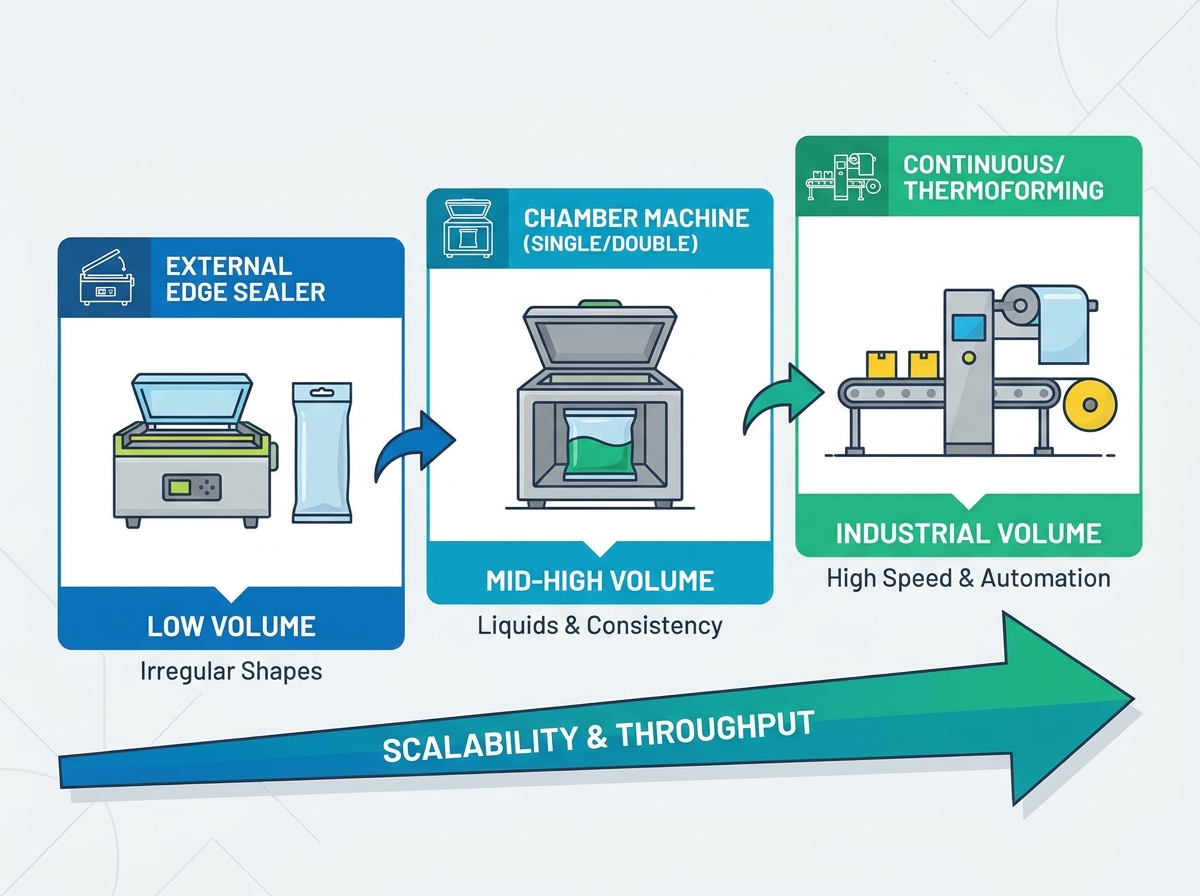
Manufacturers engineer different machine categories to solve specific production challenges. Understanding these core mechanisms helps you narrow down your search efficiently.
External Edge (Out-of-Chamber) Sealers
Mechanism: This design pulls air directly from the bag opening. The product itself remains entirely outside the machine enclosure during the process.
Best For: These units excel at handling irregularly shaped, excessively long, or oversized products. If an item cannot fit physically inside a standard chamber, an external edge sealer offers a practical solution.
Limitations: External models are generally incompatible with liquids. The suction mechanism often draws moisture directly into the pump. They also achieve a lower maximum vacuum percentage and rely heavily on specific textured channel bags to extract air properly.
Single and Double Chamber Vacuum Machines
Mechanism: Operators place the entire bag and the product inside a sealed chamber. The machine evacuates ambient air from the chamber, equalizing pressure. This equalization prevents liquid boiling or sudden pouch collapse before the sealing bars engage.
Best For: These are the workhorses of commercial kitchens, butchers, and mid-to-high volume processors. Selecting a robust vacuum packaging machine in a double-chamber configuration allows operators to load one side while the other actively runs a cycle, significantly boosting throughput.
Limitations: They require a larger physical footprint. Furthermore, product size remains strictly limited by the internal chamber dimensions.
Continuous Belt and Thermoforming Systems
Mechanism: These represent automated or semi-automated inline systems. They utilize roll stock film or continuous belt loading. They seamlessly create, vacuum, seal, and cut individual packages at exceptionally high speeds.
Best For: These systems dominate industrial-scale food manufacturing and large-scale medical device packaging operations.
Limitations: They demand significant floor space. You also need dedicated, highly trained operators to manage roll changes and monitor belt synchronization.
Table 1: Comparison of Commercial Packaging Machine Categories
| Machine Category | Ideal Application | Liquid Handling | Throughput Level |
| External Edge Sealers | Oversized or irregular items | Poor | Low to Medium |
| Single/Double Chamber | Butchers, restaurants, mid-volume processing | Excellent | Medium to High |
| Continuous Belt Systems | Industrial food and medical manufacturing | Excellent | Very High |
Evaluating Technical Specifications and E-E-A-T Criteria
Choosing industrial equipment requires looking past basic marketing claims. You must evaluate the underlying engineering to ensure the unit survives your operational environment. Pump mechanics and sanitary designs define the true longevity of the hardware.
Vacuum Pump Technologies: Oil vs. Dry
The pump acts as the heart of any sealing system. You must evaluate oil-lubricated rotary vane pumps if your goal is achieving maximum vacuum levels. These robust pumps can reach up to 99.9% vacuum depth. They handle continuous operations effortlessly. However, operators must acknowledge the trade-off. They require regular oil changes, routine conditioning programs, and strict maintenance schedules to prevent moisture buildup.
Conversely, you should assess dry (oil-less) pumps for lower-maintenance needs. They fit perfectly into environments where oil misting poses an operational contamination risk. You must understand their specific limitations. Dry pumps struggle to achieve peak vacuum depths compared to their oiled counterparts. They also face durability limits during relentless, continuous cycle demands.
Sanitary Design and Compliance Standards
Food safety compliance is never optional. Inspectors look closely at equipment materials and cleanability. Poorly designed machines harbor bacteria in hidden crevices, leading to failed audits and product recalls.
- Material Grade: Always require 304 or 316-grade stainless steel construction. These specific alloys resist corrosion in environments requiring aggressive daily sanitation routines.
- Wash-Down Protection: Check for relevant wash-down IP ratings. An IP65 rating protects internal sensitive electronics from low-pressure water jets during cleaning. Higher ratings ensure safety against high-pressure, high-temperature washdowns.
- Regulatory Certifications: Verify necessary certifications before finalizing any purchase. Look for NSF, CE, and UL marks. These badges satisfy health inspectors and prove regional regulatory compliance.
Aligning Machine Capabilities with Specific Industry Applications
Generic solutions rarely perform well in specialized environments. You must match specific machine capabilities directly to your industry demands.
Commercial Kitchens, Sous Vide, and Hospitality
Chefs face unique challenges when preserving ingredients or preparing portions for sous vide cooking. The environment moves quickly, space remains tight, and precision is paramount.
Key Requirements: Operations need 100% liquid-sealing capabilities without risking pump contamination. You also need highly precise vacuum controls. Pulling too hard crushes delicate ingredients like fresh herbs or soft berries. Furthermore, commercial kitchens typically demand a highly compact physical footprint.
Recommended Feature: Look for slanted inserts or liquid-catch systems. Slanted plates tilt the pouch upward, keeping marinades and broths safely away from the seal bar during evacuation.
High-Volume Meat, Dairy, and Food Processing
Industrial processing facilities operate under punishing conditions. Equipment runs for hours without stopping, handling heavy, dense, and sometimes abrasive products.
Key Requirements: Processors demand extreme mechanical durability. Double-chamber efficiency is practically mandatory to keep pace with production lines. The machine must possess the physical capacity to handle exceptionally large cuts, known as subprimals, or heavy bulk cheese blocks.
Recommended Feature: Modified Atmosphere Packaging (MAP) or Gas Flush capabilities are highly recommended. These systems inject an inert gas mixture immediately before sealing. This prevents ugly discoloration in fresh meats and extends shelf life without physically crushing the product under atmospheric pressure.
Non-Food Industrial and Medical Packaging
Packaging sterile medical devices or sensitive electronics requires an entirely different approach to environmental control and component protection.
Key Requirements: These applications require absolutely contamination-free environments. Strict adherence to ISO cleanroom standards is non-negotiable. The packaging process must guarantee total protection of sensitive internal components.
Recommended Feature: Seek out anti-static (ESD) designs. Additionally, prioritize bi-active sealing systems. Bi-active sealers feature both top and bottom heating elements. This double-heating approach easily melts through thick, multi-layer foil pouches commonly used in medical and electronic industries.
Implementation Realities and Rollout Risks
Procuring the hardware only solves half the puzzle. Successful integration depends heavily on how your team interacts with the new technology daily.
Operator Training
Even the most advanced equipment fails if humans operate it poorly. You must acknowledge that improper pouch placement remains the leading cause of seal failure. Wrinkles across the seal bar create microscopic channels for air to re-enter. Similarly, setting incorrect cycle times wastes expensive packaging film and slows down the line. Comprehensive, hands-on operator training mitigates these common mistakes.
Maintenance Diligence
Equipment longevity relies on proactive care. You must emphasize the importance of running pump conditioning programs. These built-in heating cycles evaporate trapped moisture inside the pump block. Skipping these cycles, or delaying mandatory oil changes, will drastically shorten the lifespan of any high-performance sealing system. Supervisors should log daily and weekly maintenance tasks visibly on the factory floor.
Vendor Service Level Agreements (SLAs)
Machines occasionally break down. Your response time dictates your production loss. Evaluate the manufacturer or distributor critically. Judge them based on guaranteed parts availability and local technician dispatch times. Demand total warranty transparency. Ensure you understand clearly which components count as normal wear parts and which fall under defect coverage.
Conclusion
Selecting the ideal packaging equipment requires a disciplined evaluation of your physical production needs. You must define maximum product dimensions precisely and establish realistic throughput expectations. From there, select the pump technology that aligns seamlessly with your maintenance capabilities and environmental constraints.
Before issuing any final Purchase Order, take proactive steps to validate the engineering. Advise your procurement team to request a live pilot test. Alternatively, submit your actual product samples directly to vendors. This step verifies seal integrity and confirms true cycle times under real-world conditions.
Take action today. Audit your current packaging bottlenecks carefully. Map out where products stall on the line, and request detailed specification sheets from qualified commercial suppliers to begin closing those operational gaps.
FAQ
Q: Can a standard vacuum packaging machine seal liquids like soups and marinades?
A: Chamber machines can safely seal liquids because pressure remains completely equalized inside and outside the pouch during the evacuation cycle. External edge sealers generally cannot perform this task, as their direct suction mechanism will pull liquid forcefully into the internal pump.
Q: How often should the oil be changed in a commercial chamber vacuum sealer?
A: It depends heavily on usage intensity and the product type. Generally, oil should be changed every 100 to 250 operating hours. You should also change it immediately whenever the oil appears cloudy or emulsified, as this visually indicates severe moisture contamination.
Q: What is a Gas Flush (MAP) feature, and is it necessary?
A: Gas flush replaces ambient oxygen in the bag with an inert gas mixture before the sealing bar closes. It is necessary only if you package easily crushable items or products where oxygen absence prevents mold, but a tight vacuum would damage visual presentation.
Q: What is the difference between single and double seal bars?
A: A single seal bar creates one line of heat to fuse the bag shut. A double seal bar creates two distinct, parallel seal lines. This provides an extra layer of security against leaks, which proves critical for heavy items, liquids, or high-value shipments.


