Upgrading or installing a new fruits processing line requires significant capital investment and careful strategic planning. This massive operational decision directly impacts your daily product yield, overall facility efficiency, and mandatory regulatory compliance. Operations managers face immense pressure to get these critical variables exactly right on the first try.
Miscalculating long-term operational costs frequently sabotages expected profitability margins. Underestimating strict hygienic design requirements often leads to severely bloated operational expenses and deeply delayed return on investment. Many procurement teams understandably struggle to separate aggressive marketing claims from genuine, verifiable performance metrics.
This comprehensive guide breaks down the essential feature-to-outcome matrix for modern processing equipment. We extensively explore realistic cost structures and outline highly proven risk mitigation strategies. You will confidently learn how to evaluate competing equipment vendors objectively and select the exact machinery necessary for your specific production environment.
Key Takeaways
- Yield is the primary ROI driver: Prioritize features that minimize bruising and mechanical waste over superficial automation.
- CAPEX is only 40% of the lifetime cost: Energy consumption, water management, and CIP (Clean-in-Place) chemical costs dominate long-term OPEX.
- Compliance dictates design: FSMA compliance and hygienic engineering are non-negotiable baselines, not premium add-ons.
- Integration risks: The steepest implementation delays stem from legacy software integration and operator training gaps.
Categorizing Fruits Processing Line Configurations
Procurement teams must first match equipment architecture to their specific business trajectory. Choosing the wrong underlying configuration severely limits future expansion and complicates daily operations. We evaluate systems based on both their integration flexibility and their output specialization.
Modular Units vs. Turnkey Systems
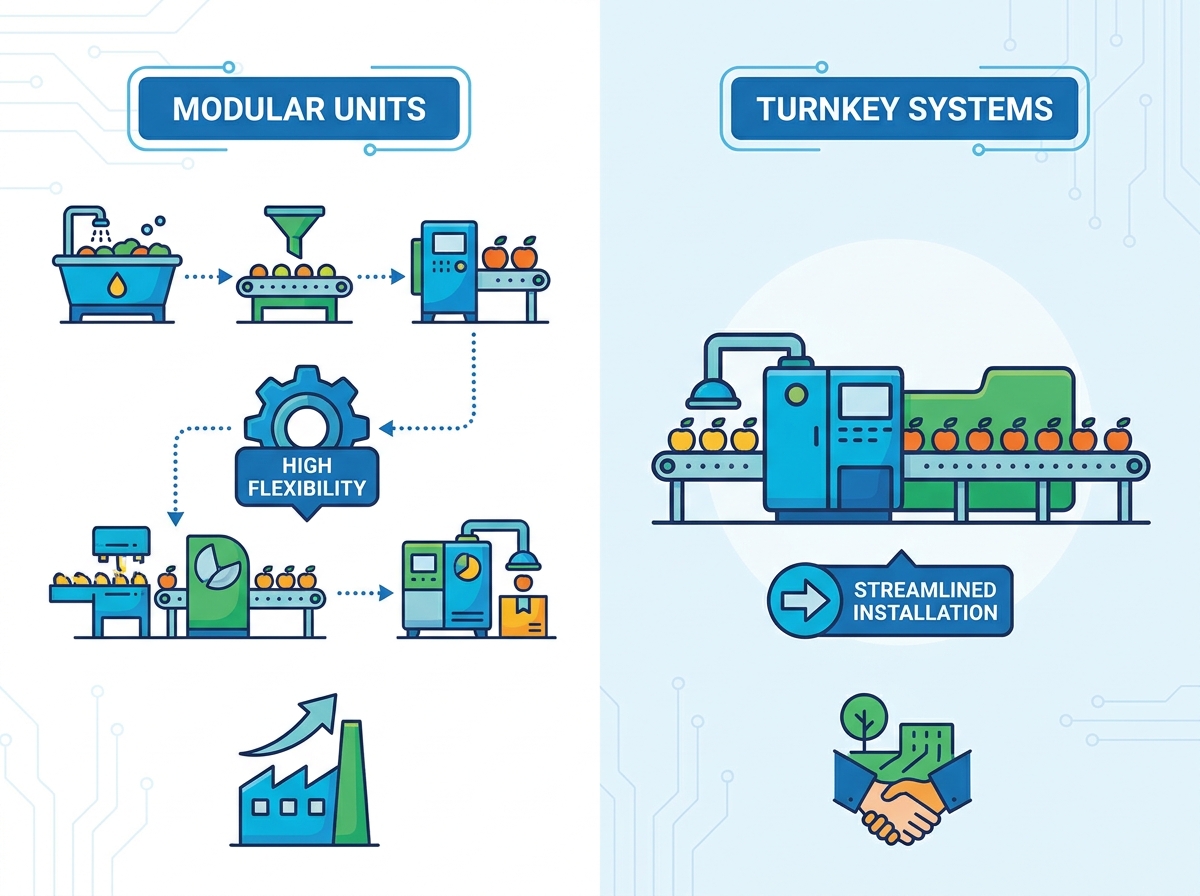
Modular units provide exceptional layout flexibility. You can phase your capital expenditures effectively over several fiscal quarters. Growing facilities often prefer modular layouts. You add specialized wash tanks or sorting belts as production demands increase. However, this flexibility requires rigorous systems integration. Your engineering team must ensure separate PLCs and mechanical conveyors communicate flawlessly.
Turnkey systems offer single-vendor accountability. This approach streamlines your installation timeline from day one. Factory engineers handle the complex wiring and software handoffs internally. Greenfield projects benefit massively from turnkey installations. However, turnkey architectures carry distinct vendor lock-in risks. You rely entirely on one company for future software upgrades and proprietary replacement parts.
Table 1: Configuration Strategy Comparison
| System Type | Primary Advantage | Ideal Facility Profile | Key Integration Risk |
| Modular Units | Phased capital expenditure | Rapidly scaling operations | Complex PLC communication |
| Turnkey Systems | Single point of accountability | New greenfield builds | Severe vendor lock-in |
Specialization by Output
You cannot use a generic setup for every product category. Each final product demands specific equipment geometries and thermal capabilities. Processing lines generally divide into three major output categories.
First, juice and puree extraction focuses heavily on thermal treatment. Your primary goal is maximizing liquid yield. Equipment must apply exact pressure profiles to extract juice without crushing bitter seeds. Thermal elements must preserve volatile flavor compounds during pasteurization.
Second, fresh-cut and slicing lines demand extreme hygiene. Blade sanitation remains a critical failure point. Facilities must maintain low ambient temperatures across the entire processing floor. Automated packaging zones often utilize modified atmosphere technology to extend retail shelf life.
Third, drying and dehydration lines rely entirely on thermal efficiency. You must control internal chamber moisture precisely. Modern dehydration equipment uses advanced energy recovery loops. These loops capture escaping heat and significantly lower your monthly utility bills.
Core Evaluation Dimensions: Features to Outcomes
Evaluating a modern fruits processing line requires looking past basic marketing specifications. You must translate physical machine features into tangible daily outcomes. Operational success depends on realistic throughput, absolute sanitation, and raw material preservation.
Throughput Scalability vs. Actual Capacity
You must evaluate the equipment’s true peak efficiency window. Sales brochures highlight maximum operational speeds under perfect laboratory conditions. Real factory floors rarely sustain these hypothetical speeds. Product variations and minor line jams constantly interrupt flow.
A machine rated for five tons per hour may only run optimally at three and a half tons per hour. You must factor in daily changeovers. Cleaning cycles and preventative maintenance eat directly into your active runtime. Ask vendors for empirical data showing sustained weekly throughput rather than burst-capacity metrics.
Sanitary Design and Automation (CIP)
Food safety compliance begins with fundamental mechanical engineering. Look exclusively for continuous TIG welds across all structural frames. Bolted joints inevitably trap organic material. Equipment must feature heavily sloped surfaces to prevent stagnant liquid pooling. Minimal dead legs in piping systems stop dangerous bacterial buildup before it starts.
Automated Clean-In-Place (CIP) systems completely transform your daily cleaning protocols. Manual scrubbing wastes countless labor hours. Automated CIP applies exact chemical concentrations and precise water temperatures automatically. These systems drastically reduce daily chemical usage. They cut turnaround times between product batches, directly recovering expensive labor hours.
Material Handling and Bruise Mitigation
Raw material preservation dictates your ultimate profitability. Assess flume transport systems carefully. Water flumes provide incredibly gentle transit for delicate produce. Gentle-drop conveyors use customized baffles to protect fragile skins during elevation changes.
Optical sorting capabilities remove defective or discolored items instantly. Advanced cameras identify internal bruising before the product enters the primary slicer. Reducing raw material damage by just one or two percent generates massive annual savings. These direct yield improvements easily justify a premium upfront equipment price tag.
Breakdown of Capital and Operational Costs
Financial modeling for processing facilities demands rigorous accuracy. Many financial planners focus entirely on the initial purchase order. This myopic view ignores the massive recurring expenses required to keep high-speed machinery running daily.
Initial Capital Expenditure (CAPEX)
Your CAPEX involves much more than the vendor's sticker price. You must account for massive international or domestic freight charges. Factory acceptance testing (FAT) requires sending your lead engineers to the manufacturer's site. This travel budget adds up quickly.
Physical installation demands specialized riggers. You need master electricians to wire heavy-duty control panels. Structural engineers might need to reinforce your concrete floors before the equipment even arrives. Always add a twenty percent contingency fund to your base CAPEX calculations.
Hidden Operational Expenses (OPEX)
Energy and utility loads represent your largest recurring liability. Industrial heat exchangers drain enormous power. Commercial chillers and large maceration motors strain standard electrical grids. You must carefully evaluate your local peak-load energy costs before signing contracts.
Water consumption presents another massive hidden expense. Initial washing stages and flume transports are incredibly water-intensive. You must evaluate closed-loop filtration options immediately. Modern water recycling features capture, filter, and reuse transit water. These systems require higher upfront capital but offer massive long-term utility savings.
Maintenance and Consumables
Downtime destroys profit margins instantly. Predictive maintenance sensors measure motor vibration and bearing temperature continuously. They add noticeable initial costs to your electrical panels. However, they prevent catastrophic mid-season mechanical failures. You replace a vibrating bearing during a scheduled shift change, rather than stopping production entirely.
Factor in the recurring cost of wear-parts explicitly. Industrial blades, rubber belts, and silicone seals degrade constantly under heavy use. You must know their exact standard replacement intervals. Keep critical consumables stocked locally in your maintenance cage.
To accurately audit these expenses, follow this standard process:
- Request specific hourly utility consumption rates from the equipment manufacturer.
- Map these consumption rates against your regional utility pricing tiers.
- Calculate the annual cost of mandatory chemical cleaning agents.
- Price out three years of recommended spare parts upfront.
Navigating Implementation Realities and Risks
Even the most perfectly engineered equipment fails if your facility cannot support it. Implementation delays routinely destroy project budgets. You must audit your physical infrastructure and software architecture months before the delivery trucks arrive.
Facility Footprint and Utility Upgrades
You must verify your physical infrastructure thoroughly. Existing floor drainage trenches might lack the required volumetric capacity. Ceiling heights frequently restrict elevated conveyors or optical sorting towers. Do not assume your current factory layout works natively.
Ensure your existing HVAC systems can handle excess thermal output. Pasteurizers and blanchers release massive heat loads into the surrounding air. Excess moisture ruins improperly ventilated production spaces. Uncontrolled humidity encourages dangerous ambient bacterial growth on walls and ceilings.
Software and PLC Integration
Bridging proprietary new software causes massive commissioning headaches. You must link OEM machinery systems to your existing central SCADA infrastructure. Enterprise Resource Planning (ERP) systems require seamless, real-time data handoffs to track inventory yields accurately.
Legacy software often rejects modern data outputs. Demand open-architecture designs from your vendors. Standard communication protocols like EtherNet/IP or PROFINET are absolutely vital. Refuse equipment utilizing locked, proprietary communication standards.
Operator Adoption
Highly automated lines dramatically change your daily workforce needs. Transitioning from manual labor sorting to technical machine operation presents a massive cultural shift. Your current team requires entirely different daily troubleshooting skills.
Structured vendor-led training prevents costly operational errors. Insist vendors provide onsite trainers for at least two weeks post-installation. Operators must learn how to clear mechanical jams safely. They must understand human-machine interface (HMI) alarm codes intimately before the vendor leaves the site.
Shortlisting Logic and Next-Step Actions
You need a repeatable, objective framework to evaluate competing machinery vendors. Relying on glossy brochures or simple price matching guarantees future operational failures. Standardize your approach to extract genuine performance commitments from engineering firms.
Defining Success Criteria
You must standardize your Request for Proposal (RFP) completely. Demand strict yield guarantees upfront in the negotiation. Specify exact energy consumption limits based on your local utility grid constraints.
Request precise throughput metrics tailored to your specific raw materials, rather than accepting generic equipment catalog numbers. Clear success criteria eliminate unqualified vendors from your pipeline immediately.
Vendor Due Diligence
Perform exhaustive background checks on shortlisted manufacturers. Follow a strict vetting sequence:
- Request Highly Specific Case Studies: They must demonstrate success processing similar product types at your exact intended scale.
- Audit Spare Parts Availability: Verify their warehouse locations. International shipping delays cause devastating downtime during peak harvest seasons.
- Review Service Level Agreements (SLAs): Scrutinize their emergency response clauses. You need guaranteed, measurable downtime support metrics written into the contract.
- Contact Past Clients: Call operations managers at reference facilities. Ask them specifically about software integration struggles and post-sale technical support.
Actionable Next Step
Develop a standardized scoring matrix for your top vendors. Weight the scores heavily toward sanitary design, utility efficiency, and domestic parts availability. Schedule Site Acceptance Testing (SAT) explicitly in your purchasing contracts. Never release the final capital payment until the installed machinery passes these rigorous SAT performance benchmarks on your factory floor.
Conclusion
Selecting the optimal configuration for your facility requires balancing upfront capital constraints against critical long-term efficiency requirements. You must prioritize yield preservation, utility management, and uncompromised food safety at every evaluation stage.
- Focus on raw material yield: Equipment that gently handles produce heavily outperforms cheaper alternatives through massive waste reduction.
- Audit infrastructure early: Verify your HVAC, drainage, and electrical panel capacities months before equipment delivery.
- Demand integration standards: Require open-source PLC communication protocols to connect new hardware to your existing software ecosystem.
- Look past the sticker price: The cheapest initial quote frequently masks terrible utility efficiency and severe compliance liabilities down the road.
Make your final procurement decisions based on a rigorous 5-to-10-year holistic expenditure model. Do not let minor upfront savings dictate your facility's long-term profitability. Contact our engineering team today for a customized throughput analysis. We can help you standardize your vendor evaluations and build a resilient processing infrastructure.
FAQ
Q: What is the average ROI timeline for a fully automated fruit processing line?
A: Most facilities see a return on investment within 24 to 48 months. This timeline heavily depends on your local labor costs, baseline energy rates, and the specific raw-material yield improvements the new machinery achieves. Rapid ROI typically comes from drastically reduced daily chemical usage and minimized product bruising.
Q: How do food safety standards (like FSMA) impact equipment choice?
A: Strict regulations require verifiable, easily cleanable designs to prevent severe cross-contamination. You must look for equipment meeting rigorous 3-A Sanitary Standards. These stringent requirements legally eliminate cheaper, poorly welded, or highly bolted equipment from viable consideration, forcing buyers toward premium hygienic engineering.
Q: Can an existing processing line be retrofitted with optical sorting?
A: Yes, modern optical sorters are frequently modular and designed for retrofitting. However, you must explicitly account for the required upstream singulation. The equipment must spread the produce out perfectly before scanning. You also need dedicated downstream routing channels to handle automatic physical rejections.


