Prep work stands as the most time-consuming phase of daily cooking for most home chefs. While chopping vegetables offers a moment of zen for some, it mostly represents tedious labor standing between you and dinner. However, choosing the wrong kitchen gadget can easily add more cleaning time than it actually saves. You might buy a device hoping for speed, only to spend ten minutes scrubbing tiny blades afterward.
This dilemma brings us to the core decision you face: selecting a manual or an electric Vegetable Chopper. A mismatch here leads to cluttered countertops and appliances gathering dust in dark cabinets. Your ultimate goal involves finding a reliable tool integrating seamlessly into your daily culinary routine.
We designed this article to provide a transparent, utility-focused evaluation framework. You will discover exactly which type of chopper matches your meal prep volume, kitchen space, and maintenance tolerance. We strip away the marketing fluff so you can make an informed, highly practical choice for your unique kitchen setup.
Key Takeaways
- Manual choppers excel in precision, portability, and small-batch tasks (e.g., mirepoix for one dinner), but require physical leverage and struggle with dense root vegetables.
- Electric choppers prioritize volume, consistency, and versatility (doubling as pureers), but demand more storage space and access to power.
- The actual ROI of a vegetable chopper is determined by the "Cleaning Paradox"—a tool is only efficient if the time saved chopping is greater than the time spent washing it.
- Success criteria depend heavily on blade material (minimum 420-grade stainless steel) and realistic dishwasher compatibility.
The Core Problem: Speed vs. Control in Meal Prep
Home cooks universally recognize meal prep as a significant bottleneck in daily cooking. We often experience profound inefficiency before any food even hits the hot pan. Inconsistent cuts cause severe problems during the cooking process. If you chop onions unevenly, the smaller pieces will burn while the larger chunks remain entirely raw. This discrepancy ruins the foundational flavor of soups and stews.
Furthermore, manual knife work introduces physical fatigue. Processing large volumes of dense produce strains your wrists and dulls your knives. Eye irritation from alliums frustrates cooks across the globe. We all dread the inevitable tears accompanying a massive pile of raw onions.
To solve these issues, you must establish clear success criteria for any kitchen gadget. The ideal tool must reduce active prep time significantly. It must deliver uniform pieces ensuring predictable cooking times. Most importantly, it needs to integrate smoothly into your specific cleanup routine. If a device fails these checks, you will simply stop using it.
Many buyers fall into a common trap. They assume maximum motor power solves every kitchen problem. We call this the over-processing risk. Purchasing excessive power often yields liquefied vegetables instead of a clean, uniform dice. You lose total control when a powerful motor spins too quickly. Control remains absolutely essential for textural dishes like fresh salsas, hearty stews, and delicate garnishes.
Common Mistake: Holding the power button down continuously on any automated machine. This action destroys the cellular structure of delicate produce, leaving you with a watery puree.
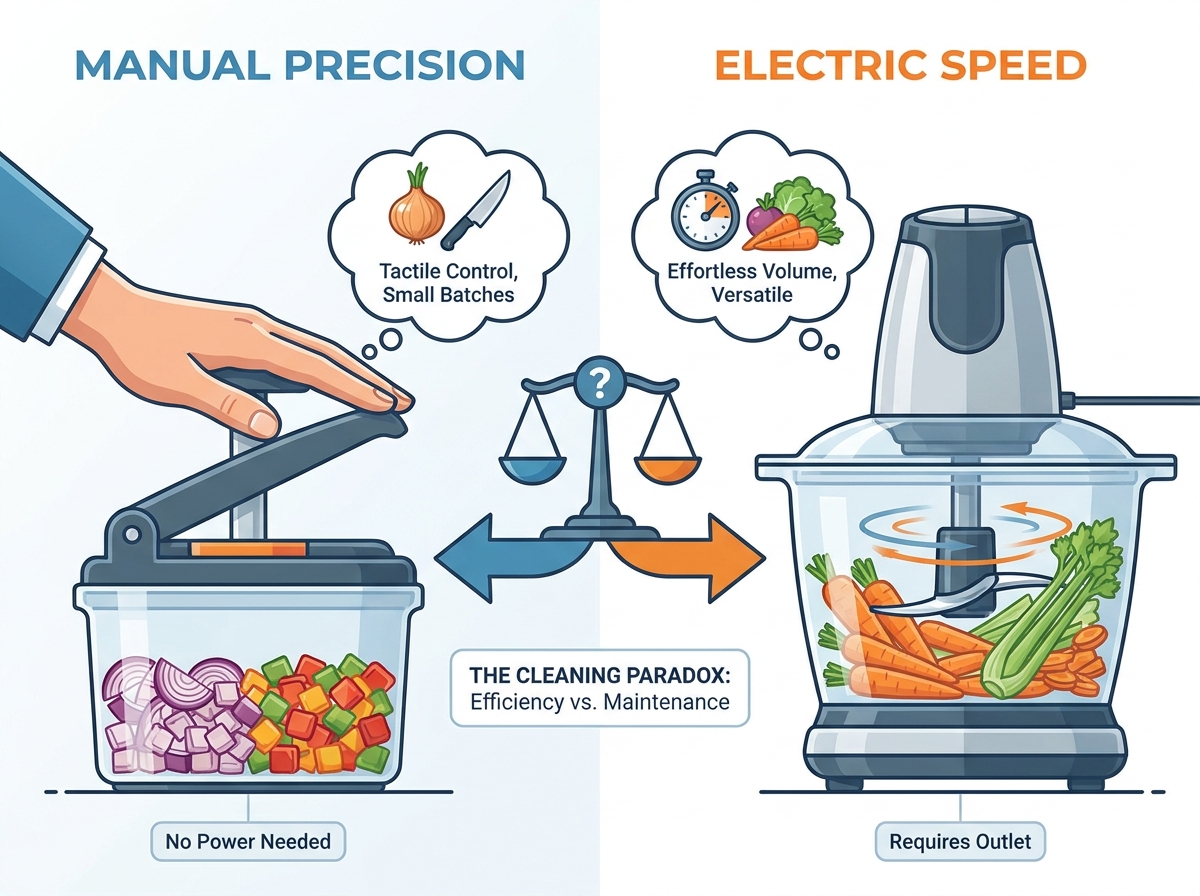
Manual Vegetable Choppers: Precision, Portability, and Sustainability
When evaluating human-powered devices, we must break down the primary mechanisms driving this category. Solution Category A encompasses several distinct designs. Pull-cord rotaries utilize a string mechanism spinning internal blades rapidly. Push-down spring handles employ vertical force to rotate blades incrementally. Press-down dicer plates force vegetables through a sharp stainless steel grid.
These designs offer substantial performance strengths for specific scenarios. You receive incredible tactile control over the final texture. This tactile feedback prevents accidental pureeing because you dictate the exact force applied. You can stop the moment your ingredients reach the desired size.
They also provide true off-grid functionality. We highly recommend them for RV living, weekend camping trips, or sustainability-focused kitchens. They require zero electricity to operate efficiently. Furthermore, they boast a remarkably compact storage footprint. You can tuck them into a small drawer effortlessly.
However, we must address their inherent limitations and operational assumptions. Manual designs require active physical exertion. Press-down models demand significant upper-body leverage to function properly. Cutting through dense, hard produce like raw carrots or thick sweet potatoes proves difficult.
If you lack hand strength or suffer from wrist issues, these models will frustrate you immensely. You often must pre-slice dense vegetables before the grid plates can handle them. This extra step somewhat defeats the purpose of an automated prep tool. They perform best on softer items like onions, bell peppers, tomatoes, and zucchini.
Electric Vegetable Choppers: Volume, Speed, and Versatility
If manual effort slows your workflow, you should explore motorized solutions. Solution Category B covers two distinct designs. Motorized blade-in-bowl designs feature a base engine driving a central spindle. Continuous-feed food processor hybrids shoot processed food directly into a separate external bowl.
These machines deliver massive performance strengths regarding pure volume. They process incredibly dense ingredients effortlessly. You can fly through massive batches during your weekly meal prepping sessions. They handle mountains of cabbage or pounds of carrots in mere seconds.
They also provide exceptional multifunctional capabilities. You can chop hard nuts, create smooth purees, and emulsify complex dressings. Most importantly, they eliminate physical strain completely. This zero-strain factor remains critical for aging users. Anyone experiencing limited hand mobility or severe arthritis will find immense value here.
Despite these benefits, electric versions carry undeniable limitations. You remain tethered to specific wall outlets. They usually occupy a bulky footprint on your precious counter space. Noise output runs significantly higher compared to manual options. A powerful motor grinding ice or nuts generates substantial decibels.
You also face a steeper learning curve initially. We frequently see beginners turn crisp vegetables into unappetizing mush. You must master the "pulse" function to avoid this trap. Quick, one-second bursts allow ingredients to fall back toward the blade evenly. Continuous running guarantees uneven, watery results.
5 Key Evaluation Dimensions for Home Cooks
To navigate a saturated market, you must evaluate products across five critical dimensions. We outlined these parameters to ensure your purchase provides genuine long-term value.
- Capacity vs. Output Ratio: You must match the internal bowl size to your actual household size. Bowl capacities usually range from 1 to 4 cups. A tiny 1-cup chopper proves entirely useless for a family of five. Conversely, a massive 4-cup chopper is absolute overkill just for mincing garlic garnishes. Buy the size matching your daily reality.
- Blade Materials & Geometry: You must evaluate the rust-resistant capabilities of the internal metals. High-carbon stainless steel represents a strict non-negotiable standard. Look specifically for 420 or 430-grade material designations. Multi-level blade stacking ensures even processing from the top of the bowl to the bottom.
- Build Quality & Plastics: Identify required material safety standards before purchasing. Ensure they utilize fully BPA-free materials. Shatter-resistant Tritan or heavy-duty ABS plastic prevents cracking under severe pressure. Cheap acrylics shatter easily when dropped on hard kitchen tiles.
- Ergonomics & Safety Features: Look closely for non-slip rubberized bases. A jumping machine presents a real danger. Locking lids prevent disastrous kitchen accidents. Press-down manual models absolutely must include reliable finger guards to protect your knuckles.
- Versatility: Assess any included interchangeable blades carefully. Some models offer julienne, spiralize, or fine dice attachments. Ask yourself honestly if you will actually use those extra parts. Often, they just create unnecessary drawer clutter and complicate the cleaning process.
Vegetable Chopper Capability Comparison Chart
| Feature Category | Manual Choppers | Electric Choppers |
| Power Source | Human kinetic energy | Standard wall outlet |
| Portability | Extremely high (Off-grid) | Low (Tethered to cords) |
| Texture Control | Precise visual feedback | Requires careful pulsing |
| Volume Handling | Small daily batches | Large weekly meal prep |
| Dense Root Veggies | Struggles heavily | Processes effortlessly |
Implementation Realities: Maintenance, Cleaning, and Storage
The true cost of any kitchen gadget reveals itself after the meal ends. We must discuss the infamous Cleaning Paradox. Compare the disassembly workflow carefully. A good Vegetable Chopper might save you 10 minutes of active knife work. However, it can easily demand 15 minutes of tedious cleaning if designed poorly.
Electric models involve washing bulky bowls, complex lids, sharp blades, and sometimes delicate rubber gaskets. Manual models generally feature fewer moving parts. Yet, they still require immediate rinsing to prevent dried food from cementing into tiny crevices. If you hate doing dishes, complex mechanisms will eventually sit abandoned in a cabinet.
We need to clarify transparent assumptions regarding "dishwasher safe" marketing claims. High dishwasher heat degrades plastic clips very quickly. Harsh detergents dull sharp steel blades over time. Hand-washing is often the unadvertised requirement for actual product longevity. We strongly recommend washing metal blades by hand immediately after use.
Storage footprint matters immensely in modern kitchens. Address cord management for electric models before buying. Cords tangle easily and consume valuable real estate. Manual dicers introduce a completely different risk profile. You might easily lose small proprietary attachments in chaotic kitchen drawers.
Durability risks define the lifespan of your investment. We often see specific common failure points. Snapped pull-cords plague cheap manual rotary units. Burned-out motors happen frequently on budget electric models. Motor failure usually occurs when stubborn users try processing hard root vegetables without pre-cutting them into manageable chunks first.
Decision Framework: Which Chopper Should You Shortlist?
To finalize your decision, apply this objective shortlisting logic. Review these if/then scenarios to identify your perfect match.
- If your main goal involves dicing soft onions for daily dinners, saving limited counter space, or outfitting an off-grid RV, then shortlist manual press or pull choppers.
- If your strategy centers around weekly batch meal prep, creating smooth salsas and hummus, or you suffer from limited hand strength, then shortlist electric choppers.
You need to take immediate next-step actions. Audit your available cabinet space right now. Determine your primary vegetable targets accurately. Are you mostly chopping soft tomatoes or attacking dense root vegetables? Prioritize models offering readily available replacement parts. Do not buy a disposable product destined for a landfill. Find a Vegetable Chopper built solidly enough to last through hundreds of dinners.
Best Practice: Always pre-slice massive potatoes or giant onions in half before inserting them into any machine. This simple habit extends motor life and prevents manual blade warping.
Conclusion
Neither electric nor manual designs reign universally superior in the culinary world. The right choice completely depends on your specific kitchen workflow and personal physical limitations. A tool transforming one cook's life might simply annoy another.
We encourage you to closely evaluate your most-dreaded prep task. Maybe you hate dicing pungent onions. Perhaps you despise shredding dense cabbage for coleslaw. Choose the tool specifically neutralizing that exact friction point.
For your next steps:
- Measure your available clearance under kitchen cabinets to ensure proper appliance storage.
- Track your weekly vegetable consumption volume to determine your ideal bowl capacity.
- Select a device matching your genuine cleanup habits and dishwasher reliance.
- Invest strictly in quality stainless steel materials to prevent premature blade dulling.
FAQ
Q: Can manual vegetable choppers cut hard root vegetables like sweet potatoes?
A: Yes, but only with significant physical force. Processing sweet potatoes or dense carrots risks snapping the internal blades on lower-end manual models. You usually must pre-slice these hard vegetables into smaller, manageable discs before pushing them through a manual dicer grid.
Q: Do electric choppers turn vegetables into mush?
A: They absolutely can if you run them continuously. The secret to success involves using the "pulse" function. Pressing the button in sharp, one-second bursts allows the ingredients to settle evenly, resulting in a uniform chop rather than a watery puree.
Q: How do I clean the grid blades on a manual dicer?
A: You must use the proprietary cleaning claw or comb included with the unit. This specific tool pushes stuck skins and fibers out of the sharp grid intersections safely. Rinsing the grid immediately after use prevents food from hardening into the corners.
Q: Are vegetable chopper blades interchangeable between brands?
A: No. Locking mechanisms and spindle shapes are highly proprietary across different manufacturers. You cannot swap blades between brands safely. We emphasize buying products from established brands offering their own specific replacement parts for long-term usability.


