Buyers are right to be skeptical about kitchen gadgets. Rinsing produce under the tap remains the universal standard. However, growing concerns about agricultural chemicals, wax coatings, and bacteria drive the adoption of dedicated purification devices. You want clean food. You certainly do not want another useless paperweight on your counter.
Traditional washing leaves a dangerous gap in food safety. Running water often misses lipid-soluble pesticides. It also fails to remove stubborn pathogens clinging to your greens. Meanwhile, modern purification tech makes bold claims. These claims often sound too good to be true.
We built this guide to separate facts from marketing noise. We provide an evidence-backed, hype-free comparison of the top five produce purifiers. You will learn how to evaluate them. We judge these units based on real-world efficacy and everyday usability.
Key Takeaways
- Top Tech Standard: Hydroxyl water ion technology and ultrasonic cleaning are the two dominant, scientifically backed mechanisms.
- Form Factor Matters: Portable capsule units are best for small households; dedicated countertop basin units are required for high-volume prep.
- Skeptic’s Truth: No machine removes 100% of pesticides, but the right vegetable cleaning machine significantly outperforms tap water and manual scrubbing without relying on chemical soaps.
- Decision Shortcut: Direct recommendations based on primary buyer needs (e.g., Best for Families, Best for Travel, Best for Heavy Wax Removal).
The Evaluation Framework: How We Compare Produce Purifiers
You must understand how a machine works before buying it. The market offers dozens of models. We evaluate them using four strict criteria. This framework ensures you get a safe, effective device.
First, we assess the purification mechanism. We look at the core technology driving the device. Electrolysis generates hydroxyl ions to degrade chemicals. Ultrasonic waves blast away physical dirt. We also watch out for ozone generators. Ozone works well in commercial settings. However, it can cause respiratory issues in poorly ventilated home kitchens.
Second, we examine capacity and workflow integration. A great machine must fit your daily routine. Capsule models drop right into your existing sink. They save counter space. Dedicated basin models hold more water. They require permanent counter real estate. We look at how seamlessly each fits into a standard kitchen.
Third, we review maintenance and scalability. You want a tool, not another chore. We evaluate device cleaning requirements. We check battery life and charging frequency. We also flag any consumable parts. Machines requiring expensive replacement filters lose points.
Finally, material safety and compliance remain non-negotiable. Kitchen devices interact with your food and water. We demand IPX7 waterproof ratings for electrical safety. We look for food-grade titanium and BPA-free plastics. We strictly penalize units causing secondary pollution.
The Top 5 Vegetable Cleaning Machines (Detailed Comparison)
Purifier Specifications Comparison Chart
| Product Category | Primary Technology | Best Suited For | Consumables Required? |
| AquaPure (Capsule) | Hydroxyl Ion | Everyday home use | No |
| K&H Countertop Wash | Hydroxyl + Rotation | Large families | No |
| Sonic Soak (Wand) | Ultrasonic (50 kHz) | Dirt & wax removal | No |
| Heyaxa (Mini Capsule) | Hydroxyl Ion | Travel & dorms | No |
| HYL Commercial Unit | Dual (Hydroxyl + Ultrasonic) | Commercial prep | No |
1. AquaPure Pesticide Purifier – Best Overall for Everyday Use
Core Specs: This unit utilizes hydroxyl water ion technology. It runs on a rechargeable lithium-ion battery. The device handles up to three gallons of water per cycle.
Implementation Reality: It performs beautifully on delicate greens like spinach. It easily penetrates the tight folds of broccoli. Hard root vegetables take slightly longer to process. You simply drop the capsule into a bowl of tap water.
Pros: It offers incredible ease of use. The one-button operation requires zero technical skill. It uses no consumable filters. The titanium plates clean easily under running water.
Cons & Limitations: You face long cycle times for large batches. Cleaning a massive haul from the farmer's market requires multiple back-to-back cycles. The battery needs frequent recharging if used daily.
Bottom Line: This is the ideal starter unit. Buy this if you want simple, effective pesticide degradation for standard family meals.
2. K&H Countertop Washer – Best High-Capacity Countertop Washer
Core Specs: This machine features a 9-liter dedicated washing basin. It combines hydroxyl tech with automated water rotation. It plugs directly into a standard wall outlet.
Implementation Reality: It takes up significant space. You need a dedicated spot near an outlet and a sink. The built-in drain pipe makes emptying the dirty water easy. It handles thick-skinned fruits and muddy root vegetables effortlessly.
Pros: High-volume processing is its biggest strength. The hands-free operation lets you prep other ingredients while it runs. The spinning action helps dislodge heavy soil.
Cons & Limitations: The footprint size is massive. It costs significantly more upfront than capsule models. You cannot easily store it away in a drawer.
Bottom Line: Ideal for large families or frequent meal-preppers. It suits anyone processing bulk produce regularly.
3. Sonic Soak – Best Eco-Friendly/Ultrasonic Option
Core Specs: This wand generates 50 kHz ultrasonic frequencies. It features a medical-grade stainless steel build. It draws power from a direct wall plug.
Implementation Reality: Ultrasonic waves excel at physical removal. They blast away dirt, heavy wax, and tiny insect eggs. However, they do not chemically break down pesticides as effectively as hydroxyl models.
Pros: It offers chemical-free cleaning. You can use it for multiple purposes. Users frequently clean glasses, jewelry, and baby pacifiers with it. It tackles heavy wax coatings brilliantly.
Cons & Limitations: The device can be quite noisy during operation. It emits a high-pitched squeal. You must thoroughly manually rinse the produce post-cycle to wash away the dislodged debris.
Bottom Line: Buy this if you prioritize physical debris and wax removal over chemical degradation.
4. Heyaxa Portable Capsule – Best Portable/Budget Purifier
Core Specs: This mini unit measures just a few inches across. It weighs under a pound. It features standard USB-C charging capability.
Implementation Reality: Battery degradation remains a long-term risk. The low power output means it struggles in large sinks. It works best in small mixing bowls. It fits perfectly into a carry-on bag.
Pros: It is highly affordable. The compact design makes it incredibly easy to store. You can take it on road trips or hotel stays.
Cons & Limitations: The lower power output requires patience. You must run multiple consecutive cycles for larger bowls. It lacks the durability of premium models.
Bottom Line: Ideal for frequent travelers, expats, or single-person households. It serves perfectly as a budget-friendly entry point.
5. HYL Commercial Washer – Best Premium/Commercial-Grade Unit
Core Specs: This beast uses dual-technology. It combines heavy-duty ultrasonic transducers with commercial-grade hydroxyl generators. It draws significant continuous power.
Implementation Reality: This unit is absolute overkill for basic home needs. However, it becomes necessary for extreme pesticide concerns. If you run a small restaurant or live in an area with poor agricultural oversight, you need this power. Finding a heavy-duty vegetable cleaning machine ensures maximum food safety compliance.
Pros: It delivers the maximum purification rate available. The heavy-duty build withstands constant, daily abuse. It processes massive batches in minutes.
Cons & Limitations: It is highly expensive. It requires dedicated kitchen real estate and specialized drainage.
Bottom Line: Best for health-compromised individuals or small commercial prep environments.
Hydroxyl Ion vs. Ultrasonic Tech: Which Actually Works?
Brands throw around scientific terms to confuse buyers. Let us simplify the science. The top machines rely on two distinct technologies. They solve different problems.
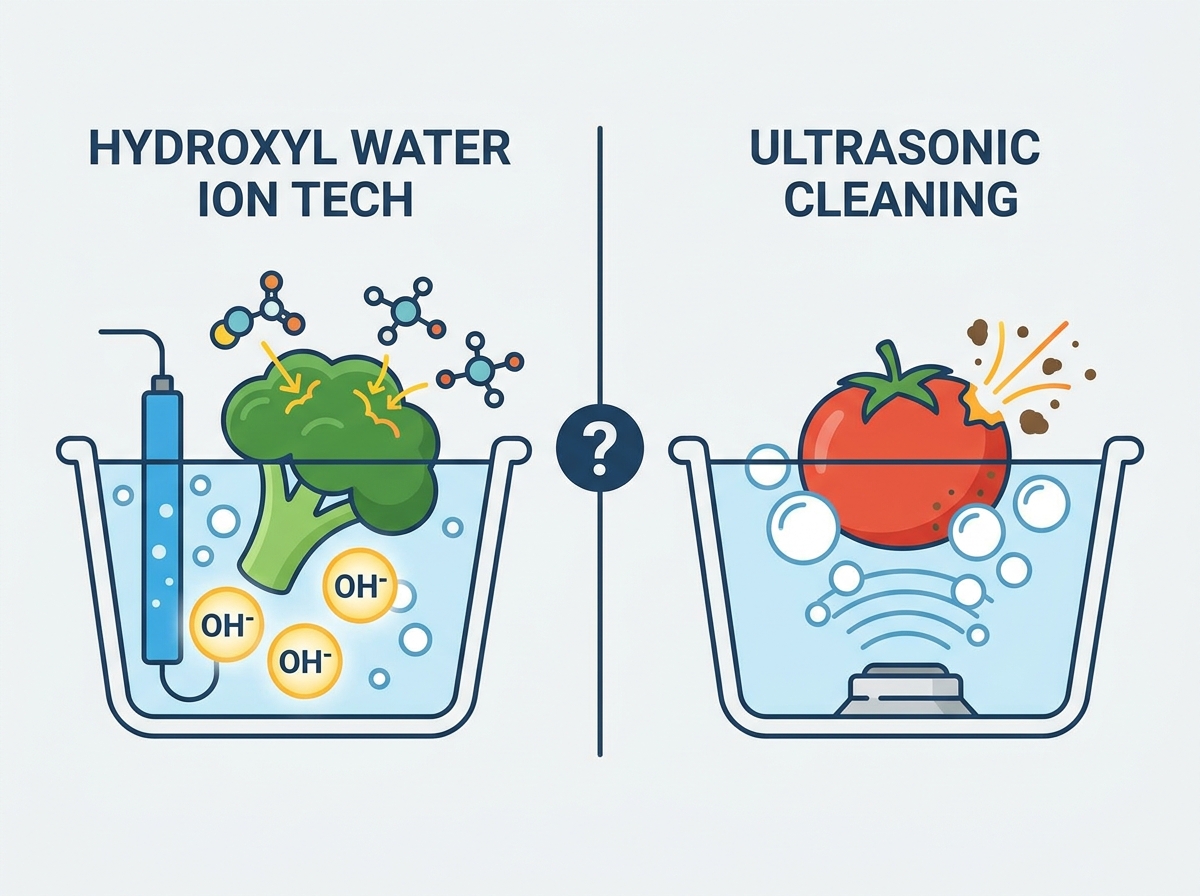
Hydroxyl water ion technology focuses on chemical degradation. The machine uses a titanium plate to perform electrolysis on tap water. This process splits H2O molecules. It creates OH- (hydroxyl) radicals. These radicals are highly reactive. They seek out the complex molecular structures of pesticides and bacteria. They steal electrons from these contaminants. This action breaks the toxic chemicals down into harmless mineral salts and water. If you worry most about invisible agricultural chemicals, choose hydroxyl technology.
Ultrasonic cleaning focuses on physical removal. The device emits high-frequency sound waves into the water. These waves create millions of microscopic bubbles. This process is called cavitation. The micro-bubbles implode forcefully against the surface of your produce. This microscopic scrubbing action blasts away physical dirt. It strips off artificial wax coatings. It destroys insect eggs hiding in lettuce folds. If you mostly buy organic but hate dirt and bugs, choose ultrasonic technology.
We must issue a strong warning about ozone. Some older machines pump ozone gas into the water. Ozone kills bacteria effectively. However, escaping ozone gas degrades indoor air quality quickly. It causes severe respiratory irritation. We generally recommend avoiding ozone-only machines for home use.
Implementation Realities: What Brands Don’t Tell You
Marketing videos show pristine vegetables emerging from a glowing blue machine. Real life looks a bit different. You need to manage your expectations regarding daily use.
First, the post-wash rinse remains mandatory. A produce purifier loosens dirt and degrades chemical bonds. It neutralizes bacteria. However, it does not make the contaminants vanish into thin air. The degraded residue still floats in the water. It clings loosely to the tomato skin. You still must manually rinse the produce under clean running water afterward. Skipping this step defeats the purpose.
Second, true purification takes time. It is not an instant process. A standard cycle takes five to fifteen minutes per batch. You cannot just dunk an apple and eat it immediately. You must build this waiting period into your meal prep routine.
Finally, water quality dependencies matter greatly. Highly hard water affects electrolysis. Calcium and magnesium build up on the titanium generator plates. Heavily chlorinated tap water can also skew the chemical reactions. If you live in an area with hard water, you must clean the machine itself. You will need to occasionally soak the device in vinegar to descale the plates.
How to Shortlist and Make Your Final Decision
Choosing the right device requires a simple elimination process. Follow these three practical steps to narrow down your options.
- Assess your volume. Look at your weekly grocery haul. Small hauls suit a sink-drop capsule. Massive weekly meal prep demands a countertop basin.
- Identify your primary concern. Determine what bothers you most. If you fear chemical pesticides, buy a hydroxyl unit. If you hate physical dirt and wax, buy an ultrasonic model.
- Check your budget and space. Look closely at your kitchen. Factor in the hidden footprint cost of basin models. A bulky machine stored in the garage does you no good. Buy what you will actually keep near the sink.
A reliable vegetable cleaning machine blends seamlessly into your existing habits. Do not buy a complex commercial unit if you only eat a few apples a week.
Conclusion
A dedicated produce purifier is a valid upgrade for health-conscious households. It bridges the gap between basic tap water and true food safety. You simply need to keep your expectations grounded in reality. These machines require time. They require a final manual rinse. They do not perform magic.
However, the science behind hydroxyl and ultrasonic technologies remains sound. They significantly reduce pesticide loads and bacterial counts. Assess your kitchen space, identify your main concerns, and pick a model from our list. Take the next step toward safer eating today.
FAQ
Q: Do vegetable cleaning machines remove 100% of pesticides?
A: No. Studies show reduction rates of 90-95% for certain chemicals, but absolute eradication is a marketing myth. They are, however, vastly superior to tap water alone.
Q: Can I just use baking soda and vinegar instead of buying a machine?
A: Compare the physical labor, ongoing cost of supplies, and varying efficacy of DIY soaks vs. the automated consistency of a machine. A machine saves time daily.
Q: Do these machines require replacement filters?
A: Clarify that most modern hydroxyl/ultrasonic units do not use physical filters, requiring only occasional cleaning of the titanium generator plates. You avoid recurring subscription costs.
Q: Does a vegetable cleaning machine extend the shelf life of produce?
A: Yes, by neutralizing surface bacteria and mold spores, purified produce often lasts noticeably longer in the refrigerator. This reduces household food waste significantly.


