Scaling food processing or commercial kitchen operations is a major operational step. You must transition from manual washing to automated systems efficiently. We know you cannot compromise produce integrity during this critical transition. A poorly specified vegetable cleaning machine leads to immediate line bottlenecks. It also causes high water waste and severely damages your delicate crop yields.
Evaluating technical specifications goes far beyond reading basic marketing brochures. You must align actual equipment capabilities against your specific production realities on the facility floor. This guide breaks down exactly how you should evaluate core technical specifications. We will help you navigate different washing technology types efficiently.
You will also learn how to align these equipment capabilities against commercial output demands and stringent compliance requirements. Read on to master these critical investment criteria and protect your production efficiency.
Key Takeaways
- Matching cleaning technology (bubble, ultrasonic, brush) to produce fragility is the primary driver of yield retention.
- Throughput specifications must be evaluated alongside water recycling capabilities to determine true operational ROI.
- Compliance hinges on material grades (e.g., SUS304 stainless steel) and the ease of sanitizing the machine itself.
Framing the Investment: Why Specifications Dictate ROI
Manual washing operations inherently result in highly inconsistent facility hygiene. They drive up your daily labor costs exponentially. They also create highly variable daily water usage. These distinct inefficiencies drain your facility resources quickly. You must evaluate specifications carefully to secure a strong return on investment.
Purchasing oversized equipment wastes essential utilities every single operating hour. Conversely, under-specifying your processing equipment causes severe daily line bottlenecks. Small equipment directly compromises your necessary cleaning times during peak production hours. You must define your exact business problem first. Are you losing yield to mechanical damage? Are your wastewater bills eroding facility profit margins?
A successful equipment deployment always achieves several specific operational criteria. You must demand the following outcomes:
- Measurable pesticide and microbial reduction verified by testing.
- Minimal mechanical damage to highly fragile produce batches.
- Predictable, standardized water and energy consumption rates.
- Seamless integration into existing upstream and downstream conveyors.
What to watch out for: Many facility managers focus solely on maximum hourly throughput. They ignore actual batch loading times entirely. This specific mistake throws off entire daily production schedules. You should evaluate every metric against your realistic daily operations.
Core Technologies: Matching the Method to the Produce
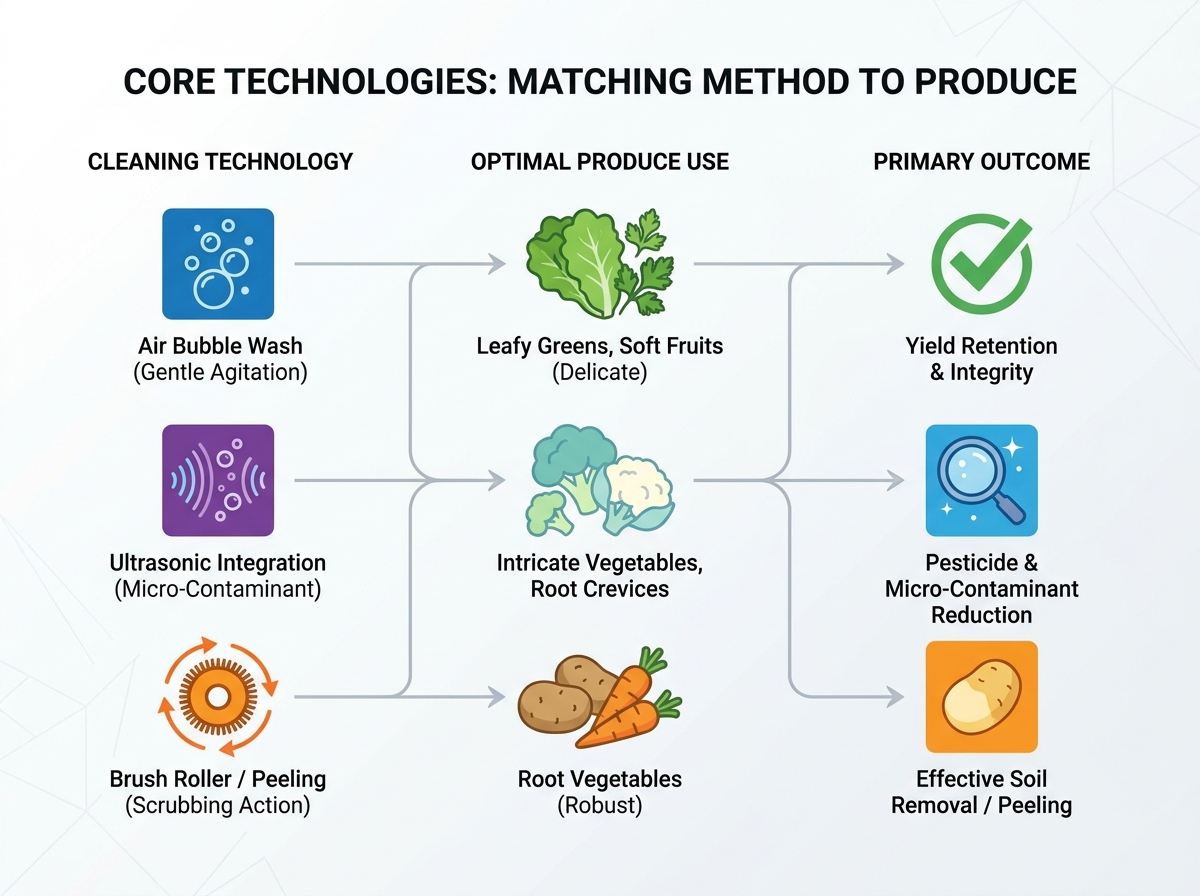
Different vegetables require entirely different mechanical agitation methods. You cannot wash delicate herbs exactly like hard potatoes. Matching your specific cleaning technology to produce fragility remains absolutely crucial. It acts as the primary driver of daily yield retention.
Air Bubble Washing Systems
Air bubble systems rely on high-pressure air injection. They create gentle, rolling water agitation inside the main wash tank. This specific process effectively simulates gentle hand-washing motions.
Optimal Use: You should use these automated systems for leafy greens. They also work perfectly for delicate herbs and soft fruits.
Limitation: These systems often struggle against heavy, caked-on field soil. They usually require a secondary brush stage for dirty roots.
Practical Experience: Operators processing spinach see massive benefits here. The rolling bubbles lift grit away safely. They never bruise delicate leaf structures.
Ultrasonic Cleaning Integration
This technology utilizes high-frequency acoustic sound waves. These intense waves create rapid cavitation bubbles in the wash water. Imploding micro-bubbles dislodge stubborn contaminants effectively. They also help reduce stubborn surface pesticide residue.
Optimal Use: Ultrasonic tanks excel at cleaning highly intricate vegetables. You will find them perfect for broccoli and cauliflower crowns. They clean deep inside tight root crevices effortlessly.
Limitation: The system requires highly precise frequency tuning. Improper settings easily cause cellular damage to highly delicate items.
Brush Roller and Peeling Washers
These machines utilize heavy-duty rotating nylon brushes. Thick bristles aggressively scrub the vegetable exterior continuously. You can configure them for simple surface washing. You can also set them for aggressive abrasive peeling.
Optimal Use: They remain the undisputed industry standard for root vegetables. Potatoes, carrots, and ginger handle this aggressive process perfectly.
Limitation: They are strictly unsuitable for leafy or fragile produce. Fast-rotating brushes will instantly shred soft vegetables into unusable waste.
| Technology Type | Primary Mechanism | Optimal Produce | Core Limitation |
| Air Bubble | High-pressure air agitation | Leafy greens, herbs, soft fruits | Struggles against caked-on soil |
| Ultrasonic | Cavitation via sound waves | Broccoli, intricate vegetables | Requires precise frequency tuning |
| Brush Roller | Rotating abrasive nylon brushes | Potatoes, carrots, ginger | Instantly destroys fragile leaves |
Key Technical Specifications to Evaluate
You must scrutinize detailed technical specifications carefully before purchasing. Marketing brochures often highlight optimal, unrealistic conditions. You need concrete data reflecting your actual facility environment.
Capacity and Throughput (kg/hr)
Manufacturers often list a theoretical maximum capacity. This number assumes ideal, continuous machine loading conditions. You must differentiate this from your realistic operational throughput. Operational rates factor in realistic loading and unloading times.
You should also evaluate internal washing tank dimensions carefully. Compare these tank dimensions relative to the density of your primary produce. A high-volume tank might process far fewer kilograms of buoyant spinach compared to extremely dense carrots.
Water Circulation and Filtration
Water efficiency dictates your ongoing daily utility bills. You must assess the presence of dual-filter systems. Overflow tanks are also critical features to look for. They actively separate large debris, floating bugs, and heavy sediment.
Calculate your estimated water consumption per wash cycle. Compare this against the efficiency of the internal water recycling pump.
Best Practice: Always test the filtration system design physically. Easy-to-remove filter baskets save your maintenance team hours of daily labor.
Automation and Control Systems
Modern commercial setups require incredibly smart control systems. Look for variable speed drives (VSD) installed on your conveyor belts. These drives allow you to adjust washing times seamlessly. You can easily slow down the belt for heavily soiled batches.
Evaluate programmable logic controllers (PLCs) as well. Smart PLCs ensure standardized, highly repeatable wash cycles every single time. They effectively remove dangerous human error from the daily equation. Operators simply press a pre-programmed profile button to start operations.
Meeting Food Safety and Regulatory Compliance
Global food safety regulations grow stricter every single year. Your new equipment must meet international compliance standards effortlessly. Failing safety audits halts your production lines immediately.
Material Standards
Never compromise on core construction materials. Insist on 304 or 316 food-grade stainless steel exclusively. This strict requirement applies to all contact and non-contact surfaces alike. Proper stainless steel prevents aggressive rust and dangerous corrosion.
It also stops dangerous bacterial harborage in its tracks. Check the welding quality on the machine frame carefully. Smooth, continuous welds prevent dangerous microscopic soil buildup.
Sanitary Design
Evaluate the machine's overall cleanability thoroughly before buying. You must inspect the internal design for dangerous blind corners. Look closely for exposed metal threads or completely inaccessible pipes. Biofilms form rapidly in these hidden, dark areas.
Common Mistake: Buyers often ignore the underside of the main conveyor belt. If your cleaning crew cannot reach it easily, bacteria will multiply there rapidly.
Efficacy Validation
Marketing claims mean very little during a rigorous safety audit. You must require hard, documented vendor data. Seek out third-party academic or regulatory alignment documents. Reputable vendors should reference HACCP, FDA, or local food safety center guidelines.
The documentation must demonstrate logarithmic reductions in dangerous microbial loads. It should also prove measurable reductions in surface pesticide residues.
Implementation Realities and Adoption Risks
Buying the machine is only the first major step. You must integrate it seamlessly into your existing daily workflow.
Facility Integration
Map the machine's exact physical footprint carefully. Compare it against your existing facility processing lines. Account for necessary loading elevations on the intake side. You must also verify precise discharge heights for downstream equipment.
A mismatch here requires highly expensive custom conveyors. It also delays your integration timeline by several weeks.
Utility Requirements
Verify your facility readiness long before final delivery. Check the total electrical draw of the new system. Confirm you have the necessary water inlet pressure available locally.
High-volume processing requires high-volume floor drainage capabilities. Without proper drainage, your facility floor will flood instantly. Standing water violates food safety regulations immediately. It also creates severe slip hazards for your workforce.
Maintenance Downtime
Assess the specific ease of replacing all wearable parts. Conveyor belts, nylon brushes, and high-pressure spray nozzles wear out eventually. Calculate the daily labor requirements accurately.
Determine exact times required for draining, cleaning, and thorough sanitization. Quick-release components reduce this downtime significantly. Machines requiring heavy tools for daily cleaning will frustrate your sanitation crew.
Shortlisting Logic and Next Steps
You are now ready to make an informed, data-driven choice. Narrowing down potential vendors requires a highly systematic approach.
Vendor SLA and Support
Prioritize manufacturers offering extremely clear service level agreements. They must provide easily accessible spare parts locally or regionally. Responsive technical support is absolutely non-negotiable in this industry. Machine downtime costs your facility money every single minute.
Factory Acceptance Testing (FAT)
Never skip the final testing phase. Demand a thoroughly documented test run before finalizing your purchase. The vendor must use your specific type of produce.
Produce behaves differently based on seasonal soil density. A carrot harvested in muddy spring conditions requires more aggressive brushing than a dry summer crop. The machine must handle your absolute worst-case scenario seamlessly.
Actionable Next Steps
Follow these exact steps to move your procurement forward safely:
- Outline your required daily throughput based on your absolute peak seasonal demand.
- Document your maximum available facility utilities, including precise electrical and drainage limits.
- Select your top three vegetable cleaning machine options based on appropriate agitation technology types.
- Create a strict spec-sheet matrix comparing these choices against your core facility requirements.
- Request formal FAT documentation from the remaining highly qualified vendors.
Conclusion
Selecting the best equipment requires highly careful, methodical analysis. The best machine is never the one boasting the most features. Instead, it is the one matching your facility’s output goals perfectly. It must align seamlessly against your specific produce types and rigid safety standards.
- Always prioritize verifiable hygiene data over generalized marketing brochures.
- Ensure physical integration realities match your existing facility footprint exactly.
- Protect your investment by demanding hard evidence of performance via FAT.
- Choose materials preventing dangerous biofilm buildup to breeze through safety audits.
Review your spec-sheet matrix carefully today. Schedule detailed discussions with your top vendor choices this week. Implement automated washing to scale your daily operations safely and efficiently.
FAQ
Q: How much water does a commercial vegetable cleaning machine recycle?
A: High-quality filtration systems reuse water for initial soil removal. They follow this stage utilizing a final fresh-water rinse. This specific method typically saves 30-50% in daily water usage compared to manual continuous-flow washing. Using integrated recycling pumps effectively reduces your utility waste while maintaining top hygiene standards.
Q: Can one machine handle both root vegetables and leafy greens?
A: Combination machines do exist, such as bubble washers featuring interchangeable brush rollers. However, dedicated machines remain much more efficient. They are significantly less risky for high-volume, mixed-produce operations. Delicate leafy greens often suffer mechanical damage in systems optimized for scrubbing hard root vegetables.
Q: Does ultrasonic cleaning actually remove pesticides?
A: Yes, ultrasonic cavitation significantly enhances the detachment of surface chemical residues. It easily outperforms simple soaking methods. However, it is not a complete substitute for proper chemical sanitizers or strict organic sourcing. You must use it as part of a highly comprehensive safety protocol.
Q: How long does it take to clean the machine itself?
A: Well-designed sanitary machines usually require 30 to 45 minutes of daily washdown. This timeframe depends entirely on the complexity of your specific filtration and conveyor systems. Quick-release belts and highly accessible drainage ports drastically reduce this daily maintenance labor.


