Capital expenditure on industrial washing equipment demands a strict operational balance. Facilities must ensure optimal food safety constantly. They also need high throughput efficiency and strong product integrity. Global supply chains place immense pressure on processing margins. Choosing incorrect specifications creates severe production bottlenecks. You might face excessive water waste daily. Poorly matched equipment often causes unacceptable rates of bruised produce. Modern facilities cannot afford these easily avoidable operational failures.
This guide provides an objective framework for facility managers. We help procurement teams evaluate washing equipment effectively. You will learn to prioritize technical realities over generic vendor marketing claims. We detail exactly which parameters define a high-performance system. Analyzing these metrics ensures you select the optimal solution for your specific produce line. You can secure product quality while maximizing daily operational yields.
Key Takeaways
- Technology matching is critical: Air bubble technology suits delicate leafy greens, while brush rollers are mandatory for root vegetables.
- Material grade is non-negotiable: True food-grade compliance requires verified SUS304 or SUS316 stainless steel to withstand constant moisture and chemical sanitizers.
- Water efficiency defines long-term ROI: Integrated filtration and water recirculation systems distinguish premium models from entry-level commercial units.
- Compliance mitigates risk: Verify electrical safety (e.g., FCC, CE) and sanitary design standards before shortlisting any equipment.
The Business Impact of Aligning Specifications with Production Goals
Facilities often underestimate the ripple effects of poor equipment selection. A mismatched system disrupts the entire processing line rapidly. We must examine how technical specifications directly influence daily business outcomes. Proper alignment protects your bottom line.
Throughput vs. Quality Trade-offs
Processing speed and cleaning efficacy share a strict inverse relationship. An undersized machine struggles during peak harvest hours. Operators often increase belt speeds to compensate for low capacity. This action reduces the crucial retention time needed for sanitation. You compromise food safety when produce rushes through the wash tank. Conversely, oversized machines waste massive energy and water during slow shifts. You must align the machine capacity perfectly. It must handle your specific kilograms per hour (kg/hr) requirements efficiently.
Yield Protection
Improper agitation specifications directly increase costly product waste. Delicate items suffer severe damage under incorrect water pressure. Excessive mechanical force causes micro-abrasions on outer skins. These tiny abrasions accelerate spoilage during transit. They drastically reduce your final marketable yield. You need precise control over washing intensity. Protecting yield requires adjustable settings for different harvest batches. A mere two percent yield loss per hour destroys monthly profit margins.
Resource Efficiency
High-volume processing facilities consume massive utility loads daily. Water consumption and power draw dictate your operational margins entirely. Standard continuous-flow washers drain resources rapidly. Upgrading to a system using advanced recirculation slashes utility bills. You must evaluate the kilowatt (kW) requirements alongside daily water usage. Efficient resource management separates profitable operations from struggling facilities. Smart procurement prevents bloated utility overhead.
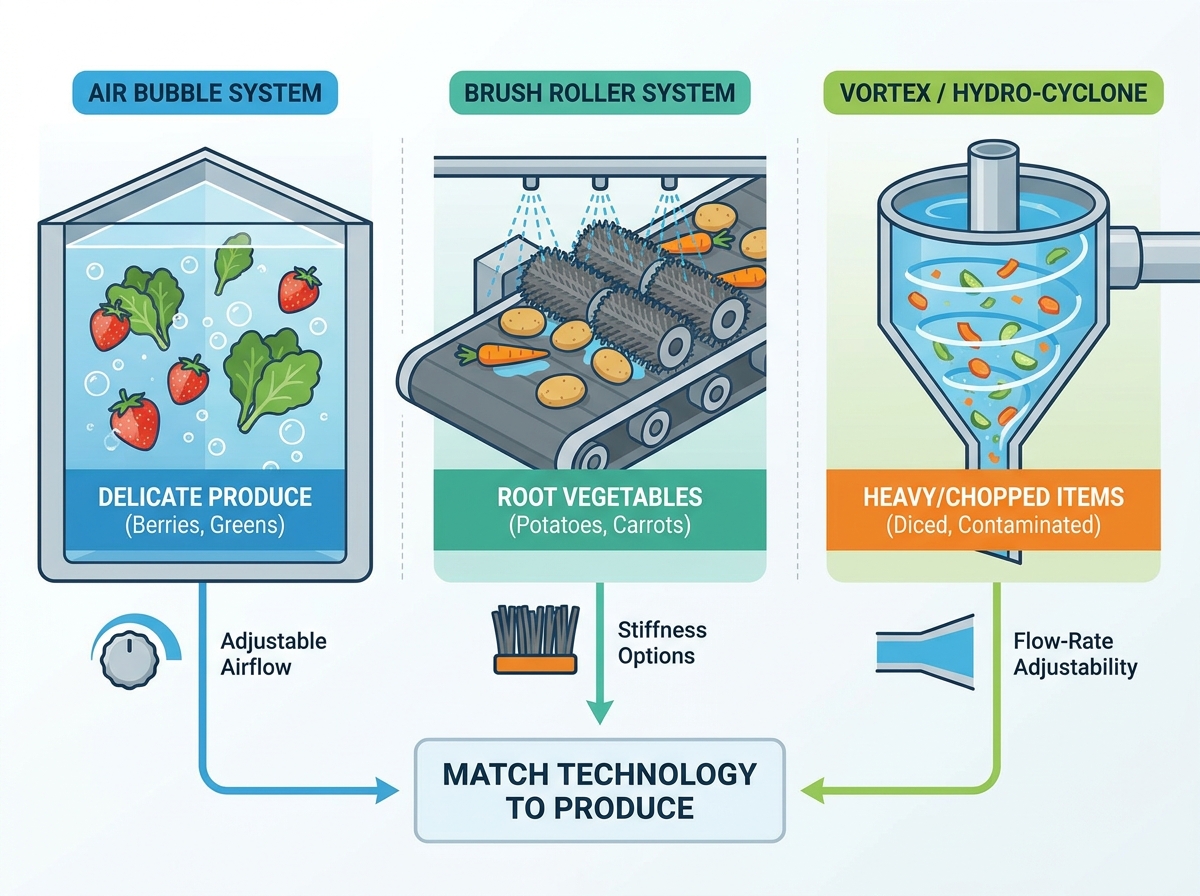
Categorizing Solutions: Which Core Technology Fits Your Produce?
Different produce types demand entirely different washing mechanisms. You cannot use a universal approach for diverse crop categories. Selecting the wrong mechanical action ruins the product. We categorize the core technologies below.
Air Bubble Washing Systems
This system relies on high-pressure air injected into the tank base. An industrial compressor pumps air through perforated pipes. It creates a vigorous tumbling effect in the water. The bubbling action gently separates dirt from the product surface.
Best for: Delicate items like berries, leafy greens, and soft tomatoes.
Evaluation lens: Always look for adjustable airflow controls. You need to calibrate the agitation intensity precisely. Gentle airflow protects soft berries from bursting. Stronger airflow handles robust greens effectively.
Brush Roller / Peeling Washing Machines
These units utilize heavy-duty abrasive nylon brushes. They combine mechanical brushing action and overhead water sprays. The friction effectively scrubs away heavy soil and peels skins. The rotating cylinders move the vegetables forward constantly.
Best for: Root vegetables like potatoes, carrots, and ginger. They also work exceptionally well for thick-skinned fruits.
Evaluation lens: Assess the available brush stiffness options. Soft nylon brushes clean without peeling the skin. Stiff nylon aggressively removes outer layers entirely. You should also check the ease of roller replacement. Maintenance staff need quick physical access.
Vortex / Hydro-cyclone Washers
This technology utilizes a continuous spiral water flow. The rotational force creates a powerful but controlled cleaning environment. It mimics natural river currents to agitate the product. It separates heavy debris from floating produce effortlessly. Investing in a high-quality fruit cleaning machine ensures thorough sanitation for difficult batches.
Best for: Chopped, diced, or highly contaminated heavy produce.
Evaluation lens: Check the internal channel width carefully. Evaluate the flow-rate adjustability. These specific features prevent clogging when processing large volumes of leafy items.
Core Washing Technologies Summary
| Technology | Primary Mechanism | Ideal Produce | Key Evaluation Metric |
| Air Bubble | Pneumatic tumbling | Berries, greens | Airflow adjustability |
| Brush Roller | Mechanical scrubbing | Root vegetables | Brush stiffness & access |
| Vortex | Spiral water flow | Diced, heavy items | Channel width capacity |
Essential Specifications to Evaluate Before Purchasing
Marketing brochures often obscure true performance metrics. Procurement teams must demand exact technical specifications. We outline the non-negotiable parameters below. You must verify these details early.
Capacity and Processing Volume
Machine size directly dictates production schedules. You must calculate accurate throughput needs accurately. Follow these strict evaluation steps:
- Assess the stated kg/hour capacity against realistic facility inputs.
- Factor in the inevitable volume spikes during peak harvest seasons.
- Verify the exact required retention time for chemical efficacy.
Pathogen removal demands specific contact durations. Produce must stay submerged long enough for sanitizers to work. An undersized tank forces you to rush batches constantly. This action violates fundamental food safety protocols.
Construction Materials and Sanitary Design
Material grade determines equipment lifespan definitively. You must mandate 304 or 316-grade stainless steel construction. Ask vendors for exact material thickness specifications. Most durable industrial units require at least 2mm steel thickness. Thinner metals warp under heavy daily use. The 316-grade steel resists pitting from harsh chlorine environments better than 304.
Sanitary design remains equally vital. Evaluate the tank for dead zones. Bacteria accumulate rapidly inside hidden crevices. The design must allow easy access for daily washdowns. Tubular frames often harbor fewer pathogens than enclosed square tubing.
Water Recirculation and Filtration Tech
Freshwater costs impact facility budgets heavily. Premium machines feature advanced recirculation systems. Look for robust multi-stage filtration setups. Primary mesh screens catch large debris like leaves and twigs. Secondary fine filters trap suspended dirt particles.
Calculate the required fresh water makeup rate. This figure reveals your true utility burden. Recirculating water significantly lowers daily operational expenses. It also aligns your facility operations alongside modern environmental sustainability goals.
Drive Systems and Automation
Modern processing lines require precise speed controls. Specify Variable Frequency Drives (VFDs) for all conveyor components. VFDs allow operators to adjust belt speeds instantly. Slower speeds accommodate heavily soiled batches perfectly. Faster speeds handle light cleaning duties quickly.
Assess the integration capabilities early. The new unit must communicate seamlessly alongside existing sorting equipment. It should feed directly into your drying lines without manual intervention. Automation reduces labor dependency.
Regulatory Compliance and Safety Standards
Industrial equipment must meet strict legal frameworks globally. Non-compliance exposes your facility to severe regulatory fines. It also risks employee safety daily.
Electrical and Operational Safety
Water and high-voltage electricity present severe workplace hazards. You must verify certifications relevant to your operating region. Check for FCC compliance regarding electrical interference. Demand CE or UL ratings for all control panels. Enclosure protection matters immensely.
- Check for IP65 waterproof ratings on standard electrical enclosures.
- Demand IP69K ratings for motors facing high-pressure washdowns.
- Ensure all emergency stop buttons remain easily accessible to operators.
The IP69K rating guarantees the machine survives high-temperature, high-pressure spray downs. This protection ensures long-term electrical reliability.
Food Safety and Efficacy Validation
Do not accept vague hygiene promises. Request actual vendor case studies immediately. Ask for independent laboratory data resembling academic journal testing. You need proof of guaranteed log reductions in microbial loads.
Confirm compatibility regarding standard chemical dosing systems. The machine components must resist degradation from chlorine constantly. They must handle peracetic acid safely. Ozone generator integration requires specialized component materials. Standard rubber seals degrade quickly when exposed to concentrated ozone.
Implementation Realities and Facility Risks
Installing heavy machinery requires meticulous physical planning. Facilities often overlook critical infrastructure limitations. You must prepare your physical space thoroughly.
Footprint and Layout Constraints
Equipment dimensions only tell half the story. You must account for the total operational footprint. Maintenance staff need adequate physical clearance constantly. They require space to remove large filtration screens.
Extracting heavy brush rollers demands significant aisle width. Forklifts need room to deliver produce crates. Failing to plan clearances extends routine maintenance times drastically. Measure your exact floor space carefully before ordering.
Utility Requirements
Audit your facility readiness well before delivery. Verify the specific electrical voltage requirements. Industrial units often demand three-phase power connections. Single-phase lines cannot support heavy-duty agitator motors.
Check your existing drainage capacity. The floor drains must handle sudden high-volume water discharges during tank purges. Confirm your municipal water pressure specifications. Low incoming pressure compromises overhead spray nozzle performance severely.
Maintenance and Downtime
Every machine eventually requires replacement parts. Evaluate the local availability of crucial spare components. Belts, nozzles, and brushes wear out predictably. Ask the vendor about the typical mean time to repair (MTTR).
Fast MTTR keeps your production line moving. Standard wear items should ship overnight reliably. Proprietary custom parts often cause disastrous week-long delays. High downtime costs negate initial equipment savings.
Vendor Shortlisting and Next-Step Actions
Choosing a vendor requires a strict vetting process. You must validate their performance claims through practical testing. We recommend specific final actions to protect your investment.
Requesting Proof of Concept
Never purchase equipment blindly. You should run a physical test batch first. Send your specific produce through the vendor’s demo machine. Bring your worst-case scenario produce. Use heavily soiled carrots or highly delicate overripe berries.
Inspect the final output closely. Look for hidden bruising on delicate skins. Check for lingering soil inside crevices. This practical test reveals actual equipment capability accurately. It exposes flaws obscured by glossy brochures.
Warranty and SLA Evaluation
Review the vendor contract details carefully. Scrutinize the fine print regarding component coverage. Vendors often classify essential parts under "wear and tear". You must distinguish these items from genuinely covered defects.
A strong Service Level Agreement (SLA) guarantees rapid technician dispatch. Look for agreements promising 24-hour response times. This ensures maximum uptime for your facility. Negotiate these terms before signing any purchase orders.
Conclusion
Evaluating a washing system demands a highly objective approach. You must prioritize measurable technical specifications constantly. Focus entirely on verified material grades and sanitary designs. Analyze the exact throughput parameters required for your peak seasons. Understand your specific utility demands clearly before installation.
These tangible metrics matter far more than generic marketing claims. Facility managers should build a standardized specification checklist. Base this list strictly on your exact produce mix. Complete this checklist before initiating any vendor outreach. Proper preparation guarantees a successful machinery investment. It secures both food safety and long-term operational efficiency.
FAQ
Q: What is the standard water consumption for an industrial fruit cleaning machine?
A: Standard consumption varies significantly by processing capacity. However, advanced models utilize integrated water-recycling technology. These systems capture, filter, and reuse water continuously. Water-recycling models can reduce overall consumption by up to 50-70% compared to traditional continuous-flow washers. This heavily decreases your daily utility costs.
Q: Can one machine handle both delicate fruits and root vegetables?
A: Combination machines do exist. However, they pose limitations. Best practices dictate separating bubble washers from brush washers. Delicate items require gentle pneumatic tumbling. Root vegetables need harsh mechanical scrubbing. Mixing these technologies compromises cleaning efficiency and increases produce damage risks.
Q: How do ozone generators improve the specifications of a washing machine?
A: Integrated ozone systems drastically enhance sanitation efficacy. They accelerate pesticide degradation quickly. Ozone provides significant bacterial load reduction without harsh chemical additives. Efficacy depends on maintaining precise ppm specifications in the water. This ensures optimal pathogen destruction while preserving product integrity.
Q: What is the difference between commercial B2B machines and B2C home purifiers?
A: Commercial B2B equipment focuses strictly on continuous throughput (kg/hr). They utilize robust stainless steel and intense mechanical agitation. B2C home purifiers handle small, static batches. They rely primarily on chemical or hydroxyl water ion technology to ensure individual consumer health.


