Investing in capital expenditure for food manufacturing carries incredibly high stakes. Making the wrong choice drains your operational budget quickly. It also creates severe compliance risks, production line bottlenecks, and costly unplanned downtime. Regulatory bodies show no mercy during facility hygiene audits. You must balance immediate production goals against rigorous industry standards. Meeting FDA, USDA, or GFSI requirements remains non-negotiable for any modern facility.
This complex procurement process demands careful planning and objective evaluation. Relying purely on initial vendor promises often leads to integration failures on the plant floor. This guide gives you a structured, evidence-based framework for capital purchases. We break down the complex buying journey into clear, actionable steps. You will learn how to evaluate, shortlist, and procure the exact machinery required for your specific facility line.
Key Takeaways
- Evaluate beyond capacity: Match equipment specifications not just to target throughput, but to facility footprint, upstream/downstream integration, and operator skill levels.
- Prioritize sanitary design: Factor Clean-in-Place (CIP) capabilities and IP69K washdown ratings into the initial ROI calculation to account for saved labor and reduced contamination risk.
- Assess Total Cost of Ownership (TCO): Upfront costs typically represent only a fraction of the equipment's lifetime expense; factor in utility consumption, wear-parts, and maintenance schedules.
- Enforce rigorous acceptance testing: Never skip Factory Acceptance Testing (FAT) and Site Acceptance Testing (SAT) to ensure the machinery performs with your actual product before final sign-off.
1. Defining Your Baseline Production and Facility Requirements
Buyers often rush to view vendor specification sheets prematurely. We recommend mapping your internal constraints first. This proactive approach prevents expensive procurement mistakes down the road. It also keeps your internal engineering and production stakeholders aligned on core objectives.
Throughput, Yield, and Scalability
You need to calculate your minimum viable throughput accurately. Compare this baseline figure against your peak seasonal demand. Food producers often face massive production spikes during holiday seasons. You must ensure your line handles these sudden surges safely. Many buyers confuse production speed and operational efficiency. Speed measures raw output per hour. Efficiency measures yield and total waste reduction. High-speed machinery means little if it destroys product yield along the way. Damaged products eat directly into your profit margins.
Consider modularity during your initial evaluation phase. Ask vendors if you can upgrade the system easily later. You want systems they can expand as your production volumes grow. Modular designs prevent you from replacing entire lines prematurely when consumer demand shifts.
Facility Footprint and Line Integration
Measure your spatial constraints very carefully. Do not just measure available floor space. You must account for ceiling height and maintenance access zones. Mechanics need physical clearance for opening safety doors. They also need ample room to pull out large mixing shafts for inspection. Assess how new machines fit into your existing layout.
They must integrate seamlessly into upstream conveyors. They also need to connect smoothly to downstream packaging systems. Misaligned transfer points cause product drops and continuous jams. Finally, verify your facility utility capacities thoroughly. Check your voltage requirements against current electrical panels. Ensure your compressed air lines meet the required CFM (Cubic Feet per Minute). Verify your boiler capacity and plant water pressure. Deficient utilities will choke a high-performance machine instantly.
2. Core Evaluation Dimensions for Food Processing Equipment
We use specific technical and compliance criteria to compare machinery objectively. This ensures you secure the best Food processing equipment for your specific plant environment. Subjective operator preferences should never drive primary capital purchases.
Material Selection and Durability
Standard 304 stainless steel works well for most general applications. It resists basic corrosion and handles standard washdowns effectively. However, 316 stainless steel becomes absolutely mandatory in harsh environments. You must use 316 for highly acidic, saline, or corrosive food processes. Tomatoes, citrus, and heavy brine solutions will pit 304 stainless quickly.
Inspect the welding quality closely on any prospective unit. Continuous, smooth welds prevent bacterial harborage points much better than spot welds. Grinding and polishing these welds removes microscopic hiding places for deadly pathogens. Always check non-metal contact parts for strict food-grade compliance. Plastics, elastomers, conveyor belts, and machinery lubricants must carry explicit FDA approval.
Material Compliance and Application Chart
| Material Grade | Corrosion Resistance | Environment Suitability | Cost Factor |
| 304 Stainless Steel | Moderate to High | Dry foods, baked goods, mild dairy | Standard Base Price |
| 316 Stainless Steel | Very High | High acid, heavy brine, raw meat | Premium Addition |
| Food-Grade Polymer (UHMW) | Chemical Resistant | Guides, scrapers, low-friction points | Variable by Part |
Sanitary Design and Washdown Compliance
Evaluate cleanability early in your procurement journey. Complex designs harbor bacteria like Listeria or Salmonella. Ask if the machine requires a complete teardown for daily cleaning. Complete teardowns consume hours of manual labor every single shift. Instead, look for systems supporting Clean-in-Place (CIP) protocols. Wash-in-Place (WIP) capabilities save massive amounts of labor. They also reduce the risk of cross-contamination from manual human handling.
Look for IP69K ratings on all electrical enclosures and sensors. These specialized enclosures withstand high-pressure, high-temperature washdowns safely. Assess the equipment surface geometry carefully. Sloped surfaces prevent pooling water naturally. Flat surfaces allow stagnant water to breed harmful microbial colonies. Accessible drive components make daily sanitation routines much easier for your crew.
Changeover Efficiency and Ergonomics
Multi-product lines demand extremely fast production transitions. You should quantify tool-less changeover times carefully. Relying on wrenches and hand tools delays production schedules heavily. Operators appreciate ergonomic, easily accessible physical adjustments.
Evaluate the Human-Machine Interface (HMI) usability next. Is the software intuitive for everyday floor operators? If it requires specialized engineering knowledge, you risk severe operational delays. Good HMI software includes visual troubleshooting guides and clear error codes. This empowers operators to resolve minor faults independently.
3. Evaluating Manufacturers and After-Sales Support Networks
You must mitigate vendor risk proactively before signing purchase orders. Evaluating the company behind the machinery matters just as much as the technical specs. A great machine fails quickly if the manufacturer disappears or ignores service calls.
Supply Chain for Spare Parts
Determine if replacement parts are highly proprietary. Off-the-shelf components usually offer better long-term availability. Proprietary motors or custom sensors lock you into single-source pricing. Assess domestic inventory levels versus overseas shipping lead times. Waiting three weeks for a simple seal from overseas halts production entirely. Ask vendors for a recommended critical spare parts list upfront.
Service Level Agreements (SLAs)
Review vendor commitments carefully before finalizing any contracts. Ensure your service agreement covers these vital post-sale metrics:
- Guaranteed response times for emergency technical phone support.
- Maximum field service technician dispatch windows (e.g., under 48 hours).
- Free software and firmware updates for the integrated HMI systems.
- Remote diagnostic capabilities using secure VPN connections.
Training Programs
Ensure the vendor provides comprehensive onboarding. Floor operators need practical training for daily use. They must understand safe startup, operation, and shutdown sequences thoroughly. Maintenance staff require detailed instruction on preventative care. They need to learn tensioning procedures, lubrication schedules, and wear-part replacement methods.
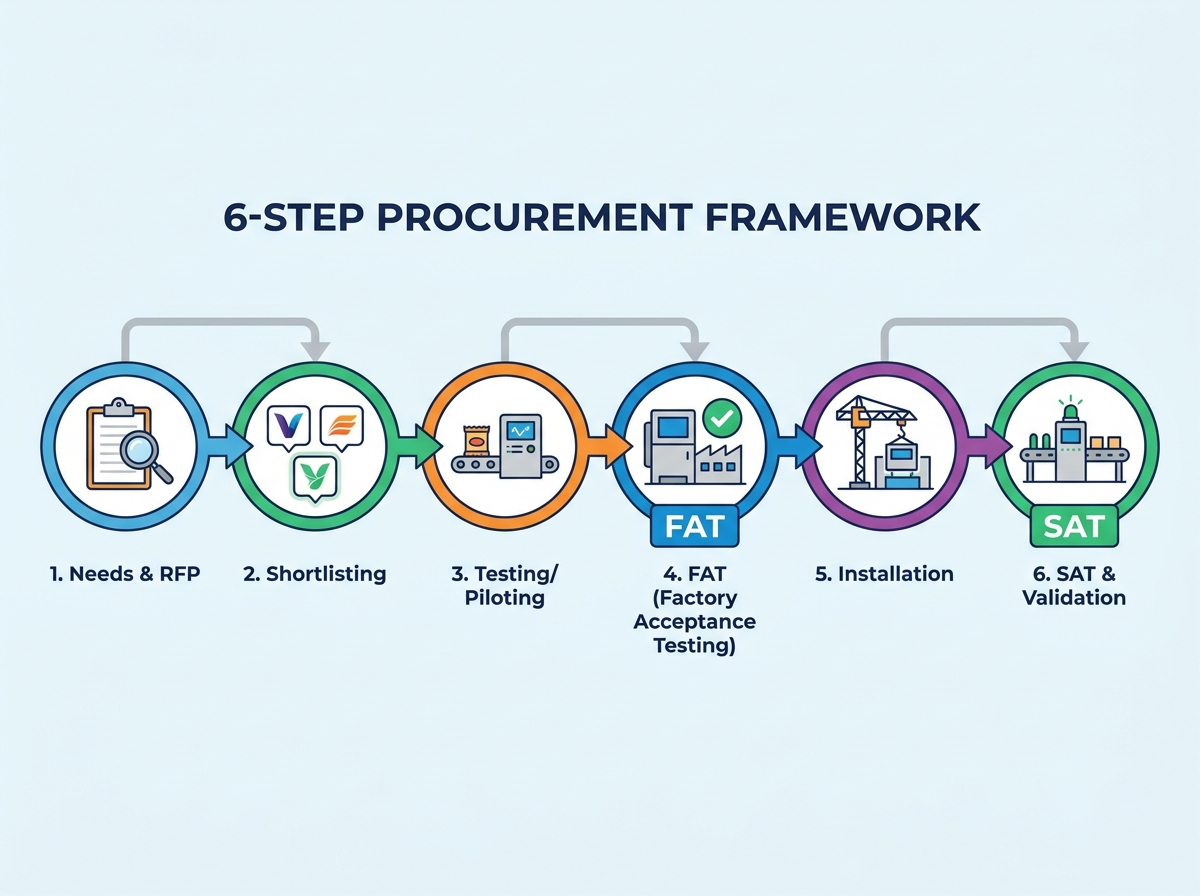
4. The 6-Step Procurement and Implementation Framework
We provide a clear, actionable roadmap for your buying process. Following these sequenced steps minimizes friction and ensures successful line deployment.
- Step 1: Needs Assessment & RFP: Start by drafting a thorough User Requirement Specification (URS). Detail your exact throughput, facility constraints, and hygiene requirements clearly. Send this document out as your formal Request for Proposal (RFP).
- Step 2: Vendor Shortlisting: Evaluate initial proposals against your written URS. Discard vendors failing to meet your mandatory compliance or spatial criteria. Score the remaining candidates based strictly on technical merit and support capabilities.
- Step 3: Product Testing/Piloting: Run your specific food product through a physical demo machine. Never rely on generic videos showing different products. This step verifies texture, consistency, and expected yield accurately.
- Step 4: Factory Acceptance Testing (FAT): Verify the equipment meets design specs at the vendor’s manufacturing facility. Bring your engineers and QA staff to this test. Approve the build only when it meets all documented performance criteria.
- Step 5: Installation and Integration: Coordinate delivery timelines carefully. Hire experienced rigging crews for safe offloading. Connect all utility hookups according to the manufacturer guidelines. Ensure level placement to prevent premature bearing wear.
- Step 6: Site Acceptance Testing (SAT) & Validation: Conduct final testing in your live facility environment. Test the machine under actual production loads over multiple shifts. Complete this final validation before signing the final handover documents.
Conclusion
Choosing the right processing machinery requires careful strategic alignment. You must balance sanitary design and line scalability with your exact facility constraints. Proper planning eliminates integration headaches and reduces daily operational friction. Advise your buying committees to prioritize manufacturers who act as consultative partners. Avoid purely transactional sellers lacking robust post-sale support networks.
Seek partners willing to prove performance through physical testing and transparent service agreements. Take the next critical step in your evaluation journey today. Download a comprehensive equipment procurement checklist. Request a custom performance analysis tailored specifically to your line. You can also schedule a comprehensive product testing session to see the machinery in action.
FAQ
Q: How long does it typically take to manufacture and install custom machinery?
A: Custom systems typically require lead times between 12 and 24 weeks. This timeframe depends heavily on your specific customization requirements. You must factor Factory Acceptance Testing (FAT) and Site Acceptance Testing (SAT) into your overall timeline. Proper rigorous testing ensures smooth installation and prevents costly delays upon delivery.
Q: What is the difference between FAT and SAT in equipment purchasing?
A: FAT stands for Factory Acceptance Testing. You conduct this at the manufacturer's site to prove the physical build meets your specifications. SAT means Site Acceptance Testing. You perform this testing at your plant. SAT proves successful integration with your existing utilities and daily production lines.
Q: How does sanitary design actually impact daily operations?
A: Easily cleanable designs reduce daily labor costs significantly. They minimize changeover downtime by eliminating complex manual teardowns. Furthermore, sanitary designs mitigate the catastrophic financial risks of product recalls. Features like continuous smooth welds and sloped surfaces prevent bacterial harborage and ensure compliance with strict food safety standards.


