Upgrading commercial or high-volume cleaning operations often forces a difficult choice. Do you stick to familiar manual tools? Or do you switch to advanced pneumatic and cyclonic systems? Standard friction-based cleaning relies heavily on scrubbing and linear suction. Adopting a vortex cleaning machine changes this dynamic entirely. These modern units utilize cyclonic air and liquid atomization for a hands-off approach. While vortex technology significantly reduces labor time and surface wear, its reliance on auxiliary equipment means it isn't a universal silver bullet. This guide evaluates both approaches based on efficiency, equipment overhead, and operational scalability. You will learn exactly how cyclonic forces compare to traditional mechanical friction. We will outline the exact infrastructure dependencies these tools demand. Ultimately, this breakdown helps you select the right system to scale your facility's daily throughput.
Key Takeaways
- A vortex cleaning machine dramatically reduces manual labor by lifting dirt from porous surfaces and tight crevices without aggressive physical friction.
- Traditional methods require lower upfront capital and no specialized auxiliary equipment, making them ideal for low-volume or entry-level applications.
- The true cost of vortex technology must include the necessary air compressor (CFM requirements) and ongoing maintenance of weighted tubes or bearings.
- High-volume operations (auto detailing, specialized commercial cleaning) typically see a rapid ROI from vortex systems due to faster turnaround times.
Framing the Cleaning Challenge: Time, Labor, and Surface Damage
Commercial cleaning faces a harsh reality every day. Operators constantly battle the clock to maintain profitability. Time spent detailing complex geometries eats directly into operating margins. Applying lean operational principles to a wash bay means actively hunting down wasted motion.
The Labor Bottleneck: Traditional scrubbing and linear suction fail predictably in tight spaces. Think about vehicle air vents, deeply recessed seat rails, or heavily textured plastics. Workers spend excessive minutes trying to jam stiff bristles into narrow gaps. They perform multiple passes just to extract trapped debris. This physical struggle directly increases the labor minutes required per job. Imagine detailing an entire fleet of commercial vehicles. Losing five extra minutes per car creates a massive operational delay by the late afternoon.
Surface Degradation: Physical friction introduces another severe risk. Mechanical agitation damages materials over time. Stiff brushes and harsh scrubbing pads easily micro-scratch modern automotive clear coats. They fray delicate upholstery fibers. They aggressively wear down soft-touch dashboard plastics. Constant dragging across a surface accelerates degradation. You risk causing permanent damage to client property. Over time, aggressive friction forces businesses to pay for costly cosmetic repairs.
The Business Impact: We must frame this decision around operational throughput. Saving 15 minutes on a single job might seem trivial initially. However, multiply those 15 minutes across ten jobs a day. You instantly unlock enough time to process an entire extra unit. Scaling daily revenue requires eliminating manual bottlenecks. Every minute your technicians spend manually scrubbing a surface represents lost revenue potential.
The Mechanics: Vortex Cleaning Machine vs. Traditional Methods
Understanding the core differences requires looking at the physical physics of both methods. Let us break down how each system attacks dirt on a microscopic level.
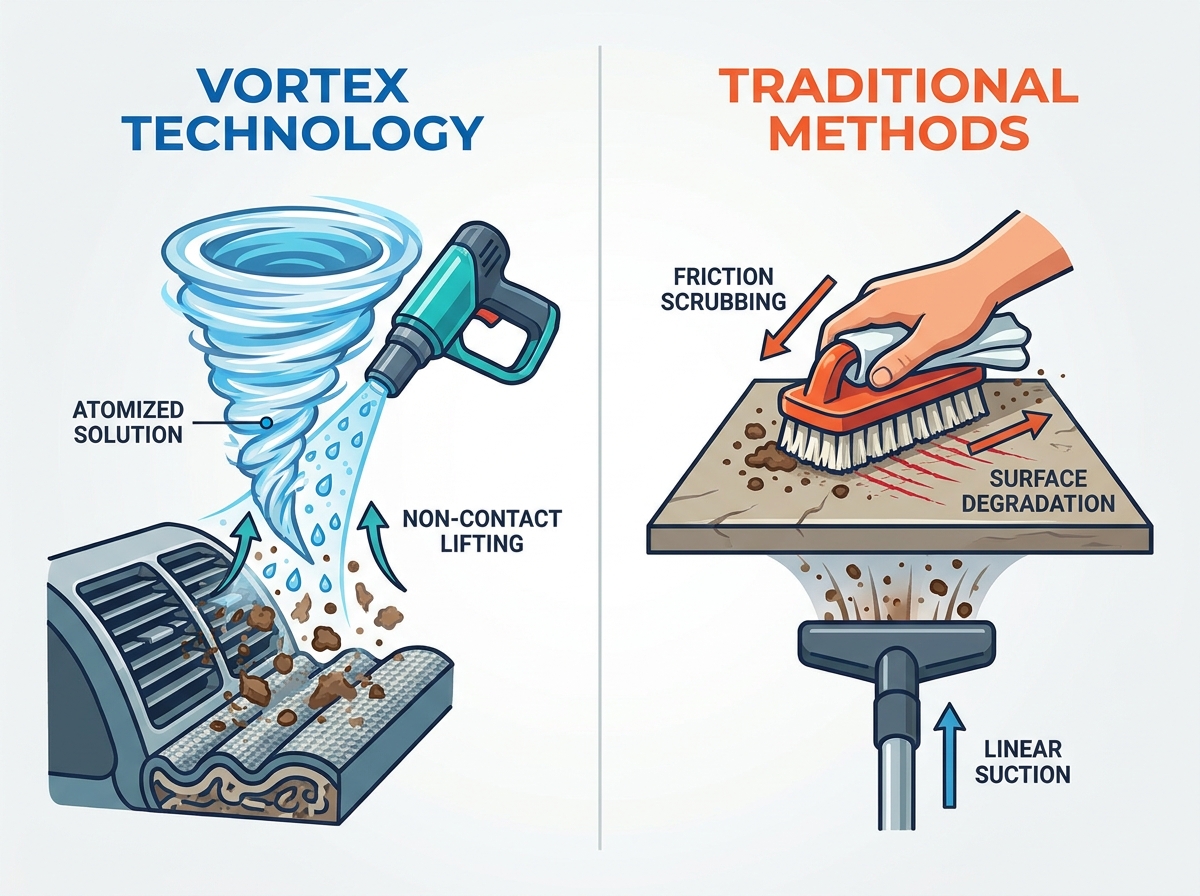
How Vortex Technology Works: A vortex cleaning machine relies on a unique cyclonic mechanism. Compressed air enters the tool and forces a flexible inner tube to rotate at high speeds. This rapid rotation creates a miniature tornado-like effect at the nozzle tip.
Here is the step-by-step physical process of cyclonic cleaning:
- High-pressure air enters the gun chamber.
- The inner weighted tube spins, generating a localized vortex.
- Liquid cleaning solution is drawn up and atomized into micro-droplets.
- The pressurized mist aggressively lifts and encapsulates dirt.
- The vortex pulls debris away from the surface without harsh physical contact.
How Traditional Methods Work: Traditional detailing sets the baseline for our comparison. This approach relies heavily on chemical dwell time first. Liquids must sit on the surface to break down grime chemically. Next, the operator applies mechanical agitation using brushes, sponges, or microfiber towels. Finally, they remove the loosened dirt using direct-line suction from a standard shop vacuum.
The Core Difference: The contrast comes down to lifting versus dragging. Vortex systems lift and atomize. They pull dirt up and out using air pressure. Traditional methods drag and scrub. They force friction against the surface to shear away the grime. This fundamental difference dictates operational speed, safety protocols, and chemical usage.
Core Evaluation Dimensions: Head-to-Head Comparison
Comparing these tools head-to-head reveals clear operational advantages. We evaluate them across speed, safety, and resource consumption.
Speed and Operational Efficiency
Vortex systems excel in complex textures. They blast dirt out of seat tracks and air conditioning vents in seconds. You achieve rapid processing in hard-to-reach areas. Operators easily blast away trapped crumbs, pet hair, and encrusted mud. The air pressure does the heavy lifting instantly.
Traditional methods move much slower. Cleaning a textured floor mat requires applying soap, scrubbing vigorously, and vacuuming. Operators must frequently change manual tools during a single task. Switching from a stiff brush to a crevice tool wastes valuable seconds.
Surface Preservation and Safety
Vortex cleaning minimizes physical wear. The non-contact nature preserves delicate finishes. You can clean Alcantara, delicate suede, and scratch-prone piano black plastics safely. However, the atomization process suspends chemicals in the air. Operators must wear proper personal protective equipment. You must mandate respirators to ensure respiratory safety.
Traditional methods present higher risks for surface abrasion. Heavy scrubbing often leaves micro-marring. Conversely, pouring liquids directly onto a surface poses a lower risk of airborne chemical inhalation. The chemicals remain primarily in a liquid state rather than a suspended mist.
Resource Consumption
Micro-atomization radically changes how you use chemicals. A vortex tool uses significantly less liquid. The tornado effect distributes a fine, highly effective mist. You avoid soaking the interior fabrics entirely.
Traditional cleaning requires heavy liquid saturation. Operators spray ample amounts of chemical to ensure proper coverage. This approach increases product waste. It also leads to considerably longer drying times for fabrics and upholstery. Wet seats lead to unhappy clients, mold risks, and lingering mildew odors.
Head-to-Head Cleaning Performance Comparison
| Feature | Vortex Technology | Traditional Methods |
| Primary Action | Lifting and atomizing | Dragging and scrubbing |
| Speed on Complex Surfaces | Extremely fast | Slow (requires multiple passes) |
| Surface Wear Risk | Very low (non-contact) | High (relies on physical friction) |
| Chemical Usage | Minimal (micro-mist) | High (heavy saturation) |
| Drying Time | Rapid | Prolonged |
Implementation Realities and Hidden Costs
Do not let the speed of cyclonic tools blind you to their infrastructure demands. Implementing this technology requires careful planning and realistic equipment assessments.
Auxiliary Equipment Dependencies: This represents the largest barrier to entry. Cyclonic tools do not operate independently. They require a massive, continuous supply of compressed air. A standard unit typically demands 4.5 to 5.5 CFM at 90 PSI. Small pancake compressors will stall operations. The tool will drain a small tank in mere seconds. You must have a commercial-grade compressor to maintain a continuous workflow. Furthermore, you need 3/8-inch air hoses to prevent airflow restriction. If your shop lacks sufficient air supply infrastructure, the tool becomes useless.
Maintenance and Wear Parts: High-speed rotation generates friction inside the tool itself. You must maintain these devices regularly. Inner liquid tubes whip around at thousands of RPMs. Weighted assemblies and ball bearings degrade over time. Operators must perform routine lubrication. You must replace the inner rotational tubes when they inevitably wear out.
- Common Mistake: Failing to flush the gun with clean water after daily use causes severe chemical buildup. This buildup hardens and ruins the internal bearing assembly prematurely.
- Best Practice: Submerge the nozzle tip in a bucket of clean water and pull the trigger for five seconds at the end of every shift.
Operator Learning Curve: Improper technique easily ruins delicate materials. Holding a high-pressure nozzle too close to a glued headliner will separate the fabric from the roof. It can also crack brittle, aged plastics. Comprehensive training is absolutely required. Your staff must learn pressure regulation and proper distance control.
Shortlisting Logic: Which Path Makes Sense for Your Operations?
Choosing the right method depends entirely on your specific business model. Let us evaluate when each approach makes the most logical sense.
When to Stick with Traditional Methods:
Some operations should avoid pneumatic tools entirely.
- Mobile setups facing severe space or weight limits. If you cannot transport a large, heavy compressor, cyclonic tools will not work.
- Low-volume hobbyists or startups operating under strict capital constraints.
- Cleaners primarily focused on wide, flat, easily accessible surfaces where standard vacuums and extractors excel.
When to Invest in a Vortex Cleaning Machine:
Scaling businesses often find immense value in upgrading their equipment.
- High-volume commercial shops where time-to-completion directly dictates daily profitability.
- Operations dealing heavily with deep-set stains, stubborn pet hair, or intricate mechanical assemblies.
- Businesses already equipped with commercial-grade, high-capacity air compressors.
Next-Step Action: Start by auditing your current daily bottlenecks. Track exactly how much time your team spends detailing tight crevices. Next, check your existing air compressor specifications. If you meet the required CFM output, upgrading to a vortex cleaning machine transforms your workflow efficiency.
Conclusion
Upgrading your detailing process requires balancing speed against infrastructure capabilities. Traditional methods remain highly reliable and carry a low barrier to entry. They work perfectly for wide surfaces and startups on a budget. However, a cyclonic approach serves as a verifiable force multiplier. It radically reduces labor time on complex, textured surfaces while preserving delicate materials.
Final verdict: Make your choice based on your facility's current infrastructure. If you have the air supply and handle a high volume of hard-to-reach cleaning tasks, making the switch is the most logical operational upgrade.
Take action today by following these clear next steps:
- Measure the exact CFM rating of your current shop air compressor.
- Calculate your daily labor hours lost specifically to crevice and vent cleaning.
- Train your staff on respiratory safety protocols before introducing atomized chemicals.
- Implement a strict weekly lubrication schedule for any new pneumatic tools you acquire.
FAQ
Q: Does a vortex cleaning machine require a special air compressor?
A: Yes. You must prioritize the CFM (Cubic Feet per Minute) rating over tank size or PSI. Most units require continuous delivery of 4.5 to 5.5 CFM at 90 PSI. Undersized compressors drain quickly, causing the equipment to stall and interrupting your workflow.
Q: Can vortex cleaning damage delicate surfaces?
A: It can if used incorrectly. Distance control is critical. Holding the nozzle too close to glued headliners blasts the adhesive apart, causing the fabric to sag. High pressure can also chip brittle or aged interior plastics. Proper operator training prevents these issues.
Q: How often do parts need replacing on a commercial vortex cleaner?
A: The lifespan depends on daily commercial use and maintenance habits. Internal rotating tubes and bearings endure extreme friction. With daily use and proper weekly lubrication, expect to replace the inner tube assembly every few months to maintain peak atomization performance.
Q: Is a vortex cleaner better than a hot water extractor?
A: They serve entirely different purposes. Cyclonic tools excel at lifting, atomizing, and purging dirt from upper surface layers and tight cracks. Extractors handle deep subsurface extraction for heavily soiled foam cushions. Detailers often use both machines in tandem for optimal interior restoration.


