Industrial cleaning requires moving beyond standard spray washing. Complex geometries, blind holes, and heavy particulate loads demand superior solutions. You cannot risk damaging delicate components during aggressive wash cycles. A vortex cleaning machine utilizes advanced fluid dynamics to create a high-velocity, low-pressure cleaning environment. This technology offers a distinct advantage for precision manufacturing and remanufacturing sectors. Traditional methods often leave hidden residues or cause unwanted surface erosion.
We provide engineering, procurement, and facility managers an evidence-based framework. You will learn how to evaluate technical specifications, operational features, and implementation realities. This comprehensive guide helps you finalize a capital equipment purchase confidently. By understanding these core metrics, you can optimize your facility's cleaning operations and eliminate production bottlenecks.
Key Takeaways
- Throughput vs. Footprint: Evaluating tank dimensions and basket capacities against facility constraints is the first step in shortlisting vortex systems.
- Fluid Dynamics Matter: Success relies on balancing pump flow rates (GPM) with specific agitation mechanisms to achieve targeted cleanliness standards.
- Filtration Determines Opex: Integrated cyclonic separation and micron filtration are critical for extending bath life and reducing chemical consumable costs.
- Implementation Requires Planning: Upgrading to a vortex system necessitates assessing existing electrical, water, and drainage infrastructure, alongside environmental compliance.
Defining the Business Case for a Vortex Cleaning Machine
Modern production environments expose the severe limitations of legacy cleaning systems. Traditional cabinet spray washers suffer from line-of-sight limitations. They spray detergent in straight lines. They cannot clean hidden channels, deep blind holes, or intricate internal passageways effectively. If the spray nozzle cannot see the contaminant, it cannot remove it.
Ultrasonic cleaners pose entirely different risks. They use high-frequency sound waves to induce cavitation. Cavitation bubbles implode violently against part surfaces. This action works well for microscopic debris. However, it can severely damage sensitive substrates. Soft metals like aluminum often suffer from micro-pitting during prolonged ultrasonic cycles. Delicate electronic housings can warp or degrade. You need a method capable of flushing out heavy soils without causing surface erosion.
Procurement teams must define measurable goals before buying new equipment. You should target reduced cycle times to boost daily throughput. Faster cleaning cycles mean more parts move down the assembly line. Lowered rejection rates in post-wash quality assurance (QA) indicate a successful implementation. If parts consistently pass QA inspections, your cleaning process works.
Decreased manual pre-cleaning labor serves as another vital metric. Operators should not spend hours scrubbing parts manually before loading them into the machine. A highly capable system eliminates the need for wire brushes and solvent tanks. Your staff can focus on higher-value tasks instead of tedious manual scrubbing.
Core Technical Specifications to Evaluate
Tank Capacity and Payload Tolerances
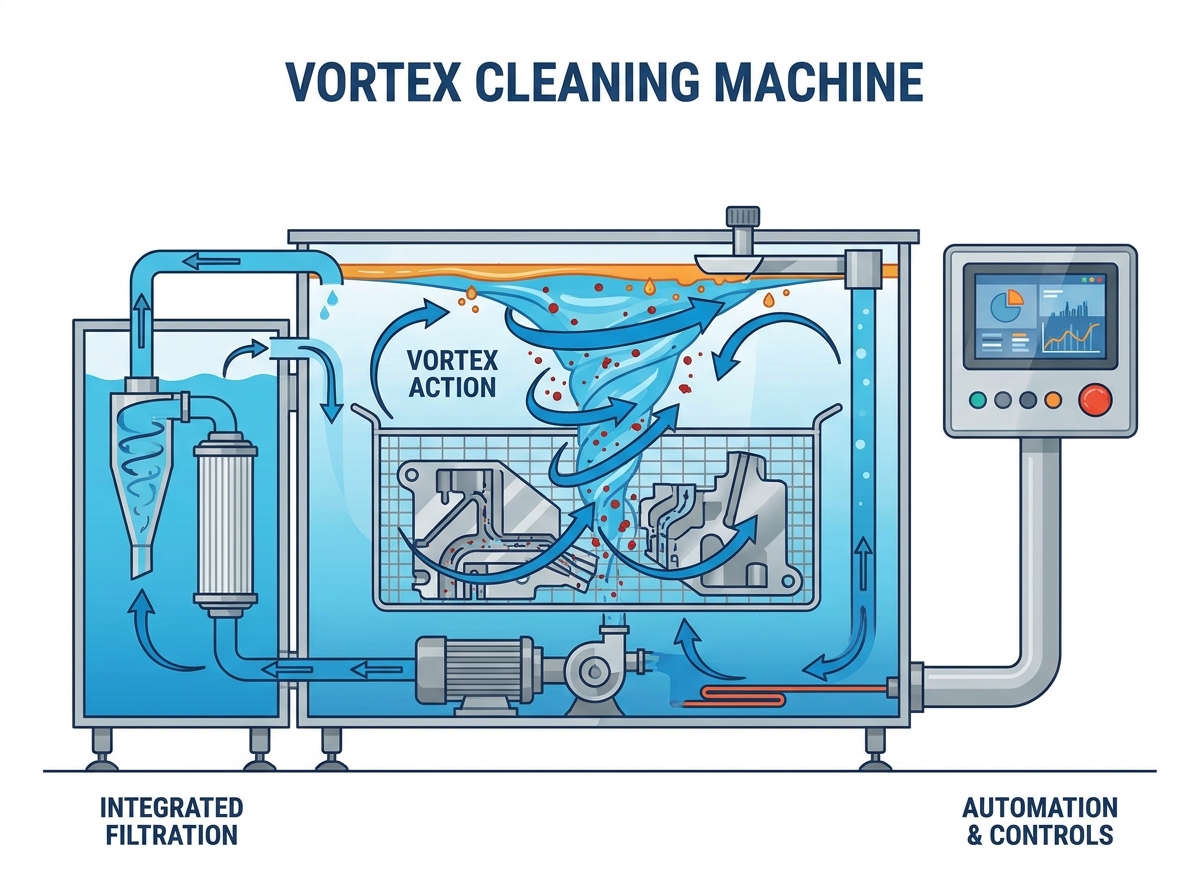
Internal working dimensions dictate your maximum batch sizes. You must match the tank length, width, and height to your largest expected part. Consider the spacing required between parts for optimal fluid flow. Overcrowding the basket restricts the vortex action. Fluid must circulate freely around every component to ensure uniform cleanliness.
Heavy-duty industrial cycles demand robust mechanical support. Evaluate the hoist and basket weight capacities carefully. Exceeding these limits causes mechanical failure and costly downtime. Ensure the lifting mechanism can handle fully loaded baskets saturated in heavy wash fluid. Dynamic loading stresses the machine differently than static loading. The basket must withstand continuous rotational forces while fully loaded.
External dimensions matter just as much as internal capacity. Factor in the machine’s overall footprint on your shop floor. You must leave adequate clearance for maintenance access. Technicians need room to change filters and inspect pumps. Loading and unloading ergonomics also require sufficient space around the unit. Operators need safe access for forklifts or overhead cranes.
Fluid Dynamics and Pump Performance
Gallons per minute (GPM) measures the pump's output volume. Assess this metric to ensure sufficient vortex action. High flow rates flush out debris effectively. However, you must avoid creating damaging turbulence. The goal is a smooth, powerful rotation of fluid. High volume always outperforms high pressure in these applications.
Evaluate pump motor specifications relative to total fluid volume. A weak motor cannot maintain consistent fluid rotation under full load. Heavy soil loads require sustained mechanical energy. This energy keeps particulates suspended in the solution. If the motor stalls or slows down, debris settles back onto the parts.
Temperature plays a crucial role in chemical activation. Review the kilowatt (kW) ratings for the heating elements. Faster heat-up times improve daily operational efficiency. Most industrial wash chemistries require temperatures between 120°F and 160°F. Robust heaters maintain these optimal temperatures during continuous operation. Cold wash baths drastically reduce cleaning efficacy.
Critical Pump and Heating Metrics
| Component | Primary Function | Evaluation Metric | Ideal Target |
| Main Pump | Drives fluid rotation | Flow Rate (GPM) | High volume / low pressure |
| Heating Element | Activates wash chemistry | Kilowatt (kW) rating | 120°F–160°F operating range |
| Agitation Motor | Rotates parts basket | Revolutions Per Minute (RPM) | Variable speed capability |
Material Construction and Durability
Industrial wash chemistries can be highly corrosive. Require 304 or 316-grade stainless steel for the main tank. Wetted parts and plumbing must also use these high-grade alloys. This prevents corrosion from aggressive alkaline or acidic detergents. Mild steel components will degrade rapidly in these harsh environments.
Best Practice: Specify 316-grade stainless steel if your process involves high chloride concentrations. The added molybdenum in 316 stainless provides superior pitting resistance.
Heat loss drives up energy expenditure significantly. Check the equipment for double-wall construction. Thermal insulation keeps the heat inside the wash bath. This reduces the workload on your heating elements. Well-insulated machines provide a safer, cooler exterior for operators. Uninsulated tanks pose severe burn hazards on the shop floor.
Key Features That Drive Operational Efficiency
Advanced Agitation and Rotation
Submerged basket rotation exposes all part surfaces to the fluid. Evaluate the rotation speeds (RPM) offered by the manufacturer. Too fast, and delicate parts might collide and sustain damage. Too slow, and the cleaning cycle takes too long. Adjustable RPM settings provide the best versatility for mixed-part production runs.
Complex internal channels trap debris easily. Look for systems featuring alternating flow directions. Reversing the vortex flow flushes out blind holes effectively. This multi-directional approach ensures uniform cleanliness across intricate geometries. Fluid moving in only one direction often creates dead zones inside the tank.
Common Mistake: Relying solely on fluid flow without mechanical basket rotation. Stationary baskets often result in shadowing, where parts block fluid from reaching adjacent components.
Integrated Filtration and Waste Management
Tramp oils ruin wash baths quickly. Assess the machine's oil removal capabilities. Coalescing or belt skimmers remove floating oils efficiently. This prevents oil from redepositing onto cleaned parts as they exit the bath. Effective skimming keeps the detergent active and prevents foul odors.
Chips and fines degrade cleaning performance over time. Review the micron filter housings included in the design. Cyclonic separators capture heavy particulates before they reach the fine filters. This multi-stage approach keeps the wash bath viable for longer periods. It also prevents premature clogging of your expensive micron filter cartridges.
Automation and Controls
Repeatability is vital for strict quality assurance. Evaluate the Programmable Logic Controllers (PLC) and touchscreens. They allow operators to run recipe-driven wash cycles. You can program specific times, temperatures, and rotation speeds for different part families. A user-friendly Human-Machine Interface (HMI) reduces programming errors significantly.
Compliance reporting requires accurate historical data. Consider systems equipped with comprehensive data logging. They track temperatures, cycle times, and fault codes automatically. This information proves invaluable for preventative maintenance and quality audits. If a batch fails inspection, you can review the logs to identify process deviations.
Navigating Implementation Risks and Facility Requirements
Facility readiness dictates your installation timeline. Audit your building capabilities before ordering heavy equipment. Check for the required voltage and phase power. Industrial washers often draw significant amperage and require 480V 3-phase power. Assess your compressed air supply for pneumatic lids or blow-off nozzles. Clean, dry air ensures reliable pneumatic operation.
Proper ventilation is also necessary to handle steam and chemical vapors. Exhaust fans must route humid air outside the facility. Condensation buildup inside your building causes rust and structural damage over time.
Wastewater management requires strict adherence to local regulations. Plan your wastewater treatment strategy early. You might need closed-loop evaporation systems. These help you meet EPA and local municipal discharge regulations. Failing to plan for wastewater can result in severe operational delays and hefty fines.
New equipment introduces a learning curve for your staff. Assess how easily operators can program wash cycles. Complicated interfaces frustrate workers and lead to costly mistakes. Evaluate the frequency of routine maintenance tasks. Filter changes and tank deslagging should be straightforward and safe to perform. Complex maintenance routines often get ignored by busy operators.
Shortlisting Logic: Selecting the Right Vortex Cleaning Machine
Part geometry dictates your specific equipment needs. Eliminate machines lacking the necessary flow dynamics. For example, aerospace manifolds require different fluid action than cast iron engine blocks. Match the machine's capabilities to your specific part intricacies. Do not assume a one-size-fits-all approach works for precision cleaning.
Never buy industrial equipment blindly. Mandate sample wash testing from prospective vendors. Send them your dirtiest, most complex parts. This validates cycle times and cleanliness specifications before purchase. Real-world testing exposes weaknesses in a machine's design. Ask the vendor to perform gravimetric analysis to prove the parts meet your cleanliness standards.
Equipment breakdowns halt production lines immediately. Evaluate the availability of replacement parts in your region. Check technician response times outlined in the Service Level Agreements (SLAs). Review warranty terms for critical components like pumps, heaters, and electronics. Strong vendor support ensures long-term operational success and minimizes unexpected downtime.
Conclusion
Selecting a highly capable vortex cleaning machine requires careful evaluation. You must balance fluid dynamics, load capacities, and automation against your facility constraints. Avoid underestimating the importance of integrated filtration and proper basket rotation. These features directly impact your daily throughput and quality assurance pass rates.
Procurement teams must finalize their throughput requirements immediately. Document your largest part dimensions and heaviest batch weights. Schedule proof-of-concept testing with at least two distinct OEMs. Validate all performance claims using your actual production parts. This rigorous approach guarantees you select the right equipment for your specific manufacturing challenges.
Frequently Asked Questions (FAQ)
Q: What is the difference between a vortex cleaning machine and an ultrasonic cleaner?
A: Ultrasonic cleaners use high-frequency sound waves to create cavitation bubbles. They are ideal for microscopic contaminants. Vortex machines rely on high-volume fluid flow and agitation. They flush out larger particulates, chips, and heavy oils from complex geometries. They achieve this without the risk of cavitation erosion.
Q: How often does the wash fluid need to be changed in a vortex system?
A: Bath life depends heavily on the soil load and integrated filtration. You can extend bath life significantly with proper management. Efficient oil skimming and micron filtration are essential. When properly maintained, bath life often extends from a few weeks to several months.
Q: Can a vortex cleaning machine handle multiple types of metals in the same system?
A: Yes, you can process various metals together. The limitation lies entirely in the wash chemistry, not the machine itself. Operators must ensure the chosen detergent is safe for both ferrous and non-ferrous metals. This prevents unwanted galvanic corrosion or surface etching during the cycle.
Q: What maintenance is required for a vortex-action parts washer?
A: Routine maintenance keeps the system running efficiently. You must empty strainer baskets and replace filter cartridges regularly. Wiping down oil skimmers prevents residue buildup. You also need to periodically drain the tank. This allows for thorough descaling and careful inspection of the heater elements.


