
Views: 0 Author: Site Editor Publish Time: 2026-11-15 Origin: Site


Operating a commercial food facility demands a delicate balance between high throughput and strict safety tolerances. Profit margins shrink rapidly when legacy equipment creates unnecessary operational drag. Inefficiencies such as physical produce damage, excessive water use, or sudden unplanned downtime quickly morph into critical business liabilities. These bottlenecks directly threaten daily output targets, keeping operations directors, plant managers, and QA leads awake at night.
This guide breaks down the operational hurdles inherent in your vegetable processing line. We deliberately strip away vendor hyperbole to examine the root structural causes behind these everyday problems. You will discover the precise technical criteria required to evaluate viable, scalable equipment upgrades. Ultimately, we provide an actionable roadmap for replacing inefficient systems without disrupting core operations, allowing your facility to scale profitably.
Standard rotary washers and abrasive peelers often apply the exact same mechanical force to highly non-uniform produce. You might run a batch of robust potatoes followed immediately by fragile root crops. When legacy machines use uniform force, they cause severe bruising and remove too much healthy tissue. This directly reduces your marketable yield and severely damages profit margins.
Solving this requires transitioning away from outdated batch processing. You should adopt continuous, variable-speed systems instead. Facilities see massive improvements when they implement adaptive peeling technology. Steam peeling systems or profile-following mechanical peelers automatically adjust to individual batch variations. They track the natural contours of the produce, removing only the necessary skin. This protects the underlying flesh and maximizes usable product weight.
When you evaluate these solutions, look closely at the feature-to-outcome ratio. You want variable frequency drives (VFDs) installed on the washing and peeling motors. VFDs allow floor operators to dial in specific agitation levels. They can easily switch from aggressive scrubbing for tough root vegetables to gentle washing for delicate greens. Giving operators this granular control drastically reduces sheer-force damage.
You must also apply a trustworthiness check during vendor discussions. Acknowledge a simple truth: zero waste is physically impossible in food manufacturing. Evaluate potential upgrades based on their guaranteed percentage reductions in trim waste. Ignore marketing brochures promising flawless processing. Ask vendors for empirical data showing how their machines preserve yield compared to your current baseline, using your specific crop varieties.
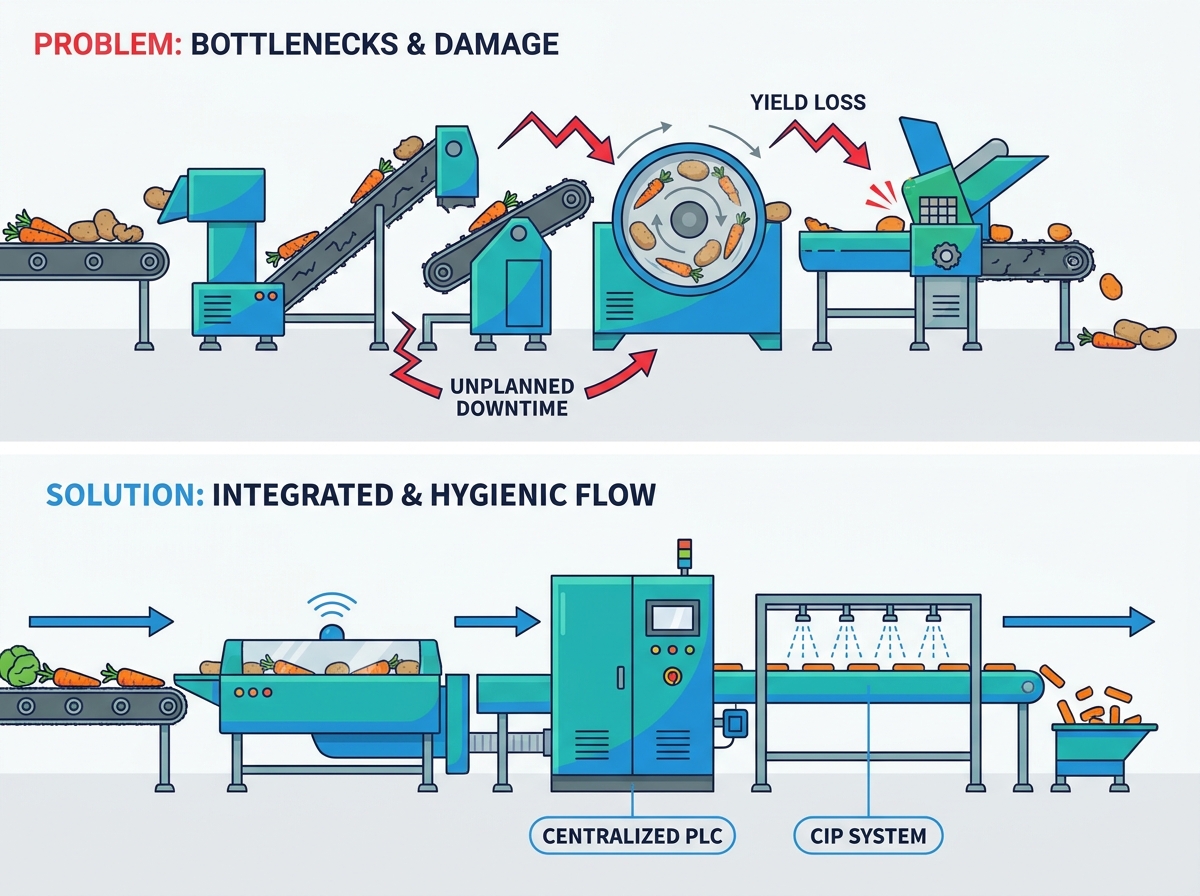
Bacterial buildup remains a severe threat in industrial food processing. Pathogens like Listeria and Salmonella thrive in hard-to-reach machine crevices. These hidden harborage points lead directly to failed QA audits, catastrophic product recalls, and severe brand damage. Legacy systems often force your maintenance team to perform total machine disassembly just to complete basic sanitation tasks. This effectively kills shift productivity and inflates nightly labor costs.
You mitigate these risks by upgrading entirely to sanitary-design machinery. Modern equipment features open-frame construction, eliminating the hollow tubes where bacteria typically hide. Machines utilize sloped surfaces to actively prevent water pooling and biofilm formation. Furthermore, you should insist on IP69K-rated electrical enclosures. These highly sealed enclosures withstand high-pressure, high-temperature chemical washdowns without short-circuiting.
Through a strict security and compliance lens, your new equipment must align perfectly with FSMA (Food Safety Modernization Act) and HACCP standards. Auditors expect to see preventive controls physically built into the machinery. An optimized vegetable processing line natively supports these rigorous protocols, utilizing continuous TIG welding and passivated stainless steel to prevent microscopic bacterial nesting.
Consider these critical implementation factors when upgrading your sanitation approach:
A processing circuit operates only as fast as its slowest component. When an older cutter fails or a conveyor motor suddenly burns out, the entire operation halts. Many facilities suffer because they connect disconnected machines from mixed vendors. These isolated units fail to communicate regarding line speeds or surge volumes, causing frequent jam-ups and downstream starvation. You lose thousands of dollars for every hour the system sits idle.
You solve this integration nightmare by moving toward modular, standardized equipment ecosystems. Modern lines feature centralized PLC (Programmable Logic Controller) interfaces. A centralized digital brain ensures the washer talks seamlessly with the dicer and the packaging infeed. If the packaging machine pauses, the PLC automatically slows the upstream conveyors to prevent product accumulation.
Use these clear dimensions to evaluate system reliability and integration potential:
| Evaluation Criteria | Legacy Isolated Systems | Modular Equipment Ecosystems |
|---|---|---|
| Scalability | Requires replacing core infrastructure when throughput demands increase. | Expands easily without replacing existing infeed and outfeed conveyors. |
| Vendor Support | Often relies on proprietary, custom-machined parts with long lead times. | Utilizes standard off-the-shelf wear parts (belts, blades) available globally. |
| Communication | Machines run at static speeds, requiring constant manual operator intervention. | Centralized PLCs automatically adjust line speeds to prevent jam-ups. |
| Maintenance Diagnostics | Failures happen blindly; maintenance reacts only after a machine breaks down. | Sensors provide predictive alerts before bearings or motors fail completely. |
Risk mitigation also requires heavy focus on operator adoption. Do not overlook the floor personnel running the machines. Highly automated HMIs (Human-Machine Interfaces) fail spectacularly if they prove too complex for your staff. Demand intuitive, multi-language touchscreens during your vendor evaluation process. Clear visual diagnostics help operators clear minor faults quickly before they escalate into hours of costly downtime.
Industrial vegetable processing consumes enormous amounts of natural resources. Traditional flume washing and continuous rinsing systems often waste thousands of gallons of potable water every hour. This massive consumption drives up operational expenses and directly conflicts with modern corporate sustainability mandates. You simply cannot scale plant profitability while pouring expensive treated water straight down the drain.
Implementing closed-loop water filtration and recirculation systems provides an immediate, measurable solution. These systems capture wash water, filter out organic solids via rotary screens or hydrocyclones, and reuse it for initial pre-washing stages. Simultaneously, you should upgrade to high-efficiency motors and optimized pneumatic systems to drastically cut your daily electrical draw.
Evaluate resource efficiency using these strict parameters:
By closely scrutinizing these metrics, you build a financially sound business case for sustainable equipment. Modernizing resource management pays for itself reliably when engineered correctly.
Upgrading your facility requires a disciplined, highly methodical approach. You must filter out shiny object syndrome and focus entirely on measurable operational improvements. Buying new equipment simply because it looks modern often leads to buyer's remorse.
Follow this simple shortlisting logic before you ever request a vendor quote:
You must take aggressive next-step actions to validate vendor claims before signing contracts. Request live demonstrations or trial runs using your facility's specific vegetable varieties. A diced carrot behaves very differently from a sliced onion. Running a Factory Acceptance Test (FAT) guarantees the machine handles your actual product specifications. Finally, demand client references from operations actively running similar throughput volumes. Speak directly to their maintenance managers to understand the true reality of operating the equipment day-to-day.
Upgrading a vegetable processing system stands as a clear operational necessity for scaling plants. However, these complex projects carry significant capital and integration risks. You need a strategic, data-driven roadmap to navigate the transition successfully and protect your facility's output.
Avoid the temptation of piecemeal fixes. Strapping a new cutter onto a failing twenty-year-old conveyor rarely solves throughput problems. Instead, focus entirely on modular, hygienically designed systems. These modern setups offer transparent return on investment through drastically reduced waste, lowered utility bills, and minimized unplanned downtime.
Initiate an internal capacity audit today. Define your exact throughput requirements, sanitation constraints, and yield targets. Form a cross-functional team involving maintenance, sanitation, and production leads. Use these hard numbers to engage equipment manufacturers for bespoke, highly engineered solutions designed for your exact floor space.
A: Depending on the level of customization and the need to retrofit existing facility layouts, installation and commissioning typically take between 2 to 6 weeks. This installation window generally follows a standard 3 to 6-month manufacturing and procurement lead time.
A: While highly dependent on processing volume, most industrial facilities see full ROI within 18 to 36 months. This rapid payback is driven primarily by a 5-15% increase in usable yield and significant reductions in manual labor expenses.
A: Yes. Modern modular lines utilize variable speed controls and interchangeable tooling, such as swapping dicer blades. This allows them to handle both robust root vegetables and delicate leafy greens, though managers must factor physical changeover times into daily production schedules.
A: IP69K-rated components and completely seamless stainless-steel construction carry a higher upfront cost, often 15-20% more than standard designs. However, they drastically reduce daily sanitation labor hours and effectively mitigate catastrophic, business-ending product recall risks.


