Selecting the wrong drying equipment ruins product quality and destroys operational efficiency. You risk uneven moisture retention, rapid product spoilage, and massive bottlenecks on your production line. Too many operators buy machines based on price alone. They ignore crucial factors like daily throughput, end-product texture, and facility footprint. Ignoring these elements leads to inflated energy bills and wasted raw materials.
The right choice demands a strict evaluation of your specific processing needs. You must match the equipment capabilities directly to your facility limitations. We will break down exactly how to navigate these technical specifications. Our goal is to provide an objective, data-informed framework for evaluating these systems.
Ultimately, this guide helps you shortlist the optimal vegetable drying machine for your exact operational scale. You will learn how to avoid common purchasing mistakes and secure reliable production output.
Key Takeaways
- Throughput dictates design: Batch sizes under 50 lbs align with cabinet dehydrators, while continuous operations require automated belt dryers.
- Airflow is more critical than raw heat: Horizontal airflow prevents flavor mixing and ensures uniform drying without manual tray rotation.
- Material compliance matters: 304 or 316 food-grade stainless steel is non-negotiable for commercial safety and regulatory compliance.
Defining Your Production Scale: Home, Commercial, or Industrial?
You must define your production capacity before browsing equipment catalogs. Many buyers skip this crucial step. They end up purchasing mismatched technology. We recommend forcing a hard look at your actual throughput needs. Self-qualifying your operation prevents costly facility upgrades later. Let us examine the three main tiers of production.
Home & Hobbyist Preppers
For personal use, production scale remains very small. You prioritize a compact equipment footprint above all else. The equipment must fit easily on standard kitchen countertops. Low noise output is also critical for comfortable home environments. You will likely use the equipment intermittently rather than daily.
- Success criteria: Compact footprint, low noise, intermittent use.
- Typical capacities: 5 to 15 square feet of drying space.
Small-to-Medium Commercial (Farms & Artisanal Brands)
This category includes independent farms and artisanal snack brands. You face entirely different operational pressures. Predictable batch times become incredibly vital for business planning. You need consistent product quality during every single run. Easy sanitation directly determines your daily labor costs.
- Success criteria: Predictable batch times, consistent product quality, easy sanitation.
- Typical capacities: 50 to 200+ lbs of raw input per batch.
Industrial Scale (Continuous Processing)
High-volume processing requires completely different engineering. You need maximum hourly throughput to maintain profitability. Automation integration is absolutely essential at this level. Energy recovery systems become critical for managing utility bills. You cannot rely on manual tray loading at this massive scale.
- Success criteria: Automation integration, maximum hourly throughput, energy recovery systems.
- Typical capacities: 500+ lbs per hour requiring continuous feed systems.
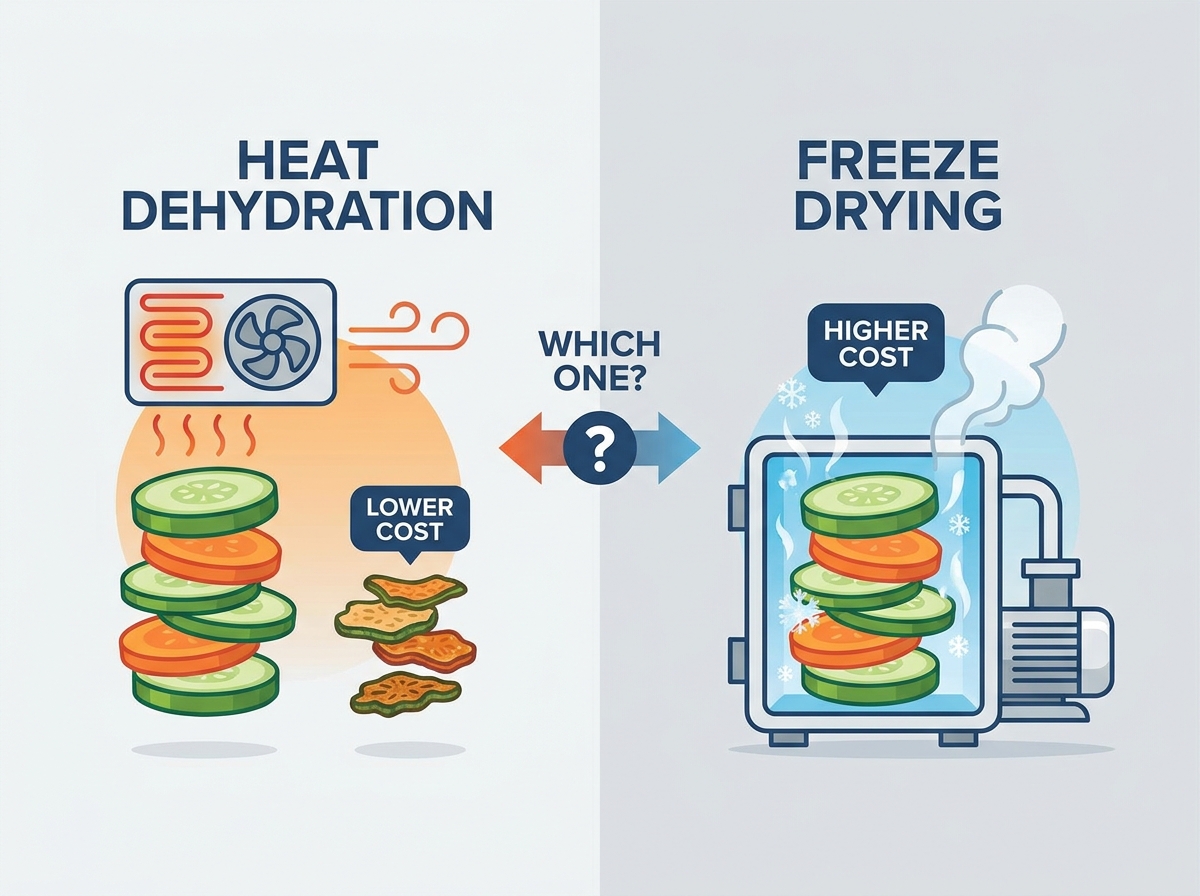
Heat Dehydration vs. Freeze Drying: Matching Tech to Outcomes
You must choose the correct moisture removal method. Two primary methodologies dominate the commercial market today. They produce vastly different end products. We will break down both approaches to help you decide.
Conventional Heat Air Dehydration
This represents the traditional approach to food preservation. The technology remains highly accessible and widespread.
- Mechanism: This method uses heated air and fans. The machine forces warm air across the food. It evaporates moisture slowly over several hours.
- Pros: These units carry a lower upfront equipment cost. They are highly versatile for most vegetables. The machinery remains durable. It features very few moving parts. Maintenance is usually straightforward.
- Cons: Heat dehydration physically shrinks the product. It fundamentally alters the cellular structure. You get a distinct chewy or hard texture. High heat can also degrade certain heat-sensitive vitamins.
Freeze Drying (Lyophilization)
This advanced method preserves food through sublimation. It caters to premium markets demanding high nutritional retention.
- Mechanism: This process relies on extreme cold and vacuum pressure. It freezes vegetables solid first. It then lowers the atmospheric pressure. This allows ice to sublimate directly into vapor. It bypasses the liquid phase entirely.
- Pros: Freeze drying retains up to 97% of nutritional value. It preserves the original shape and vibrant color. The final product boasts a decades-long shelf life. It rehydrates incredibly fast.
- Cons: Equipment costs are steep. They run 300% to 500% higher than traditional dehydrators. Batch times take much longer. You will experience significantly higher energy consumption per cycle.
Drying Technology Comparison Breakdown
| Feature | Heat Air Dehydration | Freeze Drying (Lyophilization) |
| Moisture Removal Method | Evaporation via heat and airflow | Sublimation via freezing and vacuum |
| End-Product Texture | Chewy, hard, or brittle | Crispy, porous, retains original shape |
| Nutritional Retention | Moderate (some vitamin loss) | Excellent (up to 97% retention) |
| Initial Equipment Cost | Low to Moderate | Extremely High |
| Average Shelf Life | 1 to 5 years | 15 to 25 years |
Evaluating Vegetable Drying Machine Designs: Stackable, Cabinet, or Belt?
Form factors drastically impact your daily labor requirements. We will examine three primary equipment designs. You need to match the design to your daily workflow. Choosing the wrong form factor guarantees production bottlenecks.
Stackable/Vertical Airflow Models
These lightweight units sit vertically on countertops. They feature a heating element at the base. Hot air rises upward through nested plastic trays.
- Best for: Entry-level home users.
- Drawbacks: You must manually rotate the trays. Bottom trays always dry faster than top trays. You also face a high risk of flavor transfer. Moisture from lower trays passes directly over upper trays. We do not recommend these for commercial environments.
Cabinet / Box Dryers (Horizontal Airflow)
These robust units look like commercial ovens. The fan and heating elements sit at the back of the chamber. This engineering choice changes everything about the drying process.
- Best for: Commercial batch processing and serious home users.
- Advantage: Rear-mounted fans push air horizontally across all trays evenly. You never need to rotate trays midway. This guarantees a predictable return on investment. Product dries uniformly from front to back. Finding a reliable vegetable drying machine in this category ensures consistent artisanal quality.
Mesh Belt Drying Machines
These massive systems dominate factory floors. They utilize long, heated tunnels. Conveyor belts move food slowly through multiple temperature zones.
- Best for: High-volume industrial processing.
- Advantage: The main advantage is continuous flow. Raw vegetables enter one end on a conveyor. Dried product exits the other end automatically. This drastically reduces manual labor costs. You eliminate tray loading and unloading entirely. Belt systems handle massive daily quotas easily. They often integrate directly into automated slicing lines.
4 Non-Negotiable Purchasing Criteria for Drying Equipment
Decision-makers must evaluate equipment rigorously. We recommend focusing on four specific technical criteria. Do not compromise on these elements. Failing to verify these specs leads to inferior product quality.
- Thermostatic Precision & Range: Temperature control determines product quality. The machine must maintain low temperatures reliably. Delicate herbs and leafy greens require 90°F to 125°F. Dense root vegetables demand higher temperatures between 130°F and 160°F. The thermostat cannot fluctuate wildly. Cheap sensors cause inconsistent batches. Demand digital controllers offering precise degree adjustments.
- Airflow Dynamics (CFM): You must evaluate the Cubic Feet per Minute rating. Weak fans destroy product viability. Poor airflow leads directly to case hardening. Case hardening happens when the outside dries too fast. It forms a hard crust. This crust traps internal moisture inside the vegetable. The trapped moisture inevitably leads to rot. High CFM prevents this fatal flaw by pushing moisture away constantly.
- Material Build & Compliance: Commercial environments demand strict sanitation. Avoid BPA plastics entirely for commercial use. You must demand 304 or 316 stainless steel interiors. Trays must also feature food-grade stainless steel. This ensures long-term durability. It guarantees FDA and CE regulatory compliance. Stainless steel resists acidic vegetable juices perfectly. It also withstands harsh chemical cleaners.
- Insulation & Thermal Efficiency: Heat loss wastes money. Double-walled cabinets prevent thermal leakage. Insulated walls keep the heat inside the drying chamber. This reduces the continuous electrical draw on heating elements. It lowers your long-term energy costs substantially. Uninsulated machines force heaters to run constantly. Always check the insulation rating before buying.
Implementation Risks: Hidden Costs and Maintenance Realities
You must prepare for the realities of daily operation. Hidden costs often catch new operators off guard. We highlight three major implementation risks below. Preparing for these hurdles ensures a smooth facility integration.
Cleaning & Sanitation Downtime
Food safety requires aggressive daily sanitation. Mesh trays require intensive scrubbing. Vegetable sugars stick stubbornly to wire grates during dehydration. Calculate the exact labor hours needed for cleaning. You must clean the machine thoroughly between batches. High downtime ruins your daily yield projections. Consider purchasing extra tray sets. This allows you to swap clean trays immediately while washing the dirty ones.
Acoustic Footprint
Commercial drying equipment operates loudly. High-capacity fans generate significant environmental noise. The decibel level often exceeds 65 dB in large units. This impacts worker comfort and safety. Factor in the placement of the unit carefully. You might need to isolate the machine in a dedicated room. Do not place industrial dryers next to office spaces or quiet packaging zones.
Utility Requirements
Power demands are heavy. Commercial units rarely plug into standard outlets. They often require dedicated 220V or 240V circuits. Industrial setups might demand robust three-phase power. Standard facility wiring will not suffice. Factor in professional electrician costs immediately. You may need expensive facility upgrades prior to purchase. Check your main breaker panel capacity before ordering any equipment.
Conclusion
Selecting the right equipment requires a systematic approach. Start by analyzing your true throughput capacity. Select the core technology matching your quality goals, whether heat or freeze drying. Choose the appropriate form factor between stackable, cabinet, or belt systems. Always vet the manufacturer for material compliance.
We highly recommend shortlisting two to three models. Request detailed specification sheets focusing on electrical draw and CFM ratings. Calculate the projected cost-per-pound of dried output based on local utility rates. Taking these deliberate steps ensures you purchase a machine capable of handling your specific production demands without breaking the bank.
FAQ
Q: How much energy does a commercial vegetable drying machine consume?
A: Energy consumption depends on wattage, insulation, and ambient room temperature. Poorly insulated machines consume far more power. To estimate your usage, calculate (Wattage × Hours of operation) / 1000. This formula gives you the exact kWh required per batch. Check your local utility rates to convert this into a dollar amount.
Q: What is the difference between a food dehydrator and a freeze dryer for vegetables?
A: Dehydrators use heated air to evaporate moisture. This process causes physical shrinkage and creates a chewy texture. Freeze dryers use freezing temperatures and vacuum pressure to sublimate ice directly into vapor. This advanced method maintains the original shape, vibrant color, and porous cellular structure of the vegetables.
Q: Can a continuous belt drying machine handle high-moisture vegetables like tomatoes?
A: Yes, belt dryers can handle high-moisture items. However, processing items like tomatoes requires specific adjustments. You must use slower belt speeds to allow sufficient drying time. You also need precise humidity venting systems. Proper venting prevents excess moisture from bottlenecking the continuous flow inside the drying tunnel.
Q: Is stainless steel necessary for a vegetable drying machine?
A: Yes. While plastics are acceptable for light hobby use, stainless steel is imperative for commercial operations. It ensures proper sanitation and prevents harmful off-gassing at high temperatures. Stainless steel parts easily survive harsh commercial dishwashers and acidic vegetable juices, keeping you fully compliant with health regulations.


