Purchasing commercial equipment based on marketing claims instead of technical specifications often leads to disaster. You might face uneven yields, severe bottlenecks, and soaring operational costs. Many buyers mistake entry-level food dehydrators for industrial solutions. Those basic models handle occasional weekend batches just fine. However, they buckle quickly under the rigorous demands of frequent, high-volume commercial vegetable processing. To evaluate a vegetable drying machine effectively, you must look past simple metrics like total tray count. True performance relies on deeper mechanics. You need to carefully analyze airflow dynamics, material compliance, and thermal precision. Furthermore, you must assess how the unit integrates into your current facility footprint. In this guide, we will break down the exact specifications you need to consider before making a major capital investment.
Key Takeaways
- Capacity is measured in active square footage, not just tray count: Match the machine’s total drying area to your average wet-yield processing volume.
- Airflow mechanics dictate output quality: Horizontal cross-flow systems prevent moisture trapping and eliminate the need for manual tray rotation.
- Material choices impact compliance: 304 or 316 Food-Grade Stainless Steel is required for commercial durability and regulatory compliance.
- Power and facility constraints are hidden risks: High-capacity machines require dedicated circuits (220V/3-phase) and proper ambient ventilation.
Defining Your Yield: How to Calculate Drying Capacity
Buying a machine without adequate throughput creates massive production bottlenecks. You risk heavy food spoilage when fresh produce waits too long for processing. A mismatched system forces your staff to work costly overtime just to clear the backlog.
Wet Weight vs. Active Drying Area
Do not judge a machine by its physical footprint alone. You must evaluate capacity by the total square inches or square feet of the internal drying racks. Calculate your expected wet weight per batch first. Then, match it to the active drying area. We recommend calculating pounds per square foot. Dense root vegetables take up less space but carry heavy moisture. Leafy greens demand vast tray real estate per pound. Overloading trays creates dead zones where air cannot circulate. This leads to dangerous moisture pockets.
Benchmark Vegetable Densities per Square Foot
| Vegetable Category | Average Wet Weight (lbs/sq ft) | Drying Time Estimate (Hours) |
| Root Vegetables (Carrots, Beets, Potatoes) | 1.5 - 2.0 | 8 - 12 |
| Fleshy Vegetables (Tomatoes, Bell Peppers) | 1.0 - 1.5 | 10 - 14 |
| Leafy Greens (Kale, Spinach, Herbs) | 0.3 - 0.5 | 4 - 6 |
You must use these benchmarks to calculate your true tray requirements accurately. If you process fifty pounds of kale, you need significantly more active area than fifty pounds of diced carrots.
Batch vs. Continuous Processing
You must choose between batch dehydrators and continuous systems carefully. Cabinet-style batch dehydrators work best for specialty items or farm-to-table operations. They allow tight control over distinct, smaller loads. You can easily switch from dehydrating garlic to drying bell peppers between cycles. Continuous belt dryers serve high-volume industrial outputs differently. They handle steady streams of identical produce on a moving conveyor. Belt systems reduce manual labor drastically because they load and unload automatically. However, they require a massive active processing line. They also take much longer to clean during product changeovers.
Airflow Mechanics in a Vegetable Drying Machine
The mechanism of moisture removal ranks as the most critical technical specification. Poor airflow ruins perfectly good produce, regardless of how powerful the heaters are.
Vertical vs. Horizontal Airflow
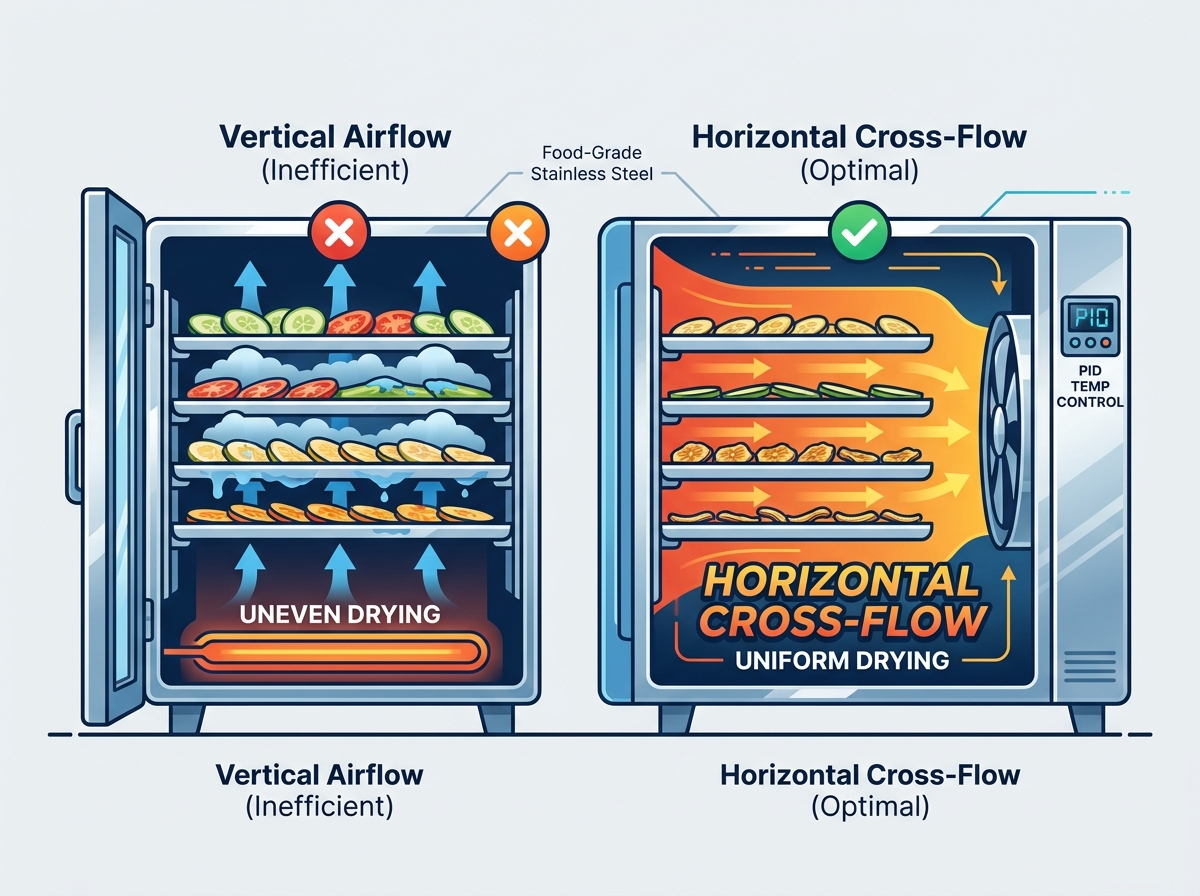
Vertical airflow systems push air from the bottom up or top down. They often cost less upfront. However, they trap moisture inside dense vegetable loads. Bottom trays dry quickly while top trays stay soggy. This leads to uneven drying and unwanted flavor transfer between tiers. You do not want your sweet potatoes tasting like onions.
Horizontal cross-flow systems fix this issue entirely. Rear-mounted fans push air evenly across every single tray simultaneously. This design is absolutely essential for any professional-grade vegetable drying machine. It completely removes the high labor cost of manually rotating trays mid-cycle. Every slice receives the exact same volume of dry air.
Heat Pump vs. Conventional Heating
Scale dictates your ideal heating mechanism. Standard resistive heating elements offer lower upfront capital expenditure. They use simple electrical coils to heat the air. However, they drive up daily operating expenses through high energy consumption. They basically function like giant hair dryers.
Heat pump dehumidification technology transforms large-scale operations entirely. It uses a closed-loop system to extract moisture while recycling heat. You face a higher initial purchase price. In return, you achieve 40% to 60% lower energy consumption over time. Heat pumps also preserve volatile flavor compounds much better than resistive heaters because they can operate efficiently at lower temperatures.
Thermal Precision and Automation Specifications
Vegetables require highly specific, sustained temperatures to dry safely. If you dry them too fast, they lose nutritional value. They also suffer from severe case hardening. This phenomenon occurs when the outside dries into a hard shell while the inside remains dangerously wet. Case hardened food will rot in storage.
Temperature Range and Fluctuation
You must require a machine capable of holding stable temperatures continuously. The optimal range for most vegetables sits between 125°F and 135°F (52°C to 57°C). Look strictly for PID (Proportional-Integral-Derivative) controllers. Basic mechanical thermostats swing wildly above and below target temps. A PID controller learns the thermal mass of your product. It micro-adjusts power delivery to prevent any temperature swings. This precision guarantees a uniform moisture content across your entire batch.
Programmable Timers and Zoned Drying
Manual dials restrict your operational flexibility severely. Evaluate machines featuring multi-stage programmable timers instead. You can program the unit to start at a higher temperature to flash-evaporate surface moisture quickly. After an hour, the system automatically drops the heat to finish drying safely. This automated zoning prevents scorching and speeds up the overall cycle. It allows your staff to set the machine and walk away without babysitting the controls.
Build Quality, Materials, and Compliance Standards
You must evaluate the machine's construction through the lens of longevity and strict food safety regulations. Subpar materials fail quickly under constant industrial use. Food safety auditors will quickly flag improper equipment.
Food-Grade Stainless Steel vs. Plastic
Plastic components carry heavy risks in commercial settings. Plastic can leach BPA or other chemicals into food. It often cracks under sustained, repetitive heat exposure. Plastic trays also prove notoriously difficult to clean thoroughly, harboring dangerous bacteria.
Specify commercial standard requirements for your facility. You need SUS304 stainless steel for general commercial use. It resists rust and withstands aggressive chemical washdowns. If you plan to dry highly acidic items like tomatoes or citrus, upgrade to SUS316 stainless steel. It offers superior corrosion resistance against tough food acids.
Insulation and Energy Retention
Cabinet insulation directly affects your bottom line every single month. Always assess the exterior build quality. Look for double-walled steel cabinets filled with high-density polyurethane or rock wool. Poor insulation leads to massive heat loss. This flaw drives up your electricity bills immediately. Furthermore, leaking heat stresses your facility's HVAC system. It creates a miserably hot working environment for your warehouse staff.
Implementation Risks: Power, Footprint, and Maintenance
A machine might fit your budget perfectly. However, if it immediately trips your facility’s breakers, it becomes a failed investment. You must plan for physical integration carefully.
Electrical Load and Voltage Requirements
Many buyers overlook basic electrical limitations. Warn your purchasing team to verify both peak wattage and running wattage. Peak wattage spikes hard during the initial heat-up phase. Commercial units rarely run on standard wall outlets. They usually require dedicated 220V/240V lines. Large industrial units demand robust 3-phase power setups. You will likely need a certified electrician for the final installation. Factor this labor cost into your initial budget.
Noise Levels and Ambient Environment
Pay close attention to operational decibel (dB) ratings. Large commercial fans run exceptionally loud. Factor this noise into your floor plan placement. Keep noisy units far away from office walls or active packaging stations.
You must also manage the ambient humidity loop. Open-loop dehydrators vent moist, hot air directly into the room. If your facility lacks proper ventilation or a strong HVAC setup, major problems arise. The machine will simply re-intake that humid air. This drastically increases your drying times and degrades product quality.
Cleaning Accessibility
Sanitation takes up significant daily labor hours. Look for structural features designed to minimize washdown time. Removable fan baffles allow deep cleaning of the internal air pathways. Seamless interior corners prevent bacteria buildup in tight, hard-to-reach crevices. Ensure all stainless steel trays are fully dishwasher safe to cut down on manual scrubbing time.
Shortlisting Logic: Making Your Final Decision
You need a sequential framework to evaluate your final choices effectively. Follow these exact next-step actions to eliminate bad options from your list quickly.
- Audit your facility's electrical panels and physical space constraints first.
- Determine your exact required weekly wet-weight throughput to establish a firm baseline capacity.
- Filter out any machines lacking horizontal cross-flow airflow or food-grade stainless steel construction.
- Request hard validation data directly from the manufacturer before proceeding. Ask for power consumption metrics under full loads and clear warranty terms on the heating elements and fan motors.
Conclusion
The best vegetable drying machine is never defined by slick brand hype. True quality stems from the strict alignment of mechanical specifications with your specific operational needs. You must carefully balance airflow dynamics, tray capacity, power limits, and material safety. We encourage all commercial buyers to consult directly with a technical sales representative. Request a pilot test dry of your specific vegetable product. Review the detailed engineering spec sheets thoroughly before you issue any purchase order. Taking these calculated steps ensures your production line runs smoothly, safely, and profitably for years to come.
FAQ
Q: What is the ideal wattage for a commercial vegetable drying machine?
A: Ideal wattage depends entirely on your active drying area. A larger surface area demands higher wattage for rapid heat recovery. Higher wattage does not mean the machine dries at higher operating temperatures. Instead, it ensures the unit quickly returns to its target temperature after you open the doors to load cold, wet vegetables.
Q: How does a heat pump dehydrator differ from a standard commercial dehydrator?
A: A heat pump dehydrator uses a closed-loop system for moisture extraction. Instead of venting hot, moist air into your room, it condenses the moisture into water and recycles the captured heat. This highly efficient process uses up to 60% less energy than standard open-air venting dehydrators utilizing basic resistive coils.
Q: Can one machine dry both high-moisture fruits and dense root vegetables?
A: Yes, a single unit can handle both categories effectively. However, it must feature a precise PID controller and horizontal cross-flow airflow. These specs allow you to manage drastically different moisture release rates. You can easily program lower heat cycles for sugary fruits and faster, hotter cycles for root vegetables.
Q: What maintenance is required for a commercial food dehydrator?
A: Routine maintenance focuses heavily on hygiene and airflow efficiency. You must sanitize trays and interior walls daily to prevent dangerous cross-contamination. Check door seals weekly for heat leaks. Inspect and clean the primary heating elements and fan blades monthly to remove any accumulated debris or sticky residues.


