In commercial meat processing, minimizing product waste remains a constant daily battle. Ensuring operator safety during structural breakdown serves as a critical driver of profitability. When you optimize these two factors, your facility’s bottom line improves directly. However, relying on manual breakdown methods creates severe operational bottlenecks. Using underpowered slicing equipment for bone-in or frozen products leads to jagged cuts. These poor practices also generate excessive bone dust and heighten injury risks for your staff. A commercial Machine For Sawing Bones is not a universal tool, but a highly specialized asset. You cannot simply drop it into any production line without careful planning. This guide breaks down the high-yield applications and operational realities you will face. We also provide the evaluation criteria necessary to justify this capital investment. You will learn how to integrate the right system seamlessly into your facility's daily workflow.
Key Takeaways
- Application Alignment: High-volume abattoirs, retail butcheries, and commercial kitchens require vastly different configurations (e.g., vertical vs. automated horizontal) to match throughput demands.
- Equipment Distinction: Meat slicers and bone saws serve mutually exclusive functions; misapplying a slicer to bone-in cuts guarantees rapid equipment failure and safety hazards.
- TCO (Total Cost of Ownership): True equipment ROI depends heavily on blade replacement frequency, sanitation downtime, and automated feeding capabilities.
- Compliance & Safety: Modern evaluation mandates looking beyond motor power to verify emergency stop mechanisms, pushers, and washdown-rated materials (IP65+).
Primary Industrial Applications: Where to Deploy a Machine for Sawing Bones
High-Volume Abattoirs and Primary Breakdown Facilities
Heavy carcasses weigh hundreds of pounds and create immense logistical challenges. Processing speed drops significantly when teams rely on manual breakdown tools. Operator fatigue spikes quickly when halving or quartering beef and pork. A high-torque machine solves this specific business problem efficiently. You need floor-standing units built for rigorous, continuous daily operation. They offer extended throat clearance to accommodate massive primal cuts. Automated feeding systems move the heavy meat steadily across the cutting plane. This maintains high processing speed without exhausting your floor workers. Fatigue drops significantly, and workplace morale improves. We often see facilities double their output when upgrading their primary breakdown equipment. Carcasses separate cleanly into uniform halves or quarters every single time.
Best practices dictate matching your motor power directly to carcass density. Dense beef requires significantly more torque than younger pork. Common mistakes include buying underpowered units that stall mid-cut. Stalling damages the meat and creates hazardous kickback scenarios for operators. Always verify the continuous duty rating of the motor before purchase.
Supermarket Butcheries and Retail Processing
Floor space is always a scarce resource in retail environments. You must balance this limitation carefully. You also need highly precise portioning capabilities daily. Customers demand visually attractive bone-in steaks, chops, and roasts. Frozen blocks require perfectly clean cuts to maintain retail appeal. Compact, vertical bone saws fit this environment perfectly. Cleanliness of the cut stands as a primary evaluation dimension here. You want to maximize retail display appeal consistently. Bone dust makes fresh meat look unappealing and oxidized. It also causes measurable yield loss over a financial quarter. A sharp, well-calibrated machine minimizes this costly waste. Butchers can focus on merchandising rather than trimming ragged edges.
Commercial Kitchens and Large-Scale Catering
Preparation times strictly dictate profitability in the catering industry. Handling bulk frozen proteins often causes unacceptable kitchen delays. Inconsistent portion sizes frustrate executive chefs and impact food costs. Benchtop models offer a highly practical solution for these environments. They prioritize quick blade changes above all else. Kitchen staff can easily break them down for daily cleaning. Cross-contamination protocols remain incredibly strict in commercial kitchens. You must prevent raw poultry from contaminating beef or fish. Quick sanitation prevents dangerous biological buildup. You gain consistent portions every time you cut a frozen block. Kitchen service speeds up noticeably when prep work runs smoothly.
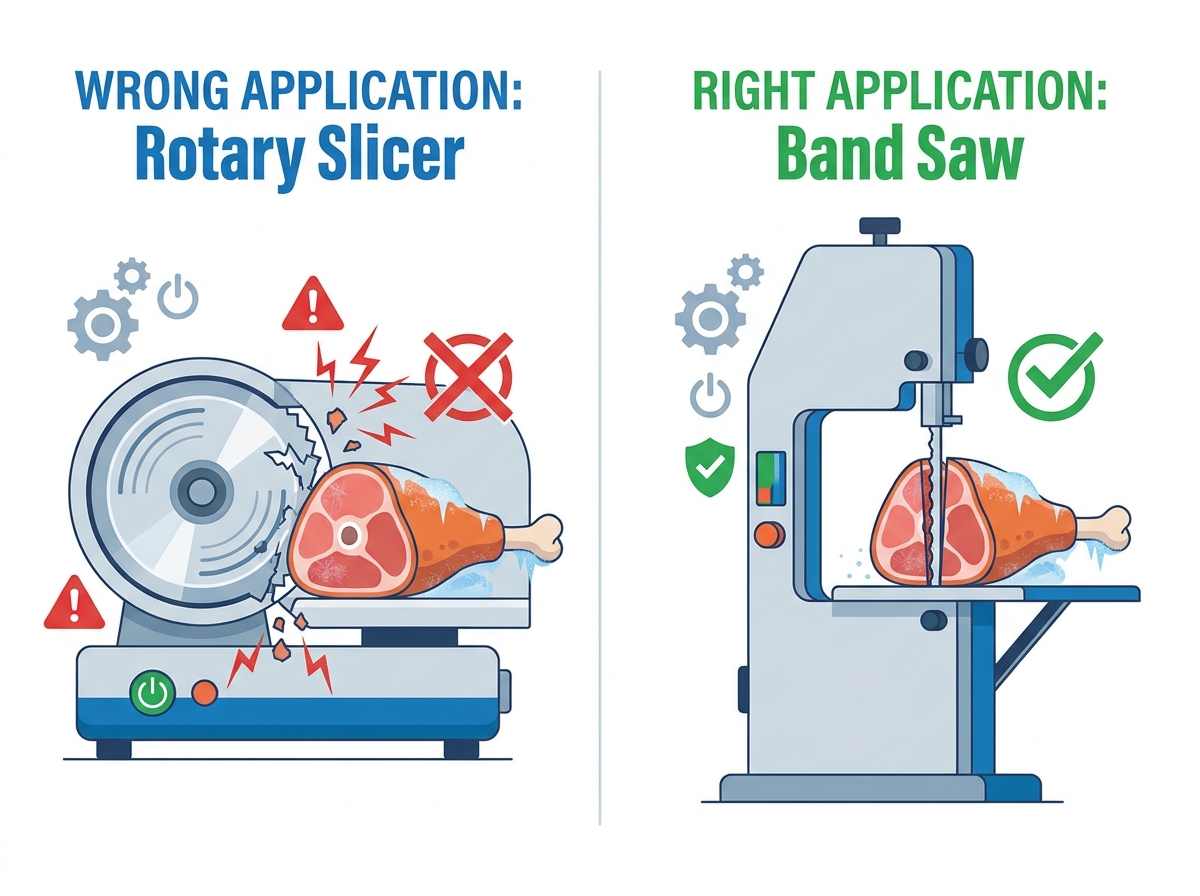
Bone Saw vs. Meat Slicer: Defining Equipment Boundaries
The Core Distinction
Meat slicers utilize rotary blades spinning in a fixed position. Engineers design them specifically for soft, boneless, or cured meats. They perform beautifully on deli products and soft cheeses. A Machine For Sawing Bones utilizes a continuous band blade instead. We engineer these continuous loops for high-density structural resistance. The aggressive teeth grip and tear through calcium easily. The blade carries bone fragments downward into a dedicated collection tray. Rotary blades simply glide across the surface and lack ripping power. You cannot interchange these machines under any circumstances. They serve mutually exclusive functions in your facility.
Risk of Misapplication
Many untrained operators force bone-in products through standard slicers. They also attempt cutting deep-frozen items to save time. This action voids your equipment warranty immediately. It also violently fragments the bone structure of the meat. Shards heavily contaminate the surrounding soft tissue. End consumers might swallow these dangerous, hidden fragments. Furthermore, misapplication poses severe projectile risks on the floor. The rotary blade can snap or kick the product back forcefully. Operators face severe laceration injuries when this occurs. Stick to the designated equipment to protect your staff and product.
Decision Framework
You need a clear rule for procurement and daily operation. Analyze your current inventory volume over a typical month.
- Evaluate if you process more than 15% bone-in products by volume.
- Determine if deep-frozen inventory exceeds this same 15% threshold.
- Assess if operators complain about jagged cuts or excessive physical strain.
- Review your current accident logs for slicer-related injuries.
If you meet these criteria, a dedicated bone saw is required. It maintains your operational integrity during heavy production runs. It also ensures OSHA compliance regarding workplace safety standards. Ignoring this framework invites steep fines and compromised product quality.
Key Evaluation Dimensions for Procurement
Vertical vs. Horizontal Configurations
Vertical models allow highly manual manipulation of the product. You can guide diverse, irregular cuts easily across the table. They feature a much smaller physical footprint on the floor. Retail and custom butchery environments prefer them for daily tasks. The ergonomics suit standing operators perfectly for precise portioning. Horizontal models handle standardized cuts automatically. They offer incredibly high-capacity output for wholesale distribution. Automated workflows rely on them entirely to maintain profit margins. Conveyors feed the product automatically into the cutting zone. The system positions the meat accurately. Automatic cutting follows precisely, dropping finished pieces into a bin.
Configuration Comparison Matrix
| Dimension | Vertical Configuration | Horizontal Configuration |
| Best Application | Retail butchery, diverse custom cuts | High-volume standardized wholesale |
| Footprint | Compact, space-saving design | Large, requires conveyor integration |
| Operator Involvement | High (manual feeding and guiding) | Low (automated feeding/positioning) |
| Throughput Capacity | Moderate | Extremely High |
Motor Power and Blade Velocity
Underpowered motors stall frequently when they hit dense marrow bones. This sudden stalling causes dangerous blade snap. You must look for continuous duty ratings rather than peak numbers. Peak horsepower claims often mislead buyers into purchasing inadequate machinery. Continuous duty ensures reliable daily operation without overheating the coils. High blade speed matters tremendously for product quality. It ensures clean separation of tissues during the cut. Slow blades rip and tear the delicate muscle fiber. Torn fiber degrades the final product quality and retains less moisture. Moisture loss directly translates to lost revenue per pound.
Material and Sanitary Design
Regulatory compliance relies entirely on intelligent material choices. You must demand 304 or 316-grade stainless steel construction. These marine-grade alloys resist harsh cleaning chemicals and continuous moisture. Avoid machines featuring exposed crevices or hollow frame tubes. Non-sealed bearings trap biological matter quickly during normal operation. Bacteria multiply rapidly in these hidden, warm spaces. Consequently, these machines will fail basic ATP swab tests repeatedly. Sanitation teams struggle to clean poor designs efficiently. Washdown-rated materials (IP65+) ensure water streams do not damage electronics.
Implementation Realities: Safety Risks and Maintenance
Operator Safety and Adoption Risks
Bone saws are inherently dangerous machines by design. Adoption requires incredibly strict training and daily supervision. Operators must respect the equipment and wear proper protective gear. We highly recommend using heavy chainmail gloves during manual operation. You must shortlist machines carefully based on modern safety standards. Require CE/UL-certified safety interlocks on all access doors. Heavy-duty meat pushers keep human hands away from the blade. Sensor guards stop operation immediately if a panel opens. Accessible emergency stop buttons save lives in crisis moments. Conduct regular safety audits to ensure staff follow these protocols.
A common mistake involves bypassing safety interlocks to speed up cleaning. This practice inevitably leads to catastrophic workplace accidents. Always enforce a zero-tolerance policy for bypassing safety mechanisms.
Blade Maintenance Economics
Blades represent your primary consumable operating expense. Using dull blades decreases your overall meat yield significantly. They also burn the meat edges due to intense friction. This friction creates unwanted heat, accelerating bacterial growth on the surface. Check the local availability of replacement blades before purchasing a machine. Proprietary blade sizes often lead to frustrating supply chain delays. Systems offering tool-less blade tensioning help your operation greatly. They reduce routine maintenance downtime significantly during active shifts. Operators can swap dull blades in minutes without calling a mechanic. Keep a strict log of operating hours to predict blade replacement cycles accurately.
Sanitation SOPs (Standard Operating Procedures)
Daily washdowns are strictly mandatory in any meat facility. Biological hazards accumulate fast on cutting surfaces and internal wheels. You must evaluate the machine's housing design closely. Consider how fast a single operator can open the main doors. The interior must clean easily with high-pressure hoses. Reassembly should happen quickly without requiring specialized wrenches or screwdrivers. Complex breakdown procedures always discourage proper cleaning habits. Staff might cut corners to save time at the end of a long shift. Simple, open sanitary designs ensure consistent regulatory compliance.
Building the Business Case: ROI and Shortlisting Vendors
Quantifying Yield Maximization
Manual cuts generate significant waste every single hour. Inaccurate portions cost your business money daily. Bone dust reduces your sellable weight and creates a mess. Compare this reality against the precision of a high-speed band saw. The mechanical precision recovers valuable protein instantly. Even a 2% yield recovery matters greatly to your bottom line. High-value proteins amplify these savings incredibly quickly. You often cover the machine's initial capital expense rapidly. Months, rather than years, usually define the payback period. Tracking your pre-installation waste provides a solid baseline for ROI calculations.
Labor Efficiency
Measure your current manual processing time accurately. Track how quickly operator fatigue sets in during a shift. Tired workers make costly mistakes and risk severe injuries. Automated or powered sawing reduces this physical burden entirely. Staff complete tedious breakdown tasks much faster. You can reallocate them to other profitable roles in the facility. Packaging and quality control always benefit from extra hands. Improved ergonomics also reduce long-term worker compensation claims.
Vendor Selection Criteria
Never buy industrial equipment based on purchase price alone. You must evaluate the vendor's reliability and industry reputation.
- Verifiable Case Studies: Prioritize manufacturers offering social proof of machines operating in similar processing environments.
- Parts Availability: Demand robust domestic parts availability. Waiting weeks for a simple bearing halts your production completely.
- Technical Support: Responsive technical support is crucial. Engineers must answer your calls promptly to troubleshoot electronic faults.
- Test Cuts: Engage with specialized vendors to test specific cuts on their machines before finalizing your procurement.
Conclusion
Selecting the right machine requires careful alignment with your operational realities. You must match the equipment's physical configuration to your specific throughput demands. High-volume environments benefit from horizontal automation, while retail spaces thrive on vertical precision. Prioritize sanitary design and operator safety over baseline pricing. CE/UL-certified interlocks and IP65-rated stainless steel protect your workforce and ensure compliance. By upgrading from manual methods, you eliminate bottlenecks and reduce product waste instantly.
- Evaluate your current bone-in processing volume to justify the upgrade.
- Audit your facility's floor space and power supply capabilities.
- Calculate your current yield loss due to jagged cuts and bone dust.
- Contact specialized vendors to arrange a physical demonstration.
- Implement rigorous safety and sanitation training for all designated operators.
FAQ
Q: What is the standard lifespan of a commercial machine for sawing bones?
A: With strict adherence to daily sanitation and regular tensioning maintenance, commercial-grade stainless steel units typically operate reliably for 10 to 15 years. However, consumable parts like blades and bearing guides require regular replacement to maintain optimal performance.
Q: Can these machines efficiently cut frozen meat alongside bone?
A: Yes. In fact, cutting meat while it is partially or fully frozen is a primary application. The frozen state produces a cleaner edge and prevents the delicate muscle tissue from tearing during the high-speed sawing process.
Q: What are the daily maintenance requirements for sanitary compliance?
A: Daily maintenance requires disconnecting power, removing the blade and scrap pans, and executing a full high-pressure washdown with food-safe sanitizers. Moving parts must then be lubricated with food-grade grease to prevent rust and ensure smooth operation.


