
Views: 0 Author: Site Editor Publish Time: 2026-08-14 Origin: Site


Food processors and commercial farms face immense operational bottlenecks today. You struggle against unpredictable yields and severe space constraints daily. Relying on traditional drying methods requires massive amounts of manual labor. Sun drying leaves you entirely at the mercy of shifting weather patterns. This unpredictability slows down production and hurts overall profitability. As global food supply chains demand longer shelf life, methods must improve. You need reliable techniques to preserve surplus harvests effectively.
Consequently, the food industry sees a massive shift toward mechanical drying. It represents a necessary evolution for scaling operations efficiently. Upgrading helps you meet increasingly strict global food safety compliances. Buyers now demand perfectly standardized ingredients for their retail products.
This article provides an objective, evidence-based analysis of this vital transition. We explore whether upgrading to commercial mechanical equipment justifies the initial capital expenditure. You will learn how modern systems drive operational efficiency and improve your return on investment. We also unpack the hidden costs of sticking to outdated, manual techniques.
We must frame the business problem accurately to establish a baseline. Traditional sun and air drying seem free initially. However, hidden operational costs quickly erode these perceived financial savings. Unpredictable weather directly dictates your entire drying cycle. Cloudy days, high humidity, or sudden rainstorms halt production entirely. This extreme weather dependency causes severe supply chain bottlenecks. You simply cannot guarantee delivery timelines to your corporate buyers. When you miss delivery windows, you lose lucrative contracts.
Furthermore, traditional methods demand incredibly intense physical labor. Workers must manually lay out produce on massive mesh screens. They spend hours turning, monitoring, and protecting the crops daily. These repetitive steps consume hundreds of expensive man-hours per week. You also need a massive physical footprint for sun drying. Spreading out tons of crops requires acres of valuable land. Real estate costs money, and open fields limit your expansion. Commercial-scale sun drying cannot scale efficiently within confined factory spaces.
Hygiene presents a massive compliance risk for any modern business. Open-air ambient drying constantly exposes your produce to dust and insects. Bird droppings and airborne pollutants contaminate exposed batches frequently. Uncontrolled humidity fluctuations lead to highly inconsistent internal moisture content. These uncontrolled variables cause higher microbial failure rates during testing. B2B food suppliers cannot afford failed lab tests today. Rejected batches destroy profit margins and permanently ruin buyer trust. The financial impact of a single rejected container can be devastating.
Common Mistake: Many farmers assume sun drying is the cheapest route available. They ignore the massive financial losses caused by weather-ruined batches.
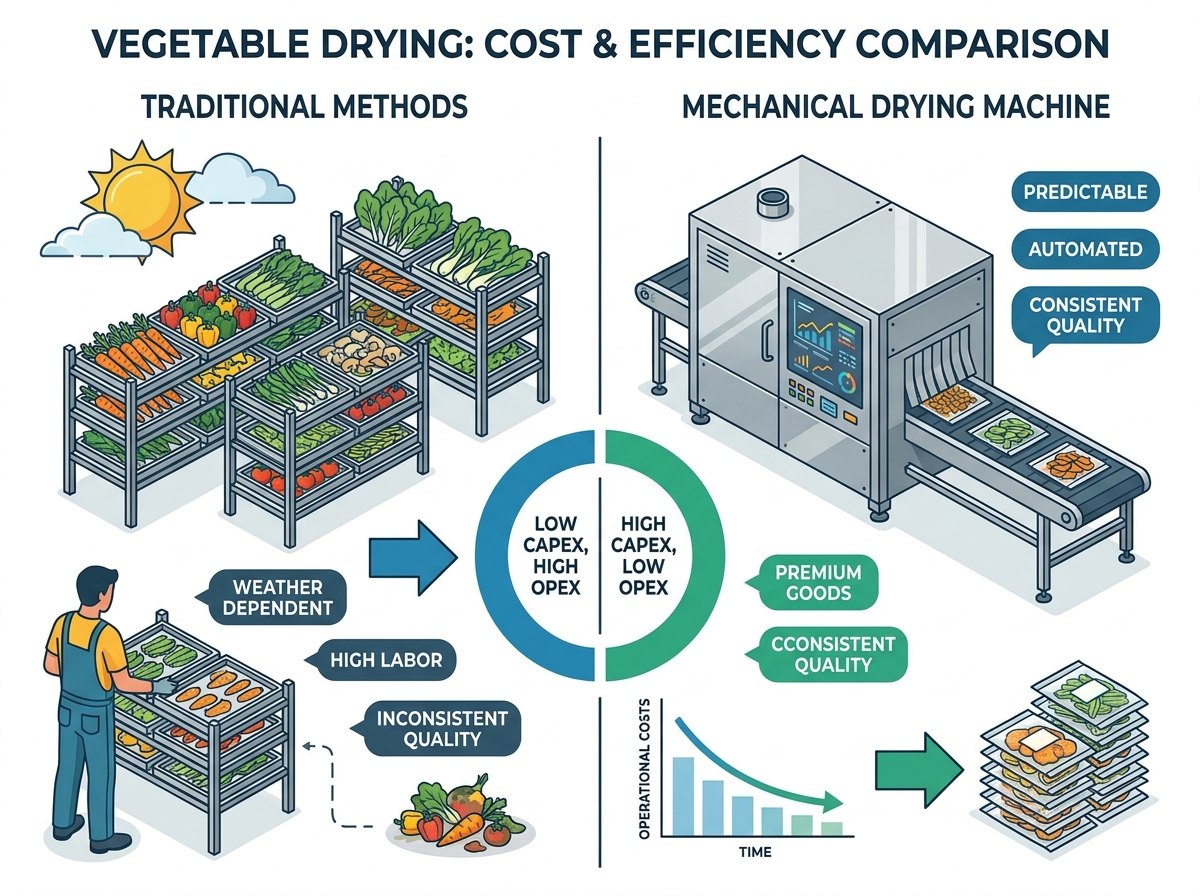
Industry experts evaluate solution categories using strict, standardized performance metrics. Thermodynamic efficiency and time efficiency form the core evaluation criteria. Modern equipment balances energy consumption perfectly against rapid moisture removal. A high-quality vegetable drying machine utilizes heat pump technology or smart continuous belts. They capture and reuse ambient heat continuously during operation. This advanced method vastly outpaces traditional ovens in speed and power usage. It removes moisture faster while drawing less electricity from the grid.
Precision moisture control is another critical factor for commercial success. Advanced units feature highly programmable temperature and humidity sensors. They prevent a devastating quality defect known as case hardening. Case hardening happens when the vegetable exterior dries far too fast. A tough outer shell forms and traps raw moisture inside the core. This trapped moisture eventually causes internal rot during storage. Programmable profiles ensure slow, even moisture migration from the center outward. Proper airflow dynamics guarantee every single piece dries uniformly.
Automation transforms a batch-based bottleneck into a streamlined production line. Automated loading conveyors move wet produce seamlessly through enclosed drying chambers. Operators monitor the entire process via centralized IoT dashboards. Continuous processing handles thousands of kilograms daily without constant human intervention. Modern SCADA systems record temperature logs for quality assurance audits. This immense scalability empowers you to accept much larger retail contracts.
Best Practice: Always calibrate your humidity sensors monthly. Accurate readings guarantee your drying profiles perform exactly as intended.
Decision-makers need a clear financial framework before upgrading their equipment. We must contrast upfront investments against ongoing operational expenses objectively. Sun drying carries near-zero initial equipment costs for the facility. However, purchasing an industrial vegetable drying machine requires significant initial procurement and installation capital (CAPEX). Buyers often fall into the dangerous "budget machine" trap. Cheap equipment boasts a very low upfront price tag. Yet, they suffer from poor insulation, failing fans, and require constant maintenance. Thin metal walls lose heat rapidly, destroying any energy efficiency gains.
Operating expenses (OPEX) determine your long-term profitability and business survival. You must analyze different power consumption models very carefully. Electric, gas, and heat pump systems all incur vastly different utility costs. Heat pumps offer an incredible coefficient of performance, multiplying your energy input. While the sun provides "free" energy, it lacks any reliability. Mechanical systems offset higher energy bills through massive labor savings. You eliminate the endless man-hours previously required for manual crop handling.
Yield recovery also drives incredible cost savings over the year. Traditional open-air methods lose up to twenty percent of crops to rot. Minimizing spoilage guarantees a near perfect usable end-product rate. Every single kilogram processed becomes highly sellable inventory. This massive waste reduction dramatically shortens your equipment payback period. You essentially print money by saving products you previously threw away.
Equipment features directly influence your business outcomes and revenue generation. Controlled, lower-temperature mechanical drying preserves heat-sensitive vitamins incredibly well. For example, Vitamin C breaks down rapidly under prolonged UV exposure. High-heat conventional ovens also destroy natural plant pigments and delicate flavors. They often trigger enzymatic browning, leaving produce looking dark and unappetizing. Advanced mechanical systems retain bright natural colors and complex nutritional profiles. Shoppers pay a premium for visually vibrant, nutrient-dense dried foods.
Standardization unlocks secure doors to highly lucrative premium markets. You can achieve a highly consistent moisture baseline every single time. Consistent products allow you to supply high-end retail chains easily. Snack brands and spice blenders require ingredients dried to exactly eight percent moisture. Export markets and strict B2B food manufacturers demand exact vendor specifications. Mechanical drying ensures you meet these tight moisture requirements consistently. You become a highly trusted supplier in a competitive landscape.
Food safety compliance is equally critical for modern agricultural producers. Enclosed, food-grade stainless-steel drying environments eliminate environmental contaminants completely. They act as a critical control point within your HACCP plan. These systems help you meet strict FDA and ISO 22000 standards easily. You protect your brand identity from costly product recalls and legal liabilities. Superior product quality immediately elevates your competitive market positioning.
We must acknowledge the practical challenges of upgrading your operations. Facility readiness is the first major hurdle you will face. Industrial equipment requires a dedicated, heavy-duty 3-phase electrical power supply. Standard commercial wiring simply cannot handle large industrial blower motors. You must also ensure proper factory ventilation for managing exhaust air. Adequate floor space is absolutely necessary to accommodate loading and unloading zones. You should logically separate your wet receiving zone from your dry packaging zone.
Operator training introduces a temporary but necessary learning curve. Your staff must learn to set specific drying profiles accurately. Different vegetables require completely distinct temperature and time curves. Leafy greens dry much faster than dense root vegetables like carrots. Incorrect settings can scorch delicate leaves or severely under-dry thick slices. Supervisors must document standard operating procedures for every crop variety.
Maintenance and downtime are unavoidable realities of any industrial production. Heating elements and circulation fans experience normal wear-and-tear over time. You must choose manufacturers offering very robust service level agreements. Spare parts availability is crucial for minimizing unexpected production halts. Proactive, scheduled maintenance prevents minor mechanical issues from becoming catastrophic factory failures. Your team must routinely clean air filters and lubricate moving conveyor belts.
We want to guide buyers on exact next steps and selection criteria. First, you must assess your exact production volume accurately. You need to calculate your required moisture removal rate per hour.
Next, evaluate the underlying technology types available on the market today. Heat pump dryers offer incredible energy efficiency but require higher CAPEX. Traditional hot air circulation units feature lower CAPEX but demand higher OPEX.
Testing equipment before buying remains a critical industry best practice. We highly recommend running physical pilot batches using your own produce. Work closely with potential suppliers to verify their yield quality claims. Pilot tests reveal your exact shrinkage ratio and final product appearance. You must also validate their stated energy consumption figures independently before purchasing. Never buy commercial equipment based solely on a glossy brochure.
The following chart illustrates the core differences between common equipment categories:
| Technology Category | Initial Investment | Energy Efficiency | Ideal Application |
|---|---|---|---|
| Traditional Hot Air | Low to Medium | Moderate | General purpose, seasonal batches |
| Heat Pump Systems | High | Excellent | Continuous commercial operation |
| Smart Belt Dryers | Very High | Excellent | Mass volume, automated lines |
We clearly see traditional drying methods appear cost-effective only on paper. Hidden expenses tied to manual handling and weather delays destroy profit margins. Sticking to outdated techniques remains entirely unsustainable for serious commercial growth.
Investing in robust mechanical infrastructure pays long-term dividends in product consistency. Start your transition by auditing your current spoilage rates and labor expenses today. Contact an experienced application engineer to schedule a comprehensive test run for your crops.
A: The payback period typically ranges from 12 to 24 months. ROI depends heavily on your production volume, local energy costs, and current labor rates. Facilities replacing manual sun drying often see faster returns due to massive reductions in spoilage and hourly wages. High-volume continuous processing accelerates the break-even point significantly.
A: Heat pumps use a highly efficient closed-loop energy recovery system. They capture moisture-laden air, condense the water, and recycle the latent heat back into the chamber. This process drastically lowers operating expenses compared to standard hot air dryers, which constantly vent heated air and waste expensive energy.
A: Yes, most modern units feature adjustable PLC controls. You can program custom temperature and humidity curves for different crops. However, you must thoroughly clean the chamber between batches to prevent cross-contamination. Operators must also adjust settings carefully, as leafy greens and root vegetables have vastly different moisture profiles.
A: Mechanical drying standardizes internal moisture to incredibly safe levels, halting microbial growth. However, it does not completely eliminate mold risks if post-processing is ignored. You must implement proper sanitary pre-processing steps. Furthermore, you must immediately store the dried produce in airtight, moisture-proof packaging to prevent rehydration from ambient humidity.


