Investing in a vegetable drying machine requires moving past flashy marketing claims. You must focus intently on moisture extraction consistency, energy efficiency, and your operational scale. You might process surplus farm yields. You might upgrade a high-volume preservation setup. In either scenario, choosing the wrong equipment carries heavy risks. Poor equipment often leads to uneven drying. It frequently causes case hardening, where moisture remains permanently trapped inside the produce. These issues directly compromise food safety, ruin textures, and waste valuable agricultural resources.
This guide strips away the fluff. We provide a practical, evidence-based evaluation framework. You will learn exactly how to evaluate different models on the current market. We cover crucial technical factors like airflow architecture, material compliance, and precise temperature controls. By the end, you will know how to select a unit tailored precisely to your specific production needs and facility constraints.
Key Takeaways
- Airflow dictates quality: Horizontal airflow prevents flavor cross-contamination and eliminates the need for manual tray rotation.
- Precision over power: High wattage means nothing without granular thermostat control to protect heat-sensitive vegetable enzymes.
- Material matters for compliance: Stainless steel construction is non-negotiable for commercial food safety compliance and long-term durability.
Defining Your Success Criteria: Capacity, Yield, and Application
Before comparing specific brands, you must accurately define your production goals. Clear operational metrics prevent you from buying an undersized or oversized unit. This fundamental step ensures your new equipment integrates smoothly into your daily workflow.
Production Volume Mapping
Many buyers focus on tray count. This represents a dangerous vanity metric. Instead, calculate your average wet-weight batch size. You need to determine the required square footage of active drying space. A ten-tray unit from one brand might offer less surface area than a six-tray unit from another.
You can map your production volume by following these essential steps:
- Weigh your typical daily or weekly harvest of wet vegetables.
- Account for differences in produce density. Leafy greens take up more space per pound than dense root vegetables.
- Calculate the total square inches of drying area provided by the manufacturer.
- Match your wet-weight volume to the active surface area to avoid bottlenecks.
Focusing on active drying area ensures you buy actual processing capacity rather than just a large metal box.
Throughput Expectations
You must clarify your processing frequency. Differentiate between intermittent batch processing and continuous 24/7 operation. Intermittent processing works fine for prosumers. You run the machine for a day, process a single batch, and turn it off.
Best Practice: Continuous commercial operation requires entirely different hardware. High-throughput environments demand heavy-duty motors. They also require commercial-grade warranties. Standard household machines burn out quickly under continuous use. Always match the motor rating to your expected weekly operating hours.
Footprint and Facility Constraints
Assess your physical workspace closely before ordering. Measure your available floor or counter dimensions. Consider your facility ventilation requirements carefully. A powerful vegetable drying machine expels warm, moist air constantly during operation.
Common Mistake: Failing to plan for humidity extraction often leads to serious facility damage. Your room needs proper ventilation to prevent mold growth on surrounding walls and ceilings. Additionally, verify your power availability. Prosumer models usually run on standard 110V outlets. Commercial setups often require dedicated 220V circuits. Check your electrical panels early to avoid expensive post-purchase rewiring.
Airflow Architecture: Evaluating Horizontal vs. Vertical Systems
Airflow design determines the ultimate quality of your dried produce. It directly impacts dehydration speed, consistency, and product safety. There are two primary architectural styles available on the market today.
Vertical Airflow (Bottom-Up/Top-Down)
Vertical systems typically place the fan at the base or the top. Heat travels vertically through a series of stackable trays.
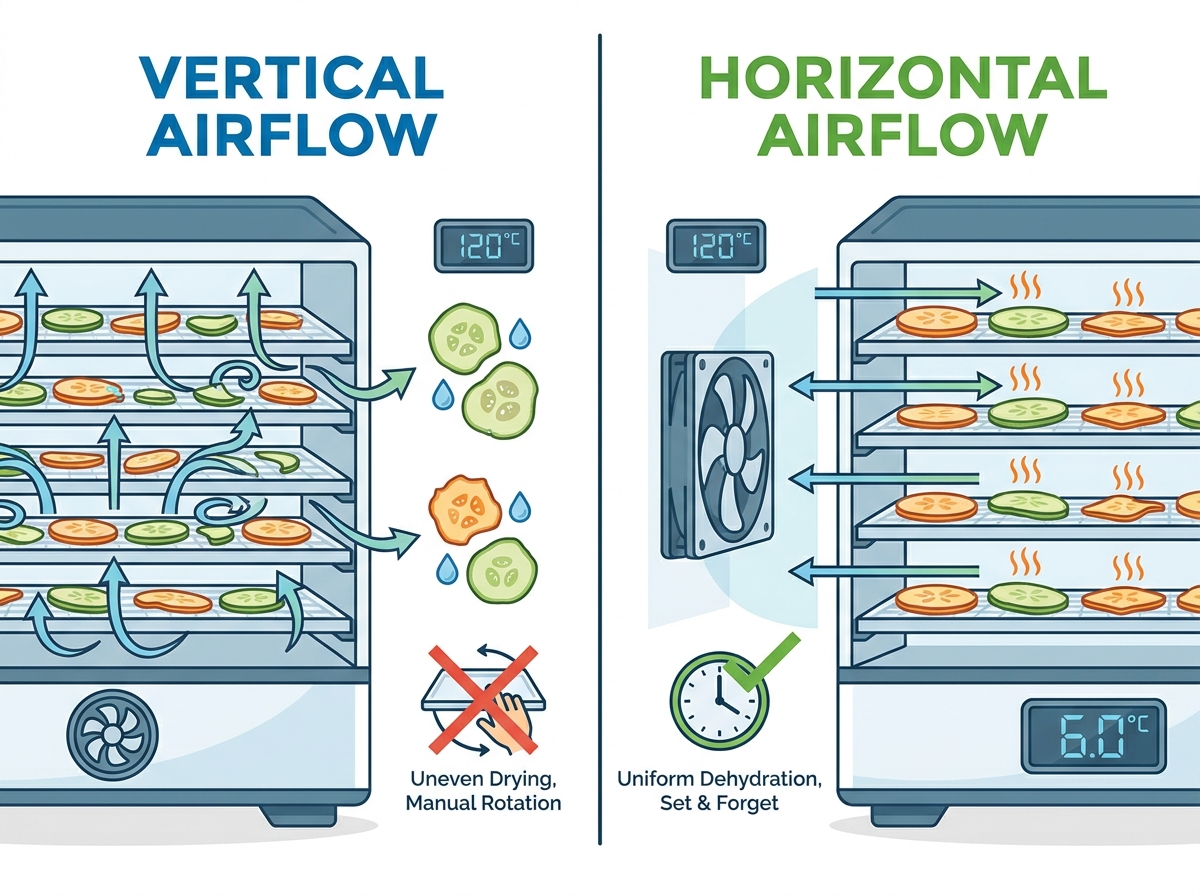
The Reality: These designs are highly prone to uneven drying. Warm air naturally struggles to penetrate densely packed layers. Trays located closest to the fan dry much faster than those farther away. Consequently, you must manually rotate trays mid-cycle. This intervention adds significant labor time to your daily operations.
Furthermore, vertical airflow creates a high risk of moisture trapping. Dense vegetables like tomatoes or thick zucchini slices often dry on the outside but remain wet inside. Flavor cross-contamination represents another major flaw. As air moves upward, juices and strong aromas blow directly onto the vegetables resting on upper tiers.
Horizontal Airflow (Rear-Mounted)
Horizontal systems mount a large fan at the back of the unit. The fan pushes heated air evenly across all shelves simultaneously. A plenum chamber often helps distribute this air uniformly.
The Reality: This design represents the strict industry standard for reliable vegetable drying equipment. It guarantees uniform dehydration across every single tray. You never have to pause the machine to rotate racks.
Horizontal airflow actively prevents flavor mixing between different vegetable batches. The air moves across the tray and immediately exits the front vents. This parallel air movement drastically reduces your active labor time. It also produces a highly consistent final yield.
| Evaluation Feature | Vertical Airflow Systems | Horizontal Airflow Systems |
| Heat Distribution | Uneven; strongest near the fan base or top element. | Highly uniform across all tiers simultaneously. |
| Manual Labor Required | High; requires frequent tray rotation mid-cycle. | Low; load the trays and leave until the cycle finishes. |
| Cross-Contamination Risk | High; flavors and juices travel vertically between trays. | Low; air moves parallel and exits immediately. |
| Best Application | Light home use, single-ingredient small batches. | Commercial processing, diverse vegetable batches. |
Core Evaluation Dimensions: Specs That Drive ROI and Quality
Evaluating technical specifications separates premium machines from mediocre alternatives. You must look beyond basic marketing descriptions. Focus strictly on parameters guaranteeing food safety and product longevity.
Temperature Range and Fluctuation Tolerance
Precision thermostat control is absolutely essential for preserving quality. Look for machines maintaining stable temperatures between 95°F and 165°F (35°C–74°C).
Lower thresholds prove critical for delicate greens and culinary herbs. High heat easily destroys vital enzymes in these fragile items. It also degrades their overall nutritional profile. For example, processing kale chips requires gentle heat around 105°F to maintain color and nutrients. Root vegetables demand slightly higher temperatures around 125°F to expel dense internal moisture safely.
Your machine must hold a steady temperature without experiencing wild fluctuations. Advanced models utilize smart digital sensors. These sensors monitor internal chamber heat constantly. They adjust the heating element automatically to prevent sudden temperature spikes.
Material Integrity and Food Safety Compliance
Housing materials impact both operational efficiency and daily sanitation. Double-walled stainless steel provides superior thermal insulation. It retains internal heat far better than single-wall plastic cabinets. This insulation translates directly to sustained energy efficiency during long runs.
The drying racks require equal scrutiny. Demand 304-grade stainless steel for all direct food-contact surfaces.
BPA-free plastics might sound safe initially. However, they degrade visibly over time. They warp under prolonged heat exposure. Plastic trays also complicate your sanitation protocols. They scratch very easily during scrubbing. Harmful bacteria often hide inside these microscopic surface scratches. Acidic vegetables like tomatoes also react poorly to cheap metals, making high-grade stainless steel mandatory.
Timer and Automation Capabilities
Long drying cycles frequently run completely unattended overnight. Therefore, you must evaluate digital versus analog controls carefully.
Analog dials drift over time. They lack the precision required for strict recipe replication. Digital controls allow highly granular adjustments. Look specifically for reliable auto-shutoff features.
Multi-stage temperature programming represents a massive operational advantage. You can program the machine to start at a higher temperature for two hours. This initial blast kills surface bacteria quickly. The machine then automatically drops to a lower temperature for the remaining ten hours. This preserves the internal enzymes perfectly without requiring human intervention.
Implementation Realities: Maintenance, Noise, and Operating Costs
Owning a high-capacity unit involves practical daily realities. You must consider exactly how the machine fits into your existing operational workflow. Overlooking these practical aspects often leads to severe buyer's remorse.
Sanitation and Maintenance
Cleaning takes significant time away from production. Evaluate the internal drip tray design carefully. A removable, seamless bottom tray catches fallen debris and sticky vegetable juices. You simply slide it out and wash it.
Machines featuring seamless stainless steel interiors wipe down in seconds. Health departments prefer smooth, continuous welds over bolted seams. Ensure the rack spacing allows for easy loading and rapid unloading. Dishwasher-safe stainless racks minimize your mandatory downtime between consecutive batches. Conversely, complex metal latches or tight plastic tracks trap food particles constantly. They require tedious, time-consuming manual scrubbing.
Acoustic Footprint
High-velocity extraction fans generate significant ambient noise. Buyers frequently overlook this environmental factor. If you operate in shared kitchens or confined spaces, verify the decibel (dB) ratings before purchase.
Aim for models registering under 50 to 60 dB for standard indoor environments. For context, 50 dB sounds like a quiet office conversation. Anything approaching 70 dB resembles a commercial vacuum cleaner running continuously. This excessive noise disrupts team communication. It also causes severe operator fatigue during long processing shifts.
Energy Efficiency
Many novice buyers assume higher wattage automatically equals better performance. A higher wattage does heat up the internal chamber faster. However, it does not guarantee overall system efficiency.
Look for models featuring thick insulated casings. Smart thermostats are equally crucial for managing power draw. They cycle the primary heating element on and off intelligently. This maintains the precise set temperature without bleeding excess electricity continuously. A well-insulated 1000W unit often consumes less daily power than a poorly insulated 600W unit running non-stop to compensate for heat loss.
Making Your Shortlist: A Step-by-Step Decision Framework
Narrowing down your options requires a highly systematic approach. The market offers hundreds of varying models. Follow this straightforward framework to identify the best equipment for your specific application.
- Step 1: Disqualify based on airflow and material. Immediately eliminate any vertical airflow models from your list. Discard units relying on plastic racks or single-wall plastic housings. Enforce this rule strictly if your goal involves commercial-grade consistency. Only horizontal airflow and stainless steel guarantee uniform, hygienic results.
- Step 2: Map capacity to budget. Calculate the exact cost-per-square-foot of the provided drying space. Divide the total machine price by the active surface area. This calculation allows you to compare models objectively across entirely different brands. It strips away marketing hype and reveals the true value behind the price tag.
- Step 3: Verify the warranty and support. Look closely beyond the standard motor warranty. Check the specific coverage duration for the heating element. Investigate the warranty on the digital control board. These specific components represent the most common failure points in high-use environments. A robust, multi-year warranty indicates strong manufacturer confidence.
- Step 4: Check for replacement part availability. A machine remains viable only if you can maintain it effortlessly. Verify you can easily source replacement fans and digital thermostats. Check if the manufacturer sells extra trays separately. Can you buy these components three years post-purchase? Avoid brands lacking a dedicated, accessible parts portal.
Conclusion
A reliable vegetable drying machine serves as a vital investment in crop yield preservation. Choosing the right equipment transforms raw produce into highly stable, valuable commodities.
- Prioritize horizontal airflow systems to eliminate manual tray rotation completely and ensure uniform drying.
- Insist on 304-grade stainless steel construction to maximize food safety and ensure long-term equipment survival.
- Demand precise digital temperature controls to protect heat-sensitive enzymes in delicate produce batches.
For your immediate next steps, audit your current and projected batch volumes. Weigh your typical daily harvest accurately. Measure your available floor space and verify your facility's electrical capacity. Finally, apply the cost-per-square-foot metric to narrow your final three choices objectively.
FAQ
Q: What is the ideal wattage for a vegetable drying machine?
A: Wattage largely depends on the machine's physical size. A range of 400 to 600W works adequately for small, intermittent setups. However, 1000W or higher is strictly necessary for multi-tray horizontal units. This higher power ensures rapid heat recovery every time you open the door during operation.
Q: Do I need a commercial vegetable dryer for home use?
A: You do not strictly need a full commercial unit. However, prosumer stainless steel models offer vastly superior longevity, safety, and consistency. They significantly outperform cheap plastic consumer models. Investing slightly more upfront makes a prosumer model a vastly better long-term asset for your kitchen.
Q: How do I prevent case hardening when drying vegetables?
A: You must avoid starting your cycle at maximum heat. Use a machine featuring precise temperature control. Apply moderate heat, typically around 125°F (52°C). Combine this with consistent horizontal airflow. This gentle approach allows internal moisture to escape completely before the exterior surface seals shut.


