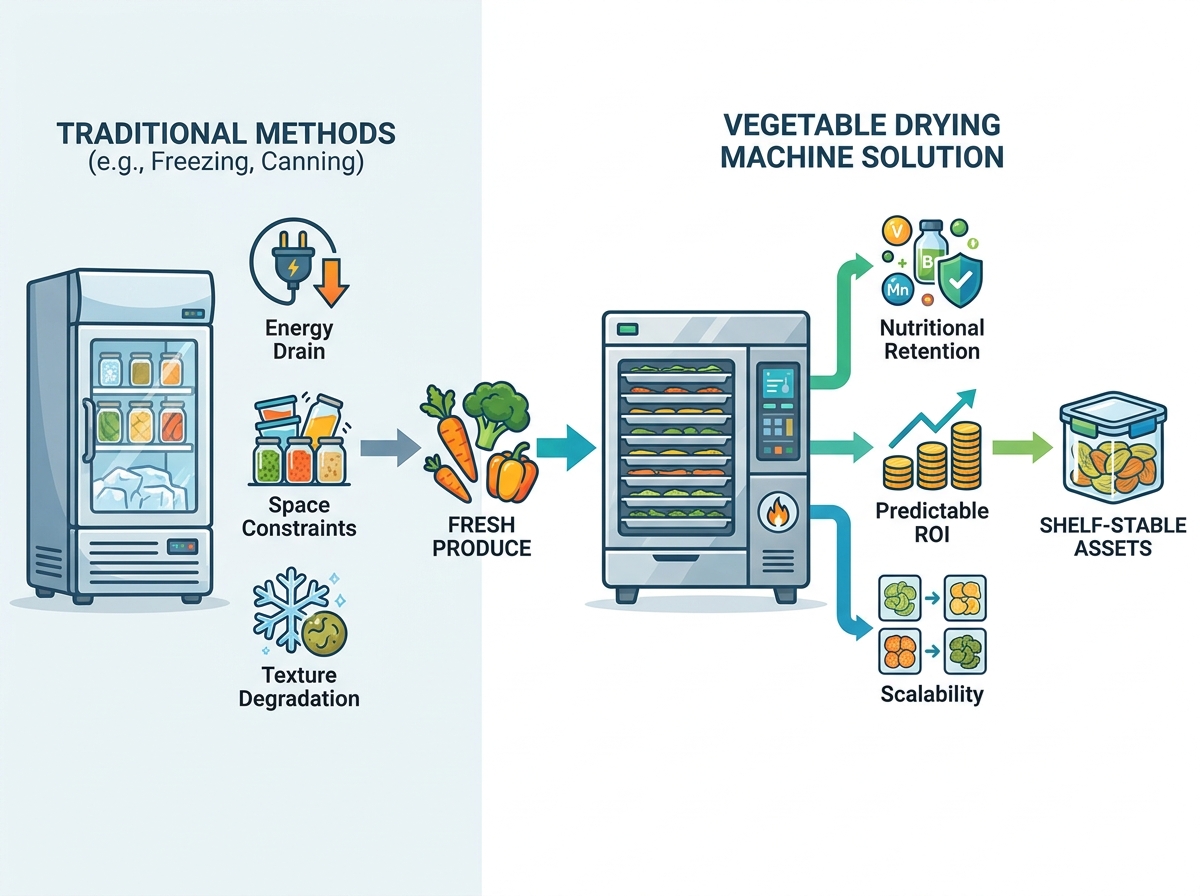
Rising food waste costs hit homesteaders and commercial kitchens hard. Traditional preservation methods like freezing and canning often create major logistical headaches. They demand constant energy, consume massive storage space, and frequently degrade food texture.
You might consider conventional dehydrating to solve these issues. However, transitioning to a specialized vegetable drying machine offers a superior approach. It delivers predictable, scalable, and high-quality moisture removal.
Upfront costs certainly exist. Yet, a purpose-built drying machine brings measurable advantages in nutritional retention and operational efficiency. It provides excellent long-term value for serious homesteaders and commercial food operations alike, completely transforming how you handle perishable inventory.
Key Takeaways
- Nutritional Integrity: Precision low-heat drying retains significantly more heat-sensitive vitamins (like Vitamin C) compared to canning or high-heat processing.
- Predictable ROI: Reduces spoilage-related financial loss by converting surplus fresh produce into shelf-stable assets with minimal ongoing energy costs.
- Scalability: Modern units (especially heat pump technologies) offer consistent batch processing without the variables of weather or humidity that affect traditional air-drying.
- Evaluation Focus: Buyers must weigh capacity needs, material compliance (e.g., food-grade stainless steel), and technology type (convection vs. heat pump) before purchasing.
The Core Problem: Where Traditional Preservation Falls Short
Preserving seasonal bounty has always challenged food producers. Traditional methods served us well historically. Today, they expose significant limitations in scale, quality, and reliability.
Freezing Dependencies
Freezing looks simple on the surface. You wash the produce, bag it, and toss it in the freezer. However, freezing carries heavy hidden costs. Deep freezers draw continuous electrical power year-round. A single grid outage can destroy months of carefully stored harvests overnight. Furthermore, freezing inherently damages plant structures. The expanding ice crystals rupture cellular walls inside the produce. When you thaw these vegetables, they often turn mushy and lose their crisp texture.
Canning Complexities
Canning eliminates the risk of power outages, but it introduces extreme labor demands. The process requires sterilizing jars, preparing precise brines, and monitoring pressure cookers. More importantly, canning relies on sustained high heat. Boiling temperatures severely degrade natural enzymes. This extreme heat fundamentally alters the natural flavor profile of fresh vegetables. Carrots, green beans, and peas often emerge tasting dull or overly cooked.
The Dehydration Gap
Some growers attempt to bridge this gap using passive air-drying or standard kitchen ovens. These methods almost always fail to deliver consistent results. Passive sun-drying relies entirely on cooperative weather. A sudden spike in ambient humidity ruins a batch quickly. Domestic ovens simply lack adequate ventilation. They trap moisture inside the cavity, cooking the food rather than drying it. These fluctuating conditions leave pockets of moisture inside the produce, inevitably leading to dangerous mold growth.
Nutritional and Quality Advantages of a Vegetable Drying Machine
Modern dehydrating equipment completely changes the preservation dynamic. A commercial-grade unit protects the fundamental integrity of your harvest.
Precision Temperature Control
Proper dehydration requires a delicate balance of heat and airflow. Exact thermostat controls allow you to maintain target temperatures, typically between 95°F and 125°F for vegetables. This low-and-slow approach prevents a dreaded phenomenon called "case hardening." Case hardening occurs when sudden, intense heat dries the exterior of a vegetable too rapidly. This forms a hard shell. The shell then traps raw moisture inside the core, guaranteeing eventual spoilage. Precise equipment ensures gradual, even moisture extraction from the core to the surface.
Vitamins and Mineral Retention
Established nutritional frameworks consistently praise low-heat dehydration. Controlled air drying actively prevents the leaching of water-soluble vitamins. Unlike boiling or blanching for extended periods, dehydration keeps B-complex vitamins and Vitamin C largely intact within the plant matrix. As the water evaporates, the equipment essentially concentrates the remaining nutrients. You yield a highly dense source of dietary fiber, minerals, and complex carbohydrates.
Flavor Concentration
Chefs and food producers highly value dehydrated ingredients for their intense culinary profiles. Removing water weight stops the dilution of natural sugars. It concentrates the intrinsic umami profiles of vegetables like tomatoes, mushrooms, and peppers. You capture the absolute peak essence of the vegetable. This allows you to reintroduce bold, concentrated flavors into soups, stews, and powder blends months after the original harvest.
Operational Efficiency and ROI Factors
Viewing a commercial dehydrator merely as a kitchen gadget ignores its true value. It functions primarily as an essential risk-management tool for any food-handling operation.
Waste Mitigation
Food spoilage represents a massive financial drain. Fresh produce carries a notoriously short shelf life. An unexpected bumper crop of zucchini or a bulk supplier discount quickly turns into a liability if you cannot process it in time. A reliable machine rescues this surplus harvest. It intercepts bulk-purchased produce just before spoilage occurs. You effectively convert highly perishable liabilities into profitable, shelf-stable assets.
Energy Consumption vs. Yield
Many buyers worry about the electricity required to run drying cycles. Modern commercial units operate on surprisingly efficient parameters. Compare the continuous, low-wattage electrical draw of a standard drying unit against a commercial deep freezer. A freezer must run 24 hours a day, 365 days a year, just to maintain the status quo. A dehydrator runs for a distinct 12 to 24-hour cycle. Once the cycle finishes, the energy expenditure drops to zero. The resulting food requires zero electricity to store.
Storage Footprint Optimization
Raw vegetables consist mostly of water. Removing this moisture drastically reduces their physical footprint. Dehydrated vegetables require only a tiny fraction of their original storage space. Fifty pounds of fresh onions can shrink down to fit inside a single large storage tub. This physical reduction eliminates the need for bulky glass jars, heavy shelving units, and expensive climate-controlled warehousing.
| Preservation Method | Energy Requirement | Storage Space Needed | Texture/Flavor Impact |
| Freezing | Continuous / High | Large (Bulky) | Cellular damage, mushy |
| Canning | Low (Only during prep) | Large (Heavy Jars) | Cooked flavor, soft texture |
| Machine Drying | Low (Only during cycle) | Minimal (Compact) | Concentrated flavor, dense |
Solution Categories: Choosing the Right Drying Technology
The market offers several distinct categories of drying equipment. Selecting the right technology depends heavily on your production volume and operational environment.
Convection Air Dryers
Convection units represent the most common style available today. They push heated air across the food surface to carry away moisture.
- Best for: Entry-level commercial ventures, boutique farms, or high-end home use.
- Mechanism: They use a simple electric heating element paired with internal fans to expel moist air out of vents.
- Pros/Cons: These models demand a much lower initial investment. They are easy to operate and simple to repair. However, they prove less energy-efficient for continuous, large-scale operation because they constantly vent heated air into the room.
Commercial Heat Pump Dryers
Industrial operations often graduate to heat pump technology. These units operate on a fundamentally different thermodynamic principle.
- Best for: High-yield agricultural operations, massive harvests, and B2B food processing.
- Mechanism: This equipment recovers and recycles heat within a completely closed-loop system. It mechanically draws out condensation and drains it away as liquid water.
- Pros/Cons: They require a significantly higher upfront capital expenditure. Yet, they deliver substantially lower operating costs over time. Furthermore, they boast zero reliance on external climate conditions, working perfectly even in highly humid rooms.
Material Considerations: Stainless Steel vs. Plastic
Construction material dictates the lifespan and safety of your equipment. We strongly advocate for food-grade stainless steel. Look specifically for 304 or 316-grade steel constructions. Stainless steel ensures long-term durability. It withstands rigorous commercial sanitation protocols effortlessly. More importantly, it complies fully with strict commercial food safety regulations.
We warn buyers against choosing cheap plastic housing or plastic trays. Plastics degrade rapidly over thousands of heating hours. They become brittle and crack. Worse, lower-grade plastics risk off-gassing harmful chemicals directly into your food during prolonged high-heat cycles.
Implementation Realities: Risks and Limitations to Consider
Bringing a commercial drying unit into your facility requires a slight operational adjustment. You must prepare for certain realities before running your first batch.
The Learning Curve
Dehydrating is not entirely "set and forget" on day one. Different vegetables require varying preparation techniques to ensure uniform results.
- Sorting: You must sort produce by size and moisture content.
- Slicing: Precise, uniform slicing is mandatory. Uneven slices result in mixed batches where some pieces burn while others remain damp.
- Blanching: Certain items, like potatoes and carrots, demand a quick steam blanch before drying to halt enzymatic browning.
- Testing: You will need to test initial batches to learn the exact drying times for your specific local humidity.
Upfront Investment
You must transparently address the cost gap. A small consumer appliance costs a few hundred dollars. A durable, commercial-grade vegetable drying machine can cost several thousand. Buyers must recognize they are purchasing heavy-duty motors, reliable thermostats, and structural longevity.
Space and Noise Constraints
High-capacity machines take up substantial real estate. They require dedicated floor space. Because convection units expel moist air, you must provide proper ventilation clearance around the chassis. Additionally, commercial fans generate consistent, humming noise. A cycle running for 12 to 24 hours produces noticeable ambient sound. You should position the equipment away from quiet office spaces or customer-facing areas.
How to Evaluate and Shortlist a Vegetable Drying Machine
Navigating equipment specifications requires a strategic approach. Focus on these critical metrics to find the ideal unit for your exact needs.
Capacity-to-Yield Ratio
Never buy a machine based purely on its physical dimensions. Calculate your peak weekly processing volume in wet weight. Then, translate that weight into the required square footage of drying trays. Overcrowding trays drastically increases drying time and encourages mold. Ensure your chosen model provides enough surface area to handle your largest anticipated harvest in a single, uncrowded layer.
Airflow Architecture
Pay close attention to fan placement. We heavily recommend horizontal airflow systems. In these designs, the manufacturer mounts the fans at the back of the unit. The air blows evenly across every tray from back to front. This prevents flavor cross-contamination. Conversely, vertical systems (fans at the bottom) blow air upward. This carries the scent of onions from the bottom tray straight into the fruit on the top tray. Horizontal systems also eliminate the tedious need for manual tray rotation mid-cycle.
Sanitation & Compliance
Food safety compliance hinges on your ability to clean the equipment. Inspect the design carefully. Does it allow for easy, tool-free breakdown? You need quick access to remove trays, pull out bottom drip pans, and wipe down fan guards. Crevices and fixed interior panels trap fallen debris, creating severe bacterial risks.
Warranty & Manufacturer Support
Commercial equipment inevitably experiences wear and tear. Emphasize selecting brands offering robust, accessible replacement parts. You will eventually need replacement fans, upgraded thermostats, or new door seals. Avoid closed-box, proprietary systems where simple repairs require shipping the entire unit back to an overseas manufacturer.
Conclusion
Investing in a commercial-grade drying setup shifts food preservation from a reactive, labor-intensive chore to a highly efficient, predictable system. You rescue valuable inventory, lock in nutritional density, and drastically shrink your storage footprint.
When selecting your equipment, carefully align the purchase directly with your weekly volume needs and available electrical budget. Prioritize heavy-duty build quality, stainless steel materials, and horizontal airflow design. Ignore superficial smart features or flashy touchscreens if they compromise the core heating components.
Your next steps involve conducting a realistic audit of your seasonal produce surplus. Calculate your peak harvest weights. Then, begin reviewing the technical specifications and total tray square footage of your short-listed models to ensure a perfect operational fit.
FAQ
Q: Does dehydrating vegetables destroy their nutritional value?
A: No. While highly heat-sensitive vitamins like Vitamin C and A may diminish slightly, dehydration preserves the vast majority of minerals, complex carbohydrates, and dietary fiber. It is significantly gentler on nutrients than high-heat canning or prolonged boiling.
Q: Do I need to blanch vegetables before putting them in a drying machine?
A: Yes, for certain types. Blanching stops active enzymatic actions in vegetables like potatoes, carrots, and green beans. A quick steam blanch before drying helps preserve their vibrant color, prevents bitter flavors, and speeds up the moisture extraction process.
Q: How long do vegetables last after being dried in a dedicated machine?
A: Properly dried vegetables can easily last 1 to 2 years. To achieve this longevity, you must store them in completely airtight containers. Keeping them in a cool, dark environment with added oxygen absorbers guarantees the best texture and flavor retention.
Q: What is the difference between a food dehydrator and a commercial vegetable drying machine?
A: A commercial machine features continuous duty-cycle ratings, heavy-duty fan motors, and precise digital thermostats. They utilize 100% food-grade stainless steel rather than consumer plastics. Commercial units also handle massive airflow volumes and may incorporate advanced moisture-extraction technologies like heat pumps.


