Investing in processing equipment involves more than just upgrading your facility. A high-quality meat tumbler machine acts as a critical lever for maximizing profit margins, ensuring product consistency, and optimizing yield management. Misjudging machine specifications creates serious operational problems. Bottlenecks slow down your production line. Aggressive tumbling can destroy delicate protein textures. Poorly designed hardware often leads to critical sanitation compliance failures. We designed this guide to help you avoid these costly mistakes. You need a strictly analytical, engineering-and-process-focused framework to evaluate tumblers accurately. We will bridge the gap between technical hardware specifications and real-world processing outcomes. You will learn exactly how to match machine capabilities to your specific protein requirements, production scale, and quality standards. This ensures you buy the right equipment the first time.
Key Takeaways
- True Capacity is Not Total Volume: Optimal tumbling requires leaving 30–40% of the drum empty; sizing must be based on actual batch loads, not absolute dimensions.
- Vacuum Power Dictates Retention: Precise vacuum controls (measured in inHg or kPa) are non-negotiable for deep marinade penetration and reducing tumbling time.
- Baffle Design Matches the Protein: Aggressive baffles suit tough beef cuts, while asymmetric or rounded baffles are required for delicate poultry or seafood.
- Sanitation Hardware Impacts Uptime: Look for continuous-weld 304/316 stainless steel and accessible vacuum line traps to prevent bacterial harbor points and pump failures.
1. Capacity and Scalability: Calculating Your True Batch Limits
Capacity is rarely as straightforward as the number on the specification sheet. Operators often mistake total drum volume for workable capacity. This mistake severely limits production efficiency and negatively impacts protein quality.
The 60% Load Rule
You cannot fill a drum to the brim. The tumbling process relies on kinetic energy. Pieces of meat need physical space to lift, fall, and strike each other. This continuous impact breaks down muscle fibers. We recommend strictly following the 60% load rule. If a manufacturer states a 1,000-liter volume, your operational maximum is typically 600 liters. Overloading neutralizes the tumbling effect entirely. It turns a dynamic protein massage into a stagnant, ineffective stir.
Evaluating Production Scale
Matching equipment size to your business model is essential for smooth operations.
- Artisan scale: A meat tumbler machine for home or small artisan shop handles small batches (10–50 lbs). Buyers should prioritize a compact footprint and reliable basic functionality. Complex automation is less critical at this level.
- Industrial scale: A commercial meat tumbler machine manages mid-to-high volume outputs (500–5,000+ lbs). Industrial buyers must evaluate continuous processing capabilities. You need automated loading systems like buggy lifters. Facility footprint integration becomes a major logistical factor.
Throughput vs. Retention Time
To calculate your required capacity accurately, you must analyze your specific tumbling cycles. Different proteins require vastly different processing times. A standard pork marination cycle might take 45 minutes. A heavy beef jerky cycle could demand three hours. Use this framework to determine your needs:
- Identify your target daily output volume.
- Determine your exact cycle time per batch.
- Calculate the total operating hours available per shift.
- Size the machine to handle the required pounds per hour, factoring in manual load and unload times.
2. Vacuum System Specifications and Pressure Controls
Vacuum technology transforms a basic mixer into a highly efficient processor. Understanding pressure controls will dramatically improve your product quality and processing speed.
Why Vacuum Matters
Using a dedicated meat tumbler marinator equipped with strong vacuum capabilities changes the physical structure of the protein. The science is straightforward. Negative pressure expands dense muscle fibers. The meat acts like a sponge under vacuum. This physical expansion draws liquid marinades deep into the core of the product. The result is superior flavor retention, improved moisture binding, and higher overall yield.
Continuous vs. Pulsating Vacuum
Processors must choose the right vacuum application for their specific product line.
- Continuous Vacuum: The machine pulls a constant negative pressure throughout the cycle. This represents the industry standard for rapid marination of dense cuts like beef and heavy pork.
- Pulsating (Breathing) Vacuum: The system alternates between high and low pressure phases. This cycle gently massages delicate proteins. It prevents cellular structural damage. Pulsating cycles are perfect for bone-in chicken or fragile seafood products.
Pump Size and Depth (inHg/kPa)
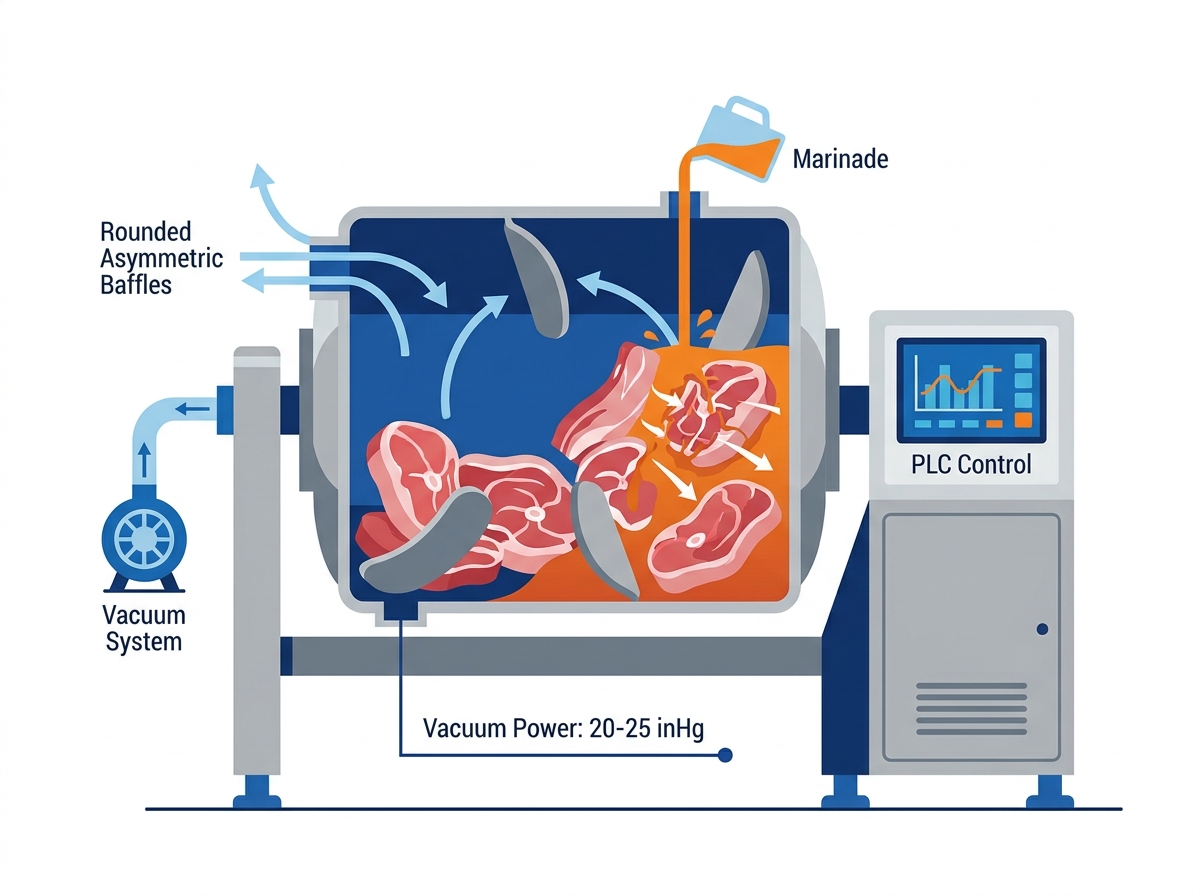
Vacuum depth drives the entire marination process. Most commercial applications require a baseline depth of 20 to 25 inHg (65 to 85 kPa). However, a common operational pitfall involves undersized vacuum pumps. Cold, high-humidity processing environments strain vacuum systems heavily. An undersized pump will struggle to maintain adequate pressure levels. It will increase cycle times and reduce marinade uptake percentages. Always verify the pump capacity against your facility's ambient conditions.
3. Drum Design and Baffle Configuration
The internal architecture of the drum directly impacts your finished product. You must match the hardware geometry to the exact protein type you plan to process.
Baffle Geometry and Product Quality
Baffles are the metal fins welded inside the drum. They lift, fold, and guide the meat during operation.
- Symmetric/Straight Baffles: These provide aggressive massaging action. They facilitate heavy muscle breakdown rapidly. You want straight baffles for tough, dense cuts like beef brisket or heavy pork shoulders.
- Asymmetric/Helical Baffles: These offer a gentle, gliding tumbling action. They protect fragile structures from tearing. Helical designs are ideal for delicate poultry, seafood, or tenderized cuts. They also assist in smoothly guiding product out of the drum during unloading.
Variable Speed Drives (VFD)
Rotational speed controls the kinetic energy inside the drum. Evaluating the RPM range is critical for processing flexibility. High speeds generate significant physical impact. This risks severe protein shear on softer meats. Low speeds (1 to 4 RPM) are mandatory for delicate items. A VFD allows operators to fine-tune the RPM to the exact requirements of each unique batch.
Reversible Drum Action
Automated, damage-free discharge relies entirely on reversible drum rotation. During the active cycle, the drum spins forward. The baffles push the meat inward. During the unloading phase, the drum reverses direction. The asymmetric baffles act like an internal auger. They gently push the finished product out into waiting buggies. This mechanism minimizes manual labor and prevents final-stage product damage.
4. Control Systems and Automation Capabilities
Modern processing demands precise repeatability. Upgrading your control systems eliminates guesswork and reduces costly operator errors.
Programmable Logic Controllers (PLC)
Older machines rely on manual analog dials. These interfaces are highly prone to operator error. A worker might easily set the wrong timer or vacuum level. Digital touchscreens powered by PLCs offer multi-phase recipe memory. You can lock in specific parameters for different products. Operators simply select the pre-programmed recipe and press start.
Phase Programming
Advanced PLCs allow phase programming within a single batch. You can program a sequence of changing variables automatically. For example, a single cycle might include:
- Phase 1: 10 minutes of high-speed rotation under deep vacuum.
- Phase 2: 5 minutes of stationary rest to allow full marinade absorption.
- Phase 3: 10 minutes of low-speed rotation without vacuum to polish the meat surface.
This automated flexibility maximizes both yield and final texture quality.
Temperature Monitoring
Tumbling generates constant friction. Friction creates heat. For facilities processing highly regulated meats, temperature control is a strict food safety requirement. Integrated chilling jackets pump glycol or cold water around the drum exterior. Internal thermal sensors monitor the meat mass constantly. These systems prevent the protein from exiting the safe temperature zone during aggressive, high-friction processing cycles.
| Control System Type | Precision Level | Operator Error Risk | Best Application Environment |
| Analog Dials | Low | High | Simple, single-product facilities |
| Basic Digital Timer | Medium | Medium | Standard marination processes |
| PLC with Touchscreen | High | Low | Complex, multi-phase recipe management |
| PLC with Thermal Integration | Maximum | Minimal | Strictly regulated food safety environments |
5. Sanitation, Material Standards, and Maintenance Tolerances
Food processing equipment lives in a harsh environment. Chemical cleaners, high-pressure water, and biological elements degrade weak materials quickly.
Stainless Steel Grades
You must demand Type 304 or Type 316 stainless steel construction. These grades offer exceptional long-term corrosion resistance. We strongly warn against lower-grade metals. Avoid bolted structural assemblies inside the food zone. Bolts and overlapping metal create microscopic crevices. These crevices become dangerous bacterial harbor points. Look for continuous, polished welds that offer zero refuge for pathogens.
Vacuum Line Protection (Snorkel/Filter Traps)
This is a critical hardware evaluation point often overlooked by buyers. The vacuum system pulls air out of a wet, sticky environment. If a liquid marinade gets sucked into the internal vacuum pump, the machine will fail catastrophically. You must look for easily accessible, cleanable inline liquid traps. Snorkel designs and heavy-duty filter traps capture stray liquids safely before they reach the delicate pump mechanics.
Washdown Ratings
Daily sanitation shifts rely on aggressive washdown procedures. The control panel, VFD enclosures, and motor housings must withstand high-pressure water jets daily. Ensure all electronic enclosures meet strict IP65 or higher washdown standards. Moisture ingress into a main control panel will shut down your entire production line immediately.
Evaluating the manufacturer is just as important as evaluating the hardware. When you are ready to make a purchase, you need a vendor who acts as a reliable, long-term operational partner.
Parts Availability and Tech Support
Downtime is a painful reality in commercial food processing. Every hour a machine sits broken costs you money. You must select a vendor based on their supply chain logistics. Ask if they have domestic parts warehousing. Find out how quickly they can ship replacement seals, hoses, or pump rebuild kits. Evaluate their technician availability thoroughly. A great warranty means nothing if you have to wait three weeks for a service call.
Factory Acceptance Testing (FAT)
Never buy industrial equipment blindly. We highly recommend conducting a Factory Acceptance Test (FAT). Run a pilot test using your exact meat cuts and your specific marinade formulations. Do not rely on generic water tests. A proper FAT allows you to verify marinade uptake percentages accurately. You can observe meat texture changes firsthand and ensure the baffle design performs exactly as promised before you finalize a large commercial purchase.
Conclusion
Purchasing the right processing equipment is a deliberate exercise in matching mechanical hardware to specific protein outcomes. You must align baffle geometry, vacuum depth capabilities, and drum capacity with your target yield, texture, and daily production scale. Do not compromise on sanitary design or control precision. Minor hardware upgrades yield massive long-term operational benefits.
To take the next step, begin by auditing your current hourly throughput to establish a clear capacity baseline. Measure your facility's available floor space, accounting for necessary buggy loading clearances. Finally, request process-specific return on investment calculations from manufacturers, focusing heavily on proven marinade uptake percentages for your specific product lines.
FAQ
Q: What is the ideal vacuum pressure for tumbling beef jerky?
A: Operational parameters for beef jerky typically target a vacuum pressure of 20 to 25 inHg (65 to 85 kPa). This deep vacuum effectively opens dense muscle fibers. However, operators must monitor the process closely. Pulling too much vacuum too quickly on very thin jerky cuts can dry out the meat or severely damage the cellular structure.
Q: Can a commercial meat tumbler machine be used for delicate proteins like seafood?
A: Yes, commercial units process seafood highly effectively, provided you specify the correct hardware. The machine must feature variable speed control running at low speeds (1 to 3 RPM). You also need continuous pulsating vacuum capabilities and rounded, asymmetric baffles. These features ensure gentle massage and prevent delicate seafood tissues from tearing.
Q: What is the difference between a vacuum tumbler and a standard meat tumbler marinator?
A: Standard marinators rely purely on gravity and physical impact to mix ingredients. Vacuum tumblers actively remove air from the sealed drum. This negative pressure physically expands the meat fibers, allowing them to draw moisture and marinade deep into the core. This drastically reduces overall tumbling time and significantly increases product weight yield.
Q: Are there viable options for a meat tumbler machine for home use?
A: Yes. Home-scale units exist and generally offer 10 to 20-pound capacities. They utilize external hand-pumps or small electric pumps to create a vacuum. These smaller models are perfectly sufficient for hobbyist jerky making or backyard barbecue prep. However, they lack the programmable phases, VFD controls, and heavy-duty washdown capabilities found in commercial processors.


