Upgrading or purchasing a new commercial frying setup is a major capital investment. It directly impacts daily operational expenses. You will see this immediately in energy consumption and cooking oil replacement. Relying on marketing terms like "high-efficiency" or "heavy-duty" is risky. Cross-referencing hard technical specifications is essential. Ignoring them often leads to mismatched equipment. You might end up bottlenecking your kitchen. You could serve soggy food or inflate your utility bills.
This guide strips away the marketing fluff. We break down the exact technical specifications. We explore performance ratios and infrastructural requirements. You must evaluate these details closely. They will help you choose the right equipment. You can then match it perfectly to your specific production volume and menu.
Key Takeaways
- Production dictates capacity: Evaluate a machine based on pounds of food output per hour, not just raw oil tank volume.
- Recovery time is critical: The speed at which oil returns to target temperature dictates food quality and peak-hour efficiency.
- Filtration specifications impact OPEX: Integrated filtration can reduce long-term cooking oil costs by up to 40%.
- Infrastructure determines power type: Existing gas lines and electrical phases (1-phase vs. 3-phase) often dictate your heating source options before you even look at models.
- Menu type dictates pot design: Open-pot specifications are required for heavily battered foods, while tube-type fryers excel for high-volume frozen items.
1. Assessing Capacity Metrics and Production Ratios
Many buyers judge equipment solely on oil capacity. They look at a 40 lb or 50 lb specification. This metric alone is incomplete. Oil volume simply tells you how much liquid the tank holds. It does not measure actual cooking output. You must look at the intersection of oil volume and heating power.
We rely on the 1.5 to 2.0 production rule. This is a recognized industry-standard benchmark. A properly specified unit should cook roughly 1.5 to 2 times its oil weight in food per hour. If you buy a 50 lb unit, it should produce 75 to 100 lbs of fries hourly. When you drop frozen fries into hot oil, water violently turns to steam. This pulls massive amounts of heat out of the oil. A unit lacking proper heating power will struggle here. The oil temperature will plummet. It will stay low for several minutes. The fries will absorb excess grease instead of crisping. This ruins the texture completely.
Ignoring this rule creates serious implementation risks. You face two main sizing errors. First, you risk oversizing. Buying a massive unit for moderate volume wastes energy. The heating elements work too hard for small batches. This accelerates oil degradation. It creates unnecessary daily expenses.
Second, you risk undersizing. Overloading a small vat causes drastic temperature drops. The oil cannot recover fast enough. You will serve grease-soaked food. Your kitchen will face extended wait times during peak rushes. If your restaurant needs to serve 120 lbs of chicken wings during a busy shift, you cannot rely on a single 50 lb unit. You would need at least an 80 lb capacity unit. Alternatively, you could bank two smaller units together. This provides flexibility during slower shifts. You can turn one unit off entirely.
Common Mistake: Never assume a larger tank automatically yields faster ticket times. Volume must always pair correctly alongside sufficient heat recovery.
Fryer Production Capacity Ratios
| Oil Capacity (lbs) | Expected Hourly Output (lbs) | Best Use Case |
| 35 - 40 | 50 - 65 | Small diners, low-volume side items |
| 50 | 75 - 100 | Medium restaurants, standard french fry output |
| 65 - 80 | 100 - 150 | High-volume fast food, large batch cooking |
2. Heating Power and Energy Source Specifications
Energy sources dictate your installation process. They also define your peak cooking power. Gas and electric units use completely different metrics. You must understand both to make an informed decision.
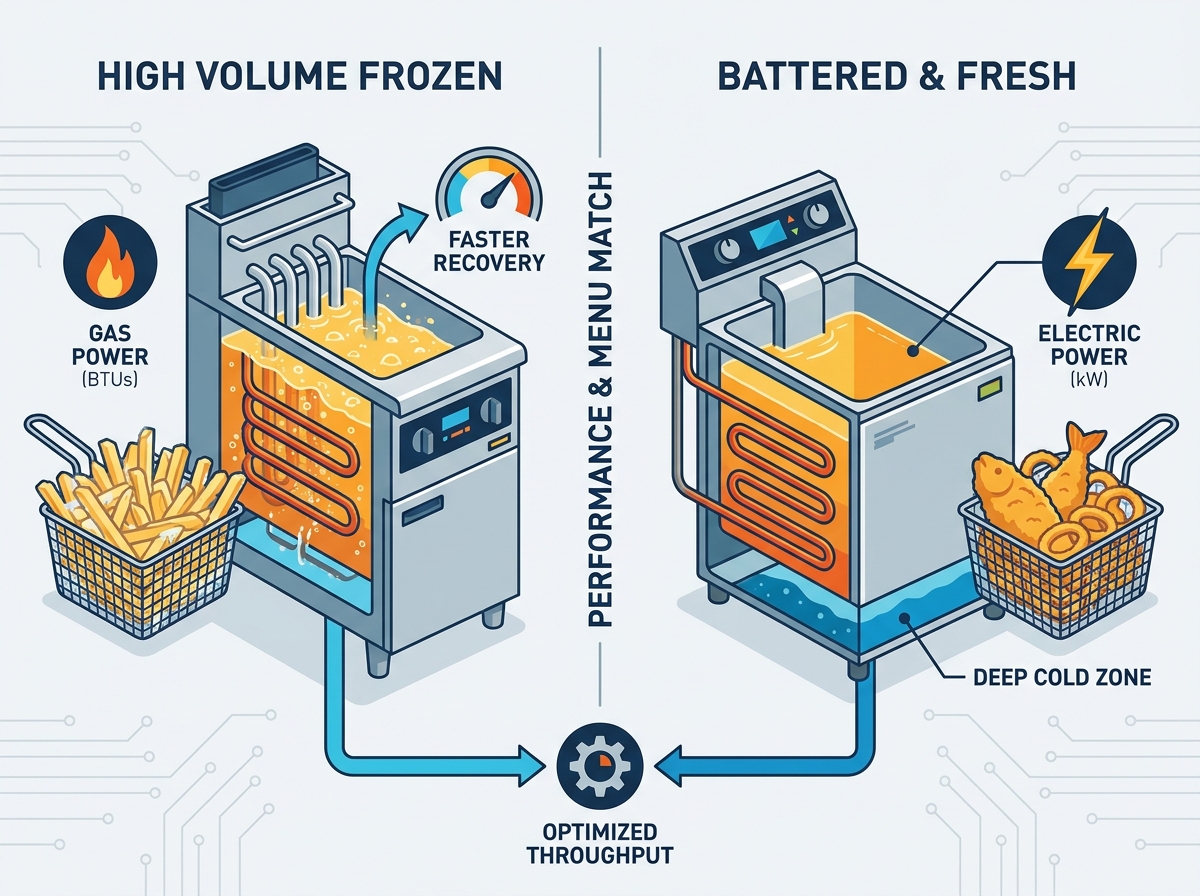
When evaluating gas models, check the British Thermal Unit (BTU) inputs. Standard usage usually requires around 70,000 BTUs. Heavy-duty volume demands 120,000 BTUs or more. You must also choose between natural gas and liquid propane. This depends entirely on your existing facility supply. Natural gas lines require specific pressure metrics. The standard requirement hovers around 7 to 10 inches of water column pressure. If your building cannot maintain this pressure, the burners will starve. They will not reach their rated BTU output. Liquid propane systems use different regulators entirely. They typically require 11 to 13 inches of water column pressure.
Electric models use Kilowatts (kW) for their power ratings. Commercial units typically range from 14kW to 22kW. Electric elements sit directly in the oil. They offer near 100% energy transfer efficiency. They lose very little heat to the ambient kitchen air. This keeps your kitchen cooler during peak summer months.
Before you finalize any choice, run an infrastructure verification. Never purchase a high-capacity electric unit without checking your panels. Confirm your facility has compatible 3-phase electrical connections. Single-phase lines rarely support high-volume commercial electric units. A 22kW unit draws significant amperage. A standard 120V kitchen outlet cannot run commercial electric fryers. You need dedicated 208V or 240V three-phase wiring. Upgrading a commercial breaker panel costs thousands of dollars. You must identify your current electrical capacity early.
Infrastructure Verification Checklist:
- Verify available electrical voltage (208V, 240V, or 480V).
- Confirm phase availability (1-phase vs. 3-phase).
- Measure the gas line diameter (typically 3/4 inch or 1 inch required).
- Check the incoming gas pressure against manufacturer requirements.
3. Thermal Recovery Time and Pot Design
Recovery specifications determine your kitchen flow. We define thermal recovery time simply. It is the time oil takes to return to 350°F after you drop a frozen basket. Faster recovery equals higher throughput. It ensures a consistent, crispy product. Thermostats play a huge role in thermal recovery. Snap-action thermostats react quickly to temperature drops. Solid-state controls offer even more precision. They pulse heat to maintain temperatures within a single degree. This precision prevents temperature overshoot. Overshoot degrades oil prematurely.
Your menu dictates your pot design. You generally choose between open-pot and tube-type configurations.
Open-pot models have heating elements on the outside of the tank. They present a smooth interior. They are much easier to clean. This makes them the required spec for wet-battered foods. Tempura or fish batter leaves heavy sediment. You can wipe an open-pot clean easily at the end of the night.
Tube-type models feature heat tubes running directly through the oil. They offer a larger heating surface area. They transfer heat aggressively. They are ideal for high-volume frozen items. You should use them for fries, mozzarella sticks, or wings.
You must also evaluate the cold zone depth. This is the space below the heating elements. A deeper cold zone specification prevents food sediment from carbonizing. The cooler oil traps breading bits safely. This extends oil life significantly. It also prevents bitter-tasting food reaching your customers. Some operations use flat-bottom configurations. These lack a cold zone entirely. They are highly specialized. You only use them for wet batter items that float, like funnel cakes or donuts. They require daily, intensive cleaning. They do not work well for high-volume frozen goods.
Pot Design Comparison
| Design Type | Heating Element Location | Ideal Menu Items | Cleaning Difficulty |
| Open-Pot | Exterior of the tank | Wet batter, fish, tempura | Very Easy |
| Tube-Type | Inside the oil tank | Frozen fries, chicken wings | Moderate |
| Flat-Bottom | Beneath the flat tank | Funnel cakes, donuts | High |
4. Oil Management and Filtration System Specs
Oil replacement heavily impacts your budget. Smart filtration specifications mitigate this expense. Four main factors destroy cooking oil. These are heat, water, oxygen, and sediment. You cannot avoid heat or water. You can, however, control sediment through aggressive filtration. Crumb buildup turns into carbon. Carbon acts as a catalyst. It breaks down oil molecules into free fatty acids. This causes the oil to smoke at lower temperatures. It also turns the oil dark and soapy.
You must weigh built-in versus portable filtration. An integrated filtration system carries a higher upfront cost. Compare this against long-term labor savings. Built-in systems make the process incredibly simple. Staff just turn a lever or push a button. A pump pulls the dirty oil through a heavy-duty paper filter. It then washes the vat walls before returning clean oil. This daily cycle extends oil life dramatically.
Daily filtration via automated built-in systems shows incredible results. It typically reduces oil purchasing by 20% to 40% annually. You usually achieve a return on investment within 12 to 18 months. Portable filters require more labor. They also increase the risk of accidental burns during transfer.
Choosing a fryer machine equipped with optimal drain valve specifications matters immensely. Ensure the unit features a front-sloping, full-port drain valve. It should measure at least 1-1/4 inches wide. This prevents clogging during boil-outs. It streamlines routine maintenance tasks.
Best Practice: Filter your oil at least once a day. High-volume kitchens should filter after the lunch rush and again at closing. This prevents free fatty acids from degrading the oil rapidly.
5. Footprint, Ventilation, and Safety Compliance
Kitchen real estate is always scarce. You must evaluate spatial constraints meticulously. Compare floor models against countertop models. Match the exterior dimensions against your available hood space. Modular multi-vat systems help tremendously here. You can bank three units together. This scales your operations within a tight footprint. It also allows you to share a single built-in filtration system across multiple vats.
Banking multiple vats together offers strategic advantages. You can dedicate specific vats to specific foods. You might fry fish in one vat and french fries in another. This strict separation prevents flavor transfer. Your fries will not taste like seafood. Modular banks also streamline the exhaust hood design. They fit neatly under a single canopy.
Ventilation requirements are strictly regulated. Commercial frying equipment requires Type 1 ventilation hoods. These hoods remove grease-laden vapors safely. They must include dedicated fire suppression systems. You cannot legally operate high-capacity units without proper ventilation. Fire suppression systems use wet chemicals. They target grease fires specifically.
Safety certifications protect your staff and your business. Verify the high-limit thermostat specifications. This is your first line of defense. If the primary thermostat fails, the heating elements will run continuously. The oil will rapidly approach its auto-ignition temperature. The high-limit switch cuts all power mechanically. It prevents a catastrophic kitchen fire. This shut-off usually activates around 400°F to 450°F. Check for mandatory commercial compliance badges. Look for NSF, UL, or CE markings before you finalize any purchase. These badges guarantee the equipment meets strict sanitation and electrical safety standards.
Conclusion
A high-performing fryer machine is a precision tool. Its specifications must align seamlessly with your kitchen infrastructure. It must also match your menu composition perfectly. You must understand your peak output demands. Evaluate capacity based on pounds of food per hour. Prioritize thermal recovery times to ensure food quality. Invest in built-in filtration to control long-term expenses.
Take these actionable next steps:
- Map your proposed equipment to your exact peak-hour ticket volume.
- Request complete cut sheets from manufacturers.
- Verify warranty terms, focusing specifically on the stainless steel tank coverage.
- Consult a commercial kitchen equipment specialist armed with your facility’s electrical and gas capacities.
FAQ
Q: What is the ideal BTU specification for a high-volume commercial fryer?
A: High-volume operations generally require 100,000+ BTUs. However, you should not focus solely on raw power. Balance this BTU rating against thermal recovery efficiency. A well-designed tube-style model might recover faster than a higher-BTU open-pot model. Always evaluate the burner design alongside the raw BTU input.
Q: How does a fryer's "cold zone" spec impact operational costs?
A: The cold zone sits below the heating elements. It stays much cooler than the cooking zone above. This prevents fallen sediment and breading from carbonizing. Less carbonization means your cooking oil degrades much slower. Extended oil life directly lowers your annual purchasing costs and reduces flavor transfer.
Q: Is an electric fryer machine better than a gas model?
A: Neither is universally better. The choice depends on your facility infrastructure. Electric models offer superior heat transfer efficiency and generate less ambient kitchen heat. Gas models typically offer faster peak recovery times. Gas might also yield lower utility rates depending on your region. Always assess your available power phases and gas lines first.


